The Empress Dowager stood at the window of her palace in Kiev, the coded telegram trembling in her hand. The message was brief, and it carried the news she had prayed for and never dared to expect. The monk was dead. They had finally killed him.
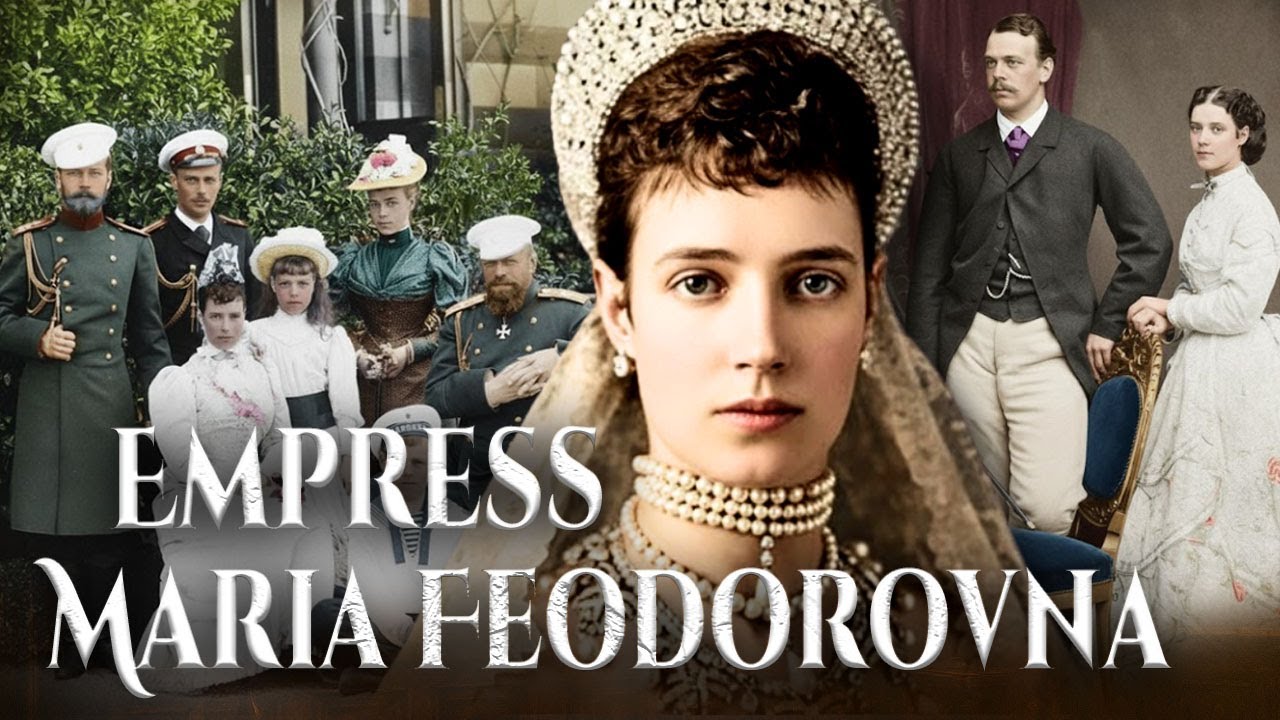
For the first time in two years, those who watched her saw the Empress smile. She had been Maria Feodorovna, Empress of Russia, the woman who had escaped while her family was being annihilated. The Bolsheviks shot her son, Tsar Nicholas II, in a cellar. They shot her daughter-in-law, that German woman she had despised.
They bayoneted her five grandchildren. They hunted down her other son and killed him too. But they never caught her. Yet this was not a story of a fortunate escape.
It was the story of what came after—a mother imprisoned for another ten years in a seaside villa in Denmark, haunted by ghosts, who built a fortress inside her own mind to survive the unbearable truth of that cellar. She died waiting for her murdered children to come home. The real woman Maria Feodorovna became was not to be found in the glittering snow-covered palaces of St. Petersburg.
She was found in a modest, happy, slightly disheveled palace in Copenhagen. She had begun as Princess Dagmar of Denmark, born in 1847 into a loving, genteel but impoverished family. Her childhood was frugal and remarkably ordinary, bound by a lifelong, inseparable bond with her elder sister Alex. Alex was the quiet beauty; Dagmar was the vibrant charmer.
Everything changed in 1863 when her father became King Christian IX, the father-in-law of Europe. Her sister Alex married the heir to the British throne. And the greatest prize of all, imperial Russia, came to Dagmar. She was seventeen and deeply in love with the heir, Tsarevich Nicholas.
It was a perfect fairy-tale romance, but it shattered when Nixa fell ill with meningitis. Dagmar rushed to his deathbed in Nice, a house of terror. There too was Nixa’s younger brother, the huge, shy Sasha. Before he died, Nixa famously placed Minnie’s hand into his brother’s, bequeathing her to him.
She was a widow before she had even become a wife. Minnie returned to Denmark heartbroken. A year later, Sasha, now the unwilling heir, proposed. Torn between her love for the dead and respect for his wish, she finally agreed.
The fairy tale began again, but it was darker. She departed for Russia, transformed into Grand Duchess Maria Feodorovna. The frugal princess flourished, stunning the rigid Russian court with her charm and fashion, and the people began to love her, calling her the Angel of Russia. Her marriage to Sasha, the huge man who worshipped her, grew into a deep, devoted love.
They spent fifteen wonderful years in the Anichkov Palace, raising their children, including her beloved heir, Nicky. She and Alex were the two sisters who conquered the world. Then on March 13, 1881, that perfect world was blown to pieces. Maria heard two explosions.
Her father-in-law, Tsar Alexander II, had been assassinated. She, Sasha, and twelve-year-old Nicky rushed to the bloody scene and watched him die. In that moment, her weeping husband became Tsar Alexander III, and the girl from Copenhagen became Empress. The throne room of the Winter Palace was stifling, filled with the scent of lilies and incense, a sickly-sweet odor that could not entirely mask the metallic taste of blood that clung to the building.
Maria Feodorovna stood beside her husband, Sasha, as the highest officials of the Russian Empire filed past to swear allegiance. She was Empress. But this was not a coronation; it was an inquest. Her husband was not a celebrated new leader.
He was a survivor. Sasha, now Tsar Alexander III, was thirty-six years old. He stood grief-stricken, his massive frame bowed under sorrow and a new, terrible weight. Twelve-year-old Nicky stood nearby, pale and terrified, having just seen his grandfather’s mangled body.
It was his first lesson in what it meant to be Tsar. It meant being hunted. Thirty-three-year-old Maria was the one who held them all together. Her grief was profound, but her spirit was stronger.
In the days that followed, with Alexander II’s body lying in state, St. Petersburg was gripped by terror. The assassins of the People’s Will had not only killed the Tsar; they had sent a message. They published an open letter declaring that the terror would not stop until Russia had a constitution.
They promised that Alexander III and his family were the next targets. This was not a change of government; it was a hostage crisis. Maria’s fairy-tale life at the Anichkov Palace, with its glittering balls and social triumphs, was over. The palace was now seen for what it really was: a death trap, situated on a public square, defenseless against any bomber.
The family was immediately evacuated under heavy guard to the Winter Palace, but even its thousand rooms offered no security. The new Tsar and his family were prisoners in their own capital. In those first turbulent days of his reign, Alexander III faced a decision that would define the rest of the nineteenth century. His father, Alexander II, had been on the verge of signing a new reform, the Loris-Melikov constitution, which would have created an advisory council, a first step toward constitutional monarchy.
It lay on his desk the day he was killed. The government’s reformers begged the new Tsar: honor your father, sign the document, calm the people, show them that violence is not the answer. But another voice, darker and more powerful, drowned them out. It was the voice of Konstantin Pobedonostsev, the new Tsar’s former tutor and head of the Holy Synod.
Pobedonostsev was a man of brilliant intellect and utter intolerance. He believed liberalism was poison, democracy a disease, and constitutions the work of the devil. He entered the palace and confronted the grieving, uncertain Tsar. He pointed to the blood stains.
This, he argued, was the price of your father’s weakness. This was the result of reform. They gave your father a free press, and it taught them how to kill. They gave him liberal education, and it produced the murderers.
You must not concede. You must crush them. You must be an autocrat. You must be God’s iron fist.
For Maria Feodorovna, looking at her frightened husband and pale son, there was no other path open. Her father-in-law, the Liberator, was dead. He had been liberal, and they had blown him to pieces in return. Her husband and her children would not suffer the same fate.
The charming, lively, western-educated Tsarevna was gone. In her place stood the Empress of Russia, a woman hardened by terror. She threw all her influence behind Pobedonostsev. The woman who had come from Denmark’s constitutional monarchy became the most passionate defender of extreme divine autocracy.
There would be no constitution. There would be no reform. There would only be order, maintained by the army and the secret police. Sasha, who loved his wife and trusted her instincts, agreed.
The Loris-Melikov constitution was torn up. The manifesto of Alexander III’s reign was published, crafted by Pobedonostsev. It was called the Manifesto of Unshakeable Autocracy. The message was clear: the new Tsar would not concede.
A hunt for the assassins began. A new, terrifyingly efficient secret police force, the Okhrana, was formed. Newspapers were censored. Universities were brought under state control.
The brief spring of Alexander II’s Russia was over. A new, freezing winter had begun. But first, the family had to be made safe. They could not stay in St.
Petersburg. The anarchists were everywhere. Maria, terrified for her children, insisted they leave the city. The family packed and headed not for a palace, but for a fortress.
They moved to Gatchina Palace, thirty miles from the city. Gatchina was not a home; it was a statement. It was a monstrous palace of 700 rooms, built by Catherine the Great for her lover, and later turned into a military barracks by the paranoid Tsar Paul. It was surrounded by watchtowers, moats, and artillery positions.
In short, it was the most secure, the most gloomy, and the most straitlaced residence in the entire empire. And here, Maria Feodorovna, the most fashionable woman in Europe, would spend the next thirteen years of her life. The move was a profound psychological shock. The Angel of Russia now lived in a gilded cage.
Her children, who had grown up in the open environment of the Anichkov Palace, were now imprisoned with her. Nicky, George, Xenia, Michael, and Olga grew up in a suffocating ring of security. They were not allowed to play in public parks. They were rarely allowed to visit the city.
Their only playmates were the children of the palace guards. Life at Gatchina was a strange paradox. On one hand, Sasha and Maria wanted to maintain a simple, almost middle-class private life. The children slept in army cots, bathed in cold water, and ate plain food.
Sasha himself lived in a small apartment, with a plain office and an old, patched uniform. He liked to go outside the palace and chop wood like a peasant. But this simplicity was inside a fortress. Every door was locked.
Every corridor was patrolled. Every visitor was searched. Spies were everywhere. The Tsar was so terrified that he had a personal kitchen, and his food was not only tested for poison but was often cooked in front of him.
This was Maria’s new reality. She, who lived on the joy of crowds, was now isolated. But Maria Feodorovna was not the kind of woman to surrender to depression. If she had to be a prisoner, she would be the most glamorous prisoner in the world.
She built a double life. In her private life at Gatchina, she was Minnie, a devoted wife and mother. Her marriage to Sasha, born of grief and now tempered by fear, became one of the greatest royal love stories of the age; he was utterly, completely and faithfully devoted to her. The Russian bear of a man was putty in her small hands.
She was the only person who could manage his gruff moods, the only person whose political advice he truly trusted. He wrote: “Minnie is my good angel. ” She ran the household, and he ruled the empire, and they never interfered in each other’s work. Their letters were full of simple family affection.
He called her “my dear little Minnie,” and she called him “my angel Sasha. ” This was the anchor of her life. But there was another Maria, the Empress known to all. Periodically, the family would move to the Winter Palace for the official St.
Petersburg season. It was not for pleasure; it was for politics. It was a display of power. Maria knew that the world and Russia could not see the autocracy hiding.
They had to show that the Tsar was in power, the empire was stable, and the glamour was intact. And Maria Feodorovna was that glamour. When the doors of the Winter Palace ballroom opened, the woman who emerged was not the frugal Danish princess. She was an apparition of breathtaking grandeur.
Tiny, but head to toe in the historical jewels of the Romanovs, enormous sapphires, ropes of pearls, and dazzling diamond kokoshniks. Her gowns from the House of Worth in Paris were the most expensive in the world. She was the undisputed arbiter of European fashion. What Maria wore, every other queen and princess in Europe, even her sister Alex, copied.
He was a magnificent dancer, leading polonaises until four in the morning, while her huge, rough husband watched, mesmerized, content to see her shine. This was her contribution to the autocracy. Sasha provided the iron rule; she provided the velvet. It was for her that the famous symbols of Romanov luxury were created.
In 1885, Sasha, knowing her love of beautiful things, wanted to give her an Easter present. He commissioned the jeweler Peter Carl Fabergé to create a surprise. The result was the first Fabergé egg. From the outside, it looked like a simple white enameled hen’s egg, but it could be opened.
Inside was a gold yolk, which opened to reveal a perfect tiny gold hen. And inside the hen was a miniature replica of the imperial crown and a small ruby. Maria was so captivated by this object, this perfect, useless, incredibly expensive symbol of personal love, that it became a tradition. Every year, Fabergé created a new, even more ingenious egg for her.
These eggs, now synonymous with the tragic and cursed opulence of the Romanovs, were her legacy. They were gifts from her beloved husband, a small, perfect world of beauty that kept her away from the ugly, frightening world outside the palace walls. But her life was not just jewels and eggs. She was a serious and extremely powerful political force.
She was the foreign minister of the bedroom. And she had two great political passions: she hated Germany and she loved France and England. Her hatred of Germany was innate, born in her childhood in 1864, when Prussia, led by Otto von Bismarck, allied with Austria, invaded Denmark and brutally seized the province of Schleswig-Holstein. It was a national humiliation for Denmark, and her father’s favorite daughter, Maria, never forgot it.
She saw Prussia and the new unified German Empire as a nation of arrogant warmongers. She hated Bismarck and personally disliked the new, insolent young Kaiser Wilhelm II. She called him “that arrogant, foolish boy,” and did everything she could to undermine his influence. Although her husband Sasha had a German father, he shared his wife’s suspicions.
Through a constant stream of secret letters to her sister Alex, the Princess of Wales, Maria built a powerful personal link between Russia and the British court. Her greatest diplomatic triumph, however, was with France. For decades, Russia and France had been rivals. Maria could see the growing power of Germany and knew that Russia needed a new ally.
She was more responsible than any diplomat for the Franco-Russian alliance. She charmed French diplomats, worked to promote French culture, and persistently pushed for a treaty, which came to a head in 1891 when the French fleet arrived at the Russian port of Kronstadt. It was a sensational event. The mighty autocrat Tsar Alexander III stood on the deck of a French warship and astonished the world by ordering the band to play “La Marseillaise.
” That revolutionary anthem, banned in his own country. He stood bareheaded in salute as the song of liberty, equality, and fraternity played. This gesture, orchestrated by his wife, was a clear message to the world, and especially to Germany: Russia had a new friend. These thirteen years, from 1881 to 1894, were the golden age of Maria’s life.
She was at the peak of her power, beauty, and influence. Her husband was the most powerful man on earth, and he adored her. Her son Nicky was the heir and the apple of her eye. Her sister was the future Queen of England.
She had everything. But the cracks were already beginning to form. Her fortress-like existence protected her children from bombs, but it did not prepare them for the outside world. Her beloved heir, Nicky, was at the center of the problem.
He was a kind, gentle, and refined young man. In short, he was a disaster waiting to happen. His mother had raised him to be a modest, charming gentleman, while his father and tutors had raised him to be a ruthless, strong-willed autocrat. These two things were contradictions.
He had the manners of an English lord, but the political thinking of a seventeenth-century king. One minister famously remarked that he was not even fit to run a post office. Maria, blinded by her possessive and uncritical love, did not see this. Or perhaps she chose not to see it.
He was her Nicky. He was perfect. The flaws she did see, she dismissed as a matter of youth, and she guided him. Then a new tragedy struck, a cruel echo of her own past.
Her second son, George, who was tall, handsome, and far more robust than his brother, was his constant companion. But in 1891, he was diagnosed with tuberculosis, the same disease that had taken her first betrothed, Nixa. Maria was distraught. She sent him to the Caucasus, to the warm, dry air, hoping for a miracle.
But it was, in effect, a death sentence. George was exiled from the family, living as an invalid, slowly wasting away just like Nixa. It was another deep grief, another shadow over the family. Then, in 1894, the unthinkable happened.
The man she thought was invincible, her protector, her huge, beloved Sasha, fell ill. It started as something minor. He was forty-nine, a man of immense build, a symbol of health. But he began to complain of back pain.
He lost weight. His face swelled. The doctors were baffled. Finally, a specialist from Berlin was called.
The diagnosis was a thunderbolt: nephritis, a fatal kidney disease. There was no cure. Maria sank into a state of utter panic and denial. She refused to believe it.
Her Sasha, ill? It was impossible. He was the most powerful man on earth. She blamed the doctors’ incompetence.
But as the months dragged on, she was forced to watch in horror as her husband, who could bend iron rods, withered away before her eyes, just like Nixa. The family rushed to their palace at Livadia in the Crimea, the very place where she would one day be imprisoned. They thought the warm air and sea breezes would help. It did not.
By the autumn of 1894, the entire royal family had gathered around another deathbed. Maria Feodorovna, who had entered this family at Nixa’s deathbed, was now at the deathbed of her own husband. She rarely left his side. For weeks, she nursed him, prayed, and fought against fate, but she was slowly losing.
And as the Tsar lay dying, a new and difficult political problem arose. His son, Nicky, the twenty-six-year-old heir, was not only unprepared; he was unmarried. And he was in love with a woman Maria despised: Princess Alix of Hesse, a German girl whose marriage Maria had opposed for years. In Maria’s view, the girl was shy, cold, and dull, and she was German, the nation Maria hated most.
She wanted Nicky to marry someone else, any French princess but Alix. But Nicky, in one great silent rebellion of his life, had refused. Now, in Sasha’s dying hours, the need for an heir and a married heir had become paramount. Nicky begged his mother.
It was his one true love. Sasha, from his deathbed, gave his blessing. “Marry her,” he gasped. “It’s the right thing.
” The helpless Maria was forced to concede. She sent word to the young German princess, the one she had previously rejected, summoning her to the Crimea. “Come at once,” the message read. “Sasha is dying.
” Princess Alix of Hesse traveled across Europe to Livadia. She entered a house in mourning, a stranger, to meet her future mother-in-law, a woman who already hated her. For a few days, the three of them were locked in an unbearable melancholy triangle: Maria, devastated from nursing her husband; Nicky, torn between grief for his father and love for his bride-to-be; and Alix, a frightened, awkward girl watching her future family fall apart. The world Maria Feodorovna knew came to an end on November 1, 1894, in a quiet bedroom of the Livadia Palace.
Her husband, her rock, her huge Sasha, was gone. The iron strength that had held the Russian Empire together for thirteen years vanished, replaced by her son, Nicholas. The scene at the palace was one of pure, unbridled grief. Maria, forty-six years old, looking like a shattered old woman, threw herself on her husband’s body, wailing, “My angel!
My Sasha! ” She refused to move, clinging to the cold body as if her love could bring him back to life. And in this mist of despair, her son, now the naked Tsar of all Russia, stood in the corridor, weeping. He cried out, “I am not ready.
I know nothing of ruling. ”
Maria, with the sharp clarity of a desperate mother, knew he was right. He was a twenty-six-year-old man, but in matters of state, he was merely a boy. He was kind.
He was gentle. He was a loving son. These same qualities made him a wonderful man, but also a failed autocrat. Her husband Sasha, in a fatal mistake of over-protection, had kept Nicky away from the actual work of ruling.
Just as he had been kept away. He had been trained to salute, to review troops, and to be a gentleman, not to rule one-sixth of the world. And in this moment of ultimate crisis, with the fate of the empire resting on her son’s weak shoulders, Nicholas made his first decision as Tsar. It was not a political decision.
It was not a military one. It was a romantic one. And for Maria, it was the first and deepest betrayal, as he announced he would marry his betrothed, Princess Alix of Hesse, immediately. Maria was shocked.
They were in the Crimea. Her father’s body was not yet cold. The long, sacred, thousand-mile funeral procession back to St. Petersburg had not even begun.
By every standard of Orthodox faith and royal decency, marrying during a period of deep mourning, especially before the previous Tsar had been buried, was unthinkable. It was dishonorable. In her eyes, it was a mortal sin. She argued with him.
She pleaded. She commanded. “It is not fitting,” she insisted. “The people will not understand.
It is a terrible omen. ” But for the first time in his life, poor, weak-willed Nicky was immovable. He was terrified. He was a drowning man.
He saw this shy German girl as his only life raft. He could not face the funeral, the journey to St. Petersburg, and the weight of the crown alone. He needed her.
He wrote in his diary: “I am weeping, you understand, but I feel my dear Alix is here, and she will be my support. ”
Maria saw it differently. This was not her son’s own decision. It was that woman, that German girl, who had come into a house of death and was already exerting her cold, foreign influence, drawing her son away from his mother and his sacred duty.
Standing over the coffin of Alexander III, the battle lines were drawn. Maria lost. The long, dark journey north began. It was the strangest procession in Russian history.
A funeral train draped in black carried the massive coffin of the dead Tsar. And in another compartment of that same train sat the new Tsar and his giggling, whispering bride-to-be. While Maria and her children were draped in black crepe and suffocating grief, Nicky and Alix were radiant and incongruously happy, planning their new life together. For Maria, it was a grotesque scene.
Upon arrival in St. Petersburg, Alix was hurriedly processed through her conversion to Orthodoxy, taking the name Alexandra Feodorovna. The funeral of Alexander III was a vast, solemn, and magnificent ceremony. The nation mournfully remembered the Peacemaker.
And just one week after her husband was buried, Maria Feodorovna was forced to attend her son’s wedding. It was the quietest and most inappropriate royal wedding imaginable. It took place on November 26, 1894, which was Maria’s own 47th birthday, a detail that felt like a deliberate and cruel knife twist. There was no ball.
There were no signs of celebration. The court was still officially in mourning. The bride, Alexandra, wore a simple royal dress, but not a bridal white gown. She later wrote that she felt like a bride and a mourner at the same time.
As Maria stood in the chapel in her heavy black mourning dress, watching her son marry the German princess, she felt nothing but cold. Only her son seemed to be smiling. The bride was crying, not from joy, but from pressure and terror. The entire court was whispering.
One guest, a Grand Duke, famously remarked: “The wedding ceremony felt like a continuation of the funeral. ” It was a terrible omen. For Maria, that omen had already become a reality. Her son had been taken from her.
Now began what would become the greatest, most disastrous, and most personal conflict of the reign of Nicholas II: the war of the two Empresses. By all rules of nature and the court, Maria, as the Dowager Empress, should have stepped back a notch. She should have ceded the stage to the new young Empress, Alexandra. But Maria Feodorovna was not the kind of woman to concede.
She had been the social and political center of Russia for twenty-eight years. She was Russia’s beloved Angel. She was not about to fade quietly into retirement, and protocol was on her side. Russian imperial law, which Maria knew by heart, stated that the Dowager Empress outranked the new Empress.
This was not a minor matter; it was everything. It meant that at every state dinner, every grand ball, every official ceremony, it was Maria, not Alexandra, who entered on the arm of the new Tsar. Maria took the place of honor. Maria led the first dance.
Alexandra, the actual ruling Empress, was forced to walk behind her, often on the arm of some minor Grand Duke. It was a public, daily, and exquisitely painful humiliation. And Maria insisted on it. She justified it to herself and to her family with perfect logic.
She was not just a widow; she was the Empress. The title was for life. She had earned it. The people loved her.
She knew how to behave. This new girl, this German woman, was shy, clumsy, and cold. She could not speak Russian well. She did not know the customs.
She hated parties. If Maria stood aside, the glamour of the autocracy, which she and Sasha had rebuilt, would collapse. She was not doing it to be cruel. She was doing it to save the dynasty.
At least, that is what she told herself. The truth was, it was a fight for her son. Publicly humiliated, Alexandra fought back in the only place she could: the private sphere. She built a protective wall around Nicholas.
She drew him away from his fun-loving, worldly mother. She emphasized her own piety and seriousness. She turned their private apartments into a temple of perfect family life, a fortress far from the court that had rejected her. The entire Russian aristocracy was forced to choose a side.
And the vast majority chose the mother. Maria’s own court at the Anichkov Palace remained the true center of St. Petersburg society. It was glittering, fashionable, and fun.
It was full of laughter, music, and French wit. This was where the power brokers, ministers, and ambassadors came. Alexandra’s court at the Alexander Palace at Tsarskoye Selo was a neglected state. It was quiet, religious, and, in a word, German.
It was isolated, a tiny band of loyal sycophants and mystics. Alexandra hated St. Petersburg’s fast-moving society, and it hated her back. She famously complained: “St.
Petersburg society is a sewer. ”
Nicholas was caught in the middle. As one courtier noted, he was a devoted son and a devoted husband. He loved his mother and worshiped his wife.
He did not have the capacity to confront either of them. So he simply tried to manage their war, which made things worse. This bitter family drama was not just society gossip; it was a political disaster. It isolated the new Tsar and his wife from their own aristocracy, the very people they most needed to help them govern.
It created a vacuum of power, a vacuum that would soon be filled by a monstrous force. Then, in May 1896, the first great catastrophe of the new reign occurred. It was the time of the formal coronation in Moscow, the last great royal spectacle Europe would ever see. For weeks, Moscow blazed with medieval splendor.
Maria Feodorovna was present in her full glory, sitting on a second throne, weeping as she watched her son and daughter-in-law be crowned. She wrote: “For my dear Sasha, who should have been here. ” After the ceremony, a traditional feast for the common people was organized at a vast, uneven military training ground on the outskirts of the city called Khodynka Field. The plan was to distribute five hundred thousand coronation gifts: a commemorative mug, a sausage, and a pretzel.
Five hundred thousand people gathered. But the field was in terrible condition, full of holes and trenches. The police presence was laughably inadequate. As the crowd surged forward, a rumor spread that the beer and gifts were running out.
Panic broke out. People began to fall into the ditches. The human tide, desperate and terrified, pushed forward, trampling those who had fallen. It was a horrific stampede.
When the dust settled, at least 1,400 people had been crushed to death. Thousands more were maimed. The field had become a carpet of corpses. The news hit the palace like a cannonball.
Nicholas was devastated. Alexandra was horrified. And Maria Feodorovna was furious. It was utter incompetence.
It was a stain on the sacred coronation. It was a terrible sign from God. She insisted, along with the other senior royals, that the new Tsar must immediately express his remorse. He must go to the hospitals.
He must cancel all the festivities. He must lead a national day of mourning. But there was a problem, a huge diplomatic problem. That very night, a grand ball was scheduled at the French embassy.
It was the most important diplomatic event of the coronation, intended to cement the Franco-Russian alliance, the very alliance Maria had worked so hard to build. The French ambassador begged the Tsar. You cannot cancel, he argued. It would be a diplomatic insult.
It would destroy our alliance. The event has already been paid for. It is not your fault. The trapped Nicholas made the worst decision of his life.
He listened to the French ambassador. He decided to attend the ball. That night, as the bodies of his subjects were being cleared from Khodynka Field, Tsar Nicholas II and Empress Alexandra Feodorovna appeared at the French embassy. They were somber.
They stayed only a short time, but they were there. The newspapers the next day were merciless. The Tsar and his German wife had danced while people died. For Maria Feodorovna, it was the moment she knew in her bones that her son’s cause was lost.
Her Sasha would never have done such a thing. He would have gone to the field himself, knelt in the dirt, and prayed with his people. He would have ordered the ambassador shot. This new reign, her son’s reign, was cursed.
Cursed by weakness, and cursed by that cold, unfeeling German woman with the heart of a foreigner. The distance between mother and son, and between mother-in-law and daughter-in-law, had now become an abyss. The next crisis was biological. The new Empress’s entire purpose was to produce an heir, and time was running out.
In 1895, Alexandra gave birth. It was a girl, Olga, a sweet child. The court was happy enough, but they were waiting. In 1897, she gave birth again, to a girl, Tatiana.
Lovely, but still not an heir. In 1899, she gave birth again, to a girl, Maria. The anxiety grew. In 1901, she gave birth a fourth time, to a girl, Anastasia.
Four daughters. It was a dynasty of women. Maria Feodorovna, who was a loving and doting grandmother, was in a state of silent dread. Where was the Tsarevich?
The empire must have a male heir. She had given her Sasha two sons almost immediately. The blame for this failure was also placed on Alexandra. It was her cold blood, her German weaknesses.
Alexandra, for her part, was not just anxious; she was becoming unhinged. She was failing in her one essential duty. She was a failure as an Empress and a failure as a wife. She grew thin, her nerves shattered.
She would pray for hours, wearing holes in her knees on the cold marble floor of her private chapel. And in her extreme desperation, she opened the door to a new, strange, and dangerous world. She began to search for holy men. She had always been spiritual.
Her devotion was genuine, but it was obsessive. Now she began to listen to charlatans. Her new close friends, a pair of Montenegrin princesses, introduced her to a holy man from France, a butcher’s assistant named Philippe Vachot. He claimed he could guarantee Alexandra a son through prayer and spiritualism.
He became a fixture at the palace. He conducted séances. He gave the Empress medications. He claimed to be able to change the sex of a child in the womb.
In 1902, Alexandra announced she was pregnant. The whole country rejoiced, but as the months passed, it became clear that it was a phantom pregnancy, a hysterical delusion. When Maria Feodorovna learned of this, she was livid. She was disgusted.
This was not just embarrassing; it was a threat to state security. She was a pragmatic, high-society woman. She despised this peasant superstition. She thought her son’s wife was not just cold, but insane.
She confronted Nicky. How could you allow this charlatan into your home? You are the Tsar of Russia. You are making the crown a laughingstock.
Banish him. Under his mother’s constant and intense pressure, Nicky finally conceded. Philippe was sent back to France, but the damage was done. Alexandra was more isolated and desperate than ever, and Maria realized that her son’s wife was capable of granting palace access to anyone who could help her.
The dynasty was in crisis: a weak Tsar, a hated, hysterical Empress, a court at war with itself, and no male heir. And then Nicholas made his second great mistake. He decided to go to war. In 1904, tensions rose in the East with the new, aggressive, modern empire of Japan.
Both sides wanted control of Manchuria and Korea. Germany’s Kaiser Wilhelm II, Maria’s much-despised nephew, was secretly egging on his cousin Nicky toward war, telling him that ruling Asia was Russia’s sacred destiny. Maria Feodorovna was fiercely and strongly opposed. She was the widow of her husband.
Sasha had been the Tsar and the Peacemaker. His motto had been: Russia needs no new territory. It needed to be strong at home. She saw this war for what it was: a disastrous, unwinnable, and unnecessary expedition, provoked by the German Kaiser to weaken Russia and divert her attention from Europe.
She argued. She pleaded. She roared. Nicholas would not listen.
He was surrounded by ministers who told him it would be a short, victorious war. A quick victory, they said, would boost patriotism and silence the growing whispers of revolution. In February 1904, the Russo-Japanese War began. It was a catastrophe from the first day.
The Japanese were modern, well-organized, and ruthless. The Russians were arrogant, disorganized, and using fifty-year-old tactics. The army was butchered. The final, humiliating blow came at the Battle of Tsushima in May 1905, when Russia’s entire Baltic Fleet, after sailing halfway around the world, was completely destroyed by the Japanese navy in a single afternoon.
The short, victorious war had turned into the most humiliating defeat in Russian history. Maria was proven right, but her heart was broken. She spent the entire war, as she had in her youth, working as a Red Cross volunteer. She organized hospital trains, tore bandages, and wrote letters for wounded soldiers.
She watched the country she loved be destroyed. The humiliation of the war was a match to a powder keg. On January 22, 1905, in St. Petersburg, a peaceful march of workers, led by a priest, walked toward the Winter Palace to petition the Tsar for better working conditions.
They carried holy religious images and sang, “God Save the Tsar. ” They were met by the army, which, in a panic, opened fire. Hundreds of men, women, and children were shot dead on the snow. It was Bloody Sunday, the day the Russian people’s sacred faith in their “Little Father” Tsar died forever.
The Revolution of 1905 had begun. The entire country erupted in protest. Strikes paralyzed the cities. The navy mutinied.
Assassins roamed the streets. Grand Dukes were blown up in their own carriages. It was 1881 all over again, but a thousand times worse. Maria Feodorovna, who had been visiting her family in Denmark when this situation began, rushed back to Russia.
She did not return as a grieving widow; she returned as the last protector of the dynasty. Her son was failing. But she would not allow it. She found Nicholas immobilized by indecision in his palace.
The regime was collapsing. His advisors, led by the able statesman Sergei Witte, told him he had only two paths open to him: either a harsh military dictatorship that would drown the country in blood, or a constitution. Nicholas, who had been taught that his autocratic power came from God, was terrified. He could not, and would not, surrender his sacred power.
It would be a betrayal of his father Sasha. And it was at this moment that Maria Feodorovna made the toughest and most pragmatic decision of her life. She, the ultra-autocrat, she who had helped her husband tear up the constitution in 1881, now saw the reality of the situation. She hated the idea; it made her sick.
But she hated the thought of her son losing the throne even more. She and the rest of the Romanov family cornered Nicholas. They told him he had no choice. The army was not loyal.
The people had lost their faith in him. You must sign it. She told him: sign it and save the throne. On October 30, 1905, Nicholas II, with a trembling hand, signed the October Manifesto.
He granted Russia a constitution, a parliament, and civil rights. The autocracy had formally come to an end. He went to his room and wept, feeling he had broken his father’s sacred oath. Maria had saved the dynasty, but to do so, she had been forced to sacrifice her husband’s entire legacy.
In the autumn of 1905, as the Russian Empire teetered on the brink of destruction, two different and rival Russias were at war. One Russia, the public Russia, was led by the pragmatic Maria Feodorovna, who had just forced her son to sign the October Manifesto. She believed that, by sacrificing the sacred principles of her husband’s autocracy, she had barely saved the crown. With statesmen like Sergei Witte, she was now desperately trying to navigate this new, dangerous world of parliament and constitutional monarchy, a system she personally despised but accepted as a bitter medicine to save the patient.
But the other Russia, the private Russia, was where a different, far more powerful force was at work. While Maria was busy with the political map, her daughter-in-law, the Empress Alexandra, was watching her son, and her son was dying. The Tsarevich Alexei’s hemophilia was the catastrophic secret that changed the course of history. It was a wound that, if revealed, would destroy the dynasty.
An heir who could die from a nosebleed was no heir at all. So Alexandra was not just a mother; she was the guardian of a state secret. And she lived in a state of perpetual terror. And it was into that vortex of terror and secrecy that Grigori Rasputin entered.
He was introduced in November 1905, just one month after the Manifesto. He was not a clever fraud like the French Monsieur Philippe. He was a muzhik, a peasant from the depths of Siberia. He was filthy.
He smelled. He had matted hair, hypnotic eyes, and he looked at the Tsar and Tsarina not as gods, but as flawed human beings. To Alexandra, this was a revelation. He was not a courtier; he was a true man of God.
When Maria Feodorovna first heard of him, she dismissed him. It was just another of the German woman’s strange mystical fads. It was embarrassing, but it was a private matter. She was too busy trying to hold the country together.
Then the miracle happened. Alexei was a prisoner of his disease. He suffered constantly. Internal bleeding would swell his joints.
Doctors with modern medicine were helpless. One day, the boy began to bleed. He was writhing in agony. The doctors were panicking.
Alexandra, in her utter desperation, did the only thing she had been told to do. She called for the starets. Rasputin arrived. He was not a doctor.
He was not a priest. He entered the boy’s ornate bedroom, a filthy peasant in a palace of gold. He looked at the child, made the sign of the cross, and possibly laid his hands on him. He spoke in a low, calm, hypnotic voice.
“Nothing has happened,” he told the boy. “Go to sleep. The pain will go away. ” And to everyone’s amazement, the bleeding stopped.
The boy, who had been writhing in agony, sank into a peaceful, deep sleep. How? We will never know for sure. Was it a hypnotic suggestion that calmed the boy and lowered his blood pressure?
Or, as some historians argue, was it his peasant wisdom telling the doctors to stop giving the boy the aspirin that was causing the bleeding? Or was it, as Alexandra firmly believed, a genuine miracle from God through a true believer? It did not matter. From that moment on, Rasputin was no longer just a holy man; he was the savior.
In Alexandra’s eyes, he was the only barrier between her son and death. He became untouchable. For Maria Feodorovna, this was no longer a fad; it was an infestation. The stories began to circulate, and they were vile.
This holy man was a debauchee. He was a drunkard. He was a notorious womanizer. The secret police, the Okhrana, began to follow him.
And their reports, which secretly reached the Empress, were hair-raising. They described Rasputin’s nighttime binges. He would go to the finest restaurants in St. Petersburg, get roaring drunk, and boast to the whole room: “The Tsar is in my pocket, and the Tsarina is mine.
” He was seen in bathhouses with prostitutes. He seduced the wives of aristocratic families, telling them that sinning with him was a holy act. And this man had unlimited twenty-four-hour access to the palace. He called the Empress “Mama.
” He called the Tsar “Papa. ” Most horrifying of all, he was seen entering the bedrooms of the Grand Duchesses, Maria’s granddaughters, to bless them in their nightgowns. To Maria Feodorovna, the elegant Victorian and highly conservative matriarch, this was an unimaginable moral depravity. It was not just a political crisis; it was a scandal.
It was a disgrace. It was filth. Her son, the Tsar of all Russia, the heir of her beloved Sasha, was allowing a lecherous, drunken, syphilitic peasant to defile the sanctity of the imperial family. She tried to rationalize it.
She wanted to believe the reports were exaggerated, but the rumors were too loud. It was no longer confined to the drawing rooms of St. Petersburg. It was now on the lips of ordinary people in the streets.
It was in the international newspapers. The French newspapers, her beloved allies, were publishing caricatures. The German newspapers, her hated enemies, were mocking her son’s weakness. The shame was unbearable.
She, who had been the most glamorous and respected Empress in the world, was now the mother-in-law of a madwoman and the mother of a fool. The time for subtlety was over. Maria Feodorovna, who had retired from politics after the 1905 Manifesto, re-entered the fray. She went to the Alexander Palace at Tsarskoye Selo, the lonely, pious, and hated residence of her son and daughter-in-law.
She was going to confront her son. We can only imagine the scene. The Dowager Empress, tiny but ramrod straight, dressed in perfect black mourning, her face burning with rage, swept into the palace. She ignored Alexandra.
She did not even look at her. She demanded to see the Tsar alone. Her weak-willed Nicky was trapped. He could not disobey his mother, but he could not ignore his wife.
“You must banish him,” Maria might have said, her voice a mixture of political and personal fury. “He is destroying you. He is destroying the dynasty. He is destroying your father’s memory.
”
“Mama,” Nicholas might have pleaded. “You do not understand. He is a man of God. He is our only friend.
When he is here, Alexei is well. When he is gone, he bleeds. Do you want my son to die? ” “He is a fraud,” she might have screamed back.
“He is a Khlyst, a heretic. He is an instrument of the devil. He is laughing at you. The whole world is laughing at you.
Your own daughters, Nicky, he goes into their rooms. How can you allow this? ” “It is not true,” Nicholas insisted, retreating into his weak, stubborn denial. “These are all slanders.
The world is cruel. They understand nothing. He is a simple man of God. Alexandra, she knows.
God speaks to her. ” And in that moment, Maria Feodorovna looked at her son and saw the truth. He was lost. She was defeated.
She, who had faced assassins and forced her son to sign a constitution, had lost to a filthy peasant, to that German woman and her demon. She left the palace, and the distance between them, once a deep gorge, was now a vast ocean. Maria was not alone. The entire Romanov family was in open revolt.
The Grand Dukes, the Tsar’s uncles and cousins, those huge, bearded, terrifying men who were the pillars of the dynasty, were incandescent with rage. This was not just a family matter; it was their throne, their inheritance, their money, their lives, which Rasputin was destroying. They tried to intervene. Grand Duke Nicholas, the army commander, the man his father Sasha had respected, confronted the Tsar.
He was dismissed. Maria’s own sister-in-law, Grand Duchess Elizabeth, who had become a saintly nun after her husband’s assassination, went to Alexandra and begged her to exile Rasputin. Alexandra, in cold fury, accused her own sister of treason. Elizabeth left in tears, saying: “Her destruction is inevitable.
”
Maria’s own children were equally horrified. Her daughter Xenia, her daughter Olga, and her son Michael all tried to talk to their brother Nicky. He would not listen. He wrote in his diary: “My mother and my sisters are attacking me again.
” “They should not listen to gossip. ” The family was broken. The rift was now total. It was formally Nicholas and Alexandra on one side, and the entire Romanov clan and all of Russia’s aristocracy on the other.
And Maria Feodorovna could not bear it. She could not stay in St. Petersburg, the city that was her stage, and watch this grotesque, tragic farce. She could not attend court functions and see the empty chair where her daughter-in-law should have been, knowing that Alexandra was at home taking advice from a peasant.
So, in a final act of protest and self-preservation, Maria Feodorovna left. She retired. Effectively, she moved to Kiev. It was a symbolic and powerful decision.
Kiev was the ancient, holy, true Russian center of the Orthodox faith. It was not the new, westernized St. Petersburg. She established her own court at the Mariinsky Palace in Kiev.
She effectively became a shadow Empress. Aristocrats, politicians, and military leaders, those who were disgusted with Rasputin, now had a new capital. They flocked to Kiev. When they wanted to work with the real Russia, with the sane Russia, they went to see the Dowager Empress.
When they had to deal with the mad Russia, they reluctantly went to St. Petersburg. In these final years before the fall, roughly from 1915 to early 1917, Maria spent most of her time in Kiev, surrounded by her own government, running her vast Red Cross organization, and writing a constant stream of agonizing pleas to her son. “My dear Nicky, I am in despair.
I hear the most terrible things. Banish him. For God’s sake, for your father’s sake, do something. ” Nicky’s replies were polite, affectionate, but completely dismissive.
“My dear Mama, do not worry so much. Everything is fine. God is with us. ”
Her one ray of light, her one connection to the sane world, was her sister Alix in England.
Their letters, flying back and forth between Kiev and London, were her lifeline. They were now two matriarchs, two Empresses, both complaining about their children, their governments, and, most of all, their common object of hatred: Germany’s Kaiser Wilhelm II. And in June 1914, that hated nephew’s world and theirs were about to catch fire. When Archduke Franz Ferdinand was assassinated in Sarajevo, the seasoned political mind of Maria Feodorovna knew exactly what it meant.
She knew her hated Kaiser would use it as a pretext to start the war he had wanted all along. When the news reached her, she was in London visiting Alix. She had to rush back to Russia, leaving Germany on one of the last trains before war was declared, just hours before the border closed. She said the Germans had treated her like a spy.
Her hatred, which was already intense, now reached its absolute peak. When Russia mobilized, she, like the rest of the country, was swept up in a wave of patriotism. This was not like the disastrous colonial war with Japan. This was a holy war.
This was a war against the Germans. She returned to St. Petersburg and, at the age of sixty-seven, threw herself into the war effort. She once again became Russia’s protector.
She became the head of the entire Russian Red Cross. She organized hospital trains, funded field hospitals, and, like her mother-in-law before her, tore bandages with her own hands. She became a symbol of national unity, sacrifice, and Russian duty. And in doing so, she became a brilliant counterpoint to her daughter-in-law, because Alexandra was, in a word, German.
It was the final nail in Alexandra’s coffin. While Russian soldiers were dying under German machine guns, the woman on the throne was a German. The rumors, entirely false but irresistible, spread like wildfire. The Empress was a spy.
She had a secret telephone line to her cousin, the Kaiser. She was deliberately sabotaging the war effort. It did not matter that Alexandra was herself a patriot, that she had trained as a Red Cross nurse, scrubbing floors and holding the hands of dying, lice-ridden soldiers. She was the German Maria.
The Danish Empress, who was openly and vocally anti-German, became the only Empress the people, the army, and the aristocracy trusted. Rasputin, for his part, had opposed the war. It was the one piece of sane advice he ever gave. He knew it would be their end.
But now that the war had become a catastrophe, his power grew even more absolute and sinister. In September 1915, Nicholas made the most disastrous decision of his reign. The army was failing. The generals were incompetent.
Nicholas, who had grown up on the heroic legends of his father Sasha, the soldier Tsar, believed it was his sacred duty to lead. He announced he was leaving the capital to go to the front at Mogilev and take personal command of the entire Russian military. He was not a general. He had no military experience.
In the words of one of his ministers, he was leaving a post office to run an empire. The entire government and his mother united in their terror. This was not just a bad idea; it was suicide. Maria Feodorovna rushed by train from Kiev to Petrograd.
She met with her son in what would be their last and most terrible confrontation. She begged him. She commanded him. She wept.
“Nicky, you cannot do this. You are not a soldier. You are the Tsar. Your place is here, in the capital, ruling your people.
” “It is my duty, Mama,” he insisted. “I will lead my soldiers to victory. ” “You are a fool,” she might have screamed. “If you leave, you are handing the empire to her.
To a hysterical, mentally unstable woman. ” And here she delivered her final blow. “Do not do this. If you do this, you are choosing a side.
You are choosing her and her devil over your country and your mother. ”
Nicholas looked at his mother, and he made his decision. He left for the front. And as he left, he formally wrote a letter to his wife.
He entrusted the government to Empress Alexandra Feodorovna. He made her his regent. Maria Feodorovna was witnessing a transfer of power. Not the abdication of 1917, but the real transfer of power.
Nicholas handed the crown of Peter the Great, the crown of her beloved Sasha, to his German wife. And Maria knew who was really pulling the strings behind his German wife. The Russian government was now in the grip of Rasputin. The final, dark chapter of this tragedy had begun.
Defeated and heartbroken, Maria returned to Kiev. She wrote to her daughter: “I am in despair, my poor Nicky. He is a good, kind man, but he is a child of weak will. He has been imprisoned, and now Russia must pay the price.
” She was right. The Rasputin era had begun, and its consequences were bloody. The winter of 1916 was one of the darkest in Russian history. The war was no longer a patriotic struggle; it was a vast, frozen, open-air abattoir.
At the front, millions of Russian soldiers, poorly equipped, poorly fed, and led by incompetent commanders, were being mowed down by German machine guns. The trenches were filled with corpses, typhus, and a deep, smoldering mutinous anger. And in the capital, Petrograd, things were even worse. The city was starving.
There was no bread, no fuel. Women and children were freezing to death in their apartments, their faces blue with cold, while at the Alexander Palace, the government was being run by a madman. This was Rasputin’s reign. The Empress Alexandra, pale-faced, her eyes burning with a fanatical intensity, was in charge, and her chief minister and sole advisor was Grigori Rasputin.
The rule of a 200-million-person empire was now being decided in Rasputin’s filthy, squalid apartment. Ambitious and foolish politicians would come to him, bowing and scraping, begging for jobs; he would hold court surrounded by prostitutes and lowlifes, drunk. If he liked someone, he would tell “Mama” to appoint him. If he disliked a person, that person was dismissed.
It became known, with cruel, mad humor, as “ministerial leapfrog. ” In the space of a single year, Russia saw four prime ministers, four ministers of the interior, and three ministers of war. Capable statesmen were dismissed because Rasputin had a bad feeling about them. Incompetent fools were placed in charge of the army or the food supply because they bribed Rasputin’s secretary.
The country was not just bleeding at the front; it was rotting from within. And five hundred miles away in Kiev, Maria Feodorovna sat and watched it all with a helpless, smoldering, icy rage. She was no longer just a mother; she was an Empress in exile. Her palace in Kiev had become a shadow capital, a sane Russia.
At sixty-nine, her energy was terrifying. Her days were a whirlwind of activity. She was in charge of the entire Red Cross for the southern front. She visited hospitals.
She organized supplies. She personally wrote thousands of letters to wounded soldiers. The very army that hated the German woman in Petrograd worshiped the Dowager Empress. She was their “Little Mother,” their “Angel.
” But her nights were spent in a state of utter dread. Her office became the cry of every sane person left in the regime. Politicians, generals, and aristocrats, dismissed by Alexandra or disgusted with Rasputin, would make a pilgrimage to Kiev. They would sit in Maria’s study and beg her to do something.
“Your Majesty, the country is being destroyed. Your Majesty, the Empress is leading us to ruin. Your Majesty, this peasant will destroy the throne. You are the only one he will listen to.
You must save us. ” What could she do? She subsisted on a diet of terrifying information from her secret police allies. She knew everything.
She knew of the debauchery. She knew of the bribery. She knew that Rasputin, when drunk, boasted of his power over the Empress and of his compromising friendship with her granddaughters. She wrote to her son Nicholas at the front.
Her letters, once full of a mother’s pleading love, had now become desperate, angry commands from an Empress. “My dear Nicky,” she wrote in one letter, full of controlled fury. “I feel you are standing on the edge of an abyss, and you are taking the whole country with you. How is it possible that this creature is still walking free?
He is a false prophet, a satan. You are letting him defile your father’s memory. ” She told him of a terrible dream: “I saw your father, my dear Sasha. He was in his study, and he was pointing his finger at you, saying, ‘My poor son, he is destroying the work of my entire life.
’” When Nicky replied, they were heartbreaking in their delusion. “My dear Mama, do not listen to the slanderers. We are all so tired of this gossip. If you only knew how good and holy Gregory is.
He is our only friend. He prays for us, for Alexei, and for Russia. ” He was lost. She knew it.
By the autumn of 1916, the entire Romanov family, the vast sprawling clan of Grand Dukes and Duchesses, knew it too. It was no longer just about Nicholas. It was about their own existence. They were watching their own death warrant being written.
They could see the end of the dynasty. They decided to make one last, unified stand. At a family meeting, they drafted a letter, an ultimatum to the Tsar. They completely bypassed Alexandra.
As a family, they begged him to remove Rasputin and his wife from all power, to return to the capital, and to form a government trusted by the people. Nicholas’s reaction was icy. He was the autocrat. He would not have his family tell him how to rule.
He rejected their appeal. He called them traitors, listening to court gossip. It was the final, fatal break. The Tsar was now at war with his own family, and the family decided to take matters into their own hands.
If the Tsar was too weak and too bewitched to remove the monster that was destroying Russia, they would do it themselves. This was not a common murder; it was an exorcism. The conspiracy was born not in the streets but in the most aristocratic salons of Petrograd. And it was led by a man who was, in effect, a member of Maria Feodorovna’s own family.
His name was Prince Felix Yusupov. He was the richest man in Russia, a strange, flamboyant, and handsome aristocrat. And he was married to Princess Irina, the daughter of Maria’s elder daughter, Xenia. In short, Felix was Maria’s grandson-in-law.
Felix, in his memoirs, described the moral horror he felt. He saw the rot. He saw the disgrace. And he saw his beloved country and his wife’s family being dragged into the abyss by a filthy, hypnotic peasant.
He was joined by two others: Grand Duke Dmitri Pavlovich, Nicholas’s cousin, who was like a son to the Tsar, and Vladimir Purishkevich, a fiery right-wing politician in the Duma, who hated Rasputin with a biblical intensity. This was not a Bolshevik plot. This was the ultimate loyalist plot. They were the last patriots.
They were not killing someone to overthrow the Tsar; they were killing someone to save the Tsar. The conspiracy was like a Gothic melodrama. Felix, who had gained Rasputin’s trust, would lure the holy father to his own Moika Palace. He would tell Rasputin that his wife, Irina, wanted to meet him.
The night came on December 30, 1916. Felix brought Rasputin into a lavishly furnished basement room. He fed him sweet cakes, laced with enough potassium cyanide to kill an elephant. Rasputin ate them.
Nothing happened. A panicked Felix gave him poisoned wine. Rasputin drank it. Nothing happened.
The supposedly supernaturally gifted peasant just sat there, smiling. In a panic, Felix ran upstairs. “He is not dying,” he told his co-conspirators. They handed him a revolver.
Felix went back downstairs. He spoke with Rasputin, then shot him in the chest. Rasputin fell, and thinking him dead, the men began to prepare to dispose of the body. But when Felix checked the pulse, the corpse opened its eyes.
With a roar like a wounded animal, Rasputin lunged up, grabbed Felix, tore the epaulet from his shoulder, and tried to strangle him. The other conspirators, hearing the screams, rushed in. The bloodied Rasputin broke free and ran into the snowy courtyard, shouting: “I will tell the Empress everything! ”
The politician Purishkevich chased him, firing his gun, missing, and finally shooting him twice in the back.
Rasputin fell onto a snowdrift. The men now gathered around the body in a state of primal terror. It was still moving. They grabbed a heavy weight, and in a wild, frightened rage, beat him with it until he was still.
They wrapped the body, drove it to the Neva River, and dropped it through a hole in the ice. The monster was dead. The news spread through Petrograd like lightning. Rasputin was missing.
In Kiev, Maria Feodorovna received the telegram. She was in her palace, surrounded by her staff. She read the coded message. Her waiting lady-in-waiting saw that, for the first time in two years, the Empress was smiling.
Maria’s reaction was not shock, not horror, not formal approval. It was pure, unalloyed, triumphant relief. She did not say it publicly, but to those close to her, her words were clear. Those who had done it, her own grandson-in-law, her nephew, they were not murderers.
They were patriots. They were heroes. They had saved Russia. In that brilliant moment, she believed she had won.
The spell was broken. The monster was gone. Now her weak-willed Nicky would wake up. He would free himself from that German woman’s control.
He would return to the capital. He would form a new, sane government. The war would be won. The dynasty was saved.
She waited. The whole country waited. And then the answer came from the Tsar. And it was something Maria had never even dreamed of in her worst nightmares.
Nicholas did not wake up. He was not freed. He was furious. Not at the monster who had destroyed his government, but at the family who had killed his friend.
He saw this murder not as patriotism, but as treason. It was a palace coup. His own family had taken the law into their own hands. And Alexandra, instead of being freed, was shattered.
She was not just mourning; she was consumed with a destructive rage. She demanded that the murderers be shot. Nicholas, who always listened to his wife, could not shoot them, but he could punish them. He ordered the patriots be arrested.
Grand Duke Dmitri was exiled to the Persian front. Maria’s grandson-in-law, Felix Yusupov, was exiled to his remote estate. For Maria Feodorovna in Kiev, this was the end. It was the final self-destructive blow.
It was worse than the war. It was worse than 1905. It was the moment she realized her son was not just weak; he was lost. He was unworthy of the Romanov name.
He was not like his father. He was a puppet. And he had severed his last link with his family, his mother, and sanity itself. He had chosen a dead, degenerate peasant over the Romanov dynasty.
She and the entire Romanov family sent one last desperate letter to the Tsar. They wrote: we beg you, do not punish them. To all of Russia, they are heroes. To punish them is to take the side of a dead traitor.
Nicholas’s answer was to scrawl a note in the margin of the letter and send it back. “No one has the right to kill. I know that my family’s duty is to support me, their sovereign. ” He had learned nothing.
It was over. Maria was as certain as a prophet that the revolution was no longer a threat; it was now inevitable. Rasputin’s murder had not stopped the fall. It had been the last dramatic chapter before the end.
And just eight weeks later, that end came. In February 1917, Petrograd was in the grip of an unbearable winter. But the hunger was even worse. The Rasputin circle had utterly crippled the capital’s food supply system.
The bakeries had no flour. On February 23, International Women’s Day, a group of textile workers, shivering from cold and hunger, left their factories. They marched in the streets, shouting, “Give us bread. ” The next day, more joined them.
Then more. By February 25, the entire city was on strike. At the front, Nicholas received a telegram about the unrest. As Tsar, he gave his final, fatal order.
He wired the police chief of Petrograd: “I command you to stop this by tomorrow. Use whatever force is necessary. ” The next day, the soldiers were ordered to fire on the crowd. And for the first time, the soldiers refused.
They were ordered to shoot their own starving mothers and sisters. Instead, they turned and shot their officers, joining the revolution. The Pavlovsky Regiment, the elite guard, mutinied, then another, then another. The arsenal was stormed.
Police stations were burned. The government, that carnival of fools, simply vanished. The ministers fled to Kiev. Maria Feodorovna was caught off guard.
The news came in, chaotic and terrifying. Petrograd was burning. The ministers had fled. The Duma had formed a provisional committee.
She was an Empress without an empire. She was a mother, and her son was at the front, cut off. She was terrified for him. She had to reach him by any means.
And then the news came. The Duma and his own generals had surrounded the Tsar’s train. They had told him the truth. It was over.
The army was not loyal. The people were gone. “Your Majesty, for the good of Russia, you must abdicate. ”
On March 15, 1917, Nicholas II, alone, trapped, defeated, signed the paper.
He abdicated not only for himself but also for his sick son, Alexei. He handed the throne to his brother Michael, Maria’s other son. When Maria Feodorovna heard this in Kiev, her whole world, which had been crumbling like a house of cards, finally turned to dust. He had done it.
Her son had given away the crown, the sacred trust from God, the legacy of her Sasha. He had signed it away like a bank slip, on a train. And he had done it without her, without consulting his mother, the Dowager Empress. Her terror turned, for a moment, into a fierce rage.
She was not just a mother. She was not just a refugee. She was the Empress. And her son had committed the ultimate sin.
She ordered her personal train. “We are going to Mogilev,” she told her staff. She raced through a country falling apart in anarchy. Her train was stopped, searched by revolutionary soldiers.
She was no longer the Angel of Russia. She was Citizen Romanova, the mother of the tyrant. But her bearing and her royal persona were so intimidating that the soldiers let her pass. She was a woman burning with rage.
She was going to find her son. She was going to tell him how stupid he had been. She was going to tell him how he had betrayed his father, his country, and God. She was going to pour 23 years of frustration, shame, and anger onto his head.
She arrived at the military headquarters at Mogilev. She stormed off the train, her seventy-year-old tiny body rigid with rage. She entered the building. And there he was.
He was not the Tsar. He was not the autocrat. He was not the man who had ignored her. He was her poor, weak-willed Nicky.
He stood on a balcony, dressed in a simple, rumpled soldier’s uniform. He was no longer protected by his generals; he was their prisoner. He looked small, tired, and very, very lost. He saw her, and the forty-eight-year-old man ran to his mother and burst into tears.
And in that moment, fifty years of imperial rage, political anger, shame, and frustration melted away. It was over. The Empress was gone. Only the mother remained.
She held him. She, who had been his harshest critic, was now his only protector. “My poor, poor Nicky,” she wept. “You have been betrayed.
” It was the last time she would ever see him. During their strange eight days together as prisoners, her focus shifted from politics to survival. She had been promised refuge by her nephew, King George V of England, but the new government separated them. Maria was forced into a final, agonizing farewell.
She watched her son return to the wife she blamed for the entire catastrophe. Maria fled with the rest of her family to the Crimea. Their house arrest at Ai-Todor began in a beautiful, unreal paradise. But their hopes were crushed when King George V, fearing political backlash, withdrew his offer of refuge.
The escape door slammed shut. Then in November 1917, Lenin seized power. The polite guards vanished, replaced by brutal, cruel Bolshevik sailors. The paradise became a real prison.
The family faced starvation, humiliating searches, and psychological terror. Yet the seventy-year-old, hungry Maria remained every inch the Empress. In a legendary act of defiance, she stared down the armed commissar who burst into her room. Her icy authority was so great that he and his men retreated in terror, apologizing.
As rumors of her son’s murder grew, she retreated into a fortress of denial, forbidding anyone to mourn. Terror reached a peak when the local soviet ordered their execution. As the entire family prepared for the firing squad, in a strange miracle, they were spared. A rival Bolshevik faction stormed the palace, not to save the Romanovs, but to arrest their guards in an administrative dispute.
They survived the internal fight, but were imprisoned again. The Red Army was approaching, and just when all hope was lost, a new, disciplined army appeared. They were not the Reds. They were the German army.
In the spring of 1918, a new, orderly sound echoed through the Ai-Todor palace. It was not the drunken shouting of the Bolshevik sailors. It was the rhythmic marching of infantry. The Red Terror vanished overnight, replaced by the German Imperial Army.
For Maria Feodorovna, this was not liberation. It was the ultimate humiliation of her life. She, who had spent her entire political life fighting German influence, who despised her nephew Kaiser Wilhelm II as an arrogant fool, was now a guest protected by his army. A German general came to assure her that the Kaiser had sent him to ensure the safety of the Tsar’s mother.
Maria treated him with the same cold contempt she had reserved for the Bolshevik commissars. She understood it was a political game. The Kaiser was not saving her; he was protecting an asset, perhaps for negotiations, or perhaps to install a pro-German puppet. Life under the Germans was a bitter paradise.
The physical terror was gone. Food began to arrive. For the first time in a year, the family could breathe. But that air was poisoned, shameful.
Maria kept herself hidden, refusing to be a pawn. And it was in this strange, quiet, humiliating safety that the real terror began. It started with silence. The letters from her son Nicky, imprisoned in Yekaterinburg, abruptly stopped.
His last letter, from April 1918, had been strangely cheerful, and then only emptiness. Into this vast, terrifying silence, the rumors began to seep. They were no longer jeers from the guards, but disjointed whispers from terrified White Russian refugees fleeing south. Each story raised the stakes of terror.
It began with a published report that the Tsar had been shot by the Ural Soviet. Maria dismissed it as propaganda. But the story did not stop there. It spread.
Then came an even more horrifying rumor. Not just the Tsar, but the whole family had been finished. The web of terror expanded, engulfing all. Word came that her son Michael had disappeared in Perm, shot in a forest.
Then came the most gruesome story of all: her sister-in-law, the nun Ella, and her nephews had been thrown alive into a mine shaft. In the face of this torrent of unbearable information, Maria Feodorovna, an ultimate realist, made a decision that would define the rest of her life. She chose the path of the Great Denial. She announced that it was all a lie, German or Bolshevik propaganda.
It was not madness. It was a conscious, calculated survival tactic. She forbade her family to mourn. She ordered them to hope.
Because to accept that her children, her grandchildren, and the work of her entire life had been brutally murdered in a dark cellar was to accept that her entire life, her marriage, her fifty years in Russia, and her faith, had all been a grotesque, meaningless, bloody failure. It was not survivable. And so, it was not true. “My Nicky is alive,” she told herself.
In November 1918, the world collapsed again. Germany was defeated in the Great War. The impact was immediate. Her shield, the German army, became a defeated, disorganized force.
It was ordered to leave the Crimea. Her protectors packed their bags and boarded their ships, leaving a vast power vacuum. Maria and her family were completely helpless. A British ship, HMS Marlborough, was sent to evacuate her.
She was given a place, but she refused to go without her relatives, her friends, and, most importantly, the loyal Cossack soldiers who had risked their lives to protect her. She, the Empress of all Russia, could not get into a lifeboat and leave her people to die on the dock. Captain Johnson, caught between the King’s orders and the Empress’s unbending will, was forced to be firm. He respectfully but firmly informed her that HMS Marlborough would sail with or without her.
And he could not guarantee the safety of those who stayed behind once the Red Army took the port. It was in that moment that the harsh truth struck home. When she realized that her stubbornness was becoming a death warrant for the very people she was trying to protect, Maria finally agreed. In the ensuing chaos, nearly eighty members of the Romanov family, aristocrats, and loyal retainers scrambled aboard.
As HMS Marlborough weighed anchor and left the port of Yalta, Maria Feodorovna stood on the deck. She was seventy-one, a widow, robbed of her sons, and it was the last time she would ever see Russian soil. The revolution had been total. The bitter exile had begun.
The ship took her to England, where she had a tearful reunion with her sister, Queen Alexandra. But England was so damp, and the mourning there was too heavy. Her heart was still in Russia, but her body ached to return to her motherland, Denmark. Eventually, she went back to where it all began, to Copenhagen.
It was the most tragic chapter of her life. She settled into a seaside villa at Hvidøre, which she co-owned with her sister. But it was not a peaceful retirement. It was an antechamber of denial.
Maria Feodorovna, until her last day, adamantly refused to believe that her sons Nicky and Michael were dead. She rejected every report, every piece of evidence, every eyewitness account. She was certain they had escaped and were hiding somewhere in Russia, biding their time. She lived in a state of constant anticipation, hoping that a door would open or a letter would arrive, bearing news that Nicky was safe.
She received countless letters from impostors claiming to be her son, and she funded expensive investigations to find her lost family. Yet when a young woman named Anna Anderson appeared in Berlin, claiming to be her granddaughter Anastasia and capturing the world’s attention, Maria did a remarkable thing. She refused to meet her. Many believe she knew it was a fraud.
But there is a more painful interpretation as well. For Maria, it was all or nothing. She preferred to cling to the faint hope that they were all safe, rather than accept the terrible truth that most of them were dead and get only one back. To accept Anastasia would have meant accepting that Nicky was lost forever.
Her life in exile was a shadow existence. She was a living relic of a fallen empire. A Dowager Empress without an empire. A mother who refused to mourn.
She outlived her sons. She outlived her husband’s empire. And she outlived the world she had once ruled. On October 13, 1928, at the age of eighty, Maria Feodorovna’s indefatigable heart finally stopped.
She died in her native Denmark, but in her mind, she never truly left Russia. She was buried in Denmark, but that was not the end. Almost eighty years later, in 2006, her remains were exhumed. With full state honors, her coffin was returned to St.
Petersburg. And there, she was laid to rest beside her beloved husband, Tsar Alexander III, fulfilling her final wish. The last Dowager Empress of Russia had finally come home.






