Jacqueline Kennedy stepped into the elevator in the White House residence, and it went down instead of up. When the doors opened, she boarded with her face streaked in soot and dressed in jeans. Harris Wofford, the president’s special assistant on civil rights, was riding with Dr. Martin Luther King Jr.
, a meeting that had to be handled with considerable discretion given the sensitivity of the civil rights situation in 1961. Jackie shook Dr. King’s hand, entirely unbothered by the encounter or by her own appearance, and the moment passed. She had been in the middle of hands-on work somewhere in the building, and this was simply where the restoration had brought her.
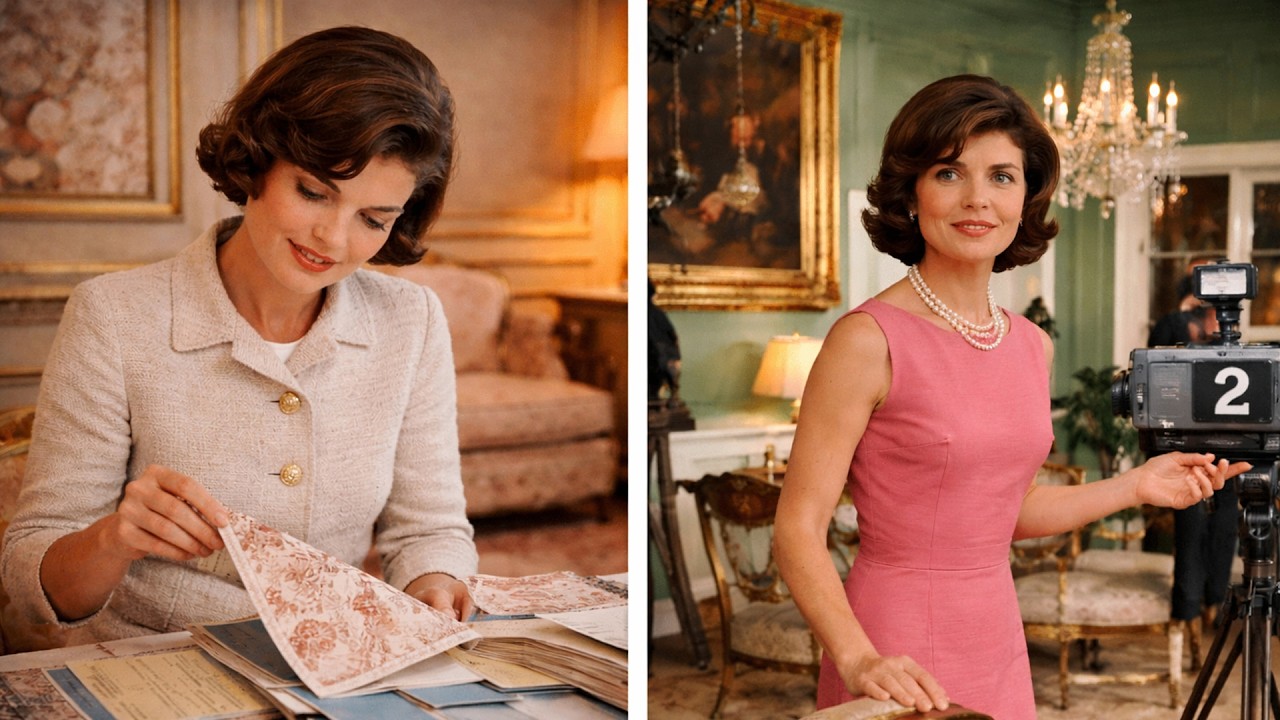
The woman who would later appear on national television in a perfectly composed pale pink ensemble, describing the historical significance of each piece of furniture in measured authoritative sentences, was the same woman who rode the elevator covered in soot and introduced herself to the most prominent civil rights leader in America without missing a beat. That physical, direct involvement defined everything she did to the White House, and it had its roots in a memory from childhood. Jackie Kennedy first visited the White House in 1941 when she was eleven years old. The visit left an impression that stayed with her for the rest of her life, but not for the reasons one might expect.
She was not dazzled or inspired. She was underwhelmed. She later told Life magazine that from the outside she remembered the feeling of the place, but inside all she remembered was shuffling through. There was not even a booklet you could buy, and Mount Vernon and the National Gallery of Art had made a far greater impression.
That childhood memory of a poorly presented, historically incoherent building became the seed of everything she did twenty years later. When she moved into the White House in January of 1961 as First Lady, she already knew what was wrong with it and already had a strong sense of what needed to happen. She was not arriving as someone encountering the problem for the first time. She was arriving as someone who had been thinking about the problem since she was eleven years old.
Her first assessment of the building as her incoming home was blunt. In private, she described the residence as “that dreary maison blanche,” simply French for White House, the phrase carrying the full weight of her disdain. She felt it looked like it had been furnished by discount stores, and she specifically objected to features like drinking water fountains mounted on various walls, which she found absurdly institutional for a residence that was supposed to represent the highest aspirations of the American Republic. Some of what she found was genuinely understandable given recent history.
During the Truman administration, from 1949 to 1952, the White House had been structurally condemned. The interior had to be gutted and rebuilt with steel to keep it from collapsing. The reconstruction had been so expensive that when it came to refurnishing the rooms, Truman’s administration went to department stores and bought modern reproduction furniture in bulk. The rooms were functional and presentable, but they had no historical character whatsoever.
The other problem was Mamie Eisenhower’s fondness for the color pink, which had made its way onto walls, upholstery, and furnishings throughout the private quarters. Jackie’s reaction to the pink was, by the accounts of people who heard her describe it, visceral and total. The pink had to go, all of it, immediately. She had been allocated a budget of $50,000 for the refurbishment of the private living quarters on the second floor.
Within two weeks of moving in, the entire $50,000 was gone. She and decorator Sister Parish moved through the second floor at a pace that left the household staff struggling to keep up. Furniture was ordered, wall colors were decided, fabrics were selected, and the money evaporated with a speed that reflected both the scale of what needed doing and the decisiveness with which Jackie approached every decision. There was no period of cautious planning followed by gradual spending.
She knew what she wanted and she bought it. Rather than being deterred by the exhausted budget, she immediately began building the financial framework that would fund the rest of the project. She turned to Henry Francis du Pont, the renowned collector of American decorative arts who ran the Winterthur Museum in Delaware, and proposed the formation of what became the Fine Arts Committee for the White House. The committee gave the project credibility, attracted donors, and eventually generated enough in contributions and guidebook sales to fund a $2 million restoration.
But it all started with $50,000 disappearing in fourteen days. The official story of the restoration, as presented to the American public during the Kennedy years, featured two principal creative figures: Sister Parish, an American decorator with impeccable social connections, and Henry Francis du Pont, the American antiques authority. Both were real contributors. Neither was the person Jackie actually trusted most to make the rooms look the way she wanted them to look.
That person was Stéphane Boudin, a Parisian designer who was president of Maison Jansen, the most prestigious interior design firm in France. Boudin had previously worked on the restoration of part of the Palace of Versailles. Jackie had been introduced to his work through her friend Jane Wrightsman, whose Palm Beach home Boudin had designed, and she was immediately convinced he was exactly what the White House project needed. The problem was political.
She had already been publicly criticized for her preference for French fashion and French culture. Having a French designer as the primary creative force behind the renovation of the American president’s home would have generated a scandal, so Boudin’s role was kept quiet. He came to Washington and worked on the rooms. His name did not appear in press releases or Fine Arts Committee announcements.
He was, as one account of the project described it, kept hidden. The arrangement worked until a Washington Post article in September of 1962 outed his involvement entirely, causing embarrassment for Jackie’s office. By that point, Boudin had already been given increasing control over most of the major rooms. The Red Room, the Blue Room, and the State Dining Room all carried his mark.
He was, as one design historian later wrote, the true tastemaker who redefined the White House rooms as stylish, historically inspired backdrops for the Kennedy presidency. He just could not be publicly credited for any of it while it was happening. In March of 1961, Jackie appointed Lorraine Waxman Pearce as the first official White House curator, a position that had never existed before. Pearce was twenty-six years old, a graduate of the prestigious Winterthur program in early American culture, and exceptionally well qualified for the job.
She began cataloging the collection, developing acquisitions policy, and collaborating with Jackie on the restoration. She also co-wrote the first White House guidebook. By any reasonable measure, she was performing well. Jackie fired her after approximately a year.
Pearce’s obituary in the Washington Post described the removal as a surprise to Pearce herself. She was not formally dismissed but was reassigned from the curator role to write the guidebook full-time, after which she resigned officially, citing a desire to spend more time with her family. The reason for the friction, documented across multiple sources, was that Pearce had a habit of making decisions without asking for Jackie’s approval first. In Jackie Kennedy’s household, that was a rule-ending offense.
She had established the curator position and defined its scope. The curator was there to execute Jackie’s vision, not to develop an independent one. After Pearce left, Jackie wrote a note to the incoming curator, William Voss Elder the Third, telling him that having him on the job was, in her words, “paradise. ” The comparison was unmistakable.
Before Jackie Kennedy arrived, there was no law governing what happened to the contents of the White House when a president left office. The furniture, the artwork, the decorative objects, everything in the building was essentially at the disposal of the outgoing president and their family. President Chester Arthur had reportedly carted away three wagon loads of historic furniture when he departed in 1885. Items that had been in the White House for generations simply walked out the door with departing administrations, and nobody could stop them.
Jackie found this situation completely unacceptable. She was assembling a collection of historically significant objects, tracking down pieces that had belonged to past presidents, persuading private collectors to donate irreplaceable antiques, and spending enormous effort to build something permanent. The idea that the next administration could remove or sell any of it was intolerable. In September of 1961, Congress passed Public Law 87-286, which officially designated the White House a museum.
The law meant that anything placed in the White House as part of the museum collection would go to the Smithsonian Institution rather than to departing presidents if they decided they did not want it. The collection Jackie was building was now legally protected. She had not only redesigned the building, she had changed the legal framework that governed it. Any future president who wanted to gut the rooms she had restored would have to fight a law to do it.
One of the most striking design decisions she made was the installation of antique scenic wallpaper in the diplomatic reception room on the ground floor. The wallpaper was not a reproduction or a custom commission. It was original antique paper manufactured in France in 1834 by the firm Jean Zuber et Cie. The paper depicted scenes of North America, including Boston Harbor, West Point, and Niagara Falls, rendered in the French scenic panoramic style that was fashionable in the early nineteenth century.
The paper had originally been hung in a house in Thurmont, Maryland. Jackie tracked it down, recognized its historical and aesthetic value, and arranged for it to be carefully removed and reinstalled on the curved walls of the diplomatic reception room. The installation was technically demanding because the room is elliptical and the paper had to be fitted around a curved surface without damaging panels that were nearly 130 years old at the time of installation. The wallpaper is still in the diplomatic reception room today.
It is one of the few elements of Jackie’s White House restoration that has never been removed or altered by any subsequent administration. Every president and every foreign dignitary who has entered the White House through the diplomatic reception room in the past sixty years has walked past Jackie Kennedy’s 1834 French wallpaper. Language mattered to Jackie Kennedy in everything she did, and on one point regarding her White House project she was insistent to the point of correction. The project was a restoration, not a redecoration.
She told Life magazine directly that it would be “sacrilege” merely to redecorate the White House, calling it a word she hated, and that what she was doing was restoring it, which had nothing to do with decoration. She said it was a question of scholarship. The distinction was not performative. It reflected her genuine conception of what the project required.
Redecoration meant expressing personal taste. Restoration meant recovering historical truth. The two activities use some of the same tools, choosing fabrics, selecting furniture, deciding on paint colors, but they are guided by entirely different principles. A decorator asks what looks good.
A restorer asks what was actually there. Jackie was asking the second question, and she wanted everyone around her to understand that distinction and to use the correct word when describing what she was doing. Staff members and committee members who slipped into using the word redecoration in her presence were corrected. Official White House communications used the word restoration.
Every word choice reinforced the same message. This was scholarship, not decoration. On February 14th, 1962, Jacqueline Kennedy led CBS journalist Charles Collingwood through the newly restored White House in a one-hour television special called A Tour of the White House with Mrs. John F.
Kennedy. The broadcast aired simultaneously on CBS and NBC. When ABC rebroadcast it four days later, the cumulative audience had reached 80 million people. It was the most watched television program of its day.
What the audience of 80 million did not know was that the tour had not been scripted. Jackie wrote her own notes beforehand, studied them, decided the route through the rooms herself, and then performed the entire hour from those personal notes without a single rehearsed line. The producers later documented that they never needed to reshoot any scenes with her. One account of the production described her as a one-take wonder.
The Television Academy recognized the broadcast with its Trustee Award, an honorary Emmy, describing the program as a singular experience. Lady Bird Johnson accepted the award on Jackie’s behalf at the ceremony. The tour was taped and sent around the world, shown cinematically in countries including China and the Soviet Union as a piece of American cultural diplomacy. The detective work behind the tour was as remarkable as the performance itself.
Pieces of historically White House furniture had been leaving the building for over a century, taken by departing presidents, sold at auction, donated to museums, or simply lost track of over the decades. Jackie and her committee set about finding them. As Time magazine reported at the time, pieces donated back to the White House during the restoration included furniture once owned by George Washington, James and Dolly Madison, James Monroe, Martin Van Buren, Daniel Webster, and Abraham Lincoln. Members of the Fine Arts Committee actively hunted for period-appropriate pieces in private collections, museums, and antique markets.
Jackie herself approached individual collectors directly, often with charming and difficult-to-refuse personal letters. One of the more famous of those letters was the one she wrote to Walter Annenberg, who owned a valuable portrait of Benjamin Franklin. She asked him whether a great Philadelphia citizen would give the White House a portrait of another great Philadelphia citizen. Annenberg donated the portrait.
By the time the restoration was substantially complete, more than 500 new items had entered the White House collection, each one tracked down, verified, and placed with the same level of care Jackie brought to every other detail of the project. The Washington Post article from September of 1962 that exposed Boudin’s hidden role also reported something else that was considerably more awkward for Jackie’s office. A desk that she had discussed during the televised White House tour, presented as an authentic antique, was not authentic. It had been constructed around 1880, decades after the period it was supposed to represent.
The desk had been donated to the White House as part of the restoration effort, accepted in good faith, and included in the Green Room. Jackie had mentioned it during the tour as one of the interesting historical pieces in the room. When the Post’s reporting revealed it was a reproduction rather than an original, the story became a minor scandal. Combining the embarrassment of the Boudin exposure with the humiliation of having vouched publicly for a fake, the desk was subsequently removed from the Green Room.
The fact that a single misattributed desk was the most significant authentication failure in the entire project, out of more than 500 acquisitions, was actually a testament to how carefully the process had generally been managed. But it stung, and she did not forget it. Henry Francis du Pont, the eighty-one-year-old collector Jackie appointed to chair her Fine Arts Committee, was deeply committed to American decorative arts. His entire life’s work at Winterthur had been devoted to proving that American furniture and interiors could stand alongside the finest work produced anywhere in the world.
He brought that commitment to the White House project with genuine enthusiasm. He also had one persistent private concern about the woman who had appointed him. Du Pont wrote in private correspondence that he had a feeling Jackie’s real interest was in French things, and that she did not believe you could have a swell house with American furniture. He said he wanted her to see that you could.
The concern was not paranoid. Jackie was a lifelong Francophile who had spent a year in Paris, studied French literature, hired a French chef, worn French clothes, and secretly brought in a French designer to run most of the major rooms of the restoration. The tension between du Pont’s American vision and Jackie’s French instincts ran through the entire project. When they disagreed about whether a particular room should feature American Empire or French Empire furnishings, Jackie reportedly resolved the argument by telling du Pont that as long as the piece had an eagle on it, it did not matter whether it was French.
Du Pont was not entirely reassured. But the collaboration worked, and the rooms they produced together were historically coherent in ways that satisfied both of their standards, even if they got there by different routes. The final cost of the restoration was approximately $2 million. It covered most of the family rooms on the second floor, nearly all the public state rooms on the first floor, and set a standard for building stewardship that every subsequent administration has been measured against.
The project took less than three years to complete and was, by the time it was substantially finished in the autumn of 1963, recognized as the most significant transformation the White House interior had undergone in its history. The funding came from multiple sources. The Fine Arts Committee raised contributions from private donors. The White House guidebook, which Jackie helped create and which sold for a dollar a copy, eventually generated enough revenue to fund the entire restoration.
The White House Historical Association, which Jackie established in November of 1961 as a private non-profit organization to support the collection, became the permanent institutional structure for maintaining and building on what she had started. Nancy Reagan specifically expressed admiration for the Kennedy style and made efforts to recreate elements of it during her own White House years. When President Kennedy was shot in Dallas on November 22nd, 1963, the White House restoration was not finished. Jackie had been working with Stéphane Boudin on the final phase of the project throughout that autumn, and the rooms that remained on their list had not yet been completed.
The sudden end of the Kennedy administration meant that the restoration abruptly stopped at the point it had reached on that specific day. The JFK Library’s documentation of the restoration notes that although the Kennedy restoration abruptly ended with the president’s death, most of the state rooms on the ground and first floors were complete. The rooms that remained undone stayed undone, at least in Jackie’s version. During the Johnson presidency, most of the completed rooms remained unchanged in deference to the Kennedys.
Lyndon Johnson kept JFK’s angel print bedding. He kept Boudin’s Blue Room. He kept the 1834 French wallpaper in the diplomatic reception room. The unfinished state of the restoration when Jackie left gave her work a quality it might not otherwise have had.
It was not the completed monument of a triumphant project. It was the interrupted work of someone who was not done yet, preserved mid-sentence by the assassination that ended everything else as well. Jackie Kennedy walked into a building she had first seen as a disappointed eleven-year-old child, blew through its entire budget in two weeks, secretly imported a French designer, fired a curator who made decisions without asking her, passed a federal law to protect the furniture she had hunted down across more than a century of history, and then walked 80 million Americans through the result in one unscripted take. She did not finish.
The assassination stopped her before she was done. But what she completed in less than three years changed the way the entire country thought about the building at the center of its national life, and it has not been undone since.






