John Jenrette stood in a hotel room at the Mayflower Hotel on October 20th, 1979, and made a choice that would destroy everything. The men across from him were not Arab sheikhs. They were FBI agents, and a camera hidden in the room was recording every word, every gesture, every exchange of cash. They laid out the deal plainly.
In exchange for his promise to introduce a private immigration bill granting asylum to one of the fictional sheikhs, he would receive a briefcase containing $50,000. There was no hesitation. At one point, believing he was in a private conversation with an associate, the congressman from South Carolina admitted with chilling casualness, “I’ve got larceny in my blood. I’d take it in a goddamn minute.
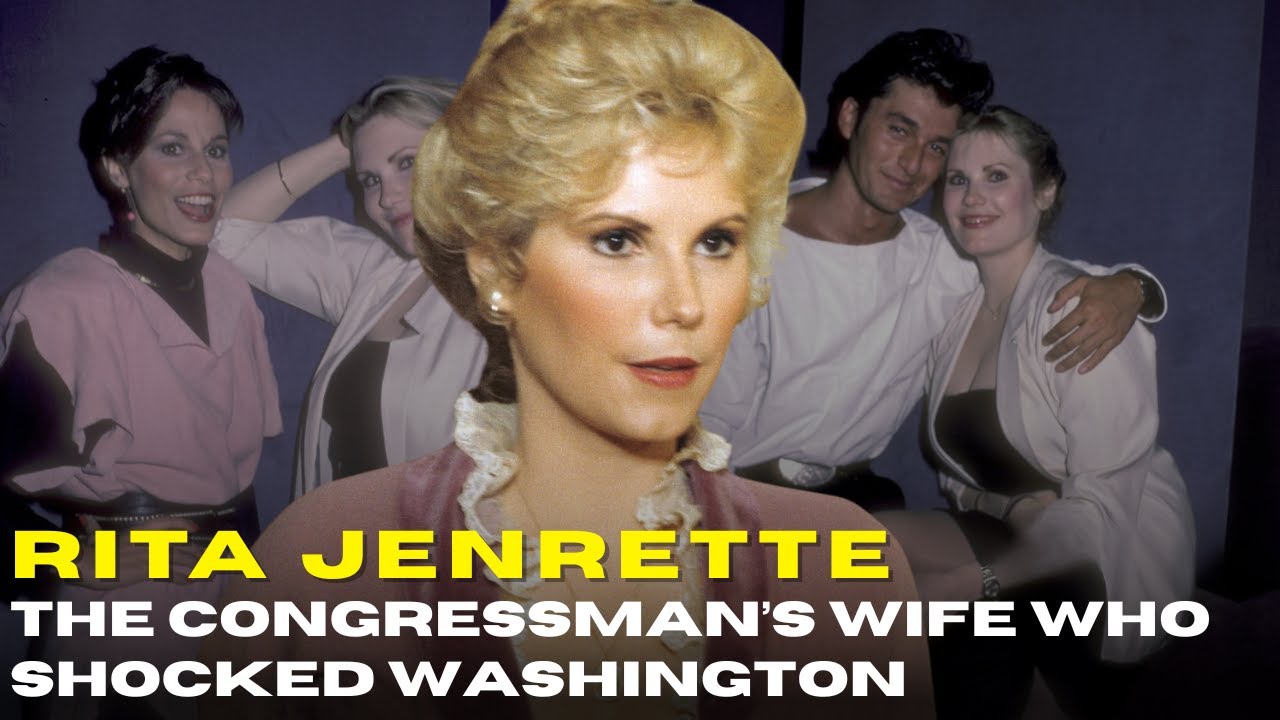
” Then he took the briefcase. He did not know that the tape would seal his fate, that in a few short months his wife would be posing naked for Playboy, or that his name would become synonymous with corruption. He did not know that the woman standing beside him at the center of Washington’s social scene was about to become the most talked-about woman in America. Rita Jenrette was born in 1949 in San Antonio, Texas, a daughter of the Sun Belt rather than the East Coast establishment.
She was a Texan beauty with a razor-sharp mind and a formidable will. Armed with a degree from the University of Texas, she possessed a potent combination of Southern charm and relentless drive. Her first taste of politics came early, through her work for the Republican National Committee, a fascinating detail for a woman who would later marry a Southern Democrat. It suggested her allegiance lay less with any particular ideology and more with the arena of power itself.
Her time at the RNC was more than just a job, it was a masterclass in the mechanics of Washington. Picture the Washington of the early 1970s. It was a town of smoke-filled rooms, old-boy networks, and hardened political lines drawn in the wake of the 1960s. For a young woman from Texas, no matter how bright, it could have been an intimidating place.
But Rita did not just navigate it. She thrived. She had an incredible ability to remember names, connect faces to districts, and understand who needed what from whom. She became a sort of human rolodex, a vital node in the city’s intricate social wiring.
She was not just another pretty face at a Georgetown cocktail party. She was the person who could quietly introduce a junior congressman to a key donor or offer savvy advice on handling a tricky piece of press. She learned the unspoken language of influence, a currency far more valuable than a party platform. In 1976, that ambition found its perfect vehicle.
She married John Jenrette Jr. , a charismatic, larger-than-life politician from South Carolina, a classic good-old-boy Democrat who had fought his way into the US House of Representatives. He was ambitious. She was strategic.
He had the political position. She had the social grace and the killer instinct. Together they were a perfectly matched pair, ready to take on Washington and climb its treacherous social and political ladder. They were young, attractive, and hungry, and for a time their ascent was meteoric.
Rita was no mere bystander in her husband’s career. She was its co-pilot. She ran his Washington office with an iron fist, managed their social life with the precision of a chess grandmaster, and cultivated an image of them as the city’s most exciting new power couple. She understood that in Washington, perception is reality.
She ensured they were seen at the right Georgetown dinner parties, photographed with the right senators, and mentioned in the right society columns. She was the architect of their brand. Their townhouse on Capitol Hill became one of the hottest tickets in town. An invitation to one of their parties was a sign that you mattered.
The bourbon flowed freely, the political gossip was top-shelf, and Rita moved through it all like a queen in her court, ensuring every guest felt like the most important person in the room, all while subtly advancing her husband’s agenda. It was a high-wire act, a constant performance of effortless power and charm, and she played her part to perfection. But maintaining that perfect facade took its toll. Behind closed doors, the partnership was showing signs of strain.
John, for all his political charm, had a fondness for the faster side of life. He loved the back-slapping, the late nights, the endless flow of whiskey that lubricated the wheels of DC politics. Rita, ever the strategist, saw his appetites not as a quirk but as a liability. She spent more and more of her time managing not just his career but him.
She was the steady hand on the rudder of a ship whose captain was growing increasingly erratic. And in a town like Washington, secrets do not stay secret for long. Whispers began to circulate on the cocktail-party circuit, the very circuit Rita had conquered. Whispers about John’s drinking, about his recklessness, about late-night antics on the Capitol steps.
The polished veneer she had so painstakingly constructed was beginning to crack, and she knew, with that razor-sharp mind of hers, that it was only a matter of time before a crack became a chasm. This was more than just a supportive wife playing her part. It was a woman with her own formidable ambitions, channeling them through the only avenue readily available to her at the time. She was, in essence, the CEO of Jenrette Inc.
But the company they were building was engaged in a high-risk business, and its foundations were built on ground far less stable than it appeared. In 1980, the entire enterprise would be swallowed whole by a scandal that would expose the dark underbelly of Washington. The sting operation had a name that sounded like something out of a spy novel: Abscam, short for Abdul Scam, named for a fictional entity called Abdul Enterprises Ltd. It remains one of the most audacious and controversial undercover operations the FBI has ever conducted.
At its heart was a brilliant con man named Mel Weinberg, a career swindler who, facing a long prison sentence, agreed to work with the FBI to catch bigger fish. Weinberg was the operation’s maestro. The FBI created a fantasy world. They cast Weinberg and other agents as representatives of two fabulously wealthy Arab sheikhs, Kambir Abdul Rahman and Yassir Habib.
They rented a lavish townhouse in Georgetown, a yacht in Florida, and hotel suites in New York and Philadelphia. They let it be known, through a network of shady middlemen, that their sheikhs were eager to pour hundreds of millions of dollars into the United States and were willing to pay handsomely for political grease. They needed help with things like casino licenses in Atlantic City and private immigration bills for their associates. The bait was set.
It was a test of integrity, and one that a shocking number of public officials failed spectacularly. One by one, congressmen, a senator, and other political figures were lured into the web, their meetings secretly recorded on videotape. They were drawn by the siren song of easy, untraceable cash. Congressman John Jenrette, known to be struggling with personal debts and with a taste for the high life, was a prime target.
The FBI’s cameras were waiting for him in that room at the Mayflower Hotel. The videotape of the meeting is a chilling artifact of political decay. There is no agonizing, no wrestling with conscience. It is a transaction.
The Abscam story broke on February 2nd, 1980, and it detonated like a bomb in the national consciousness. The country was enthralled and horrified. Seven members of Congress were ultimately convicted. For Rita Jenrette, this was not a distant news story.
It was an intimate catastrophe. The life she had so painstakingly constructed, the future she had banked on, was annihilated in an instant. The ensuing trial was a media frenzy. John Jenrette’s defense was as desperate as it was infamous.
He did not deny taking the money. Instead, his lawyers argued that he was a chronic alcoholic and had been so drunk during the FBI meeting that he was not legally responsible for his actions. It was dubbed the Bambi versus Godzilla defense, portraying him as a helpless fawn in the jaws of a monstrous government sting. The prosecution countered with testimony about his functional alcoholism, presenting him as a man who knew exactly what he was doing.
The jury agreed with the prosecution. On October 7th, 1980, John Jenrette was found guilty of bribery and conspiracy. He was sentenced to two years in prison and resigned from Congress in utter disgrace. The name Jenrette became synonymous with corruption.
And Rita, in the cold, swift judgment of Washington society, was collateral damage. The power couple was no more. She was now just the wife of a convicted felon. The phone stopped ringing.
The powerful friends who had once flocked to their parties now crossed the street to avoid her. At 31 years old, she was left stranded in the wreckage, facing social ostracization and financial ruin. But Rita was never one to simply accept her fate. That formidable will, that Texas grit, had not been washed away in the flood of scandal.
Humiliation can curdle into a very potent form of anger. And for a strategist like Rita, anger demands a plan. She looked at the chessboard of her life and saw that all the traditional pieces had been swept off the board. The powerful husband, the social status, the political access, all gone.
So what do you do when the game is over? You flip the whole table over. She decided to use the one asset she had left: her story. Not just her story, but the secrets of the city that had shunned her.
If the establishment was going to treat her like a pariah, she was going to expose its hypocrisies from the inside out. Her chosen vehicle for this bombshell was as shocking as the scandal itself. It was not a quiet interview with a sympathetic journalist. Rita Jenrette decided to pose for Playboy magazine.
This was not just about the money, though she certainly needed it. The interview that went along with the pictorial was her true weapon. It was her chance to tell the unvarnished truth about the drinking, the affairs, and the anything-goes culture that permeated the capital’s corridors of power. If Washington was going to make her an outcast, she was going to pull back the curtain and show the world exactly what she was being cast out from.
It was a breathtakingly audacious move, a declaration of war against the city that had made and then broken her, refusing to become a quiet footnote in some political trivia book. The ultimate insider was about to become the ultimate outsider. Washington DC had no idea what was about to hit it. In 1981, with her husband’s appeals still pending, Rita Jenrette did the unthinkable.
She posed for Playboy. It was not just a pictorial. It was a declaration of independence. She stripped away the prim persona of the Washington wife, both literally and figuratively, and replaced it with something raw, defiant, and entirely of her own making.
The ten-page spread, titled “The Liberation of Rita Jenrette,” was a cultural bombshell. But as shocking as the photos were to the establishment, it was the accompanying interview that delivered the mortal blow to propriety. In it, she spoke with startling candor about the hypocrisy and debauchery she had witnessed behind the marble facades of Washington. And then she delivered the line that would be etched into the memory of a generation.
When asked about the blend of power and sex in DC, she revealed that she and her husband had once made love on the steps of the US Capitol building during a late-night recess. That one sentence sent a seismic shockwave through the country. It was the sound of a million jaws hitting the floor. Suddenly, Rita Jenrette was not just part of a political scandal.
She was the scandal. Late-night hosts had a field day. News anchors reported it with a kind of grim fascination. The image was just too powerful, too perfectly symbolic of the perceived rot at the heart of the capital.
The confession was an act of symbolic warfare. The Capitol, the hallowed temple of American law and order, was reimagined as a stage for private transgression. She took the most revered symbol of the system that had crushed her and stained it with an intimate, human, scandalous act. It was her revenge served cold.
Back in DC, the reaction was pure, unadulterated fury. It was not just pearl-clutching over the act itself. It was outrage that she had broken the city’s unspoken code of silence. She had pulled back the curtain on their private club, and for that, she was deemed a traitor.
The last few doors that had not slammed shut in her face were now bolted and barred forever. And John Jenrette, from his perspective, saw it as the ultimate betrayal. Here he was, fighting to stay out of prison, and his wife was on the cover of a men’s magazine, turning their private life into a national punchline. The marriage, already destroyed by the scandal, was now publicly cremated.
But out in the rest of America, the reaction was more complicated. Plenty of people were scandalized, but others, especially women, saw something else. They saw a woman who had been used and discarded by a powerful man and a corrupt system and who was now refusing to go away quietly. Was she a shameless opportunist?
Or was she a survivor using the only weapons she had left? For a brief moment, she became a Rorschach test for the country’s changing views on sex, power, and a woman’s place in the world. She was denounced on the floor of Congress as a disgrace. The Washington Post editorial board fumed.
Religious groups and conservative commentators branded her a Jezebel, a symbol of moral decay. But while the establishment clutched its pearls, a different reaction was brewing elsewhere. To many people, especially women who felt trapped in their own conventional lives, her act was seen as one of astonishing bravery. She had been publicly shamed, and instead of hiding, she had seized the spotlight and turned its glare back on her accusers.
For Rita, the gambit worked, but it came with a heavy price. She was no longer invisible. She had money, a platform, and a name everyone knew. But in escaping the shadow of her husband, she had stepped into a new, even brighter, and perhaps harsher spotlight.
She was free, but she was also notorious. The question now was what on earth she would do with this newfound scandalous fame. In her 1981 book, My Capital Secrets, she gave insight into her mindset. She described feeling like a non-person, stripped of her identity and resources.
The Playboy offer was a lifeline. It was money, yes, but it was more. It was a platform. It was a way to scream, “I am still here, and you will listen to me.
” It was a desperate, brilliant, and deeply controversial act of self-creation. She had lost the game of Washington, so she flipped over the entire board. The scandal made Rita Jenrette a household name. She was no longer just the wife of a disgraced politician.
She was a celebrity in her own right, a new and baffling kind of public figure: the bad girl of the Beltway, and she leaned into the role. She embarked on a whirlwind media tour, proving to be articulate, witty, and completely unfazed by the criticism. She attempted to parlay this notoriety into a lasting career. She became a special correspondent for the tabloid news program A Current Affair, a job that perfectly matched her insider-turned-outsider status.
She wrote her tell-all book, further solidifying her narrative. And she tried her hand at acting, starring in a series of low-budget horror and comedy films with titles like Zombie Island Massacre and The Naked Truth. This was her wilderness period. She was famous, but it was the hall of fame of infamy.
She was recognized everywhere but respected almost nowhere. For years she rode this strange wave, a living symbol of a decade defined by greed and scandal. But one can only be a symbol for so long before it begins to consume the person underneath. The constant need to perform her own past, to be the scandalous Rita Jenrette, must have been profoundly exhausting.
She had survived. She had profited. But she had not yet found peace. To do that, she would have to perform one last, final vanishing act.
In the mid-1990s, Rita Jenrette made her most radical move yet. She left America. She moved to Rome, the eternal city, a place layered with millennia of history, a city that knows that all empires, personal and political, eventually turn to dust. It was an inspired choice, a place where a woman could lose herself in antiquity and, in the process, find a new self.
And in Rome, a third Rita Jenrette was born. This was not the ambitious political wife, nor the defiant media celebrity. This was a woman reborn. She quietly and deliberately began to build a new life, one founded not on scandal but on substance and style.
She became a high-end real estate broker, a profession that suited her perfectly. She tapped into her innate intelligence, her still-potent charisma, and a newfound sense of discretion to carve out a unique niche. She specialized in selling and leasing Italy’s historic treasures, Renaissance palazzos, ancient castles, and noble villas, to a discerning international clientele. A woman whose life was publicly destroyed inside the halls of a new world power found her calling in becoming the discreet guardian of the treasures of an old-world empire.
She traded the fleeting currency of political capital for the enduring value of history, beauty, and stone. Her metamorphosis was absolute. She learned to speak fluent Italian, immersing herself in the nuances of the culture. And in the ultimate symbol of her rebirth, she bought her own piece of history: a magnificent, sprawling 16th-century palazzo.
She did not just buy it. She undertook its meticulous restoration, pouring her energy into bringing its faded grandeur back to life. In restoring the palace, she was, in a very real sense, restoring herself. She was no longer a tenant in the house of power, dependent on a man for her position.
She was the mistress of her own castle. People who encountered her in Rome spoke of a woman transformed. The defiant edge was gone, replaced by a quiet European sophistication. Many in her new circle had no idea of her tumultuous past in America.
The story of Abscam and Playboy seemed to belong to a different person from a different century. She had achieved the impossible: a clean slate. The life of Rita Jenrette is a triptych. Three distinct panels that tell one incredible story.
The first panel is a cautionary tale of ambition and the precarious nature of power in Washington. The second is a raw, explosive portrait of scandal and survival, a woman refusing to be erased. And the third, the final panel, is a serene masterpiece of rebirth and self-actualization. Her story forces us to ask difficult questions.
Was her rebellion in the 1980s a cynical ploy for fame and money, or was it a legitimate act of feminist defiance in an era that offered few other options? The truth is, it was likely both. She was a pragmatist, a survivor who used the weapons at her disposal. Her journey is also a profound commentary on the American obsession with celebrity and second acts.
We love to build people up, tear them down, and then, if they are lucky and resilient enough, marvel at their ability to rise again. Rita Jenrette did not just rise again. She transcended the entire cycle. She walked away from the game and created her own world, by her own rules, on another continent.
In the end, it is the third act that defines her legacy. It proves that your past, no matter how public or how scandalous, does not have to be your prison. It demonstrates that disgrace is not a terminal diagnosis.
Through an extraordinary combination of courage, intelligence, and sheer force of will, Rita Jenrette authored her own life, transforming herself from a symbol of scandal into an embodiment of quiet, elegant triumph.






