At 2:22 on the morning of November 3, 1944, a German officer named Heinz Baumann lay in a waterlogged ditch at an unnamed road junction east of Aachen, waiting for American artillery to stop. He had been there for fifty minutes. Nearby were four men and eight containers of food, and the only path to his company’s position was the intersection in front of him, where American shells fell singly and at irregular intervals. One had landed at 1:07, another at 1:31, two nearly together at 1:44, then nothing for twenty-six minutes.
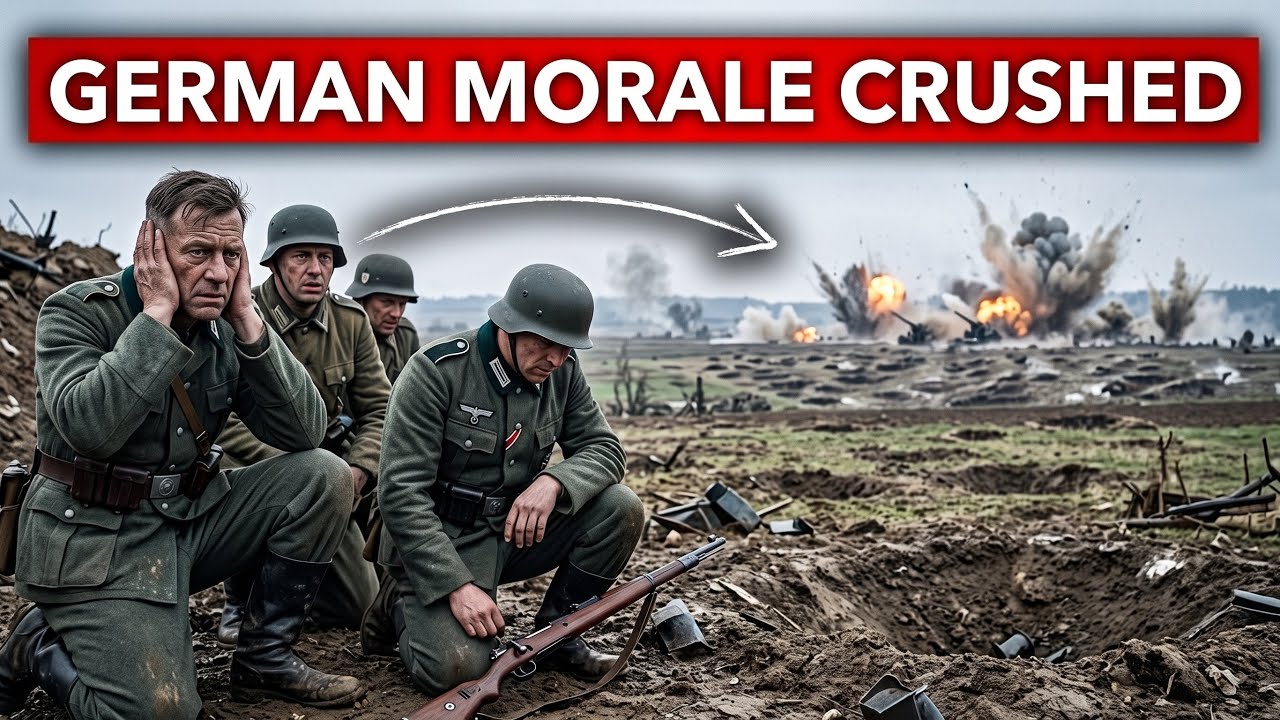
That long quiet stretch was enough to convince a new recruit, a seventeen-year-old from Kassel, that it was safe to move. Baumann pulled him back down. Forty seconds later, the intersection exploded again, a single shell dead center, and shrapnel tore through the space where the boy’s chest had been. No observer was directing this fire.
Baumann knew this with professional certainty. No human eye could see this junction on a moonlit November night, and the guns firing at it were miles away, manned by men who could not see Germany at all. By every measure his training gave him, they were firing at nothing. That empty, purposeless shelling was worse to him than any barrage he had endured in Russia.
A barrage meant something. It meant an attack was coming. This had no pattern, no readable design, no beginning and no end. His company had eaten cold food for six days because of this junction.
The supply group of the second platoon had lost two men here on Tuesday. Men no longer slept more than an hour without being jolted awake by the noise of an arbitrary shell somewhere on the supply routes, hearts pounding, hands reaching for rifles in anticipation of an attack that never came. What German soldiers at the receiving end did not know was that the shells falling on empty intersections were not waste and not nervousness. They were deliberate entries in a written schedule, drafted that evening by an American lieutenant with a map, a set of firing tables, and a policy of intentional randomness.
The shelling had a name in American military doctrine. It had a budget. And it had a target, which was not the road junction at all. The target was Baumann.
The origin of this system lay in the quietest place imaginable: a classroom in Oklahoma, fifteen years before Baumann’s ditch. In the early 1930s at the Field Artillery School at Fort Sill, a handful of American officers confronted an uncomfortable truth. Their beloved arm was still fundamentally a World War I instrument. Guns fired at targets their batteries could see or had registered in advance with great effort, and massing the fire of several battalions on a single point required hours of planning.
In a fluid battle, by the time the guns agreed on a target, the target had moved. Officers of the Gunnery Department, led by Major Carlos Brewer and the instructors who followed him, treated the problem as engineers. They stripped the aiming calculations out of individual gun pits and centralized them in a single room called the fire direction center, a tent or cellar with a map board, firing tables, and conscripts trained in computation. They invented graphical instruments that turned twenty minutes of trigonometry into forty seconds of plotting.
They connected the whole apparatus with voice radio. And they made one man, a forward observer anywhere, the trigger for every gun his radio net could reach. This room was something the Germans never built. In the German system, an artillery battery largely fought its own war.
In the American system, by 1943, every gun within map-coordinate range answered within minutes to any twenty-three-year-old lieutenant looking at those coordinates. The guns of a battalion, a division, a corps were fused into a single weapon with a thousand barrels and one nervous system. From that nervous system came a trick of the stopwatch that turned massed fire into slaughter: time on target. Fire direction centers calculated the time of flight for every shell from every participating battery, thirty seconds from these guns, nineteen from those, and coordinated firing orders across the radio net with a countdown so the first rounds from each gun arrived at the target in the same instant.
There were no ranging shots, no escalating warning, no thirty seconds of incoming fire to let men duck into holes. A moment of silence, then the simultaneous detonation of an entire division’s artillery above men still standing. The American gunners, in their professional black humor, called the all-guns version, when every battery within a corps range hit the target on a synchronized clock, a “serenade. ” The men it was played for never used such a gentle word.
German survivors of time-on-target missions, interrogated through 1944 and 1945, reached for comparisons and always arrived at the same ones: a mine explosion, a lightning strike, an apocalypse that ambushed you mid-sentence. The human nervous system processed ordinary shelling as an event. It processed the serenade as an ambush from the sky. But the stopwatch was only half the doctrine.
The other half was what Baumann faced at his road junction, and it was the half that broke armies slowly rather than instantly. The American manuals called it “harassing and interdiction fire,” defined in dry bureaucratic language: fire directed at possible enemy routes, assembly points, and positions during darkness and at irregular intervals to prevent rest, delay movement, and reduce combat efficiency. Behind that language lay a nightly ritual repeated across every front held by American divisions in Europe. Each evening, an officer sat in a fire direction center with a map of the German rear and a list of everything any German formation needed to do in darkness: draw rations, rotate companies, evacuate wounded, bring up ammunition, water the horses.
At every point where those needs intersected with geography, he programmed shells. A crossroads. A bridge approach. A valley sheltering a supply road.
A farmhouse intelligence guessed to be a command post. Then came the detail that separated science from spite: he introduced randomness into the schedule. No fixed intervals. No pattern a German NCO like Baumann could learn and time and beat.
The entire point was that twenty-six minutes of quiet meant nothing. The American gunners were not betting that one particular shell would kill one particular German soldier. They were buying in bulk a psychological condition on the other side of the line: the permanent, exhausting impossibility of ever feeling safe, or getting food, or rest, or keeping an appointment. The arithmetic behind this purchase was ammunition supply.
During the Battle of the Bulge alone, in roughly five weeks of winter fighting, the American artillery fired more than a million and a quarter shells. A German artillery regiment in 1944, rationed to a few dozen rounds per gun per day or less, could not have played this game for a single week. The Americans played it every night on every front for eleven months, and the damage accumulated exactly as the doctrine predicted. Hot meals stopped reaching the German front lines, not always because the kitchens were destroyed, but because transport squads took hours to cover a mile or refused to cross intersections at all.
Relief operations that needed one night took three. Wounded men who should have survived died at aid stations waiting for ambulances that crawled between bombardments. Sleep collapsed, the quietest logistics of war. German medical officers in the West documented what the Americans could only infer: men aged in weeks, their startle reactions worn so thin that the slam of a door would drop combat veterans to the ground.
Old Eastern Front hands who had survived winters before Moscow told their interrogators, in a phrase echoing through captured files, that they would rather serve three years in Russia than endure months under American guns. Because in Russia, at least, the shelling had a reason. The target was never the intersections. It was the small surrenders that added up to four hundred casualties a day: the cold meal, the canceled patrol, the sleepless night that dissolved a fighting unit while its rifles remained clean.
The whole system, observers, radio nets, fire direction centers, timed fire, the inexhaustible supply depot, came together in one battle on a hill in Normandy in August 1944. The place was Mortain. On the night of August 6, Hitler pushed four panzer divisions, including the 1st and 2nd SS Panzer Divisions, westward in Operation Lüttich, a counterattack meant to slice through the American breakout toward the sea at Avranches and cut Patton’s Third Army off at its roots. The blow fell directly on the American 30th Infantry Division, focused fatefully around high ground east of Mortain, marked on maps as Hill 314, where roughly seven hundred men of the 2nd Battalion, 120th Infantry Regiment, were quickly surrounded by the vanguard of SS forces flowing around them.
By every military doctrine on earth, a surrounded infantry battalion is a loss not yet completed. But Hill 314 possessed something no surrounded battalion in history had ever had: perfect observation over the entire German attack corridor, and a radio link to a hidden American corps artillery. For six days, the hill became the retina of a massive firepower organ, led by a forward observer, Lieutenant Robert Weiss. As his radio batteries died hour by hour, he called in mission after mission, nearly two hundred by the end, targeting every column, every assembly area, every fuel truck and grenadier company moving below him.
German armor columns jamming the roads toward Avranches met dense concentrations and time-fused shells that arrived without warning and without mercy. German after-action reports described the attack arteries hardening under fire that seemed to know, because it did know, that the hill was watching them. SS forces assaulted the slopes repeatedly to extinguish that eye. The battalion was desperately short of medical supplies.
The Americans even tried dropping morphine and bandages to them inside empty smoke shells while continuing to direct gunfire. When the regiments of the 30th Division fought their way through on August 12, roughly three hundred of the seven hundred men on the hill had fallen, dead or wounded. Around them, Operation Lüttich, the last major German offensive in Normandy, was shattered. More than one hundred German armored vehicles were abandoned or destroyed in the corridor the hill had watched, and the divisions meant to reach the sea were falling back toward the closing trap known as the Falaise pocket.
Field Marshal von Kluge, in his report on the failure, blamed the impossibility of moving under intense enemy fire and air power. Within two weeks he was dead by his own hand, and the German army in Normandy had ceased to exist as a coherent force. One battalion, one radio, and every gun in range. The Germans at Mortain were not beaten by the seven hundred men in front of them.
They were beaten by the hundreds of guns those men spoke for. Four months later, in the frozen December of the Ardennes, the Germans ran the experiment one final time on the largest scale they could manage, and the guns delivered the war’s final verdict. When the Bulge offensive erupted on December 16, its true center of gravity was not Bastogne. It was the northern shoulder, specifically the Elsenborn Ridge, where the SS divisions of the Sixth Panzer Army had to break through the American 99th and 2nd Infantry Divisions to reach the roads on which their entire timetable depended.
In the first days of chaos, American commanders did the most important thing of the whole battle: they massed artillery behind that ridge, battalion after battalion, until more than three hundred guns stood in the snow, linked into a fire direction net capable of concentrating all of them on one map square within minutes. Then the 12th SS Panzer Division, Hitlerjugend, rebuilt and hungry for the Meuse, attacked again and again from December 19 onward at Krinkelt, Rocherath, and above all at the farm crossroads of Dom Bütgenbach. What met them was the concentration fire perfected in the classrooms of Fort Sill, falling on assembly areas the Germans believed secret. More than ten thousand shells rained on a single square kilometer on individual days, joined that very week by new proximity fuses that sensed the ground and burst overhead, stripping soldiers of the old protection of trenches and holes.
Panzergrenadier battalions shattered in their forming-up areas before their attacks formally began. Tanks that broke through the infantry line wandered alone into the antitank guns, because the infantry meant to follow them lay pinned in the snow a mile back under a ceiling of steel. Prisoners from the 12th SS, from seventeen-year-olds to Eastern Front veterans, told their interrogators the same things Baumann’s generation had been writing home for months: that no one had told them the Americans could fight like this, that the fire came from everywhere at once with no warning, that in Russia one learned the rhythm of the enemy guns, and here there was no rhythm. The northern shoulder never broke.
The Sixth Panzer Army, the striking force of the offensive, equipped with the best a collapsing Reich could assemble, was forced back from this decisive terrain within a week, largely by field artillery, and the entire German plan bled to death on secondary roads. The men who stopped the offensive, in account after account of those December nights, barely saw their enemy. They heard him, as the rumble of a freight train of heavy shells passing overhead all night, every night. That sound, as one soldier of the 99th Division put it, was the sound of someone else finally going through the worst of the war.
The verdict: the shelling was never random. It was directed with a precision unmatched in the history of warfare. It simply targeted things no previous army had possessed the mathematics or the ammunition to target: probabilities, schedules, sleep. A German gunner in 1944, heir to the greatest artillery tradition in Europe, aimed at what he could see or predict, because every shell he had was irreplaceable and had to buy a corpse or smash a fortress to justify its value.
The American system aimed at everything the enemy might do, every road he might take, every hour he might rest, because the industrial base made shells cheaper than the things those shells prevented. A German officer watching single shells fall on an empty crossroads at two in the morning could only classify it as madness or waste, and the files show he classified it as both. He was auditing the wrong account. The shell that killed no one at Baumann’s junction earned its full price: two hours of a company’s sleep, one canceled hot meal, the nerves of a seventeen-year-old, another small subtraction from an army being subtracted to death.
Two armies fought with artillery in the West. One treated the gun as a sniper rifle and wasted its ammunition. The other treated it as a system, a single weapon the size of a theater of operations, with a classroom as its brain, a radio net as its nerves, and an industrial continent as its heart, and then did the coldest, most modern thing any army could do. It aimed that weapon at the enemy’s peace of mind and pulled the trigger every night for a full year.
The Germans could fortify against shells. They fortified everything. There are no fortifications against insecurity. On a November night in 1944, at an empty road junction that appears in no history book, a single shell arrived on schedule, a timetable set by a lieutenant the Germans never saw, fired by men who never knew what it accomplished.
But what it accomplished was everything. The men in the trenches understood it before their generals did. An enemy who can afford to fire at nothing is an enemy who can afford to win.






