The steel rod ran the length of her spine, fastened at the waist and again across the shoulders, and she wore it for hours during her lessons. It held her shoulders back and her chin level. It also made it nearly impossible to bend forward far enough to write comfortably, so she learned to hold her books up instead of leaning down to them. Visitors would later remark on her carriage, a regal, unbending posture that seemed to outsiders like a natural aristocratic bearing.
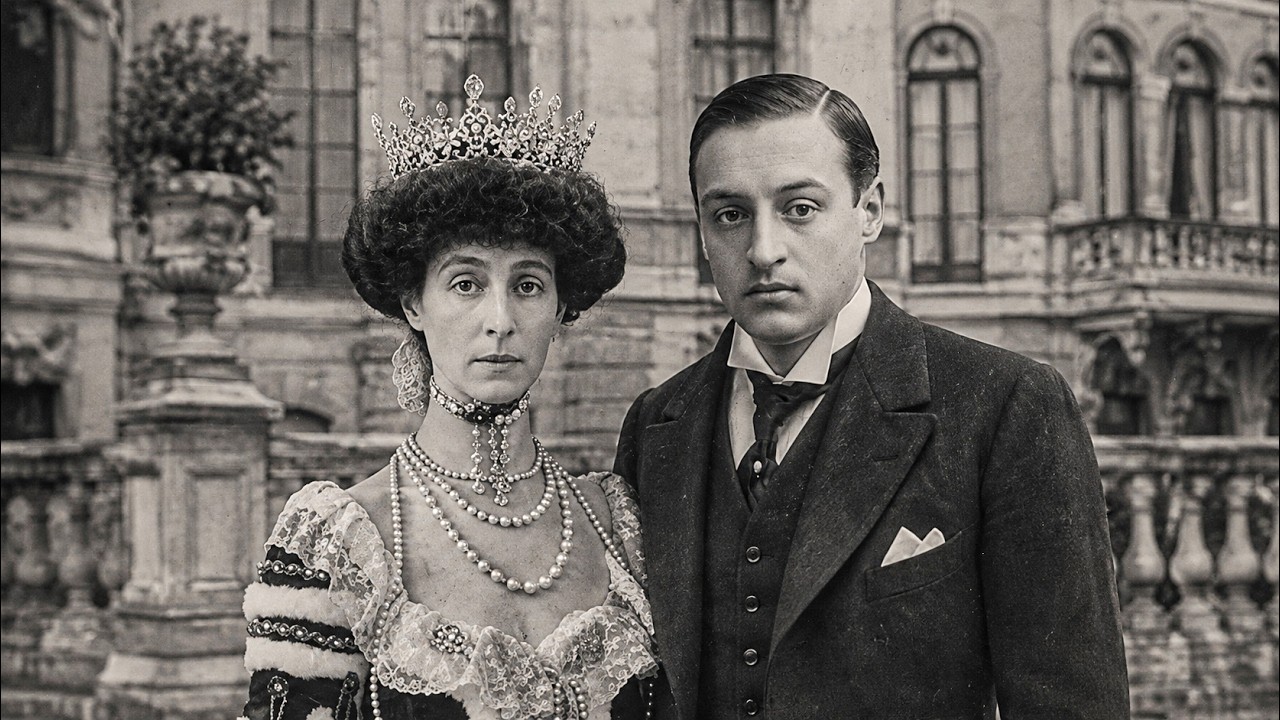
Almost no one outside that Fifth Avenue schoolroom knew what had actually manufactured it. Her name was Consuelo Vanderbilt, the richest heiress in America. She would grow up to become Duchess of Marlborough, mistress of Blenheim Palace. She had more money than almost any woman alive, and for years no real say in how she stood, who she loved, or who she married.
This is the story of the wedding that saved a palace, and the confession decades later that no one in that church expected to hear. Historians have spent a century arguing about one wedding. Not who attended it, not what it cost, but a simpler question. How does a woman with more money than almost anyone in America come to stand at an altar with no real choice in the matter at all?
In the autumn of 1895, Fifth Avenue filled with crowds who had come to see something that money does not usually buy. Inside St. Thomas Church, garlands of roses and orchids hung nearly a hundred feet from gallery to floor, paid for by a fortune built on American railroads. It was, in every sense the era understood the word, a spectacle.
The bride was a Vanderbilt. The groom would become the ninth Duke of Marlborough, master of Blenheim Palace, the one house in England grand enough to be called a palace without a crown behind it. By many accounts, parts of its roof no longer kept out the rain. A house grand enough to seat a king for dinner was, behind its correct facades, quietly falling apart for lack of money to repair it.
It was a trade that repeated itself across a whole generation. American fortunes flowing east in exchange for European titles flowing west. Newspapers on both sides of the Atlantic had a name for these young women. They called them dollar princesses.
By 1895, this particular trade was already well underway, in one New York household in particular. The bride’s mother had been born into a genteel southern family whose fortune had not survived the Civil War, and had spent every year since rebuilding a name for herself brick by brick, mansion by mansion, until she stood among the most talked about women in New York society. She was said to judge people the way she judged investments, and long before her only daughter was old enough to object, she had already decided exactly what that daughter’s marriage was going to be worth. The society pages called this the wedding of the century.
They photographed the flowers. They counted the guests. They wrote almost nothing about what the bride had actually spent that morning doing alone before anyone came to fetch her. And even less about who had made certain she would be there at all.
Twelve years before her daughter’s wedding day, Alva Vanderbilt had already shown exactly how far she would go to get what she wanted. In the spring of 1883, New York’s oldest families still would not receive the Vanderbilts. The Vanderbilt fortune was real, built by a grandfather everyone called the Commodore, who had turned steamships and railroads into a fortune worth more than $100 million by the time he died in January of 1877, just weeks before his great granddaughter Consuelo was born into what remained of it. Money alone, though, did not open every door.
And the doors that mattered most in New York society were controlled by one woman, Mrs. Caroline Astor, who kept an unofficial list of exactly four hundred names considered acceptable. The Vanderbilts were not among them. Alva decided to force the issue.
She commissioned a French-style chateau for the family’s new Fifth Avenue mansion, invited the city’s newspapers in beforehand to photograph the decorations, and announced a costume ball so extravagant that within days it was the only subject anyone in New York wanted to discuss. Twelve hundred invitations went out, though not at first to the Astors. Mrs. Astor’s own daughter had spent weeks rehearsing a dance for the ball, expecting an invitation as a matter of course, until it became clear that none was coming.
When the girl finally asked why, Alva had her answer ready. She could hardly invite a family that had never formally called on her own house. The following day, Mrs. Astor herself arrived at the Vanderbilt mansion and left her calling card.
An invitation was delivered within hours. On the night of the ball, Alva received her twelve hundred guests dressed as a Venetian princess, a string of pearls once said to have belonged to Catherine the Great looped at her waist. Police were called to hold back the crowds who gathered outside just to watch the carriages arrive. The party was estimated to have cost close to six million dollars in today’s money, for one night in one house, to prove one point.
By morning, the woman who had spent years trying to force her way into New York’s oldest families was, by every account, the most talked about hostess in the city. Even that triumph did not entirely satisfy her. At the same ball, Alva’s own sister-in-law arrived in a gown wired with battery-powered lights sewn into a lightning bolt pattern, carrying a small electric torch that made her glow like a walking beacon, an invention so novel it eclipsed even Alva’s Venetian princess costume in the next morning’s newspapers. Alva did not forget being upstaged in her own ballroom.
Within a few years, she had commissioned an even grander showpiece, a Newport summer cottage modeled on Marie Antoinette’s own retreat at Versailles. Marble House alone required fifty thousand cubic feet of marble shipped in from Italy. It was less a home than a stage set, built, like so much else in Alva’s life, to be looked at rather than lived in. The instincts that turned one calculated evening into total social victory did not stay confined to ballrooms and guest lists.
They came home with her. And they would, in time, be turned on someone considerably smaller and considerably less able to defend herself. On the second floor of that same Fifth Avenue mansion, two governesses conducted lessons behind a door that was almost never opened to anyone else. One governess spoke only German.
The other spoke only French. Their pupil was drilled daily in recitation, long passages of prose memorized and delivered aloud until every word landed exactly where it should. By the time she was eight years old, she could read comfortably in both languages. There was an hour set aside each day for exercise in Central Park.
There was a mother downstairs, or in Newport, or in Paris, depending on the season, who had built an entire second life out of the conviction that her daughter would be perfect, and who treated any evidence to the contrary as something to be corrected immediately. To fix her daughter’s posture, she ordered a steel rod made, one that ran the length of Consuelo’s spine, worn for hours during lessons. For smaller infractions, a wrong word, a slouched shoulder, a forgotten line of recitation, Alva was known to reach for a riding crop. And when Consuelo, old enough now to have opinions of her own, objected once to a dress her mother had chosen for her, Alva did not raise her voice.
She did not need to. “I do the thinking,” she told her daughter. “You do as you are told. ”
Consuelo, years later, would not let her mother off quite so easily.
In her memoir, she remembered a woman of real force and real intelligence, not a caricature. “Her dynamic energy and her quick mind, together with her varied interests, made her a delightful companion. But the bane of her life, and of those who shared it, was a violent temper that, like a tempest, at times engulfed us all. ”
A tempest is not something a child learns to argue with.
A child learns, instead, to read the sky. Biographers who have studied Consuelo’s early years describe a child already unusually skilled at self-correction, a girl in the habit of searching her own conscience for faults before anyone else had the chance to find them. She was, by the same accounts, unusually quiet for a child surrounded by so much noise and spectacle. The kind of child adults describe approvingly as no trouble at all, without ever asking what that quiet is costing her.
By the time she was a teenager, she had learned to watch herself. Contemporaries described a young woman who was slim, strikingly tall for the era, with a long swan-like neck and dark hair swept high above a face that painters found irresistible. John Singer Sargent and the French draftsman Paul Helleu would each make their own studies of that neck and that composure without ever showing what it had cost to acquire. The posture brace was long gone by then.
She no longer needed it. Her father, when he was present at all, was an easier, more distant figure, fond of yachts and racehorses, and increasingly of women who were not his wife. He rarely intervened in his daughter’s upbringing. It was, by the unspoken arrangement of the household, simply not his department.
By 1893, Alva had begun looking past Fifth Avenue and Newport entirely, toward a title she had set her sights on for her only daughter on the other side of the Atlantic. Consuelo, by then seventeen, had already met someone of her own. His name was not the name her mother had in mind. His name was Winthrop Rutherford, and by the standards of Consuelo’s own world, he was close to perfect.
He came from an old New York family, descended, it was said, from Peter Stuyvesant on one side, and from the first governor of colonial Massachusetts on the other. His own father had been a pioneering astronomer, one of the first men in America to photograph the stars in any detail. Rutherford himself was tall, easy in company, and widely considered the most handsome bachelor in New York. The novelist Edith Wharton, who knew him, later admitted he had been something of a model for the ideal, unattainable suitors in her own early fiction.
One society wit summed up the mismatch that followed in a single, cruel line. “Winty was outclassed. Six foot two in his golf stockings, he was no match for five foot six in a coronet. ” What Rutherford did not have was a title.
And by 1894, a title was the only currency Alva Vanderbilt still cared to collect. That same year, at a dinner party arranged by Minnie, Lady Paget, an American who had married into the British aristocracy and now made a comfortable living introducing wealthy heiresses to impoverished noblemen, Alva secured her daughter an introduction to Charles Spencer Churchill, the ninth Duke of Marlborough. It was not her only option that season. By then, Consuelo had already turned down five proposals of marriage during their travels together, including one from a minor German royal, Prince Francis Joseph of Battenberg.
The tour itself had been carefully engineered from the start, taking them through England, France, and Italy, country house to country house, ballroom to ballroom. An entire continent’s aristocracy paraded past a teenage girl like items on a very long menu, with almost no unsupervised time built into any of it. It worked exactly as designed, right up until Consuelo came home for the summer and got back on a bicycle. Consuelo did not tell her mother about Rutherford directly.
She did not have to. Alva found out the way Alva found out about everything in her daughter’s life, by asking the people paid to watch her. What followed was not an argument. It was closer to a siege.
On her eighteenth birthday, Rutherford sent her a single red rose, and not long after proposed to her in secret during a bicycle outing along Riverside Drive, drawing back from the rest of their party just long enough to ask the question and hear her say yes. Consuelo’s letters were intercepted after that. Rutherford tried writing under other names, through mutual friends, through anyone who might slip a note past the companion now permanently stationed at Consuelo’s side. Almost none of it got through.
When pleading failed to move her, Alva reached for something considerably less gentle. She told her daughter there was madness in the Rutherford family and that the man she loved would never be able to have children. Consuelo, for the first time in her life, refused to correct herself. “I considered I had a right to choose my own husband,” she wrote decades later in a memoir that chose its words with visible restraint everywhere except here.
“These words, the bravest I have ever uttered, brought down a frightful storm of protest. I suffered every searing reproach, heard every possible invective hurled at the man I loved. ”
From a woman who would go on to host kings, address public meetings, and outlive nearly everyone in this story, it says something that this ordinary sentence about an ordinary man was in her own accounting the bravest thing she ever said. Alva’s response left no doubt about how the storm would end.
According to several of Consuelo’s biographers, when pleading and forbidding failed to move her daughter, Alva threatened something considerably darker still: that if Consuelo did not give Rutherford up, she would see to it that the man was shot. Whether delivered as a genuine threat or as theater aimed at a frightened teenager, it worked exactly as intended. Rutherford was told in terms that left no room for negotiation that the engagement was finished before it had properly begun. Consuelo did not agree easily.
For a young woman raised to comply on command, this was, in its own small way, a rebellion. Weeks of refusal held against a mother who did not lose arguments. She was, by her own account, locked in her room during part of this standoff, watched even by the household staff, cut off from the one person who might have argued on her behalf. Not even her own governess, the woman who had drilled her in French and Latin since childhood, who had spent more waking hours with her than her own mother had, was permitted through the door.
Something changed after that. Not Consuelo’s feelings; those, by every account, stayed exactly where they had been. What changed was her mother’s method. Threats and confinement had bought time, not surrender.
Alva needed something Consuelo could not simply outlast. What Alva did next was simpler than a threat and far harder to argue with. She took to her bed. Doctors were summoned.
The household was told in grave tones that Mrs. Vanderbilt’s heart could no longer withstand the strain her daughter’s defiance had placed upon it. Consuelo was informed by her mother weakly from the pillows that her continued refusal to give up Rutherford was quite literally going to kill her. A physician was even said to have hinted delicately that Alva might not survive the week.
A girl raised her whole life to read a room for signs of her mother’s temper did not need to be told twice what this particular performance required of her. Consuelo gave in. She agreed to marry the man her mother had already chosen for her: Charles Spencer Churchill, the ninth Duke of Marlborough, whom Alva had met and decided upon on the strength of a single winter in his aunt’s company in India. Almost as soon as the engagement was secured, Alva’s illness lifted.
She made what one account calls an astonishing recovery. There would be no more mention of a failing heart. The wedding took place on the sixth of November 1895 at St. Thomas Church on Fifth Avenue.
The bride wore cream satin with a five-foot train. Her bridesmaids stood at the altar in ivory satin and powder blue ostrich feathers, pearls at their throats, waiting for a bride who did not come. Four hundred guests were inside. Thousands more stood outside in the cold hoping for a glimpse of the bride the newspapers had already crowned the season’s undisputed prize.
Not a single member of the groom’s own family had crossed the Atlantic to attend. There was a reason the guest list looked the way it did beyond geography. Alva herself was in the middle of divorcing Consuelo’s father that same year on grounds of adultery, one of the first true society divorces of the age, and a scandal nearly as large as the wedding it now overshadowed. She had already taken a lover, a family friend named Oliver Belmont, and would marry him within ten weeks of watching her own daughter walk down the aisle.
William Vanderbilt was permitted to escort his daughter to the altar that morning. He was not permitted, by his soon-to-be ex-wife’s order, to stay for anything after. The woman arranging her daughter’s wedding to save one household’s fortune was, at the very same moment, dismantling her own. On the third floor of the house, a young woman sat alone, her face already swollen from hours of crying, while a footman stood posted outside her door under orders that no one, not a friend, not a maid, not even the governess who had raised her since childhood, was to be let inside.
“I spent the morning of my wedding day in tears and alone,” she wrote years afterward, in the one section of her memoir where the composure briefly cracks. “No one came near me. A footman had been posted at the door of my apartment, and not even my governess was admitted. ”
When the hour finally came, she remembered walking downstairs to meet her father and her waiting bridesmaids, feeling, in her own words, cold and numb.
The ceremony was delayed by twenty minutes. When Consuelo finally appeared at the altar, her face was still swollen enough that the veil was, for once, doing real work rather than ceremonial work. In her own later account of the wedding gifts, Consuelo cataloged the jewels she wore that day as plainly as if she were reading from an inventory. Pearls that had once belonged to Catherine the Great and to the Empress Eugenie, a diamond tiara from her father, a diamond belt from the groom himself.
One necklace, a nineteen-row pearl choker, would later be cut down to fifteen rows because, as one account delicately put it, it chafed the Duchess’s slender neck. Even her jewelry, it seemed, had to be adjusted to fit the constraints of the role. As part of the marriage settlement, the Duke received two and a half million dollars in railroad stock, a fortune large enough, even then, to be reported in newspapers on both sides of the Atlantic, and large enough, more quietly, to repair a roof that had been letting in English rain for years. Blenheim Palace would survive.
The woman who had paid for its survival had not been asked whether she wanted to. She would have almost twenty years to consider the arithmetic of that trade. It began on the honeymoon itself, when her new husband, with the same plainness Alva had once used on her, told his eighteen-year-old bride exactly why he had married her. It was not, he made clear, a matter that required much romantic explanation at all.
She would later write that the Duke did not wait long to explain himself. There was money involved, he told her plainly, within their first weeks together. Her money. And a house that needed it badly.
He also made it clear, in the same conversation, that he had no particular fondness for America and did not intend to spend more time there than duty required. There was, in fact, someone else in Consuelo’s life by then who had felt entirely differently about her, and for far longer. A year before her wedding, at a coming-out ball in Paris, a twenty-six-year-old French cavalry officer named Jacques Balsan had seen the seventeen-year-old Consuelo across a crowded room and, by every account, simply never stopped loving her. He said nothing to her at the time.
She was already spoken for in every way that mattered. It would be twenty-six more years before either of them acted on it. Blenheim Palace, in the meantime, did not soften the arithmetic of the marriage she had actually made. It was, by any measure, one of the great houses of England, three hundred rooms, its own church, staff numbering in the dozens.
It was also, Consuelo discovered quickly, a machine with rules she had not been given a manual for. She once asked a butler to light a fire herself and was informed, coldly, that this was a footman’s task, not hers to perform, and certainly not his. She was considered dangerously modern for sorting the leftover meat, vegetables, and pudding into separate tins for the poor, rather than piling them together, as tradition required. Nineteen years old, mistress of a great English house, and corrected again for getting a small thing wrong.
Before any formal dinner, Consuelo was expected to know, without hesitation, the exact rank of every guest at the table, so that precedence could be observed down to the seating chart. A misplaced place card was not a small mistake at Blenheim. It was closer to a diplomatic incident. Her own calendar followed a rhythm mapped out years in advance and rarely by her.
The London season each spring, Blenheim through the summer, and the autumn shooting parties, a retreat to warmer climates each winter. It was the geography of duchesshood, fixed well ahead of time, with almost no room left in it for anything spontaneous. Two sons were born in those early years, John and Ivor. An heir and a spare, Consuelo is said to have called them later, with a dryness that suggests she understood exactly what her body had been required to deliver.
And whatever else the marriage lacked, it did not lack the appearance of success. The Marlboroughs were painted formally by Sargent. Consuelo hosted, over the years that followed, a guest list few American women of her generation ever matched: Queen Victoria, Edward VII and Queen Alexandra, the Tsar of Russia, and often informally as family rather than guest, a young cousin of her husband’s named Winston Churchill. None of it warmed the house itself.
From her bedroom window at Blenheim, Consuelo could see a pond where, she later learned, a former butler had drowned himself. “As one gloomy day succeeded another,” she wrote, without asking her reader for sympathy, “I began to feel a deep sympathy for him. ” It is one of the driest sentences in her entire memoir, and one of the saddest. A woman who had dined with an empress that same season, confessing that the closest thing she had to a kindred spirit at Blenheim was a dead man she had never met.
She did not stay silent about it forever. Within a few years, encouraged in part by Churchill himself, Consuelo delivered her first public address, an unusual step for a Duchess of her era, and went on to build a second, entirely different life out of the one Alva had assembled for her. Her circle by then included some of the era’s sharpest minds. H.
G. Wells, J. M. Barrie, and George Bernard Shaw were all regular guests at the literary gatherings she began to host.
Men who had far more interest in what she actually thought than her husband ever had. She raised money for the Young Women’s Christian Association. She helped fund a refuge for women and children called Sunderland House. She campaigned, quietly but persistently, against the trafficking of women into brothels abroad, and for a minimum wage for the female factory workers whose lives looked nothing like her own.
By 1906, eleven years into the marriage, even the appearance of success had worn through. “We had been married eleven years,” she wrote afterward, with the same restraint she brought to everything painful. “Life together had not brought us closer. Time had but accentuated our differences.
The nervous tension that tends to grow between people of different temperament condemned to live together had reached its highest pitch. ”
She left Blenheim that year. The Duke did not stop her. Jacques Balsan, by then, had spent most of two decades quietly at the edge of her life.
The same social circles, the same country house weekends, a man who by every account never married and never entirely stopped watching for her. It would take fifteen more years and the slow rekindling of that old feeling on both sides before an English court finally made the separation official. The divorce was granted in 1921. Consuelo married Balsan that same year in July in a registry office in London.
No crowds, no garlands, no footman posted at any door. It was not, however, finished. English law had settled what it could settle. Rome had not yet been asked.
And in the autumn of 1926, a summons arrived concerning that long dissolved marriage, addressed this time not to Consuelo at all, but to her mother. The Duke in the years since the divorce had converted to the Roman Catholic Church. Rome does not recognize a civil decree the way an English court does. If his current marriage was to mean anything within the faith he had adopted, an ecclesiastical tribunal would first have to rule on a question no civil judge had ever been asked: whether his marriage to Consuelo had been a real marriage at all, or whether something the church required from the very first vow, freely given consent, had been missing from the start.
To answer that question, the tribunal needed a witness who had actually been in the room on Fifth Avenue in 1895. It did not summon Consuelo. It summoned her mother. By 1926, Alva Vanderbilt Belmont was in her seventies, widowed twice over, and a long way, on paper at least, from the woman who had once locked a door and threatened a man’s life.
In the years between, she had thrown herself into the militant wing of the American suffrage movement with the same absolute conviction she had once reserved for her daughter’s wedding. In London in 1909, she watched a group of suffragettes, freshly released from prison, receive medals for their imprisonment, and wrote afterward that she had never felt such electric fervor in her life. She called herself simply exalted. She brought the militant British suffragette Christabel Pankhurst to America for a speaking tour, funded a conference of great women at the same Newport cottage she had once built at the height of her campaign against Mrs.
Astor, co-founded the National Women’s Party, and paid, largely out of her own pocket, for its Washington headquarters. She had spent two decades, in other words, arguing publicly and loudly that women deserved a say in their own lives, the one thing she had refused to let her own daughter have. The tribunal did not require her to reconcile that record with what she had once done to her own daughter. A simple yes or no would have satisfied the church’s paperwork.
Canon law required more than an accusation in any case. An annulment on these grounds meant proving to the church’s satisfaction that consent itself had never truly been given, and the only person who could offer proof beyond a daughter’s word was the very woman accused of forcing it. Tribunals in cases like this rarely got what they needed. Mothers denied, fathers stayed silent.
Alva did neither. It would have been easier and far less exposing to simply say yes and stop there. Instead, in a room with no journalists and no family present to soften what she said, the most socially ambitious woman of her generation chose to describe, in her own words, exactly what social ambition had made her willing to do to her own child. Before the tribunal, under her own name, in testimony intended for a church court rather than a newspaper, Alva Vanderbilt Belmont stated for the record that she had compelled her daughter’s marriage from beginning to end.
“I forced my daughter to marry the Duke,” she said. “I have always had absolute power over my daughter. When I issued an order, nobody discussed it. I therefore did not beg.
I ordered her to marry the Duke. ”
She did not frame it as a mother doing what she believed was best. She did not ask to be understood. She used the word forced.
She used the word ordered. She stated, as a plain fact for the record, exactly how much choice her daughter had never been given. Thirty-one years earlier, that same woman had locked a door, threatened to have a man shot, and staged her own collapse rather than let her daughter marry for love. Now, an ocean and three decades removed from that Fifth Avenue bedroom, she stood before a tribunal that had not even required her to explain herself, and explained herself anyway, in a small room in Rome where nobody outside the church’s own records would hear it for years.
Rome ruled on the nineteenth of August, 1926. Consuelo’s consent at the altar in 1895, the tribunal found, had never been freely given. Precisely as her own mother had just testified under her own name in her own words. A marriage that had lasted on paper for a quarter of a century was declared retroactively never to have existed at all.
The annulment carried no threat to her son’s place in the family or the succession. Under English law, the boys remained exactly who they had always been, heirs in the line that ran through them, regardless of what a tribunal in Rome had to say about their parents’ vows. Under the eyes of the Roman Catholic Church alone, on paper in a country neither of them had married in, the marriage that produced them was now considered never to have happened at all. No letter survives, and no page of Consuelo’s memoir explains what it cost either woman to arrive at that ruling.
Consuelo, characteristically, wrote almost nothing about the annulment itself. A silence that says as much as any sentence might have. What survives is only the fact of it. A mother who had spent a lifetime deciding what was best for her only daughter, choosing, once, near the very end of the matter, to tell the truth about it instead of managing it.
The testimony itself surfaced publicly only decades later, pieced together by biographers combing through church records long after both women were gone, which means neither Alva nor Consuelo ever had to sit in a room together and watch the other one read it. Alva did not live to see her daughter grow old. She spent her final years as one of the country’s most recognizable suffrage advocates, remembered for one piece of advice she liked to give. Pray to God, she would say, because God, in her telling, was a woman, and she would help you.
She died in 1933, seven years after that testimony, having said in a Roman courtroom the one sentence her daughter had never once heard from her on that Fifth Avenue morning in 1895. She had been wrong. Six years after a tribunal in Rome closed the file on her first marriage, Consuelo and Jacques Balsan built a house on the Florida coast just south of Palm Beach, twenty-six thousand square feet of it, designed by the society architect Maurice Fatio, standing where the Atlantic could be heard from nearly every room. She named it Casa Alva.
She never explained, in the memoir or anywhere else, why she chose to put her mother’s name over the door of a house she herself had finally built by choice. Perhaps it was forgiveness. Perhaps it was simply the only name that had ever meant home to her, however badly home had once treated her. Either way, it was Consuelo, not Alva, not the Duke, not any tribunal, who decided this time whose name would hang there.
They did not get to enjoy the house undisturbed for long. In the summer of 1940, with Paris fallen to Nazi Germany, Consuelo and Jacques joined the flood of refugees fleeing south through France, crossed into Spain, and secured passage on a transatlantic flight to America, arriving in the end at the very house on the Florida coast she had built eight years earlier and named for her mother. It was not the first time in her life she had been forced to leave one country for another on someone else’s timetable. It was, this time, the first time she had somewhere of her own waiting on the other side.
It was in that house, family accounts say, that an old friend once sat working on the words of a speech that would help define the next fifty years of the world. Winston Churchill, on his way to deliver an address in Fulton, Missouri, in the spring of 1946, is remembered by the family as having spent time at Casa Alva polishing what would become known as the Iron Curtain speech, a piece of history, if the story is accurate, drafted in a house named for the woman who once had her own daughter watched at every door. In 1953, at seventy-six, Consuelo published the memoir this story has drawn from throughout, The Glitter and the Gold. She had a name, too, for the difference between her two marriages, and it is the reason the book carries the title it does.
The years with the Duke, she suggested, had been all glitter, dazzling, borrowed, cold to the touch. The years with Balsan, by contrast, she called something else entirely: gold. A reviewer at the New York Times called the finished book at the time an ideal epitaph of the age of elegance. It is, in truth, a careful, guarded volume, one that says a great deal by choosing, again and again, to say very little.
But near its close, she allowed herself one line that reads less like memoir and more like verdict. “It is a melancholy fact,” she wrote, “that childhood, so short when compared with the average span of life, should exert such a strong and permanent influence on character, that no amount of self-training afterwards can ever completely counter it. ”
She never named the steel rod, or the riding crop, or the footman at the door in that sentence. She did not have to.
Jacques Balsan died in 1956, after thirty-five years of a marriage nobody had arranged for her. Consuelo lived eight years beyond him, dividing her time between New York and Long Island, still, by every account, a familiar and welcome figure in rooms she now entered on her own terms. She died on the sixth of December, 1964, at Southampton, eighty-seven years old. She had asked, in her will, to be buried not beside Balsan, and not in America at all, but in the small churchyard of St.
Martin’s in the village of Bladon, Oxfordshire, within sight of the grounds of Blenheim Palace, next to her younger son, Ivor, who had died eight years earlier. It was the one piece of England she chose to keep. Nothing in English law or church law required it of her by then. The marriage was long annulled, the title long relinquished in every way that mattered to her personally.
She could have rested anywhere. She chose the churchyard nearest the house that had once made her miserable because her son was already waiting there, and because some ties, it turns out, survive even the ones the Vatican is willing to dissolve on paper. There is a door at Casa Alva still in the house that stands there today under a different name.
Nobody has to ask permission to open it anymore.






