In late July 1914, the financial center of the world froze solid. The discount markets in London, where banks traded commercial paper, simply stopped functioning. Banks that needed cash could not obtain it at any price. The seizure was global.
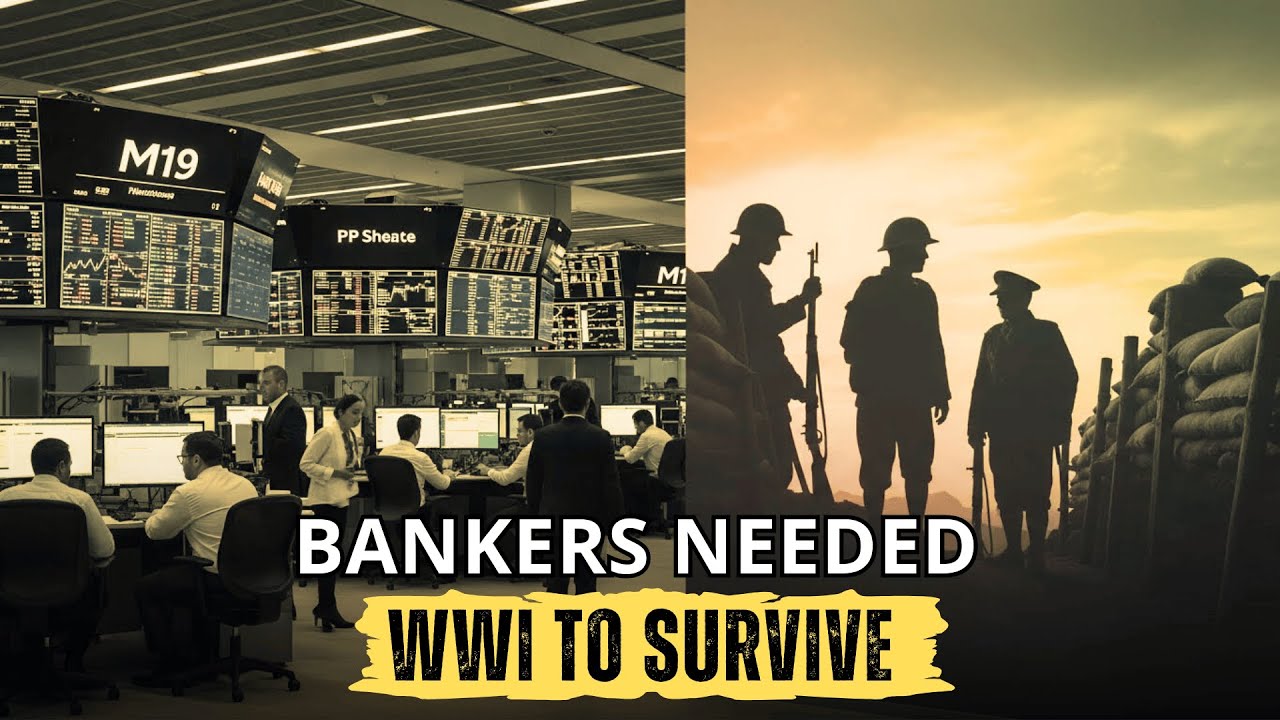
Some fifty countries faced simultaneous financial crisis before a single shot had been fired in anger. On July 30th, the London Stock Exchange closed its doors indefinitely. By August 1st, virtually every major stock exchange in the world had followed suit. The war did not break the financial system.
It saved it. The conventional story of the outbreak of World War I begins with the assassination of Archduke Franz Ferdinand in Sarajevo on June 28th, 1914. Austria retaliated against Serbia. Germany pledged unconditional support.
Russia mobilized to protect its Slavic brethren. The great powers chose sides. But this narrative is profoundly incomplete. Sovereign nations do not commit their entire young male populations to industrial slaughter because one royal figure was killed.
The true conflict was a subterranean struggle decades in the making, driven by the movement of capital, the power of private banks, the rigid constraints of the gold standard, and secret financial agreements that ultimately cost millions of lives. The structural flaws were visible by the 1870s. Britain, though ruling a quarter of the world’s surface and the richest nation on earth, was financially overextended, bleeding funds faster than colonial revenues could replenish them. Germany, unified in 1871 after defeating France, was a dynamic industrial behemoth but a latecomer to the imperial feast.
The most resource-rich colonies were already claimed. Forced to rely on imports for the raw materials crucial to its skyrocketing industrial production, Germany felt financially vulnerable and surrounded. France nursed an expensive resentment over the 1871 defeat, which cost it Alsace-Lorraine and a crippling indemnity of five billion francs, a fortune equivalent to hundreds of billions today. The financial humiliation cemented a forty-year strategy of revenge.
Russia was an empire in financial disintegration, borrowing prodigiously from Paris. By the turn of the century, its debt to France was measured in billions of francs, gifting France critical leverage over Russian foreign policy. Austria-Hungary, a sprawling multi-ethnic empire held together by increasingly expensive coercion, spent gargantuan sums on military occupation and internal policing simply to prevent the entity from fracturing, steadily driving itself toward fiscal bankruptcy. The debt was overwhelmingly held not by state treasuries but by private financial consortiums.
The world’s largest banks were clustered in London, Paris, Berlin, Vienna, Amsterdam, and New York. These institutions were the true sovereigns, lending capital to governments who repaid them with handsome interest collected from public taxation. The apex of European finance was the Rothschild family, whose operations spanned London, Paris, Vienna, Frankfurt, and Naples. They financed wars, often lending to both sides, and underwrote the massive infrastructure projects that defined the industrial age.
In Germany, the Warburg family wielded enormous influence. Across the Atlantic, JP Morgan functioned as the de facto central bank of the United States prior to the Federal Reserve’s establishment. These banks were not merely passive lenders. When a state owed you billions, you possessed a veto over its strategic decisions.
No finance meant no war. The system was a ticking time bomb. Private correspondence confirms that the smartest money in Europe was running scared long before Sarajevo. The Rothschild family was quietly reducing exposure to the riskiest loans and increasing gold holdings as early as 1913.
Wealthy clients received private advice to convert deposits into gold, resulting in net gold outflows from Britain of approximately thirty million pounds during that year. Banks who owned or influenced major newspapers suppressed the bad news, reporting withdrawals as slight liquidity pressure adequately managed by prudent reserves. The public was misled, but the insiders were ready. Throughout this period, nearly every major nation operated under the gold standard.
National currency was fully backed by a physical reserve of gold. The system was designed to enforce fiscal discipline, but it created a massive bottleneck. As industrial economies expanded, they required ever-increasing supplies of currency, yet they could not print new money unless they simultaneously acquired new gold reserves. By the 1890s, the entire European banking system was operating at catastrophic reserve ratios.
The Bank of England ran at just fifteen percent by 1900. German banks were even more aggressive, often operating at below ten percent. The system hinged entirely on belief. Compounding the risk was rampant accounting fraud.
European banks collectively held billions in African colonial debt that was effectively worthless by 1910, yet valued it at full face value and paid dividends based on phantom profits. This dynamic ignited a fierce international competition to hoard gold. London, possessing the largest reserves, stood as the world’s financial meridian. The pound sterling served as the primary reserve currency.
Britain could expand its money supply based on its existing wealth, while Germany’s growth was perpetually capped by London’s grip on the metal. Germany coveted this power and sought to elevate the mark to reserve currency status. French banks had poured capital into Russia, cementing the Franco-Russian military alliance. Russia’s borrowing was so vast that by 1914 any Russian default would have guaranteed the collapse of the French banking system.
France was structurally compelled to continue lending to Russia purely to prevent its own domestic financial ruin. A similar dynamic locked Germany to Austria-Hungary, binding the world’s destinies through debt, not just diplomacy. The arms race that followed was at its core an economic competition disguised as a military one. Britain’s Royal Navy was the foundation of its global power, and maintaining naval supremacy meant accepting perpetual astronomical costs.
Germany’s Kaiser Wilhelm II directly challenged this supremacy, passing the Navy Law in 1898. Britain retaliated with a shipbuilding spree that in 1906 produced the HMS Dreadnought, a revolutionary vessel that rendered every existing battleship on earth instantly obsolete. Germany immediately responded with its own dreadnought program, initiating a ruinous spiral of competitive spending. The land arms race followed the same logic.
Armies grew larger, conscription expanded, and artillery became exponentially more complex and expensive. Russia rushed to build railroads with French capital to accelerate mobilization, while Germany constructed lines right up to the French and Belgian borders. Governments financed this buildup through bonds, and when civilian investment was insufficient, they turned to the banks. Banks bought colossal quantities of government bonds, effectively financing the arms race while making immense profit on the interest.
Commercial interests formed a powerful lobby for conflict. Krupp in Germany saw its profits explode alongside the naval buildup. In Britain, Vickers and Armstrong Whitworth actively funded politicians who supported naval expansion. French companies like Schneider-Creusot, with close government ties and investments in Russian industry, pushed for French support of Russia.
A revolving door developed between military industry and government, tying the financial fate of the elite irrevocably to military escalation. By the early 1900s, some powerful financial and industrial groups were actively hoping for a war, expecting a quick localized conflict similar to the Franco-Prussian War of 1870. A swift conflict would allow countries to test new weapons, redefine the balance of power, and provide vast immediate profit. This was a naive, destructive delusion, but it permeated the thinking of powerful figures who saw war as a necessary reset button for Europe’s complex financial problems.
The primary engine was financial. The system was trapped in a self-destructive loop of debt, competitive military spending, and resource hunger. The explosion was only a matter of timing. A key turning point was the global financial panic of 1907, which originated in the United States.
JP Morgan personally intervened to organize a massive bailout, preventing total systemic collapse. The panic exposed the extreme fragility of the intertwined global financial structure, triggered a global recession, and intensified the desperate competition for resources. In the Balkans, the collapsing Ottoman Empire was the subject of intense maneuvering. Austria-Hungary viewed Serbia’s emergence from the Balkan Wars of 1912 and 1913 stronger and more confident as an existential threat, and military leaders began drafting plans for a preemptive strike.
Germany issued its infamous blank check of unqualified support, not out of affection but because it could not afford to lose Austria-Hungary. German planners believed war with the Franco-Russian alliance was guaranteed and calculated that fighting now was strategically and financially superior to fighting later. The Bank of England’s reserve ratio had fallen to a dangerously low level of twenty-six percent by July 23rd, 1914, forcing the bank to choose between abandoning the gold standard or allowing banks to fail. Interbank lending rates in London spiked from a normal three percent to eight percent, signaling that trust had completely broken down.
It was into this primed, debt-laden, militarily overheated environment that Archduke Franz Ferdinand was shot. The assassination was merely the ignition spark. The ammunition had been loaded by decades of financial competition, the arms race, crippling debt, and interlocking alliances cemented by economic necessity. Austria-Hungary issued an ultimatum to Serbia designed for rejection, and declared war on July 28th, 1914.
Russia mobilized to defend Serbia. Germany declared war on Russia. France was obligated to support Russia. Germany declared war on France and invaded Belgium to bypass French defenses.
Britain was bound by treaty to defend Belgium. Within a single week, all the major European powers were consumed by conflict. The gold standard, the ultimate promise of stability, was broken overnight to fund the machinery of death. On August 5th, 1914, Parliament passed the Currency and Banknotes Act, allowing the Treasury to issue new notes backed not by gold but by government credit, effectively killing the gold standard in a single day.
Debt moratoria were declared across the continent, freezing all payment obligations and papering over loans about to default as performing assets. The conflict lasted four years and consumed more capital than any event in history up to that time, costing well over two hundred billion dollars in 1914 funds, a staggering figure equivalent to trillions today. Governments appealed first to their populations via war bonds, then turned to the major banks. Britain borrowed heavily from the Bank of England.
Russia, already drowning, borrowed still more from France. Crucially, the conflict ushered in the financial ascendance of the United States. Initially neutral, American banks began lending enormous sums to the Allies. By 1917, American capital had poured billions into the Allied effort, creating a massive vested interest in an Allied victory.
Germany and Austria-Hungary, cut off from international credit, were forced to rely almost exclusively on their own banks and citizens, placing them at a severe financial disadvantage that worsened as the grinding war continued. The bankers orchestrated the largest balance sheet laundering operation in modern history, exchanging their risky private loans for newly issued government war bonds. Deutsche Bank’s failing Ottoman railway loans, effectively defaulted before the war, were swapped for German war bonds. British banks converted approximately three hundred million pounds in toxic South American debt into British government obligations.
This mechanism transferred private failures to public ledgers, making the banks’ mistakes everyone’s problem. The war machine ground to a halt in November 1918 with Germany’s surrender. The great autocratic empires had collapsed into ruin. Only Britain and France remained victorious but financially crippled.
The 1919 Treaty of Versailles was less a treaty of peace and more a punitive indictment. Germany was forced to accept the infamous war guilt clause and committed to paying an astronomical 132 billion gold marks in reparations. The desperate response from Berlin was to print money, and by 1923 the Weimar Republic descended into hyperinflationary madness. The Reichsmark became utterly worthless.
People required wheelbarrows full of notes to purchase a loaf of bread. Savings evaporated overnight, decimating the German middle class and providing fertile ground for political extremism that set the stage for the next global conflict. The financial tensions that ignited World War I were precisely those that guaranteed the outbreak of World War II. The interconnected cycle of debt, mandated reparations, economic dislocation, and national bitterness.
In 1925, the Bank of England forced Britain to return to the gold standard at the pre-war parity of $4. 86 per pound, a policy championed by then Chancellor Winston Churchill. It required deflation and high interest rates, protecting the real value of debts owed to banks while producing persistent mass unemployment throughout the 1920s. Churchill later admitted this was one of the greatest mistakes of his career, but he had little choice.
The banking community demanded it. The war also marked a pivotal shift in global finance. Before 1914, European banks backed by the perceived stability of the gold standard ruled the world economy. After the armistice, the financial center of gravity shifted decisively across the Atlantic.
The United States ascended as the undisputed global financial titan, and the axis of financial power moved from the City of London to Wall Street. The Federal Reserve Act had been rushed through Congress on December 23rd, 1913 and became operational in November 1914, perfectly positioned for the European crisis. The war fundamentally altered the relationship between the state and the economy, demonstrating that governments could borrow and spend on a scale previously unimaginable. The notion of laissez-faire began to recede, a shift accelerated later by the Great Depression.
The most bitter injustice lay in who bore the final cost. Those who profited, the bankers who structured the massive war bonds, the industrialists who reaped fortunes selling artillery shells and battleships, the political leaders who retired comfortably, mostly escaped accountability. The real victims were the ordinary citizens. The millions of soldiers whose lives ended in muddy despair.
The families permanently broken by loss. The working classes whose generational savings were devoured by inflation. In Britain, the banking system shrank dramatically from thirty-eight major institutions in 1913 to just five dominant banks by 1920. Across the Atlantic, JP Morgan saw its assets grow from roughly $550 million in 1913 to $1.
22 billion by 1919. The institutions that should have failed emerged as untouchable monopolies. The concept of too big to fail was firmly established. The common soldier believed he was dying for king, country, and civilization.
He was in brutal reality dying for collateral, profit margins, and the enforcement of foreign debt collection. The enduring legacy of World War I is that while it dissolved the old world of dynastic empires and inaugurated the modern era of integrated global finance, the core dynamic remains disturbingly constant. War is immensely profitable for a select powerful few, and those individuals wield the influence to orchestrate conflict. The cycle of debt, competitive military spending, and resource hunger that drove 1914 is still running.
The players have new uniforms, but the game is unchanged. The young men who died in 1914 were blinded by propaganda because they lacked the data and the distance to understand the dark deals struck between financiers and politicians. We lack that excuse. The information detailing these financial mechanisms is available.
The historical patterns are starkly clear. The financiers who steered Europe towards the abyss were not cartoonish villains. They were often respectable, self-justifying individuals, patriots aiming for their nation’s success, astute businessmen maximizing returns. They arrived at mass murder not through a single evil decree, but through an aggregation of seemingly small, manageable decisions.
War sneaks up on the world through a thousand minor transactions. Each decision seems small and rational in isolation, but they accumulate, creating momentum. Eventually, the system generates a force that becomes unstoppable.






