In the summer of 1907, the crowds were out on the pier when the fire began moving through the hotel row on shore. It took down six of the town’s major hotels and roughly seventy cottages, and then it reached the steel and planking of the pier itself, consuming the first hundred feet of decking. Two people were killed that night. Five more were injured.
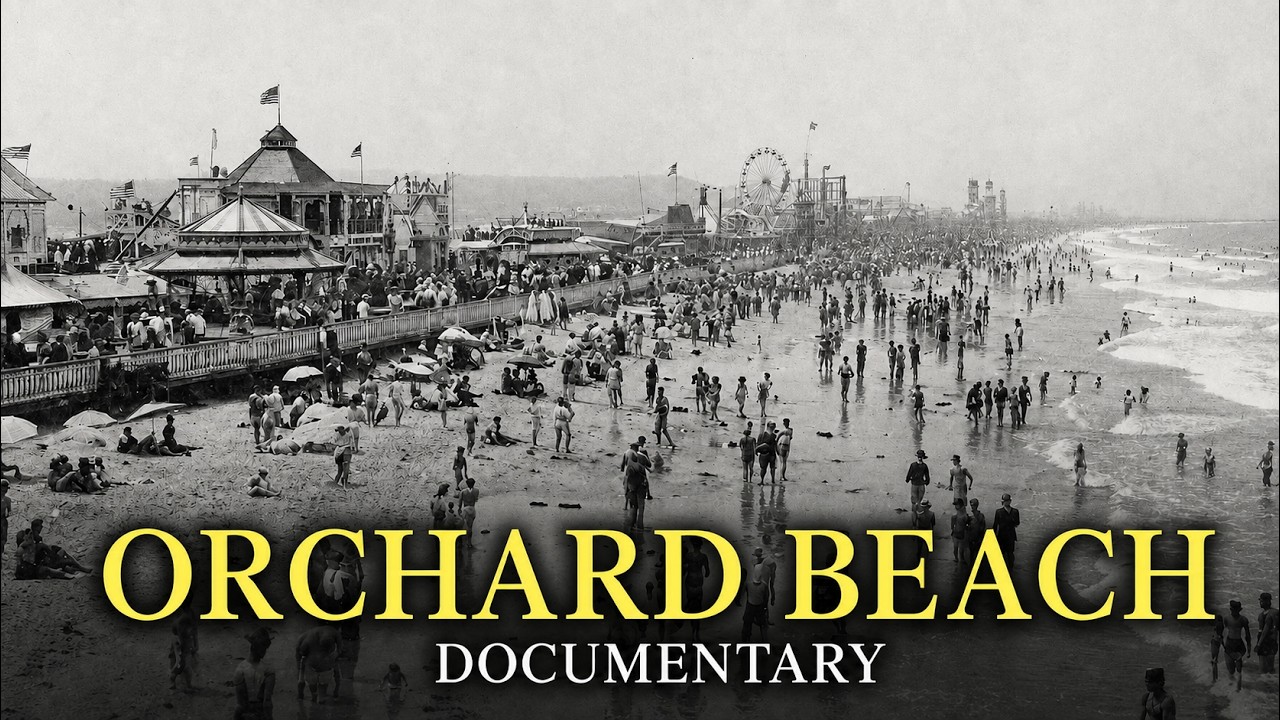
And with the flames closing the only route back to land, the people trapped at the far end of the pier tore up its own boards with their hands, opened a gap the fire could not cross, and laid the same planks down again to bridge themselves toward what still stood. They passed each heavy board hand to hand over open water, working the length of the structure one torn piece at a time, until the crowd reached the section of decking that fire had not yet claimed. The pier had been built only nine years earlier, and it had already given ground to the ocean once. Now it had given ground to fire.
The town would rebuild it, just as it had rebuilt it before, and just as it would rebuild it again. The pier that stands at Old Orchard Beach today runs five hundred feet, a little more than a quarter of its original length, and the story of how it shrank tracks almost exactly everything else the town has lost along the way. In 1636, an English settler named Thomas Rogers walked up from the tide line of a beach whose name did not yet exist and planted an orchard on the hill above it. Apple trees, pear trees, laid out in the deliberate rows of a man who intended to stay.
He called his homestead the garden by the sea. The English name for the settlement that grew around it would come directly from those trees. Not from a founder’s surname, not from a colonial patron in London, but from an orchard that was already old by the time anyone thought to write the town’s history down. The beach itself required no planting.
Seven miles of it ran unbroken along the coast, sand packed so hard and so flat by tide and current that a person could walk its full length at low water without sinking past the ankle. New England’s coastline was mostly rock, granite headlands and cobble shores that punished anything larger than a rowboat. Old Orchard Beach was an anomaly, a stretch of geology in a region built out of stone. And for two hundred years after Rogers planted his trees, almost nobody thought to ask what seven flat, hard miles of sand might eventually be good for.
What it was good for first was visitors. In 1837, the Old Orchard House opened on the bluff above the beach, the first hotel built specifically to face the ocean rather than the road behind it. Around 1840, Ebenezer Staples of the farming family that had worked the land nearby for a generation began taking in summer boarders at his farmhouse, charging city families for a room and a view that had cost his family nothing to build. It was not yet an industry.
It was a Maine farmer noticing that strangers would pay to sleep near water. The railroad made it one. Maine’s first line opened in 1842, and by 1853, the Grand Trunk Railroad had laid track connecting through to Montreal. A single continuous run from the beach to a foreign country’s largest city.
The first Quebec families began making that trip within the decade, boarding a train in a language the beach had never heard spoken and stepping off it onto Ebenezer Staples’s sand. They brought a devotion to Old Orchard that no marketing campaign built and no later owner would ever fully explain. They brought it back every summer. They brought their children and their children’s children, in a relationship between one small Maine beach and the province of Quebec that would still be intact 170 years later.
Then in 1873, the Boston and Maine Railroad opened its own direct line, with its own passenger station standing almost on the sand. Boston was closer, richer in the short term, and hungrier for a coastal escape than any French Canadian city had reason to be. The hotels came almost immediately after the station did, not one at a time the way the Old Orchard House had come in 1837, but in a wave, block after block of new lodging rising along streets that had been farmland five years before. By February of 1883, Old Orchard had outgrown its arrangement with the town of Saco, the municipality that had governed the beach and the farms around it since the colonial period.
On February 20th of that year, it incorporated on its own. A beach, a name borrowed from a two-hundred-year-old apple orchard, and a train station, now officially its own town. It had hotels. It had two railroads and two countries sending passengers every summer.
What it did not have was anything built specifically to hold the crowds those trains could now deliver. Nothing engineered, nothing permanent, nothing built to a scale that matched the ambition the town had started to develop about itself. That would take fifteen more years. And in the spring of 1898, a bridge-building company from Connecticut arrived at Old Orchard Beach with a plan to build something the town had never attempted.
The Berlin Iron Bridge Company built bridges, trusses of riveted steel meant to carry railroads over rivers, not tourists over surf. What it proposed for Old Orchard Beach was neither. A pier driven straight out into the Atlantic from the sand. Construction began on May 17th, 1898.
By July 2nd, six weeks later, it was finished. Steel decking reaching far out past the low tide line, advertised without much room for argument as the longest steel pier in the world. It had cost $38,000. Nothing at Old Orchard Beach had ever been built to that scale or that speed.
To walk its length was to leave the town behind by degrees, the shoreline itself shrinking to a low gray line on the sand and then to nothing, while underfoot the riveted trusses carried the sound of surf breaking beneath instead of beside. The storm came almost immediately. Weather took a hundred and fifty feet off the far end within weeks of completion, a fact the town absorbed and moved past rather than mourned. It would not be the last time the ocean, and later fire, would take pieces of the pier back.
For now the structure held, shortened but intact, still longer than anything comparable on the eastern seaboard. At its ocean end stood a casino, not a gambling hall but an entertainment pavilion built for concerts, for dancing, and for a new attraction called moving pictures, which by 1898 had only just begun appearing in venues built specifically to show them. Crowds who had come by rail from Boston and from Montreal now had somewhere to walk to after dark, out over the water, with a band playing and a screen flickering at the far end of thirteen hundred remaining feet of steel. An evening there kept its own order.
First the concert, the band’s sound carrying out over open water with nothing on shore loud enough to compete with it. Then the floor cleared for dancing, couples turning while the surf worked steadily at the pilings below. And later, for those who stayed longest, the moving pictures, a screen going pale at the pier’s far end while the ocean sat black and enormous on every side. Four years later, in 1902, a second structure went up on the beachfront itself.
Palace Playland, built around a roller skating rink and a carousel. The rink drew its own crowd, the scrape of skates replacing the distant sound of the pier’s band. The carousel turned beside it, wooden and circular, built for children rather than for the couples who filled the casino’s floor after dark. Neither structure reached out over open water the way the pier did.
Both simply sat on the sand and waited for the town to come to them, which it did year after year. By the turn of the century, Old Orchard Beach had a pier a quarter mile long, a casino at the end of it, and a carousel turning on the sand where Ebenezer Staples had once rented out spare rooms for a few dollars a week. The town had built itself into something it recognized. It had five more years of believing that would last.
By the summer of 1907, Old Orchard Beach had been building for sixty years and rebuilding when the ocean required it for nine. The pier had already surrendered half its storm loss. Nothing about August 15th announced itself in advance. The morning ran the way most did at the height of the season, trains arriving from Boston and Montreal, the boardwalk filling by mid-morning.
By evening, six of the town’s major hotels were gone. The fire moved through the district built closest to the pier’s landward end. The Hotel Velvet, the Hotel Emerson, and the Hotel Alberta were among them, along with roughly seventy cottages packed into the streets behind the beachfront. The hotels stood in a row facing the water, the cottages packed close behind them, and the fire moved from the hotel row backward through those blocks before turning toward the water again, leaving gaps where whole streets of buildings had stood that morning.
It reached the pier and took the first hundred feet of decking. The same stretch that had already given ground to a storm nine years earlier, now giving ground to fire instead. Two people were killed. Five more were injured.
When the accounting was finished, the damage came to $800,000, a sum with no precedent in the town’s short history as a resort. It came to more than twenty times what the pier itself had cost to build in 1898. The worst of it happened where the fire met the crowd still out on the pier. As the flames advanced along the shoreline behind them, the people who had walked out over the water for the evening found the route back cut off.
Men tore up the pier’s own planking with their hands and whatever tools were near, the nails pulling loose of the joists in long splintered lengths. They used the boards to open a gap the fire could not cross. They laid the same boards down again to bridge the crowd toward the section of decking still standing, passing each plank hand to hand over open water and working the length of the pier one torn board at a time. The boards were heavy and awkward over open framing, and the crowd could move only as fast as each new section could be laid, the work going on without any clear way to see how much of the pier still remained ahead of them.
It was improvised and it was direct. And on a structure with fire closing its only exit, it was the difference between two deaths that night and a higher number. The pier reopened in 1908, rebuilt along the line it had held since 1898, shortened by the hundred feet the fire had taken and by the hundred and fifty feet the ocean had taken before that. The work went forward through the winter and into the following spring, pilings driven where pilings had stood before, decking laid plank by plank over the same stretch of water the fire had cleared.
The casino at its end went up again. The trains kept arriving. Old Orchard Beach had now lost pieces of the same structure to water and to fire within a decade of building it, and had rebuilt both times without slowing the season around it. The rebuilding did not settle the matter.
In March 1909, a storm swept one of the pier’s pavilions off its pilings entirely, less than a year after the reconstruction was finished. It was a smaller loss than the fire. No hotels, no deaths, a single pavilion gone into the Atlantic. But it arrived quickly enough to make a pattern of what might otherwise have passed as a single bad year.
The pier would stand through it, as it had stood through worse. By 1911, the town had found a use for the flat hard sand that the fire and the storms had left alone. That Labor Day, for the first time, automobiles ran races on the beach itself. Seven miles of sand, packed flat and firm by two tides a day, needed nothing built or rebuilt to become something new.
The automobile itself was still close to a novelty in 1911. On Labor Day that year, an estimated fifty thousand people came to see automobiles run the beach as a racetrack. The cars started and finished at the pier, and they turned at a formation of rock down the shore known as Googan’s Rocks. On the straightaway between, several drivers exceeded one hundred miles an hour, the engines carrying over the surf to a crowd pressed close along the edge of the course.
The beach that had spent sixty years selling quiet mornings to families now sold speed to a gathering the size of a small city. The racing did not end with that single afternoon. Drivers returned to the same hard sand for two more seasons, through 1913, running the same line from the pier out to the rocks and back. Each race drew its own crowd to the water’s edge.
No storm and no fire had touched this part of the beach’s business. Then after 1913, the racing stopped, and the sand went back to being only sand. Ten years passed before the beach produced the next fact worth setting down, and it belonged to a different kind of business entirely. In 1923, Cummings’s Guest House began taking in guests on a beach where segregation kept Black visitors out of most of its hotels.
It offered lodging plainly, on ordinary terms, in a resort town that did not extend those terms everywhere. The arrangement was not unusual for the New England coast in the 1920s, where the same line ran through nearly every shore resort north of Boston. Cummings was simply one of the houses that worked on different terms than the rest. A modest address set back from the grand hotels rebuilt after 1907.
It asked nothing of its guests beyond what any guest house asked. It opened its doors that year and kept them open. What Cummings would become over the following seventy years had little to do with lodging. Music arrived there before it arrived almost anywhere else on this stretch of coast.
And once it arrived, it did not leave. The names arrived first at the Pier Casino Ballroom, built to hold five thousand people at once, a capacity that outran the town’s year-round population several times over. Through the 1920s and into the 1950s, the ballroom booked whoever a given decade required. Across those decades, the roster came to include Frank Sinatra, Louis Armstrong, Guy Lombardo, and Benny Goodman, each standing on the same stage in a different year, each drawing a floor packed shoulder to shoulder beneath him.
On the fullest nights, the sound of it carried past the open doors and over the boardwalk, the brass and the scrape of five thousand pairs of shoes on wood reaching the sand below before it reached the water. The band leaders changed. The tempos changed with them. The crowd did not thin.
It grew instead, carried by radio and record sales into a town that had already sold fire, storm, and speed, and now sold an evening under a name printed on a marquee. A quarter mile south, the Palace Ballroom ran a smaller floor on its own terms. A thousand dancers a night rather than five thousand at a stretch. It did not compete with the Pier Casino so much as split the same appetite into a second room and a second orchestra, a second line forming at a second door most nights of the season.
A dancer leaving one floor before the last set could cover the quarter mile in minutes and still find a line moving at the other. Between the two buildings, the beach carried a corridor of music that ran nearly every evening the weather allowed. Cummings’s Guest House kept its own roster built on different terms than either ballroom. Over the seventy years that followed its 1923 opening, its guests included Duke Ellington, Cab Calloway, Count Basie, and Lionel Hampton.
Names that belonged on any marquee on the beach and appeared on none of them. The whites-only policy that governed the Pier Casino and the Palace Ballroom did not book these men to play and did not offer them a room, and Cummings did both. A Black musician could fill a marquee anywhere else in the state and still find no bed waiting for him anywhere on Old Orchard Beach except at Cummings. It took them in on the same plain terms it had opened its doors on in 1923, without ceremony and without exception.
The music did not stop, but the beach found one more use for its runway of hard sand before the decade closed. By September 1927, aviators had begun eyeing the same seven miles of packed shore that had once carried automobiles past a hundred miles an hour, sizing it now for something built to leave the ground entirely and not come back down until it reached the far side of the Atlantic. The seven miles of hard sand served on the morning of September 6th, 1927, as a runway. A Fokker monoplane named Old Glory stood loaded and waiting at one end of that stretch, its tanks filled with the fuel a crossing to Rome would require, its flight financed by the newspaper publisher William Randolph Hearst.
Three men were aboard when it left the ground. Pilot James DeWitt Hill, radio operator Lloyd Bertrand, and editor Philip Payne. The same sand that had carried automobiles past a hundred miles an hour now carried an aircraft loaded past any weight it had lifted before. For a long stretch of the seven miles, the plane ran low and heavy, engines straining against that load before the wheels at last cleared the packed surface.
There was no margin left in that distance. Had the sand run out before the wheels lifted, the flight would have ended before it began. It climbed off the sand, banked out over open water, and set a course east across the Atlantic. Old Glory did not complete the crossing.
Hill, Bertrand, and Payne were never seen alive again. No further word came from the plane after it passed beyond the coast, and no account exists of what happened to it in the hours that followed its departure from Old Orchard Beach. Wreckage identified as belonging to Old Glory turned up off the coast of Newfoundland days later, confirming the loss without explaining it. The beach that had launched the flight kept no monument to it.
It returned within days to the ordinary business of a summer resort. Two years passed before the sand was measured off for that purpose a second time. In 1929, Old Orchard Beach hosted the first transatlantic airplane race, a competition run along national lines, each entry flying its country’s colors toward the same ocean that had taken Old Glory without a trace. The French entry, a plane named Yellowbird, lifted off the beach and made the crossing.
It reached the far shore of the Atlantic, entering its country into the record as the first to complete that particular route from that particular runway. The American entry made no such claim. Green Flash, built and crewed to fly the same race under the same conditions, crashed on the sand before it could get off the ground. Its attempt ended closer to where it started than to where it was going.
Where Yellowbird had risen from the sand and dwindled from sight over open water, Green Flash rose only far enough to fall back onto the same stretch of beach it had left from. One plane crossed an ocean. The other did not clear the beach it took off from. Neither outcome altered what the beach did next, which was what it had always done.
It opened for another season and another after that. But somewhere past the middle of the century, without a single afternoon or headline to mark the turn, the town counted fewer people arriving each summer than it had the summer before. The decline did not arrive as a headline. It arrived as a column of numbers filed with the state.
Between 1950 and 1960, the town’s year-round population fell from 4,977 to 4,580, a drop of 7. 7 percent, spread evenly enough across the decade that no single year carried the blame. The mills and shoe factories that had employed the region for a century were shedding workers up and down the New England coast, and Old Orchard Beach lost its share along with the rest. The shifts shortened, the payrolls thinned, and machinery built for a boom ran, where it ran at all, for a market that had stopped growing.
Nothing closed. Nothing burned. The orchestras kept their bookings and the boardwalk kept its lights, and underneath all of it, a few dozen families packed up and did not come back. The Palace Ballroom did not survive to see the decade close.
In 1963, the building that had once filled its floor with a thousand dancers a night came down. No fire took it, no storm forced the decision, and no one thought to mark the occasion. The demolition crews arrived the way demolition crews arrived for buildings that have simply stopped earning their keep. What remained was a cleared lot where an orchestra’s music had once carried past the doors and out onto the boardwalk.
Six years later, fire returned to the pier, though not the fire that had rewritten the beach’s history once already. In 1969, a blaze destroyed the Noah’s Ark funhouse along with two carousels and several other attractions that had stood on or near the pier since before the war. The carousels had turned on that pier long enough that their horses had been repainted season after season, familiar to the point that visitors stopped registering them as attractions and began treating them as fixtures. The funhouse beside them was built of the same timber and paint as everything else along the pier.
The fire that found it did not pause to distinguish between the two. It was a smaller loss than 1907 had been, contained to a section of a pier that had already been rebuilt once, and it left no plaque or postcard in its name. But it added itself to a pattern the beach had never quite shaken. Automobiles, then dance halls, then a funhouse.
Each era ending in fire or in the quieter demolition that comes when no one bothers to rebuild. None of it stopped the town from opening for another season. But the casino hall, standing since the boom years and carrying a name that had once meant gaming tables and dance floors, was already on borrowed time. It came down in 1970, cleared from the pier without ceremony.
No newspaper ran a retrospective. No committee formed to save it. The structure that had anchored an entire wing of the boardwalk’s social life for decades was reduced to an open lot within weeks. It had outlived its era.
It did not outlive the decade. Eight years later, the weather came for what remained. The blizzard of 1978 tore into the pier with the force New England reserves for its worst winters. When the storm passed, the structure had been broken apart for the third time since 1898.
The town had rebuilt twice before. The question in 1978 was whether it would find reason to rebuild a third time on a pier that had spent eighty years being taken apart in pieces. It rebuilt. Construction crews raised the new pier in 1980 on the same pilings the town had returned to across three separate disasters.
But this version made no attempt at the original’s ambition. No reach for the horizon the 1898 pier had once claimed as its own. The 1898 pier had run 1,825 feet into the Atlantic, far enough that reaching its end counted as an afternoon’s outing on its own. The 1980 structure stopped at 500.
Less than a third of the pier that once carried orchestras, gaming halls, and a funhouse out over open water. A visitor in 1898 could walk to the pier’s end and still have the return trip ahead, an excursion measured against the length of the day. A visitor in 1980 reached the same end before the afternoon had properly begun. Nothing built since has changed that number.
By 1980, the pier had already been the short one longer than the original had ever stood at all. Thirteen years after that rebuilding, the town lost the last of what had opened its doors in 1923. Cummings’s Guest House closed for good in 1993, seventy years after a family first welcomed travelers into rooms built for exactly that purpose. Seven decades of continuous operation had carried it through the boom years, through the Depression, through two wars, and the population decline that had already thinned the town by the 1960s.
Seventy years meant the same families returning summer after summer, a grandchild booking the room a grandmother had once slept in. It closed the way the casino had closed. No fire, no storm, simply not enough business left to justify keeping the lights on for guests who had stopped arriving in numbers large enough to matter. By the middle of the 1990s, the beach carried only a partial resemblance to the one platted in 1898.
The pier ran at less than a third of its original length. The ballroom was gone. The funhouse was gone. The guest house that had housed the town’s earliest visitors was gone with them.
One structure from that founding era had not yet had its turn. A hotel built in the same boom, standing a few blocks back from the water, and its story had not finished being written. The hotel survived. Built around 1895 in the same wave of construction that raised the casino, the Palace Ballroom, and the guest house that would not outlast the century, the Ocean House still stands a few blocks back from the water.
It is today the oldest hotel on the beachfront. No plaque marks the distinction. It simply kept receiving guests through the decades that emptied out its neighbors, and it receives them still. The hotel did not fall.
Palace Playland has fared the same way, though its survival carries a different weight. It opened in 1902 as an amusement park on the sand, and it operates today from that same original footprint, unmoved through a century and a quarter of rebuilding elsewhere on the strip. In 2018, it added a roller coaster, the Sea Viper, threading steel track through space that once held simpler rides and, before that, nothing but open ground behind the boardwalk. The additions changed the skyline.
They did not change the address. What opened in 1902 is still, in the most literal sense, open. Maine’s first water park opened later, in 1979, when brothers Wesley and Wayne Hurst built Aquaboggan a short walk from the same stretch of sand that had drawn every business before it. It has opened every summer since.
Wayne is no longer part of daily operations. Wesley is in his eighties now. He is still there most days on a property that has outlasted the ballroom, the funhouse, and the guest house combined. The town that holds all of this numbers about nine thousand people across the winter months, thinning out the way it has thinned out every year since the trains stopped bringing the crowds that built it.
Summer changes the arithmetic entirely. The population swells to roughly seventy-five thousand between June and Labor Day, a factor of eight, filling the same shoreline the founders staked out in 1883 for exactly this purpose. The beach still does what it was built to do. It simply does it for fewer months than it once did.
For most of the resort’s history, a significant share of that summer population, as much as forty percent in a given year, has crossed the border to reach it. The majority of them from Quebec, following a route into Maine first opened by the Grand Trunk Rail Line in 1853. Cars replaced trains generations ago. The direction of travel did not.
Then came 2025 into 2026. Canadian crossings into Maine fell roughly twenty-five percent for the year and close to twenty-eight percent in July alone. Business owners along the strip described the quietest summer any of them could remember, before a modest recovery began appearing by mid-2026. The line that once brought them is gone.
The road that replaced it carried fewer of them across. The pier still stands at the length it has held since 1980, a little more than a quarter of what it ran to in 1898. It ends where it has ended for over forty years now. It points at the same stretch of Atlantic that once watched a monoplane called Old Glory lift into the air bound for Rome and disappear somewhere over open water, never recovered.
The ocean kept the mystery. The pier kept pointing at it anyway. The beach is still there. Seven miles of hard, flat sand running unbroken from one end of the town to the other.
At low tide it turns pale and wide, open enough to hold the crowds it once held, though it holds fewer of them now. The water comes in twice a day regardless, filling the space back in, indifferent to what stands or falls above the water line. A town was built here because the sand was flat enough to hold a crowd, and the sand does not know the crowd got smaller.
It is only waiting, the way it has always waited, for whoever comes next.






