In the summer of 1904, a fourteen-year-old boy in Corvallis, Oregon, crawled beneath his family’s house in search of fishing worms. In the darkness under the floorboards, he found something else. A naked man, filthy and starved, with a long matted beard and eyes unaccustomed to daylight, had been living there for weeks, fed in secret through the cracks in the boards. The entire state had been hunting him for months.
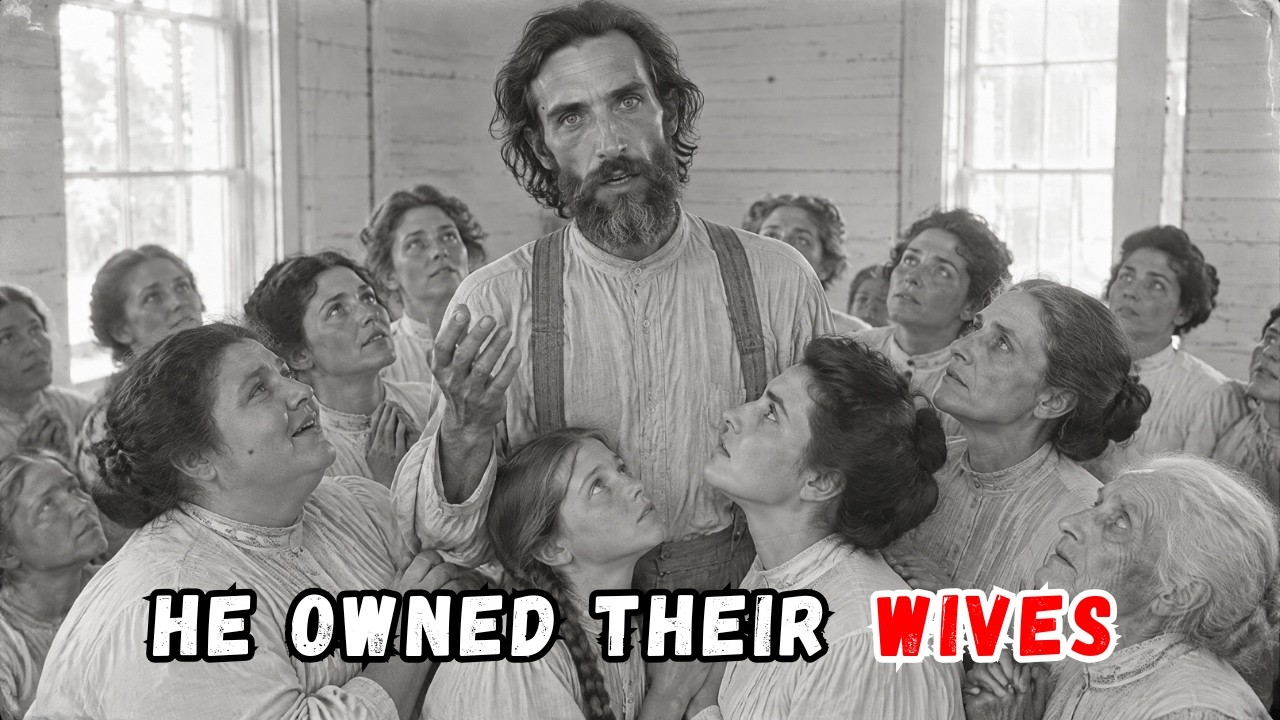
He had never left town. The man was Franz Edmund Creffield, and his story would not end there. Before it was finished, two people would be dead in Seattle, killed by members of the same family, shot in nearly the same place on the neck. Creffield arrived in Corvallis in late 1902, a German immigrant in his early thirties.
His early years in America were unremarkable; contemporary accounts described him as a drifter, a man at the bottom of things. Then he stopped on a Seattle street corner to listen to Salvation Army preachers, and something took hold of him. He got sober, joined the organization, and rose quickly, earning promotions across Oregon. By 1901 he had made captain.
But the ordinary church had grown too soft for him. He resigned, telling his superiors that God had called him to something more direct. By the winter of 1902 he had settled in Corvallis and begun building his own congregation. He called it the Holiness Mission, then the Army of Holiness.
His followers called themselves God’s Anointed. The town would soon call them something else. At first, Creffield preached nothing alarming. He spoke of peace, love, and holy living.
He was young, said to be handsome, and possessed a way of looking at a person as though they were the only soul in the room. In a town where a woman’s days were measured in laundry, cooking, and the endless management of other people’s needs, a man who told her that her soul mattered, that God had a special place waiting just for her, was not a threat. He was a door swinging open. The ones who walked through first were the women.
The popular explanation at the time was hysteria. The newspapers and physicians declared the women sick in the mind. The harder question, the one later historians kept circling back to, was whether the women were mad at all. They were trapped, bored, and starving for something, and Creffield was the first person who had ever offered them a taste of it.
His meetings grew loud and strange. Worshippers threw themselves to the floor, wept, shook, and rolled across the boards for hours in an ecstatic frenzy. The church-going people of Corvallis made up a word for them: the Holy Rollers. As the weeks passed, the husbands and fathers fell away, and the women stayed.
The women let down their hair, threw off their corsets, burned their hats, and dressed in long shapeless tunics they called wrappers. By the following summer, the meetings had grown so loud and so late that city officials formally forbade Creffield from holding services within the city limits. Being told no did not slow him down. He loaded his flock onto a low green island in the Willamette River called John Smith Island, just south of the city.
Cut off from town, the group turned inward. It was on that island that Creffield began branding any woman who refused to do as he ordered as satanic, marked by the devil. He stopped being merely a preacher. He announced that God had told him to take a new name.
He was no longer Franz Creffield. He was Joshua, a holy prophet chosen to gather his anointed ones and ready them for the end of the world, which he assured them was coming soon. Once a person truly believes the world is about to end and that you alone hold the key to survival, there is almost nothing they will not do for you. When the fall rains came and the island grew cold, one of Creffield’s most devoted followers opened her home to him.
Her name was Sarah Hurt, and her husband was Orlando Victor Hurt, a prominent, well-liked man everyone simply called OV. Sarah invited Creffield and around twenty of his followers to move into the Hurt house on the edge of town. Her three children were already devoted to him: a daughter named Maud, a son named Frank, and a younger daughter named May. OV had flirted with the group at the beginning, then thought better of it and stepped away.
But stepping away did him no good. The church moved into his living room. In October, the group decided that worldly possessions were an obstacle between them and God. They threw the family’s belongings onto a bonfire in the front yard: furniture, kitchen utensils, family heirlooms, a guitar, a bicycle.
They tore up the wooden sidewalk and fed it to the flames. According to more than one account, they threw the family cat and dog into the fire as well. There was talk, real talk, that the group had discussed whether a small child in the home should be given to the fire as well. The bonfire was too much even for OV Hurt.
He threw the whole group out of his home. But throwing them out did not dissolve them. It only scattered them for a moment. Creffield had begun to teach his followers that marriage was not necessary, that the bonds of the earthly world did not apply to the anointed.
The doctrine that came out later was that to be pure enough to enter the coming kingdom, a woman had to purify her body, and the purification could only be achieved through physical union with him. The closer a woman got to God, the more she belonged to Creffield. By the winter, the men whose families had been swallowed by this made a decision. On the night of January 4th, 1904, a group of around twenty men, calling themselves the White Caps, went to where Creffield was staying.
They dragged him out along with three of his closest male followers, stripped them, covered them in hot tar, rolled them in feathers, and told them to leave Corvallis and never come back. It did not work. That same night, the tarred and feathered men crept back into town, and the Hurt family helped clean the tar off him. The very next day, still reeking of pine tar, Creffield married OV Hurt’s daughter, Maud.
Witnesses said the smell of tar hung in the room during the wedding. When the vigilantes came looking for him the following night, this time carrying a rope, he had already vanished, slipping north with Maud. OV Hurt had already lost his wife and his home. Now he had lost his daughter Maud in the most binding way possible.
Every terrible thing Creffield would go on to do, OV would now have to watch as the father of the man’s wife. He never once walked away from it. Creffield and Maud went north to Hood River, where he gathered followers there too. A married couple named Warl joined the sect, then got close enough to see the truth.
They realized Creffield was having sexual relations with the female members and calling it purification. They walked away and they talked. The law caught up with him through a woman named Donna Starr, Sarah Hurt’s sister-in-law and the aunt of Maud. Donna was married to Burgess Starr, and her maiden name was Mitchell.
She had brothers, one of them named George. In early 1904, Donna had submitted to Creffield’s purification. When her husband found out, he did not reach for tar or a rope. He went to the courthouse.
In Oregon at that time, adultery was a crime. Burgess filed a criminal complaint, Donna signed a sworn statement describing what had happened, and a warrant went out for Creffield’s arrest. The manhunt stretched across the whole state. Creffield had simply evaporated.
Meanwhile, back in Corvallis, his followers were coming apart. They fasted for days at a time, lying flat on the floor of the Hurt house, refusing food, refusing to move, waiting for a sign. The men of Corvallis reached for the last tool available to them. One after another, wives and daughters were declared insane and committed to the Oregon State Insane Asylum at Salem.
The younger ones were sent to a home for troubled youth in Portland. Sarah Hurt was committed that June, and the authorities pronounced her hopelessly insane. Among the young girls sent away was a quiet, intense teenager named Esther Mitchell, Donna’s little sister and George’s little sister. Her own brothers signed the papers that sent her to the children’s home.
Something in that girl fastened onto Creffield and did not let go. By the middle of that summer, the state had all but given up finding Creffield. Then came the afternoon the boy went digging for fishing bait under the Hurt family home and found the prophet living beneath the floor. The most wanted man in Oregon had never fled at all.
He had gone to ground quite literally in the crawl space under his own wife’s family home, and the devoted women of the house had been passing him food and water in secret for weeks. He was pulled out naked, starving, and barely able to stand. He was put on trial, not for the cult, but for the one thing the law could name: adultery with Donna Starr. It was during this trial that a former member corrected the record.
Creffield’s church had a real name: the Church of the Bride of Christ. Every woman in it was, in his teaching, married to God through him. Creffield was found guilty and sent to the Oregon State Penitentiary. With the prophet behind bars, the spell seemed to break.
The women drifted home from the asylum and the children’s home, declared cured. The whole nightmare looked like it was finally over. It was not over. It had not even reached the part that ends in blood.
Creffield served roughly a year and a half of his sentence. When he walked out of the prison gates, he walked out convinced that his imprisonment had been part of God’s plan all along. He told his followers that emerging from that cell was his resurrection. He was not merely a prophet anymore.
He was Jesus Christ risen from the dead. Unbelievably, the followers who had seemed to shake him off listened and came back. On April 18th, 1906, the great earthquake struck San Francisco and the city burned. Creffield had publicly cursed what he called the Sodoms of the West: San Francisco, Portland, Seattle, Corvallis.
To his followers, the earthquake was proof. One of them, a woman named Cora Hartley, said it plainly: Creffield is Jesus Christ. He condemned San Francisco and brought the earthquake, and he has condemned Corvallis, and an earthquake will destroy this place too. They obeyed his order to flee the doomed cities and gather on the Oregon coast to await the end of the world.
Some of the women walked miles through coastal wilderness thick with bears and cougars to reach him. One of the men, a mine owner named Hartley, husband of that same Cora, followed his wife and daughter to the coast. As the group boarded a ferry, Hartley pulled a revolver and fired at Creffield five times at close range. The gun failed every single time.
The cartridges were the wrong type for the weapon. To the followers, this too was a miracle. Their prophet could not be killed. Then there was George Mitchell.
He was a mild, unremarkable mill worker, not a violent man, not the sort anyone expected to make history. But this preacher had taken one of his sisters and set his sights, it was believed, on the other, Esther, barely more than a child. With Creffield loose again, gathering the women to the coast, and every attempt to stop him having failed, George made a decision. He would go and finish it himself.
Learning that Creffield and Maud had fled north to Seattle, George followed. He arrived on May 2nd, 1906, and for five days he watched and waited. On the morning of May 7th, he found his target. Creffield was walking down First Avenue with Maud at his side.
George Mitchell stepped into position in front of the Quick Drugstore at the corner of First and Cherry. He let the couple pass, then raised a . 32 caliber revolver and shot Creffield once in the back of the neck. The prophet who could not be killed died instantly on the sidewalk.
George did not run. He turned himself over to the police on the spot. From his cell, he sent a telegram to OV Hurt. The message was five words long: I’ve got my man.
Creffield’s body was taken to the Bonney-Watson funeral home in Seattle and buried in the city’s Lake View Cemetery. His followers believed he would rise from that grave any day, exactly as he had risen from the prison cell. They were simply waiting. George Mitchell, sitting in a Seattle jail, having confessed to murder in broad daylight, was about to become the most popular man in the Pacific Northwest.
The district attorney of Multnomah County wrote to the Seattle prosecutor to volunteer as a witness against the dead man, saying that taking the law into one’s own hands under such circumstances was almost excusable. The newspapers ran with it. They called Creffield a reptile, a vampire, a thing barely human. The press did not report the story so much as prosecute the corpse.
Then OV Hurt came to Seattle. The father of the woman Creffield had married used his money and standing to make sure George Mitchell got the best defense available. Well-wishers back in Oregon raised the fee, $650, and hired one of the finest criminal defense firms in Seattle. The defense they built was temporary insanity.
They called witnesses who testified about the terrible things they had told George about the cult: the sexual purification, the debasement of mothers in front of their own daughters, the plot to take young Esther from the children’s home and hand her to Creffield to bear, in their words, a second Christ. A great deal of that testimony was very likely not true, or at least heavily arranged. It was a town closing ranks around one of its own, using the machinery of a courtroom to put a dead man on trial. The jury received the case at 3:14 in the afternoon.
By 4:45, they were back. Not guilty. Because they had not actually declared him insane, only not guilty, George Mitchell walked out of that courtroom a completely free man, cheered as a hero. His sister Esther was in the city, and she was not cheering.
Esther had come to Seattle after the killing, furious not at George but at him. To her, George had not saved anyone. He had murdered the risen Christ. She and Maud Creffield were living together under the watchful eye of a police matron, who had already taken one gun away from Maud, then a second gun Maud had bought to replace the first.
On the 12th of July, George Mitchell went to the Seattle train depot to head back south, accompanied by his brother Perry. There to see them off was Esther. She shook her brother George’s hand. The four of them walked together toward the platform.
Esther was carrying a coat over her arm. Her brother Fred kindly offered to carry it for her, and that was the moment the truth came out from under the coat. There was a revolver hidden beneath it. Before anyone could react, Esther Mitchell raised the gun to the back of her brother’s head and fired.
She had aimed, witnesses said, at the exact same place on the neck where George’s bullet had entered Creffield. The shot severed an artery. George Mitchell, acquitted only days before, bled to death on the floor of the depot with his brothers around him. He was about twenty-three years old.
His body was laid out at the very same Bonney-Watson funeral home that had received Creffield. Two men, the prophet and the man who killed him, passed through the same room within nine weeks. Esther Mitchell and Maud Creffield showed no remorse. Maud freely admitted she had bought the murder weapon using money the two women had received as witnesses.
OV Hurt, who had already paid to defend the killer of his son-in-law, now stepped forward once more to pay for the defense of his own daughter, who had helped arm the girl who murdered the man he had just helped free. The judge who had overseen George’s trial proposed skipping the expense of a second trial by appointing a commission to declare the two women insane. On cue, they declared both women delusional and dangerous. While the appeals crawled on, Maud Creffield ended it herself.
Strychnine was smuggled into the county jail, and she swallowed a dose the chemist said was enough to kill three people. She had one final wish: to be buried beside her husband. OV Hurt arranged it. He had Creffield’s body moved to a new plot and laid his daughter down in the ground right next to the prophet who had ruined them all.
Esther Mitchell was sent to the Washington State Asylum at Steilacoom. She was released about three years later, in 1909, declared cured. The staff said she was by then thoroughly disgusted with herself. The spell at last had broken, but it broke too late to save anyone, including her.
OV took her in, guardian to the girl who had shot his son-in-law’s killer. Because at this point, who else was left? She grew up. She married.
By 1914, she was living in Waldport on the Oregon coast, twenty-six years old, married only a few months, and by all outward appearances finally at peace. Then Esther Mitchell did the same thing Maud had done. She took strychnine, and she died. The Church of the Bride of Christ died with its founder.
Creffield never rose from the grave his followers were so sure could not hold him. The little group that survived him scattered, though many of them stayed close, settled in Waldport, married one another, raised children, and tried to live ordinary lives in the place where their prophet had promised them the end of the world. What Franz Creffield understood was never really about God. It was about power.
He found people the world had taught to obey, and he simply stood at the front of the room and told them heaven was on the other side of doing what he said. Everything else, the fire, the asylums, the graves in Seattle and two more in Oregon, all of it grew from that one quiet exchange repeated in one home after another until a whole town could not tell the difference between devotion and ruin. The men who loved those women tried tar and the law and the asylum and finally a gun. And even the gun only made more graves.
In the end, the only thing that ever truly broke Creffield’s hold was time. And by the time it worked, it had taken almost everyone.






