The brake was not in the cab, and it was not a lever the driver could reach. In the logging trains of the 1880s, the brake that actually stopped the train was a wheel of cast iron mounted on a vertical shaft at the end of every car, and to reach it a man had to climb up and stand on top of the logs. Round logs, stacked, chained down, slick with rain or frost. He carried a stick.
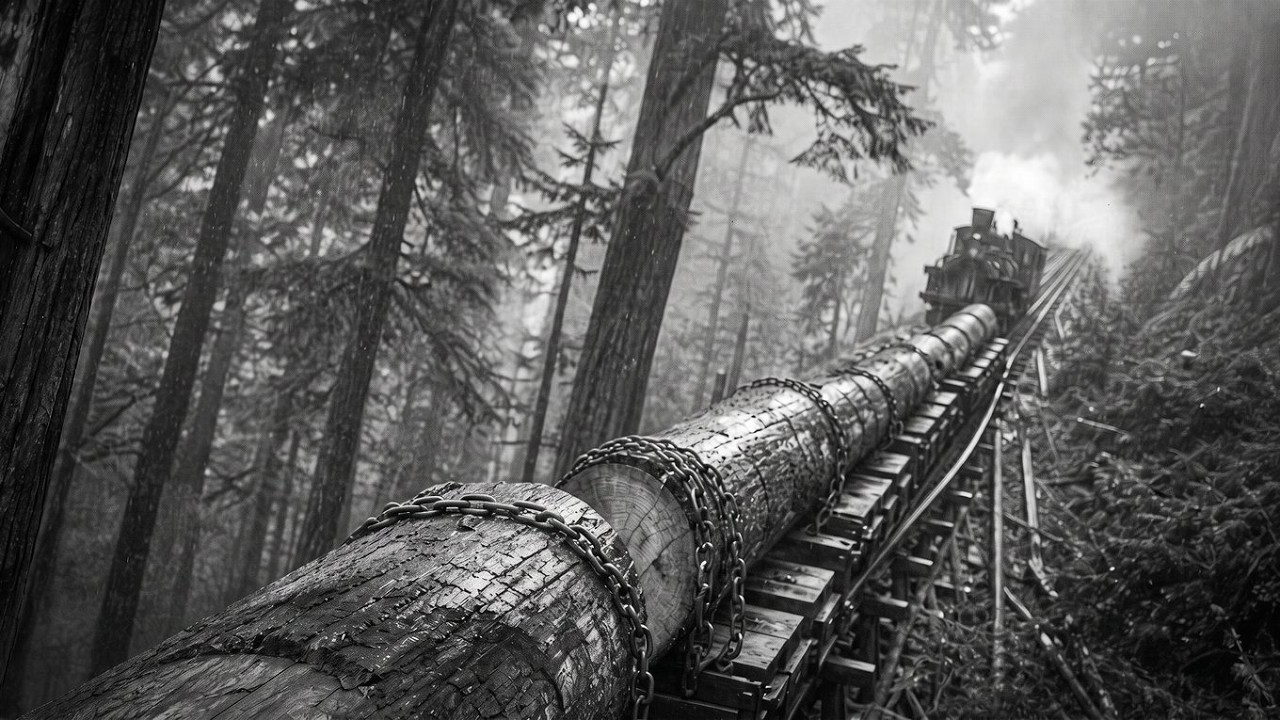
It was called a brake club, and it was not a weapon or a tool in any precise sense. It was a piece of hardwood he shoved between the spokes of that wheel to give himself enough leverage to turn it, because his arms alone were not enough to fight what was pushing from behind. What was pushing from behind was two hundred tons. He understood what that meant.
The locomotive alone on a logging line weighed eighty tons. Behind it came the flatcars, each bearing old-growth timber, and a single log could weigh as much as a fully loaded boxcar. Four or five cars and you were past two hundred tons before you counted the engine. And all of it was moving downhill on temporary track laid over bare dirt a season earlier, on grades no mainline railroad in America would have allowed for any price.
The man on top had to stop it. The man in the cab could not help him. This is the story of how that job actually worked, the twenty years it should never have existed, and the Iowa farmer who ended it. The man at the throttle could not stop the train.
That is the fact everything else rests on, and it is the hardest one for a modern audience to accept, because everyone has seen a driver press the brakes. He could not. The locomotive of that era had brakes on the locomotive itself. That was all.
The engine and its tender could slow down by the man in the cab, but the fifty or one hundred or two hundred tons behind him could not be slowed, because there was no connection running the length of the train that let him control them. Each car braked itself, or not at all. So consider the mathematics of the grade. The engine weighed eighty tons and could brake itself.
Behind it, the four loaded cars outweighed the engine, and each one pushed the train forward. On level track, that was an annoyance. On a five percent grade, the kind logging lines took regularly while mainlines did not dare go near it, it was a disaster waiting to happen. The track underneath made it worse.
Logging railroads were laid quickly and cheaply directly on the forest floor with no ballast, because they would be torn up after a season or two. They sank into the ground. They shifted. They went out of line in wet weather.
Every train ran on a structure that had quietly changed shape since the last train passed. There was one answer to all of this, and the answer was men. Before the train started down, the brakemen climbed up. They went up onto the cars and spread themselves along the train.
A man might be responsible for two or three cars, and then at the signal they began working the hand brakes. Not all at once. Not all the way. Setting them too hard could lock a wheel and make it slide, losing all friction at the worst possible moment.
Setting them too soft did nothing. Braking the front of the train hard while the rear ran free meant the rear cars crashed into the front ones. It required gradation and coordination and constant adjustment from men standing in different places on a moving train, who could not hear each other on a grade in any weather the mountain produced. In 1874, a farmer from Iowa stood on a station platform and watched a man lose two fingers.
His name was Lorenzo Coffin. He was born in 1823 in rural New Hampshire, came west to Iowa in 1855, and by any reasonable description was not a railroad man. He was a farmer. He was a part-time preacher.
He had served as a chaplain in the Union Army during the Civil War, and he worked as an agent for right-of-way claims, which is what put him standing where he was standing. What he watched was a brakeman coupling two cars. Coupling in that era was done with a link and pin. The link was an oval iron ring.
The pin was a heavy iron rod. Two cars were pushed together, and a man stood between them holding the link to feed it into the opening in the other car, then dropping the pin at the right moment to lock them together. Between them. Two cars moving toward each other, and the man’s hand in the gap.
The margin was the speed of his reflexes. If the cars came together faster than he expected, or if the link hung up, or if he was tired at the end of a fourteen-hour day, the gap closed on his hand. Coffin saw what happened, and then he did something almost no one did. He asked questions.
He learned that it was not an accident in any sense of the word. It was normal operation of the equipment. Men lost fingers coupling cars the way other men got calluses. The loss of fingers was so common among experienced trainmen that it became a badge of experience.
You could identify a man who had worked the trade for years just by looking at his hands. He also learned something else. Men were being killed and maimed up on top of the cars too, setting the hand brakes. That moment decided what was left of Lorenzo Coffin’s life.
He was fifty-one years old. The brake club was just a piece of wood. That is worth pausing on, because it was the only technology available for this deadly task. The worker’s entire kit consisted of a stick for leverage on the brake wheel, a lantern and flags for signaling, and a switch key.
That was all. That was everything standing between a loaded timber train and a runaway down the grade. Here is how the descent actually went. The train stopped before the grade.
The men climbed up onto the cars by the ladders at their ends, then made their way toward the load, because the brake wheel was at the end of the car and the distance between it and the next car was a gap. The conductor or engineer gave the signal to start. The engineer blew the whistle. Along the length of the train, the men began turning the brake wheels, using the stick between the spokes when their hands tired, feeling for the point where the brake pressed the wheel without quite stopping it.
Then the train started down. Now the job was not to hold the brakes. It was to manage them continuously for the whole descent. The brakes heated up.
A piece of cast iron pressing against a steel wheel for several miles got hot enough to lose its grip, and a hot wheel could develop flat spots or cracks. So the brakes had to be released and reset, worked in rotation, given time to cool, which meant men moving along the train as it descended, easing off here and setting there, judging speed by feel. They walked across the load to do it, not on a walkway, but on the cargo itself. Logs, chained down, cylindrical, uneven, and in the Pacific Northwest, wet nearly all winter.
They did this while estimating speed with no instruments at all. There was no speedometer on a logging car. The worker knew the train’s speed from the feel through his boots and the way the trees went past him, and he had to decide from that whether the train was under control or beginning to lose it. He had to decide early, because once a loaded train was moving on a grade, no amount of hand braking could stop it.
Everything depended on men being in the right place before the grade began. Because if a brakeman was not already on the car when the train needed him, there was no way to get him there. You could not stop to pick him up, because stopping was the thing you were trying to do. So the crew climbed up before the descent and stayed up.
And if something went wrong halfway down, the men were exactly where the problem was. Everything about it was wrong, and everyone knew it. Start with the surface. Logs are round.
The load was a curved, shifting mass held by chains, and the man crossing it walked on a cylinder that could roll under his boots. Add rain, which is the weather for most of the year on the northwest coast. Add frost. Add the fact that he was carrying a club and needed at least one hand to use it.
Now add the third dimension. He was ten or twelve feet above a moving train, with no railing, no safety harness, and nothing between him and the roadbed but air. The fall did not end on the ground. It ended under the train, because the train kept moving forward while he fell.
Now add the branches. A logging railroad ran through the forest, and the clearance above the load depended on what the crew that cleared the right of way thought was enough. A branch at the wrong height would pluck a standing man off the top of the load without slowing. And add the gaps between cars.
To move from one car to another, a brakeman stepped across the space between them. A gap that opened and closed as the train moved over a set of wheels. Railroad work in that period, in the language of statistics, was the second most dangerous occupation in the United States, behind only coal mining. And within railroad work, the men on top of and between the cars, the brakemen, bore the brunt of it.
Here is the toll for a single year. In 1888, coupling accidents alone, just the link and pin, just the men standing between cars, killed three hundred railroad workers and injured more than sixty-seven hundred. One category of accident in one year. Now take the entire industry a decade later.
In 1900, 2,500 American railroad workers were killed on the job and 39,000 were injured. Count that out daily. Seven men killed every day of the year. 107 injured every day of the year.
Not in war, but in the ordinary operation of American freight railroading. And those were the reported numbers, the ones the companies submitted. The solution had existed since 1872. That is the part of the story that turns it from tragedy into something else.
George Westinghouse had patented an air brake in 1869, a steam-driven pump on the locomotive that forced compressed air through hoses to every car, so the engineer could open a valve and apply the brakes along the entire train from the cab. The problem Coffin watched men die from was, in principle, already solved. But that first design had three genuine flaws. If a hose broke, the system did not work at all.
If cars separated on an upgrade, only the hand brakes kept them from rolling backward. And the air took too long to reach the rear cylinders on long trains. So Westinghouse rebuilt it, and on March 5, 1872, he patented the automatic air brake. The change he made was a genuine piece of engineering elegance.
Instead of sending air forward to apply the brakes, he kept the entire train line permanently pressurized and put a compressed air reservoir on each individual car. The brakes were applied not by adding pressure, but by reducing it. A drop in line pressure told every car to use its stored air to apply its own brakes. That meant anything going wrong applied the brakes.
A burst hose dropped the pressure, and the brakes went on. A train breaking in two dropped the pressure, and the brakes went on in both halves automatically with no one touching anything. The failure mode of this system was stopping. The next year, 1873, Eli Janney patented an automatic coupler that locked together like clasped hands, taking the worker out from between the cars entirely.
By the mid-1870s, both problems Lorenzo Coffin had witnessed were solved. And still they were not installed. Passenger trains got air brakes with reasonable speed because passenger accidents made headlines and produced lawsuits. But there were tens of thousands of freight cars in the United States, and equipping the freight fleet would cost about forty million dollars, so the railroads resisted for decades.
During those decades, the brakemen kept walking over moving trains with sticks and putting their hands between cars, and they kept dying at the rate of seven a day. Coffin did not let it go. He served as the first railroad commissioner of the state of Iowa from 1883 to 1888. Iowa became one of the first states to require the use of air brakes and Janney couplers on trains operating within its borders.
Then he took the fight to Congress. He lobbied for the federal bill for six years, almost alone, a farmer and part-time preacher in his sixties going up against a national industry. The logging railroads, to be fair, were among the first American lines to adopt air brakes voluntarily. It was not conscience either.
It was that runaway trains in mountain country were destroying equipment. When the safety argument also served the capital argument, the industry could listen. Even then, the solution was not complete. On the steepest mountain grades, the early air brakes were not enough on their own, and the logging lines continued to run cars with both systems, air and hand, together, for years afterward.
There were still men up on top of the loads. There were simply fewer of them, doing less. Harrison signed the law on March 3, 1893. The Safety Appliance Act had passed Congress the day before.
It made air brakes and automatic couplers compulsory on every train operating in interstate commerce in the United States. Not recommended, not encouraged, but required. March 3 was President Harrison’s last full day in office. He signed the bill, then handed the pen to Lorenzo Coffin.
The law came with a seven-year grace period, which is a silent comment on how fierce the industry’s resistance had been. It did not take full effect until 1900, the same year 2,500 railroad workers were killed. But from then on the numbers fell, and kept falling. The act is generally credited with the sharp decline in American railroad injuries in the early twentieth century.
Lorenzo Coffin lived until 1915. He was ninety-two years old. He had spent forty-one years on a cause he had no professional reason to care about, begun by his position on a station platform watching a stranger lose two fingers. We do not know that man’s name.
No one wrote it down. He was a brakeman on a freight train in Iowa in 1874. The only trace of him is that Lorenzo Coffin happened to be looking in his direction that day, and could not stop thinking about it afterward. Which leaves us with the men on the log cars.
They climbed up before the grade and walked across the timber. They put a stick between the spokes of an iron wheel and leaned on it. And they stopped two hundred tons on a mountain grade with their own weight and their own judgment for twenty years after the machine that could do it for them had been patented, drawn, built, and demonstrated.
Not because it did not work, but because it cost forty million dollars.






