In March 1603, the most powerful woman in Europe refused to go to bed. For days, Queen Elizabeth I sat on cushions on the floor of her own palace, silent, staring at nothing, a finger pressed into her mouth like a frightened child until her body gave out beneath her. And when she finally died, her ladies barred the door. No physician would ever be permitted to examine the body of the Virgin Queen.
Most people remember Elizabeth as the glittering Gloriana who crushed the Spanish Armada and presided over a golden age. Her ending was far darker than the schoolbooks admit, and the story of why her death remains a mystery to this day begins strangely with a ring. Elizabeth Tudor was born on the 7th of September 1533 at Greenwich Palace, and she was a disappointment before she could speak. Her father, Henry VIII, had torn England away from the Catholic Church largely so he could marry her mother, Anne Boleyn, for the son Anne was supposed to deliver.
Instead she delivered a daughter. Henry’s patience with disappointing wives was notoriously short. On the 19th of May 1536, Anne Boleyn was beheaded on charges of adultery and treason. Elizabeth was two years and eight months old.
Within weeks, Parliament declared the toddler illegitimate and struck her from the succession. Before she could properly read, Elizabeth had absorbed the first rule of Tudor survival: the people closest to the crown are the first to disappear. The next man to put her life in danger would do it from inside her own home. After Henry’s death in January 1547, the teenage Elizabeth lived in the household of her stepmother, Catherine Parr, and Catherine’s ambitious new husband, Thomas Seymour.
Seymour’s conduct toward the young princess alarmed the household, and after Catherine died, his ambition curdled into a reckless plot to seize power. When he was arrested, the investigators turned on Elizabeth herself. They interrogated the fifteen-year-old for weeks, hunting for proof she had conspired to marry him. They got nothing.
She was fifteen and she outmaneuvered the entire Privy Council. Seymour went to the block on the 20th of March 1549. Elizabeth walked away with her life and with a mask of perfect composure she would spend the next half century perfecting. She would need it, because the next person to nearly destroy her was her own sister.
When the boy king Edward VI died on the 6th of July 1553 and the nine-day reign of Lady Jane Grey collapsed, Elizabeth’s Catholic half-sister Mary took the throne. Within a year, a Protestant uprising, Wyatt’s Rebellion, put Elizabeth under devastating suspicion. In March 1554, the twenty-year-old was imprisoned in the Tower of London, the same fortress where her mother had been executed. She spent roughly two months waiting for an axe that never came, then more than a year under house arrest.
And then history blinked. On the 17th of November 1558, Mary died childless and Elizabeth became queen of England at twenty-five. The survivor had outlasted them all. Now came the performance of a lifetime.
She was crowned at Westminster Abbey on the 15th of January 1559, and even that was a quiet scandal. The senior Catholic bishops refused to crown a Protestant queen, so the job fell to the lowly bishop of Carlisle. Elizabeth didn’t care. She reportedly told Parliament she was already bound to her husband, the Kingdom of England itself.
And on her finger sat the coronation ring, the wedding band of that strange marriage. It would not come off again for forty-four years. When it finally did, it would take a piece of her with it. As queen, she rebuilt the English church with herself as its supreme governor, and she turned her own unmarried status into a weapon.
For decades, half the crowned heads of Europe lined up for her hand, and Elizabeth ran the courtship like a diplomatic auction that never closed, collecting alliances from hopeful suitors and paying out to none of them. The one man she may truly have wanted, her dashing favorite Robert Dudley, became untouchable in 1560 when his wife, Amy Robsart, was found dead at the bottom of a staircase with a broken neck. There is no evidence Elizabeth had any involvement, but the rumors were ruinous, and marriage to Dudley became politically impossible. The Virgin Queen would stay a virgin officially and, for the record, medically documented.
But the queen was about to face an enemy no charm could manage. In October 1562, smallpox nearly killed her at Hampton Court. She survived scarred. And out of that brush with death grew one of history’s most ruthless image machines.
Elizabeth painted her face with Venetian ceruse, a paste of white lead and vinegar, and by the 1590s royal proclamations controlled which portraits of her were even allowed to exist — an eternally youthful mask stamped onto every canvas. The mask would hold for forty years. What lay underneath it would not. Then came the rival she could neither free nor forgive.
In 1568, Mary, Queen of Scots, fled to England, and Elizabeth locked her cousin away for nineteen years. In 1570, the Pope excommunicated Elizabeth and released every Catholic subject from allegiance to her, which was effectively an open invitation to assassination. Plot after plot followed until the Babington Plot of 1586 finally implicated Mary directly. Elizabeth signed the death warrant, and on the 8th of February 1587 Mary was beheaded at Fotheringhay.
Elizabeth then insisted she had never intended the execution to be carried out so fast, though her letters suggest careful political maneuvering, and some historians believe the outrage was at least partly performance. A queen had killed a queen. The precedent was set, and the king of Spain was watching. In 1588, Philip II launched his Armada, a fleet of around 130 ships, to destroy her.
Elizabeth rode out to her troops at Tilbury and, in the version of the speech that survives, declared she had the heart and stomach of a king. The Armada was shattered, and Gloriana stood at the absolute zenith of her legend. Then, within weeks of the victory celebrations, Robert Dudley died. The golden age had arrived.
So had the loneliness, because Elizabeth was about to discover the cruelest side effect of a long reign: outliving everyone. Through the 1590s the deaths kept coming, including, in 1598, William Cecil, Lord Burghley, the adviser who had steered her for forty years. The old guard was gone, replaced by a younger, hungrier generation that saw not a living legend but an old woman blocking the road. Chief among them was the Earl of Essex, Dudley’s own stepson — charming, reckless, and catastrophically arrogant.
After a disastrous campaign in Ireland, he reportedly burst unannounced into her private chambers before she was painted and dressed, glimpsing the unmasked queen no one was permitted to see. It was the beginning of the end for him. On the 8th of February 1601, Essex launched a botched rebellion in London. It collapsed within hours.
On the 25th of February 1601, he was beheaded, and this time Elizabeth signed the warrant with no claims of mistake. She had executed the fatal favorite. According to the courtier Sir John Harington, her mind then sank into a dark, paranoid grief from which she never truly recovered. Harington’s letters from 1601 paint a chilling picture of the aging queen.
She reportedly paced her privy chamber in the dark and thrust a rusty sword into the wall tapestries, hunting for assassins who weren’t there. She reportedly ordered every mirror removed from her presence. The monarch who had built an empire on the weaponization of her own image now refused to look at the unpainted truth. Then in February 1603 came the loss that seemed to break her.
Katherine Howard, Countess of Nottingham, one of her oldest and closest friends, died that month, and courtiers watched the Queen’s spirit collapse in the weeks that followed. Whether grief caused what came next, no one can prove, but the timing is beyond dispute. At Richmond Palace through early March, the reports from foreign ambassadors grew grim. Her throat was inflamed until she could barely swallow.
She refused food. She refused medicine. She refused to let doctors near her. She sat sleepless for hours, her eyes fixed on a single object, saying almost nothing.
And then she refused something else: her bed. The French ambassador recorded the scene that has haunted historians ever since. The most powerful woman in Europe sat for days on cushions laid on the floor, rigid and silent, a finger in her mouth like an anxious child. Courtiers came to believe she was convinced that if she ever lay down, she would never rise again, though no record survives of her saying so herself.
So she sat, and she stood propped on pillows, defying gravity itself, until her body finally failed and she collapsed. It was in these last days, according to the historian William Camden, that the coronation ring she had worn since 1559 was dealt with at last. It had grown so deeply into her swollen flesh that it had to be filed from her finger. Forty-four years of marriage to England, severed with a rasp, and the court understood exactly what that meant.
Her cousin, Sir Robert Carey, was allowed in to see her around the 19th of March. She took his hand and told him, “No, Robert, I am not well. ” Then, he recalled, she sighed as he had never heard her sigh before. Moved at last to her bed, the dying queen clung to one final comfort.
The elderly Archbishop of Canterbury, John Whitgift, knelt beside her and prayed until his knees ached. When he tried to rise, the mute queen waved her hand. He prayed on. When he tried to stop a second time, she waved again.
The exhausted old man stayed on his knees into the night. It is one of the most heartbreaking scenes in royal history: a dying woman who could no longer speak, begging with one hand for more prayer. And while she begged, her own government was already somewhere else entirely. Her secretary, Sir Robert Cecil, had spent the previous two years in secret correspondence with King James VI of Scotland, quietly arranging the transition of power while his queen still breathed.
While Elizabeth fought for every breath, Cecil was in effect two years into onboarding her replacement. To be fair, his cold efficiency probably saved England from civil war, but it meant the court had buried her before she was dead. On the 23rd of March, Elizabeth lost the power of speech entirely. Her counselors gathered at her bedside and named James of Scotland as her successor.
She lifted her hand to her head. Her counselors chose to read the gesture as consent. Whether it truly was, we will likely never know. Hours later, it was over.
Between two and three in the morning on the 24th of March 1603, Elizabeth I died at Richmond Palace aged sixty-nine, after a reign of forty-four years. Her chaplain, who was present, said she went mildly like a lamb. The poignant last words later attributed to her — trading all her possessions for a moment of time — appear in no contemporary account. She had been silent for a day.
The Tudor dynasty ended not with a speech but with silence. And the scramble began instantly. Carey’s sister, one of the Queen’s ladies, slipped him a sapphire ring as proof of the death. Carey thundered roughly four hundred miles to Edinburgh in under three days, to be the first voice telling James he was king.
He didn’t wait for the funeral. He barely waited for her heart to stop. James was proclaimed in London that same morning. But the strangest chapter of Elizabeth’s death was only beginning, because of what her ladies did next.
The women of the bedchamber refused to allow an autopsy. No physician examined the body. No post-mortem report exists in any state paper, any diary, any dispatch — nothing. Later writers claimed Elizabeth herself had forbidden it, to protect the mysteries of the Virgin Queen, though no such order appears anywhere in the record.
The body was wrapped, sealed in a lead coffin, unexamined, and carried by barge down the dark Thames to Whitehall on the 28th of April 1603, thirty-five days after her death. She was buried at Westminster Abbey, and she rests today in a vault she shares with Mary I, the sister who once sent her to the Tower. In death, the Tudor sisters were locked in together forever. Then four years later, the horror stories began.
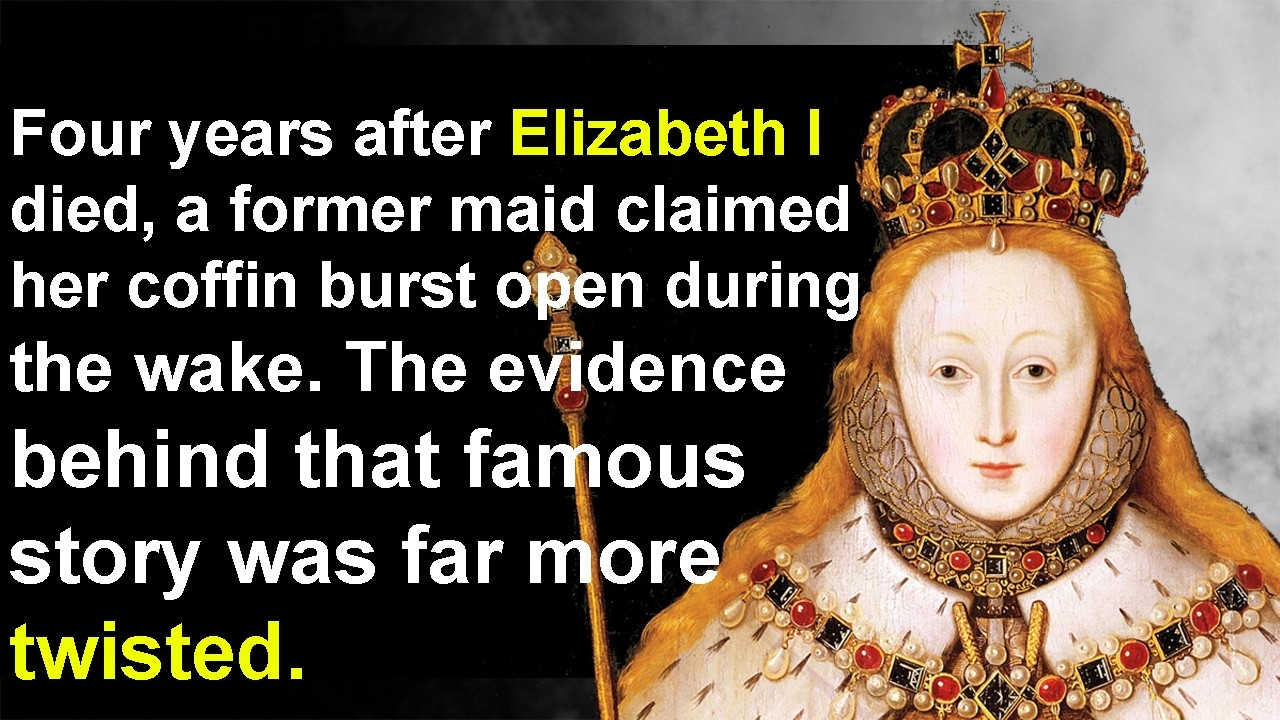
In 1607, a former maid of honor named Elizabeth Southwell produced an account claiming the queen’s unembalmed corpse had swollen with foul vapors and burst its coffin during the wake with a terrible crack, and that a playing card — the Queen of Hearts, with an iron nail driven through its forehead — had been found hidden beneath Elizabeth’s chair, hinting at witchcraft inside her own court. It is the most infamous detail ever attached to Elizabeth’s death. It is also almost certainly false. Not one person actually present in those weeks — not Carey, not the diarists, not a single ambassador — recorded anything of the kind.
Southwell had fled to the continent and converted to Catholicism, and her lurid account was recycled in 1610 by the Jesuit propagandist Robert Persons as ammunition against the dead Protestant queen. Historians have treated her Gothic horrors as propaganda ever since. Even the tidy schoolbook ending took a hit recently. Around 2021, researchers imaging William Camden’s original manuscript drafts discovered he had rewritten his account of the queen’s death to flatter the new king, quietly upgrading a weak, ambiguous hand gesture into a clear deathbed nomination of James.
The serene ending was edited in after the fact. And the cause of death? Modern pathologists working from reported symptoms alone — in a 2022 televised reconstruction — have speculated bronchopneumonia, perhaps complicated by heart failure and decades of lead-based makeup. But speculation is all it can ever be.
Her remains have never been opened, tested, or examined. Not in 1603, not once in the four centuries since. The queen who spent forty-four years controlling exactly what the world was allowed to see of her is controlling it still.
No one ever saw beneath the mask, and now no one ever will.






