At the edge of a shallow lake in what is now southern New Mexico, a young woman walked into wet mud, a small child balanced on her hip. She was perhaps 1. 55 meters tall. She was in a hurry.
Her pace measured close to four kilometers an hour, well above the speed of a casual stroll, and she carried the child for roughly half of her journey, shifting the weight from one hip to the other every few minutes to spare her muscles. The track she left stretched almost a kilometer and a half in a nearly straight line toward the north. Hours later, the same footprints reappeared on the return path. This time, there was no mark of the child being set down.
Someone else must have taken the child ahead. The woman walked back alone. She could not have known what she was leaving behind. But in 2021, when a team led by the researcher Matthew Bennett published its analysis of those tracks from White Sands National Park, the footprints delivered a number that shook American paleoanthropology: roughly 23,000 years old.
That was 10,000 years before the date that mainstream science had long treated as the earliest possible human arrival in the Americas. At the very peak of the last ice age, when glaciers sealed off the northern land routes, someone had been walking the shore of a lake in the middle of what is now the United States. The story of how that woman came to be there begins more than 20,000 years earlier, on a planet that looked nothing like the one we know. Twenty-one thousand years ago, the northern hemisphere lay under ice up to three kilometers thick.
In places, the glaciers towered higher than any mountain in the southern half of Brazil. This was the Last Glacial Maximum, the coldest point of the last ice age. Nearly all of what we now call Canada, much of the northern United States, large parts of northern Europe, and Siberia lay buried under solid sheets of frozen water. The cold had locked up so much of the planet’s water that the oceans dropped roughly 120 meters below their present levels.
Islands became peninsulas. Entire seas dried out. And in the strait that today separates Siberia from Alaska, a vast expanse of dry land appeared. It was not the narrow bridge that generations of schoolchildren were taught to imagine.
It was a territory 1,500 kilometers wide from north to south, a low, wind-scoured plain of tough grasses grazed by herds of bison, mammoth, and wild horse. Scientists named this lost land Beringia. It was not a corridor to be crossed quickly; it was a home. A complete ecosystem with its own seasons, rivers, and sheltered forests.
To the south, protected by the mountain chains of Alaska and eastern Siberia, grew patches of willow, dwarf birch, and hardy conifers. These forest shelters were essential. They provided wood for fire, cover from the wind, and safe places to pitch camps during the longest winters. Biologists gave the plain a specific name: the mammoth steppe.
It was a biome that no longer exists anywhere on Earth, drier than modern tundra, richer in nutritious grasses, capable of sustaining enormous herds of large herbivores. In a single summer, an extended family could watch thousands of bison cross the horizon. And it was there, most likely, that the first ancestors of the peoples of the Americas waited. For thousands of years.
Genetics helps explain that pause. Studies of mitochondrial DNA show that the founding lineage of American peoples became genetically isolated from the rest of the Asian populations at some point between 25,000 and 20,000 years ago. That prolonged isolation, in a relatively small region, only makes sense if a group stayed put, out of contact with other populations, long enough to develop its own genetic markers. Geneticists call this the Beringian standstill.
A wait of perhaps 5,000, perhaps 8,000 years, inside that now-submerged land. The hypothesis was formally proposed in 2007 by geneticists Erika Tamm and Hugo Perego, working with American anthropologist John Hoffecker and American geneticist Dennis O’Rourke, then refined by several research groups. Unique genetic markers found in Indigenous American populations, such as certain variants of mitochondrial haplogroup C and the male haplogroup Q, could only have arisen in an isolated environment. For many generations, Beringia was that environment.
To live there was to endure constant wind cutting at exposed skin, a sun that rose low over the horizon and barely warmed the tundra. Small groups of ten or twenty people camped near a river. They ate the meat of large animals, wore hides sewn with bone needles, slept in shelters of leather stretched over branches. During the coldest months, the diet was almost exclusively animal: bison, mammoth, wild horse, elk.
Fat above all was vital, providing the concentrated calories needed to survive extreme cold. In summer, when the tundra briefly bloomed with mosses, lichens, and small flowers, they could gather roots, berries, and mushrooms. Their technology was already refined. Polished bone needles, stone blades, projectile points, scrapers for working hides.
Nothing was improvised. Each tool required days of work and knowledge passed down through generations. At the Yana site in far northern Siberia, Russian archaeologists led by Vladimir Pitulko uncovered in the 2000s an extraordinary set of tools dated to about 32,000 years ago: mammoth-ivory spear points, bone awls, decorative pendants. Someone at that extreme latitude had already mastered life in the cold, long before the Last Glacial Maximum began.
And far to the east stretched a continent no human being had ever seen. For nearly a century, one theory dominated the history books. It was called Clovis First. It held that the first Americans had arrived about 13,000 years ago, crossing Beringia on foot and moving south through an ice-free corridor that supposedly opened between two glaciers in western Canada.
These people were named the Clovis culture, after a small town in New Mexico where, in 1932, distinctive spear points were found embedded in mammoth bones. Clovis points are remarkable objects: long, slender, with a characteristic central depression that eased fitting onto a spear shaft, a weapon designed specifically to bring down large animals. Within little more than a decade, similar points turned up at dozens of sites across the western and southern United States. It was a beautiful story, a clean story, and for decades it was nearly a dogma.
Anyone who dared to suggest humans had been in the Americas before Clovis was ridiculed, could lose funding, lose a job, lose a reputation. Science has its heretics. In the 1950s, American archaeologist Louis Brennan presented finds suggesting much earlier occupation at sites in New York State. He was marginalized.
In the 1970s, Jacques Cinq-Mars excavated caves in the Bluefish region of the Canadian Yukon and proposed dates above 24,000 years. He was met with disbelief. It took decades for his work to be revisited with respect. In 2017, a complete reanalysis of the bones Cinq-Mars had found at the Bluefish Caves, published by a Canadian team led by archaeologist Lauriane Bourgeon, confirmed cut marks made by human tools on horse bones more than 24,000 years old.
The French-Canadian researcher’s reputation was partially rehabilitated, but the recognition came too late. The evidence kept accumulating. In southern Chile, at Monte Verde, excavations led by American archaeologist Tom Dillehay revealed a campsite with remains of wood, mastodon bones, chewed medicinal plants, even a child’s footprint preserved in hardened clay. Monte Verde’s preservation was exceptional.
The site had been covered by a layer of peat, waterlogged, oxygen-poor soil that stopped organic materials from decomposing. Researchers found wooden stakes still tied with vegetable cords, pieces of animal hide used for shelters, remains of seaweed brought from the coast more than 70 kilometers away, probably for medicinal purposes. The plants identified in the chewed remains included species still used today by Indigenous communities in the region to treat inflammation, stomach pain, and respiratory infections. It is one of the oldest known pieces of evidence of sophisticated pharmacological knowledge anywhere in the world.
The dating was done, redone, questioned, confirmed. Monte Verde was at least 14,500 years old, more than 1,000 years older than Clovis, and it sat at the southern tip of South America, on the other side of the map. How could anyone have gotten so far, so early, if the crossing could only have begun 1,000 years later? The answer demanded a complete rewriting of the manual.
In 1997, a group of twelve international specialists traveled to Monte Verde to inspect the site in person. It became known as the Tribunal of American Archaeology. Among them were some of the firmest defenders of the Clovis First model. After days of examining the excavation, they jointly signed a document accepting the site’s antiquity.
It was the first major crack in the dogma. In the following years, other sites received renewed attention. Meadowcroft in Pennsylvania, excavated by archaeologist James Adovasio, showed layers of human activity possibly 16,000 years old. Cactus Hill in Virginia showed even older traces.
Paisley Caves in Oregon yielded human DNA preserved in coprolites, fossilized feces, about 14,300 years old. Each new find pushed the human arrival a little further back in time. Then came the discovery that collapsed the old certainty entirely. In 2021, Matthew Bennett’s team published its study of the White Sands footprints.
Between chalk-colored gypsum dunes, hundreds of human footprints had survived in ancient sediments: adults, adolescents, small children. They were concentrated in an area that, 23,000 years ago, was the shore of a shallow lake. The lake has since disappeared completely, leaving a white gypsum desert, one of the strangest landscapes in North America. But in the hardened sediments beneath the sand, the footprints survived like a photographic snapshot of an ordinary day, more than 200 centuries ago.
The dating, done by carbon analysis of aquatic plant seeds found in layers above and below the prints, produced a number that seemed impossible. 23,000 years. Reaction was divided. Some researchers challenged the dates, arguing the seeds could have absorbed ancient carbon from the water and skewed the result.
But in 2023, a second study redated the site using pollen grains and quartz crystals from the same layers. The result was almost identical. The technique, called optically stimulated luminescence, measures how long a grain of quartz has been buried without seeing sunlight. It is completely independent of carbon dating.
When two different methods reach the same result, the chance of error drops dramatically. The team, led by geochemist Kathleen Springer of the United States Geological Survey, presented more than 75 dated samples. All converged on the same chronological range. The detailed analysis of the footprints revealed specific stories.
One, especially poignant, was reconstructed by biomechanics researchers from the sequence of impressions. A young woman walking through wet mud by a shallow lakeshore, carrying a small child. Occasionally she put the child down and walked with the child beside her. The walk extended almost a kilometer and a half in a nearly straight line northward.
Hours later, the same footprints appeared on the reverse path, returning to the starting point. This time, there were no marks of the child being set down. The child had likely stayed somewhere ahead with another adult. The young woman returned alone.
The biomechanical analysis, led by Matthew Bennett with researcher Sally Reynolds, estimated the walker’s height at approximately 1. 55 meters. From the varying depth of the footprints, it was possible to calculate that she carried the child for half the route, probably alternating hips every few minutes to avoid muscle fatigue. Her walking speed was about four kilometers per hour.
She was in a hurry. In some footprints, archaeologists also identified overlapping tracks of megafauna: Colombian mammoths, giant ground sloths. In one specific stretch, the human footprints crossed those of a giant sloth, and analysis suggests the animal reacted to the human presence, changing direction abruptly. In another set of impressions, discovered in 2022 during a second excavation season, footprints of adolescents appeared walking side by side, apparently in a cohesive group.
The age distribution pattern suggested the White Sands lake was a routine stopping point, not an isolated event. Whole families, over generations, used that path to reach the water. Those footprints survived for 23,000 years. And the woman who left them did not know she was rewriting an entire chapter of human history.
She walked before it was possible to walk. If the ice corridor was closed 23,000 years ago, how did people reach the southern United States? The most accepted answer today has a name: the Pacific coastal route. The idea is simple and revolutionary at once.
Instead of crossing the interior of the continent on foot, human groups would have traveled down the west coast of North America, skirting the ocean. They would have followed in canoes, small skin boats, or simply walked along the beach strip, which in that era was much wider. With sea level 120 meters below today’s, much of the coast that existed 20,000 years ago is now submerged. The villages, campfires, and tools of those first seafarers rest on the floor of the Pacific Ocean.
Underwater archaeology teams have in recent years mapped the ancient shoreline with high-precision sonar. Off the coast of British Columbia, Canada, structures were located that appear to correspond to ancient campsites, now dozens of meters deep. In 2019, researchers recovered stone tools from the seabed in the Haida Gwaii region, with estimated dates of about 13,000 years. Canadian researcher Daryl Fedje of the University of Victoria led much of this mapping.
Using remotely operated underwater vehicles, his team recovered not only stone tools but also fragments of worked wood and remains of ancient fires, preserved under layers of marine sediment. The work is slow, expensive, and technically challenging, but every piece recovered confirms that the coast was indeed a migration route. That is why the evidence is so hard to find: the archaeological sites are underwater. But clues survived.
On the Channel Islands off California, human remains and stone tools were discovered, about 13,000 years old. Those islands, even at the glacial peak, could only be reached by boat. Someone, long ago, had learned to navigate. These first mariners were not sailors in the modern sense.
But they knew the currents and the tides. They could read the clouds over the water. They had what archaeologists call a littoral culture, living between land and sea, hunting seals, fishing for salmon, gathering shellfish on rocky beaches. The so-called kelp highway, proposed by archaeologist Jon Erlandson of the University of Oregon, describes this possibility.
Along the entire west coast of North America, down through Central and South America, ran a continuous corridor of underwater kelp forests. These environments sheltered extraordinary biodiversity: fish, mollusks, marine mammals, coastal birds. A human group adapted to this environment could advance almost without interruption from Alaska to Patagonia, never needing to lose sight of the sea. The giant kelp forest creates an ecosystem as productive as a tropical rainforest.
Kelp blades can grow up to 60 centimeters per day, forming green underwater tunnels where dense schools of fish shelter. Even during the harshest Pleistocene winters, these forests continued to provide abundant food. For a human group with small boats and coastal knowledge, it was practically a self-feeding highway. That culture allowed them to advance fast, far faster than anyone imagined.
Within a few millennia, they reached Chile, reached Patagonia, reached the end of the known world. The peopling of the Americas was probably the fastest migration in the history of our species. Two continents. 18,000 kilometers of distance.
From northern Alaska to Tierra del Fuego. Climates ranging from polar ice to scorching desert, from humid tropical forest to the cold steppe of the Andes. And yet, within a few thousand years, human groups had reached nearly every corner. Part of the answer lies in the emptiness.
The Americas were, for humans, a completely new continent. No competitor of our species. No Neanderthal, no Denisovan, no other hominid had ever been there. In Eurasia, for hundreds of thousands of years, modern humans had to share territory with other human species, negotiate for hunting grounds, compete for shelter.
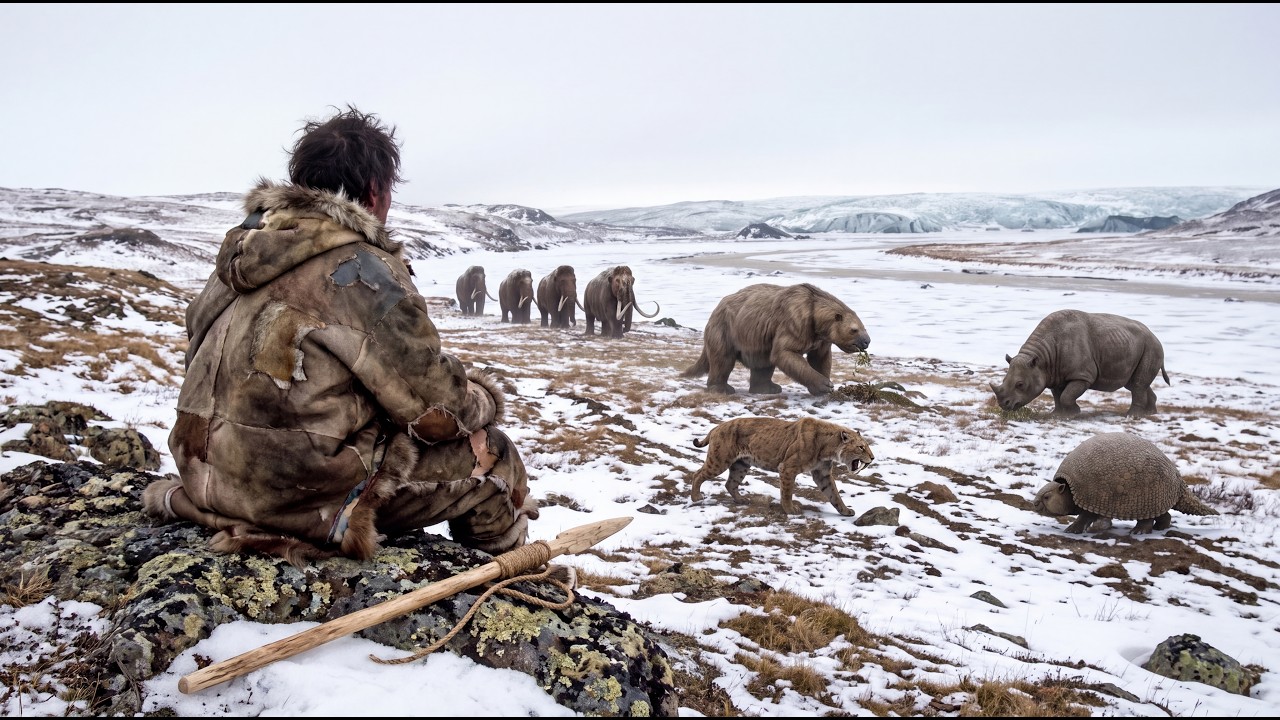
In the Americas, none of that. Entirely new land, for a single intelligent bipedal species. The fauna was naive too. Mammoths, mastodons, giant ground sloths the size of elephants, armadillos the size of a small car, saber-toothed tigers.
Huge animals that had never seen a human being. The megafauna did not know what was coming. Abundant game, rivers full of fish, varied vegetation in every region. Groups split apart, followed valleys, crossed mountain ranges, found new territories.
Within a few generations, each new landscape was discovered, named, inhabited. Mathematical models of population dispersal estimate that, with reproduction rates compatible with hunter-gatherer populations, about 1,000 years would have been enough for an initial group of a few hundred people to colonize the entire American continent. 1,000 years, on a geological timescale, is a blink of an eye. Simulations by British researcher James Steele of University College London, using demographic data from known hunter-gatherer populations, show that expansion rates of about 40 to 50 kilometers per generation would have sufficed to cover the entire continental extent in less than a millennium.
Each new generation settled a little further ahead than the previous one, in a wave-front expansion that, accumulated over generations, covered enormous distances. In Lagoa Santa, Minas Gerais, researcher Walter Neves and his team at the University of São Paulo spent decades studying the remains of ancient populations. Among those remains, one skull in particular became famous. Found in the 1970s by the team of Annette Laming-Emperaire, the fossil received a name that would enter Brazilian history: Luzia.
11,500 years old. Luzia was about 20 years old when she died. She was short, barely over 1. 5 meters.
She walked through the Brazilian Cerrado when it was colder and drier than it is today. The Lagoa Santa region back then was a mosaic of open fields, gallery forests along the rivers, and limestone caves used as shelter. Luzia and her people hunted small mammals, gathered Cerrado fruits, and buried their dead with care in specific grottoes. Systematic excavations conducted by the USP team over three decades revealed more than 200 skeletons in the region, forming one of the largest collections of prehistoric human remains in the Americas.
These individuals were buried over a period from approximately 11,000 to about 7,000 years ago. Tooth analysis shows a diet rich in fibrous plant foods, with dental wear characteristic of populations that chewed many roots and seeds. For many decades, she was considered the oldest Brazilian known. In 2018, the National Museum in Rio de Janeiro caught fire.
Luzia was inside. Hundreds of archaeological pieces were lost. But fragments of her were recovered from the rubble, reconstituted, preserved. She survived a second time.
In the hinterlands of Piauí, among reddish sandstone walls and dry canyons, lies a park most Brazilians have never visited. Serra da Capivara, a World Heritage site, guardian of more than 1,000 archaeological sites and stage of one of the greatest controversies in world archaeology. Brazilian archaeologist Niède Guidon of the Museum of the American Man Foundation devoted more than five decades of her life to studying these sites. Guidon arrived in Piauí in the 1970s, trained in Paris, and never left.
She founded a museum, trained generations of local researchers, and transformed a semiarid region forgotten by public authorities into one of the most important archaeological centers in the southern hemisphere. Beyond scientific work, Guidon built a local preservation network that included park rangers recruited from neighboring communities, training schools in archaeology and tourism, and a dating laboratory installed inside the park itself. In her view, researching the human past was inseparable from securing the livelihoods of families living around the sites. This integration of science and local development became an international reference.
According to her work, humans had been there far longer than conventional science admitted. In the deepest layers of a site called Boqueirão da Pedra Furada, chipped stones were found that, according to Guidon and her team, had been made by human hands. Carbon dating of charcoal fragments from ancient hearths produced numbers that seemed absurd: 50,000 years. Humans, 50,000 years ago, in the heart of Piauí.
The international scientific community pushed back hard, arguing the supposed charcoals could have come from natural fires and that the chipped stones could have fractured from falls, not human hands. The debate escalated in the 1990s when American archaeologist David Meltzer of Southern Methodist University published, with colleagues, a critical review of the site, pointing out what they considered methodological weaknesses. Guidon responded with new publications. The exchange turned tense, with mutual accusations of Eurocentric bias on one side and lack of rigor on the other.
The dispute continues to this day, unresolved. In 2022, a Franco-Brazilian team published a reanalysis of the site using modern optically stimulated luminescence dating. It confirmed human activity in layers of at least 24,000 years, still below the most extreme dates Guidon defended, but enough to place Serra da Capivara among the oldest sites on the American continent. One thing is undeniable.
On the rock walls of Serra da Capivara are thousands of cave paintings: human figures dancing, hunting, having sex, giving birth, burying the dead. Paintings that, even by the most conservative dating, are at least 12,000 years old. Some, much more. Brazil’s oldest art is in the sertão.
These images are not scribbles. They are narrative compositions, with scenes, characters, plots. In one panel known as the dance of the figures, dozens of people appear side by side, holding hands, in a kind of collective dance. In another, called the victim, a human figure lies fallen while others around it make gestures that seem to indicate mourning or ceremony.
There are birth scenes. There are scenes of organized hunting, archers flanking a large animal. There are scenes of combat between groups. The pigments were made from ground iron oxide mixed with vegetable resins or animal fat, a technique with impressive durability.
Millennia later, the red and ocher colors still vibrate under the sertão sun. Chemical analyses by teams from the National Institute of Amazonian Research and French laboratories identified at least four distinct types of pigment used in different periods. Red came from ground hematite, yellow from goethite, white from kaolinite, a clay rare in the region, probably transported from distant areas, and black from charcoal. This variety of materials indicates trade between groups from different regions long before European arrival.
These were people telling stories about themselves, millennia before the first pharaohs of Egypt, millennia before the first bricks of Mesopotamia. And most Brazilians never learned this in school. When Walter Neves’s team analyzed Luzia’s skull in the 1990s, something drew attention. The shape of her skull did not resemble that of any current Brazilian Indigenous people.
The proportions of the face, the prominence of the nose, the width of the eye sockets, all pointed to characteristics closer to populations of Africa and Australia than to populations of northern Asia. From this came a bold hypothesis: Luzia belonged to a first migratory wave distinct from the main ancestry of today’s Indigenous peoples. A wave that would have arrived earlier, by perhaps different routes, and was gradually absorbed or replaced by later groups from Asia. This hypothesis became known as the two-components model.
It provoked intense controversy. Some researchers argued the cranial differences were due only to local adaptation, not distinct migratory origins. Others argued the sample size was too small to draw conclusions about entire populations. For nearly two decades the debate remained heated, with publications contesting each other in international journals.
Then genetics made the story even more complex. In recent years, studies of ancient DNA, led by international laboratories including that of researcher David Reich at Harvard and the group at the Max Planck Institute in Leipzig, mapped the genomes of dozens of ancient individuals from the Americas. They found unexpected signals. In some Indigenous peoples of the Amazon today, especially among the Suruí, the Karitiana, and other populations of central Brazil, a strange genetic trait appears, a distant heritage reminiscent of the peoples of Oceania, Australia, Papua New Guinea, and the Melanesian islands.
There is a genetic ghost in the Amazon. Researchers named this mysterious heritage population Ipikuera, meaning ancestor in the Tupi language. The first study to formally identify this signal was published in 2015 by the team of geneticist Pontus Skoglund, then at Harvard, now at the Francis Crick Institute in London. The analysis compared the genomes of South American Indigenous peoples with current and ancient populations worldwide.
The result showed that while other Indigenous populations of the Americas do not present this trait, specific Amazonian groups carry a rare signature statistically linked to Australian aborigines and Papuans. How did this DNA get here? No one knows for certain. It may be that an ancient migratory wave carried this heritage through Asia and Beringia tens of thousands of years ago.
It may be that groups mixed at some point in the crossing. One hypothesis under discussion is that long before the main crossing, a small population originating from insular Southeast Asia advanced along the northern Pacific coasts, eventually mixing with the ancestors of Americans before entering the continent. This population would later have been diluted in almost all regions but survived, even as a genetic breath, in relatively isolated groups of the Amazon rainforest. In 2021, a new analysis led by Marcos Araújo Castro e Silva, a Brazilian researcher at USP affiliated with the evolutionary genetics group of Tábita Hünemeier, confirmed and refined this hypothesis.
The study, published in the journal PNAS, proposed that the genetic signal reached Brazil at least 15,000 years ago, probably brought by groups that entered through the Pacific coast and penetrated the interior following the great Amazonian rivers. What genetics confirms is that the history of the Americas was not a single migration. It was a sequence of waves, of mixtures, of encounters. And part of that history is still hidden in the living bodies of Indigenous peoples today.
When the first humans reached the south of the continent, they found animals that today exist only in paintings and museum skeletons. The South American megafauna was a spectacle in itself. Giant ground sloths nearly six meters tall. Giant armadillos called glyptodonts with shells the size of a small car.
Mastodons roaming the pampas. American saber-toothed tigers. Native wild horses of the Americas, extinct long before European horses returned. There was also the toxodon, like a robust hippopotamus grazing the South American floodplains.
There was the macrauchenia, a strange animal with long legs and a snout resembling a small trunk. There were giant birds of prey like the teratornis, with wingspans exceeding four meters. These were the inhabitants of Brazilian landscapes 20,000 years ago. In the regions corresponding to northeastern Brazil lived the giant ground sloths of the genus Eremotherium, weighing about four tons, larger than adult African elephants.
In the south, across the fields of Rio Grande do Sul and Argentina, groups of glyptodonts of the genus Doedicurus carried bony clubs at the tips of their tails, probably used in territorial combat between males. It was a bestiary comparable in diversity to modern Africa. In little time, geologically speaking, all of this disappeared. Between about 12,000 and 10,000 years ago, dozens of giant species went extinct simultaneously across the American continent.
Why? The answer has been debated for decades. Two main forces are under suspicion. The first is the end of the ice age itself.
The climate changed fast. Entire habitats vanished. Grasslands became forests. Dry forests became humid savannas.
Many large animals, specialized in certain vegetation, could not adapt. The second force is us. Humans arrived. They hunted, especially the large animals, because one such hunt fed an entire group for weeks.
And the naive megafauna let itself be approached. It had never seen a predator that attacked in groups, used spears, planned ambushes, and set traps with fire. In research led by Mário Dantas of UFBA and Castor Cartelle of UFMG, Brazilian experts in South American megafauna paleontology, evidence of interaction between humans and these giant animals accumulates at sites like Lagoa Santa, the Peruaçu Valley, and dozens of caves across central Brazil. Giant sloth bones with cut marks.
Stone tools mixed with glyptodont skeletons. Spear points embedded in vertebrae. In caves of Bahia and Minas Gerais, impressive sets of giant sloth bones from the genus Eremotherium were found, some with evidence they had been partially processed by humans. In sites in Rio Grande do Sul, stone flakes appear beside toxodon skeletons.
In certain limestone caves, the bones indicate humans specifically sought bone marrow and tendons, extremely nutritious parts of these large animals. In 2023, a team led by archaeologist Thaís Pansani of the Federal University of São Carlos published analyses of giant sloth bones found in Santa Helena, Mato Grosso, showing tool marks dated to more than 23,000 years ago. In one of the most surprising finds, osteoderms, small bone plates embedded in the sloth’s skin, had been transformed into decorative pendants with holes carefully made for hanging on a cord. Personal adornment made from a hunted animal.
Humans lived alongside the giants, and the giants disappeared. We were the last to see them alive. It was not a deliberate extermination. It was an unequal encounter between a defenseless fauna and a newly arrived, intelligent, organized species with fire in its hands.
Similar extinctions happened on other continents whenever modern humans first arrived. In Australia, about 40,000 years ago, with the arrival of the first Aborigines, a local megafauna vanished within a few millennia. In Madagascar, giant birds and large lemurs disappeared soon after human colonization of the island. In the Americas, the same pattern repeated.
And a silence settled over the landscapes of the Americas that lasts to this day. While in Europe and the Middle East the first cities were rising, while scribes engraved contracts on clay tablets, while pharaohs raised pyramids, here in the Americas another history ran in parallel. And that history did not stop. It never stopped.
The descendants of those first hunters who crossed Beringia continued, multiplied, diversified into thousands of peoples speaking thousands of distinct languages. It is estimated that at the moment of European contact, between 2,000 and 3,000 different languages were spoken in the Americas, each with its own grammar, its specific sounds, its worldviews embedded in vocabulary. It was one of the greatest linguistic diversities ever documented in any region of the planet. In 2020, a survey conducted by Brazilian linguist Luciana Storto of USP catalogued more than 150 Indigenous languages still spoken in Brazil, belonging to nearly 40 distinct language families.
For comparison, all of Europe has approximately 300 living languages, grouped into half a dozen families. Brazilian linguistic diversity, even after centuries of erasure, remains among the greatest in the world. In the north arose the Mississippian cultures, builders of ceremonial mounds that still mark the American landscape today. The city of Cahokia, in present-day Illinois, housed between 15,000 and 20,000 people at its peak around the year 1000 CE.
It had ceremonial plazas, earthen pyramids, and an astronomical alignment of wooden posts called Woodhenge by archaeologists, used to mark the solstices. At that time, it was larger than most contemporary European cities. In Mexico and Central America flourished the Olmec, the Maya, the Aztec. Civilizations with astronomical calendars of impressive precision, with stone cities rivaling anything in the Old World.
The Maya developed a complete writing system of about 800 glyphs, capable of recording poetry, dynastic history, and astronomical treatises. They could calculate eclipses with minute-level precision. They built observatories whose orientation remains, to this day, perfectly aligned with the movements of Venus and the Sun. The Mayan Haab calendar, with 365 days, was combined with the Tzolkin in a system of high astronomical precision.
The Tzolkin calendar, of 260 days, was used in parallel for ritual and astrological records. The combination of the two cycles produced a calendar wheel that repeated every 52 years, structuring the social, political, and religious life of millions of people. In the Andes arose the Inca, heirs to a millennial lineage that included the Moche, the Nazca, the Tiahuanaco. Agricultural terraces climbing mountains of 5,000 meters.
Highways crossing continents. The Inca road network, called the Qhapaq Ñan, totaled more than 30,000 kilometers, crossing deserts, mountain ranges, and tropical forests. Suspended bridges of plant fibers spanned canyons hundreds of meters wide. Runners relayed information between Ecuador and Chile in a matter of days.
All of this without the wheel, without large pack animals, without writing in the Western sense. Here in Brazil, Indigenous peoples whose names the colonizer tried to erase, but whose histories archaeologists are recovering. In the Amazon, far from images of untouched forest, studies led by researchers such as Eduardo Góes Neves of USP and Denise Schaan of UFPA revealed something surprising. The Amazon rainforest was, for millennia, a densely inhabited territory.
Terra preta, a type of dark, fertile soil created by human action over centuries. Geoglyphs discovered in Acre, giant geometric figures dug into the ground. Traces of villages organized in circles, with central plazas and radial paths. The so-called Indian dark earth is one of the most studied finds of recent Amazonian archaeology.
Researchers from the Emílio Goeldi Paraense Museum and the National Institute of Amazonian Research demonstrated that this soil was deliberately created over centuries by mixing charcoal, organic remains, crushed bones, and broken pottery. The result is soil up to three times more productive than the natural soil of the rainforest, capable of retaining its fertility for millennia. The Acre geoglyphs, revealed in recent decades when stretches of forest were cleared for agricultural expansion, number in the hundreds of structures: perfect circles, squares, octagons, up to 300 meters in diameter. They were built from about 2,700 years ago, possibly for ceremonial or astronomical purposes.
Their existence directly contradicts the idea that pre-colonial Amazonia was empty. Pre-colonial Amazonia may have housed millions of people. Farmers, engineers, astronomers, traders. The forest was a scattered city.
On the lower Amazon, in the Marajó archipelago, arose the so-called Marajoara culture, with elaborate ceramics, funerary mounds, and complex social hierarchies. This all existed 1,000 years before the Portuguese arrived. The Marajoara pieces, studied in detail by American researcher Anna Roosevelt at the Emílio Goeldi Paraense Museum, show notable technical and aesthetic sophistication. Funerary vessels painted in black, red, and white, with stylized human and animal figures, complex geometric forms.
The region’s ceramic technology dates back more than 7,000 years, making it one of the oldest in the Americas. Recent research by Cristiana Barreto, also of the Goeldi Museum, identified recurring patterns in Marajoara ceramics suggesting the existence of a structured mythology, possibly linked to cults of female entities and shamanic transformation. Anthropomorphic funerary urns, some up to a meter tall, contained the remains of high-status individuals, buried with elaborate offerings and mineral pigments. It was a society with stratification, with religious specialists, with well-defined ruling classes.
The idea that pre-Cabraline Brazil was inhabited only by small nomadic groups is a colonial myth. The reality was different. It was a dense network of sophisticated societies, shaping the land, inventing unique agricultural techniques, building a relationship with the forest that the modern world is only now beginning to understand. And that is a version of Brazilian history that took far too long to reach the books.
The arrival of Europeans, five centuries ago, brutally interrupted a continuity of more than 20,000 years. It is estimated that the Indigenous population of the Americas at the moment of contact was around 60 million. Within little more than 100 years, that population fell to fewer than 6 million. 90 percent.
Diseases brought by Europeans, against which American peoples had no defense: smallpox, measles, influenza. Added to that was the violence, the enslavement, the forced displacement. It was one of the greatest demographic collapses in human history. And yet, the lineage did not vanish.
Today, more than 50 million people in the Americas identify as Indigenous. They still speak more than 1,000 distinct languages. They preserve knowledge about plants, about the sky, about rivers, that modern science is still discovering. In Brazil, according to the most recent census, more than 1.
5 million people declare themselves Indigenous, belonging to about 300 different peoples. Each of these peoples is a direct heir of that young woman who walked with a child in her arms through wet mud at White Sands, 23,000 years ago. In 2024, new footprints were discovered at other sites in the western United States. In caves of Mexico, stone tools were attributed to layers up to 30,000 years old, though those dates are still under debate.
The story of the first Americans continues to be rewritten. We still do not know when we arrived. And perhaps we will never know with total precision. But what science has been revealing, decade after decade, is that we came earlier, that we came by more routes, that we were more numerous and more inventive than official history long allowed.
The next footprint is still out there, in some forgotten sediment, in some unexcavated cave, in some submerged stretch of the ancient Pacific coast. Waiting for someone, one day, to find it.






