They came out of the Gray Well on the seventeenth day, and the first thing the county noticed was that they did not need the litters they had been carried up on. They sat up, squinted at the gray October light, and asked mildly what all the fuss was about. They were not thin. That was the thing the doctor from the river town fixed on first and could not get past.
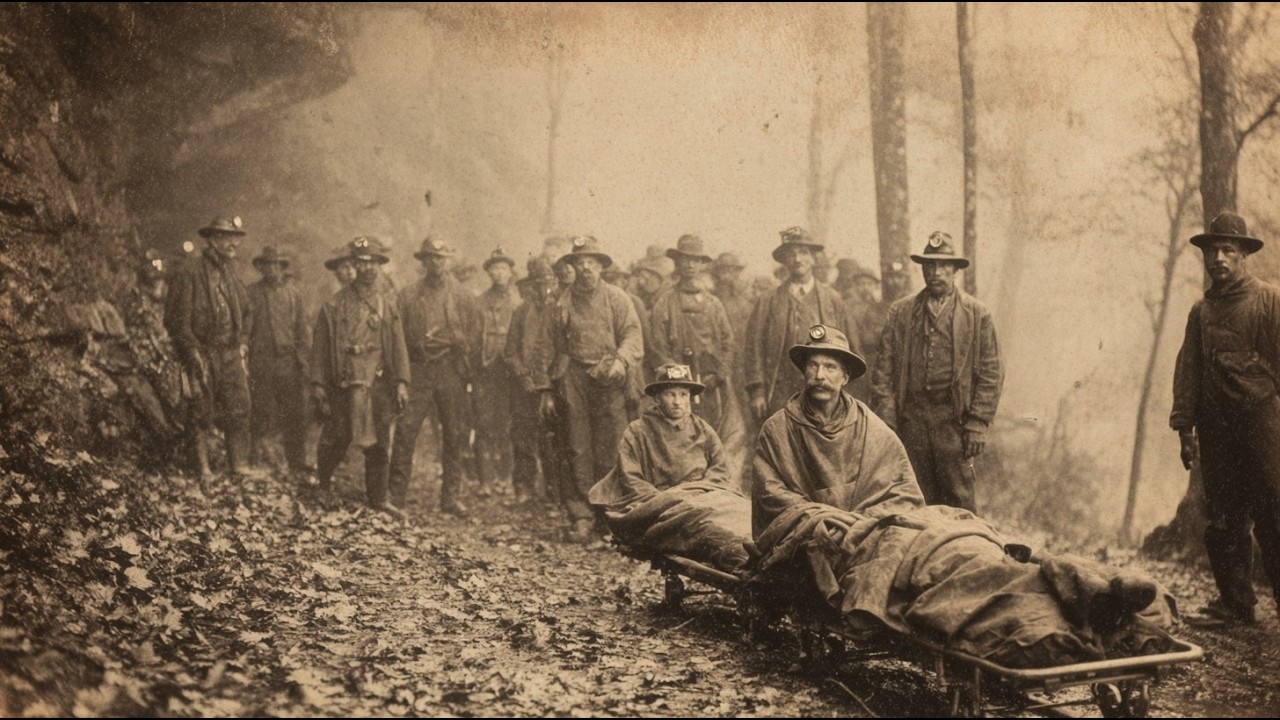
They were not thin. If anything, Lemuel Garrick had filled out a little in the face, and he was a man who had carried no more than three days of food past the front room. Their lamps had no carbide left, which meant they had spent days in absolute dark, and yet their eyes were not right for that either. A man who has been weeks in true blackness brought into daylight will weep, will clutch his face, will beg you to put the light out.
These three only narrowed their eyes the way you do at a window in the morning, like they had been somewhere that had a light of its own. When Verlie Ashmore asked her brother gently, her hand shaking on his arm, how they had lived, how they had borne seventeen days down in the cold, Asahel Pruitt looked at her with a small puzzled smile and said the thing that started the county down the road it ended on. “Seventeen days? Verlie, we were down there one evening.
”
He said it the way you would correct somebody who had got the date of a church social wrong. No fear in it. A little amusement, even. The other two nodded along, agreeable, like the matter was not worth arguing about.
The doctor wrote it down, made a note that men in great distress will lose their sense of time. That is a true thing, that happens. But it did not sit right, and you could see it did not sit right with him as he wrote it. Seventeen days is not an evening.
And a man does not come out of the dark fed. This was the place they came out of, and the place I have to tell you about, because you cannot understand what happened in Cane Hollow in the autumn of 1931 without understanding the ground it happened over. There are stretches of that country where the ground is not as solid as it pretends to be, where you can stand in a hayfield in the full noon sun, stamp your boot, and hear something underneath you answer back hollow. The Ozarks are like that.
Limestone country, old as anything, worn down soft and green on top, and underneath, all eaten away. Water has been at work down there longer than there have been people to notice, carving patient, in no hurry at all. And every so often the top of one of those rooms gives way, and a piece of the world just drops out from under a man’s feet. The year was 1931, and in a place like Cane Hollow, that meant lean.
It meant the banks down in the river towns had gone quiet and the work had gone quiet with them. A man counted himself fortunate to have a mule, a roof, and a reason to get up. It was the kind of year that made people listen when somebody came around with money in his hand and a question that sounded simple. The man with the money was named Cyrus Holloway.
Forty years old, maybe a year past it. Lean as a fence rail and dressed a notch better than the country he was standing in. He came up from a limestone concern down river, the sort that bought the right to dig into a hillside and haul out whatever paid. What Holloway wanted was somebody who knew the underground of Cane Hollow the way other men knew their own back forty.
That was Obed Carraway, forty-six years old, a surveyor by training, a guide by trade, and a caver by something closer to hunger. He was a big man, Obed, broad through the shoulders in a way that made low passages a misery for him, which tells you he loved the work, because a sensible man that size would have stayed up in the daylight where he fit. His hands were a story all by themselves, wide and knuckled, the skin gone hard and seamed from rope and rock, with two fingers on the left that never closed all the way from a fall in a wet chimney when he was younger and stupider. He had a slow way of talking, like he was reading each word off a wall before he said it.
And he had eyes that had spent too long looking into places without light, so that even up top in the sun they seemed to be waiting for them to adjust. Holloway wanted the Gray Well mapped. The Gray Well was the big one. Everybody in Cane Hollow knew its front room, a wide cold mouth in the side of a ridge where the kids used to dare each other in years past, and the old folks left jars of milk to keep cool.
But past the front room it went back and down, and nobody local had ever followed it to the end, because as far as anyone could tell, it did not have one. Holloway’s company thought there was good clean stone back in there, worth the hauling. He needed it surveyed before he would spend a dollar. So Obed Carraway took two men in with him on a Monday morning in the back end of October, meaning to be out by Thursday.
The first was Lemuel Garrick. Garrick was the company’s own man, thirty-eight, a rock reader, slight and quick and certain of himself in the way of men who have gone to school for a thing the rest of us learn by getting hurt. He carried the maps and the instruments and most of the opinions. The second was Asahel Pruitt.
Asahel was Cane Hollow born and forty-four years old, a trapper and a digger, and the only other man in the county who would go down the Gray Well for love instead of money. He was small and bent and gray before his time, with a face that never told you much. And he was the one who did not want to go that week. He had said so.
He had said the cave did not feel right that fall. Said the air coming out of the mouth had changed, that it used to come out cool and dead and even the way cave air does, and that lately it came out in a slow breath, in and then out, like the hill had taken up sleeping. Garrick had laughed at him. Obed had not laughed, but Obed had a wife who needed the dollar and a county full of neighbors who would take the work after him if he turned it down.
So he packed his carbide and his rope, and he told Asahel that a hill is a hill, and they went in. Three men, Monday morning. Carbide lamps hissing on their hats, throwing that little white circle of light that is all you ever get down there. The county watched them go in, and then the county went back to its harvest, and waited for Thursday.
Thursday came. They did not. Waiting on men in a cave is the worst kind of waiting there is. When a man is lost in the woods, you can go in after him and call his name, and the trees will pass it along.
When a man is lost on the river, you watch the water, and you hope, and you have somewhere to look. But a cave gives you nothing. You stand at the mouth of it, and you holler down, and the dark just takes the sound and keeps it. No echo, even.
Just gone. The first search party went in Friday, six men with what light they could scrape together. They found the rope Obed had run, his mark line, his little stacks of stone meant to point the way back. They followed it down past the front room, past the wet crawl they called the birth canal, because of how it squeezed down into the deep stuff.
And the line just stopped. Did not break. Did not fray. The end was coiled neat and tied off to a knob of rock, the way Obed tied off when he meant to stop running line and go on by feel.
Past that, nothing. No tracks they could read in the wet, no lamps, no men, no answer. Just the cold, and that breathing the hill did, in and out. They came up white in the face and short on words.
The days went by. Three, then five, then a week. They brought up help from the river towns. They brought a man who had dug coal and knew bad ground.
They brought ropes by the wagon load and lamps and a fellow with a notion about lowering a string of bells. And every single day somebody went down into the Gray Well and followed the line to the end of it and stood there in the cold and called three names into a dark that gave nothing back. By the tenth day, the praying had changed. At first you pray for a man to be found.
Then, when enough time has gone by and you have done the arithmetic of how long a person lasts down there without water, you stop praying for that and you start praying for something quieter. For a body to bring up. For a grave to stand at. For an ending you can bear.
By the fourteenth day, the county had let them go in its heart. Asahel Pruitt’s sister, a hard-handed widow named Verlie Ashmore who kept the store and the telegraph key, had already put black cloth on her door. She was the one who had argued loudest that the search should stop, not out of meanness, but because she had buried enough people to know that hope kept too long turns into something that eats you. “They’re with the Lord or they’re with the hill,” she said, “and the hill don’t give back.
”
She was wrong about that. On the seventeenth day, the hill gave them back. It was a young hired man, twenty-two years old, named Dale Renfro, who had gone down on the morning search more out of duty than hope. He was at the end of the line at Obed’s last knot, doing what they all did now, which was standing there a minute in the cold so he could go back up and say honestly that he had looked.
And he called the names. Carraway. Garrick. Pruitt.
And out of the dark past the end of the line, out of the part of the cave that had no tracks and no answer and no end, a voice came back. “We’re here,” it said. Plain as that. Calm as a man answering his own front door.
“We’re here. Took you long enough. ”
Renfro near fell into the water. He told it after that he stood there and could not make his legs do anything, and that the worst part was not fear, it was the everydayness of the voice.
Seventeen days. A man who had been seventeen days lost in the cold dark, past the reach of food and water, should not have sounded like a fellow you had kept waiting at a fence gate. But there it came again. “That you, Dale?
Lights no good back here. Come on and fetch us. ”
And it was Obed Carraway’s voice. Renfro went back up that line faster than any man had ever gone up it, and he came out of the mouth of the Gray Well screaming that they were alive, all three, alive and talking.
The whole county dropped its harvest and ran. For about an hour it was the gladdest day Cane Hollow ever had. Then the men got a real look at the three they had carried up. Obed Carraway was the quietest of the three.
His wife had run to him at the mouth of the cave and thrown her arms around his neck. The men who saw it said that he hugged her back and patted her, kind enough. But that over her shoulder his face had no more weather in it than a stone. And that when she pulled back and looked at him and said his name, he looked at her for a beat too long.
Just a beat, the way you look at a person whose face you know you ought to know. Then it passed. And he smiled and called her by her name, and everyone told themselves it was the daylight and the shock and seventeen days. Seventeen days will do strange things to a man.
That became the sentence the county leaned on. They leaned on it hard that first week, because the alternative was to ask what had really happened down the Gray Well. And nobody wanted to be the one to ask it out loud. The trouble did not come back all at once.
It came back the way Obed always said the deep cave came at you, a little at a time, so you can talk yourself out of each piece. The first piece was the counting. Verlie Ashmore noticed it in her brother. Asahel had always been a quiet man, but now he had gone quiet in a new way.
And if you watched his lips when he thought he was alone, he was counting under his breath. Slow and even. One, two, three, four. And then he would start again.
She asked him about it once, and he looked at her surprised and said he did not know he was doing it. Then he said a thing she never repeated to anybody until she was an old woman and it did not matter anymore. “There’s four of us, Verlie. I keep losing the count of the fourth.
”
And she said, “There were three. Three men went into the Gray Well. ” And Asahel got a look on his face like a man trying to remember a dream that is already half gone. And he said, “Were there?
”
The second piece was the smell. The three men carried it out of the cave with them, and it did not wash off. It was not a bad smell, exactly, and that was what made it terrible. It was cold.
It was the smell of deep stone and standing water and something underneath that, something faintly sweet, the way the air gets in a cellar where something has been put up to keep and then forgotten. People said you would be talking to Garrick or to Obed and you would catch it and find yourself stepping back without meaning to, the way an animal steps back. It got stronger when they were upset. And it got strongest, several people swore, at three in the morning, whether the men were near you or not.
You would wake in your own bed across the hollow and the room would be full of that cold sweet cellar air, and you would lie there and know, the way you know things at three in the morning, that somewhere one of the three men was awake too. And counting. The third piece was the thing about Lemuel Garrick. Garrick had been the company man, the certain one, the one who laughed at Asahel’s notions about the hill breathing.
He held out longest at being normal. He went back to work for Holloway. He kept his maps. And about three weeks after they came up, he came to find Obed Carraway in the evening, and he was not certain anymore.
He had brought his survey of the Gray Well, the one they had been making the day they went in, and he laid it out on Obed’s table by the lamp and put his finger on it, and his hand was not steady. “Obed,” he said, “where did they find us? ”
And Obed, who had been very quiet for three weeks, who had been sleeping less and less and counting more and more, put his own finger on the map at the end of his marked line, at the last knot, and he said, “There. Past there.
Back of the line. ”
And Garrick said, “There’s no back of the line, Obed. ”
And he showed him. He showed him on his own survey, in his own neat hand, that the line ended at a wall.
A solid wall of stone. The cave did not go on past Obed’s last knot. It had never gone on. There was nowhere for three men to have been for seventeen days, because there was no farther in.
They had been found alive in a place that did not exist. Garrick had measured it himself. He had put his own hand on that wall. And he could not, for the life of him, explain how three men had answered Dale Renfro’s call from the other side of solid rock.
The two men sat in the lamplight and looked at the map, and neither of them said the next thing, because the next thing was a door neither of them wanted to open. If the cave ended at the wall and they had come from past the wall, then where had they been? And who, exactly, had come back? Nobody who was there ever claimed to know.
But they noticed things. They noticed that the three men never disagreed. Three men who had been friends and rivals and strangers, who had argued about everything on the way down, now finished each other’s sentences and turned their heads at the same moment towards sounds nobody else could hear. And counted, all three, under their breath to four.
They noticed that the dogs would not go near them. Cane Hollow was full of hounds, the way that country always is, and not one of them would come within a stone’s throw of the three men after they came up. They would set up a low, steady whine, not quite a growl, and back away stiff-legged, and not stop until there was a wall between them and the men. And they noticed the dark.
The three men had no more use for lamps. They would sit of an evening with the fire down to coals and no light lit, the three of them in a house in the black, content. Verlie Ashmore came on her brother that way one night. Came over to bring him supper and found the house dark and silent and lit her own lamp and found Asahel sitting at the table in the pitch dark and across from him two empty chairs.
But she said, and she swore this to her dying day, that when her lamp first caught the room for just the smallest part of a second, there had been a fourth chair pulled up and someone in it. Then her eyes settled. And there were three chairs and two were empty. And only her brother sat there smiling at her, saying she should not trouble herself coming all this way after dark.
Obed Carraway was the one who finally did the thing nobody else would do. He went back down into the Gray Well. It was December by then. Cold up top, colder in the ground.
He told his wife he was going to seal it. Holloway’s company had lost its taste for the limestone after all the trouble, and the county wanted that mouth shut for good, and Obed said he would run a last line, set the charges right, and bring the front of it down. But that was not the whole of why he went. And his wife knew it.
He went because he could not sleep. And he could not stop counting. And he had begun, late at night, to remember things that had not happened to him. He would lie in the dark and remember a place, a wide cold room far down with a light to it that did not come from any flame, a soft gray light that seemed to come up out of the stone itself.
And a long low sound in that room that he understood somehow to be talking, though no words came in it. And he would remember being content there. Glad, even. And he would wake up with the count on his lips, one two three four, and his wife awake beside him stiff with fear.
Because the room would be full of that cold sweet cellar smell. And it would be exactly three. So he went down to seal it, and to find out whether the place in his head was real. He took Dale Renfro with him to the front room, no farther, and told the young man to wait there at the mouth with the charges and a watch.
And that if Obed was not back up by full dark, Dale was to set the charges himself and bring the hill down, whether Obed was out or not. Dale argued. Obed did not. He just looked at the young man with those eyes that had spent too long in the dark.
And Dale stopped arguing. Then Obed Carraway lit his lamp and went down the Gray Well alone, following his old line into the cold, to the last knot, to the wall that Garrick had measured, the wall the cave ended at. Here is what Dale Renfro waited through up at the mouth in the gray light with his watch. For a long while, nothing.
The ordinary nothing of a cave, drip and cold and the small sounds of the hill. Then the hill started to breathe. Dale felt it on his face. A slow draw of air down into the mouth, and then after too long a pause, a slow push of it back out.
In and out. And the out-breath carried that smell. Cold, sweet, the forgotten cellar. And under the smell, far down and faint, came a sound that Dale Renfro spent the rest of his life trying not to hear again.
It was Obed Carraway’s voice. But it was not calling for help. It was talking low and easy and glad, the way a man talks to old friends he has been too long away from. And there were other voices answering him.
More than two. Dale could not count them. He said it was like trying to count rain. But the longer he listened, the surer he was of one thing, which was that the conversation down there was happy.
And that it had been going on, in some sense, the whole seventeen days and longer. And that Obed Carraway had only ever been allowed back up to fetch the rest of himself. Dale watched the light go out of the sky. Right at the edge of full dark, right when his hands were already on the charges and his nerve was already gone, he heard Obed call up the cave to him.
Clear, calm. “Dale. Set them. Don’t wait on me.
” And then, after a breath, in a voice that had something underneath it now, something that was no longer all the way Obed’s: “There’s four of us coming up. Set them before we do. ”
Dale Renfro set the charges and ran. He brought the front of the Gray Well down on itself in the last of the December light.
A roar, and then a fist of cold air punched out of the collapsing mouth and knocked him flat in the leaves. That cold sweet cellar air. The whole breath of the hill let out at once. And then, stillness.
The hill that had taken up breathing stopped, and nobody ever heard Obed Carraway again. But that is not quite the end. It almost never is with these. You would think with the cave sealed and Obed buried in it that Cane Hollow could finally close the book.
For a while it seemed it might. The smell faded out of the houses. The dogs settled. But there were three men brought up alive, and only one of them went back down.
Lemuel Garrick left the county that winter, went back down river to wherever men like him go, and the people of Cane Hollow lost track of him on purpose, the way you let go of a thing you do not want to be holding. But Verlie Ashmore had a cousin in a river town who wrote her years on about a surveyor who had come to work for the waterworks there. A quiet, certain man, well thought of, except that he kept no lamp in his house, and the people in the rooms next to his complained some nights of a cold sweet smell, and of hearing him through the wall late, talking low and glad to people who were not there, and counting. Asahel Pruitt never left at all.
He lived out his years in his sister’s care down in Cane Hollow, gentle and quiet, and not quite present. The only trouble he gave her was at three in the morning, when she would find him at the back door, not trying to go out exactly, just standing, facing the ridge where the Gray Well used to be, listening. And once, near the end, she asked him what he was listening for. He turned and looked at her with that small puzzled smile he had come up out of the cave wearing, and he said, “He’s still down there counting, Verlie.
He keeps getting to three. He can’t ever quite get the fourth one to hold still. ”
Then he said the thing that closed the door on it for her for good. He said, “I think the fourth one’s me.
I think part of me’s been down there since October, and I’m only up here borrowing the rest. ”
He died in his sleep that same winter. Peaceful, the doctor said. But Verlie was the one who found him, and she said that the window of his room was standing open to the cold, and the room was full of that smell.
And on the floor by his bed in the frost that had come in, there were footprints coming in from the open window, stopping at his bed. And only one set going back out. She had the ridge dynamited a second time after that, deeper, to be sure. And she put it about that there had only ever been three men in the Gray Well, and that two of them came home, and one of them died in the dark.
That is the story Cane Hollow agreed to tell, and the reason the county does not go by its name anymore. But she told her own granddaughter, when she was very old and past caring how it sounded, that the hill never gives back what it takes. It only ever sends something up wearing the shape of it to fetch the rest, a little at a time. One, two, three.
And then, if you are not careful, and if you answer when it calls your name out of the dark past the end of the line, four.






