At the end of March 1945, with the German occupation of the Netherlands crumbling around them, the Dutch police acted on a tip. They arrested Adriana Valkenburg and her husband Joop Boleij and took them to the internment camp at Meijlust in Bergen op Zoom. The information that led to their capture had come from Valkenburg’s own sister. By then, Valkenburg was one of the most feared people in the country, a woman who had built a reputation as a savior of Jews while secretly delivering them to the Nazis.
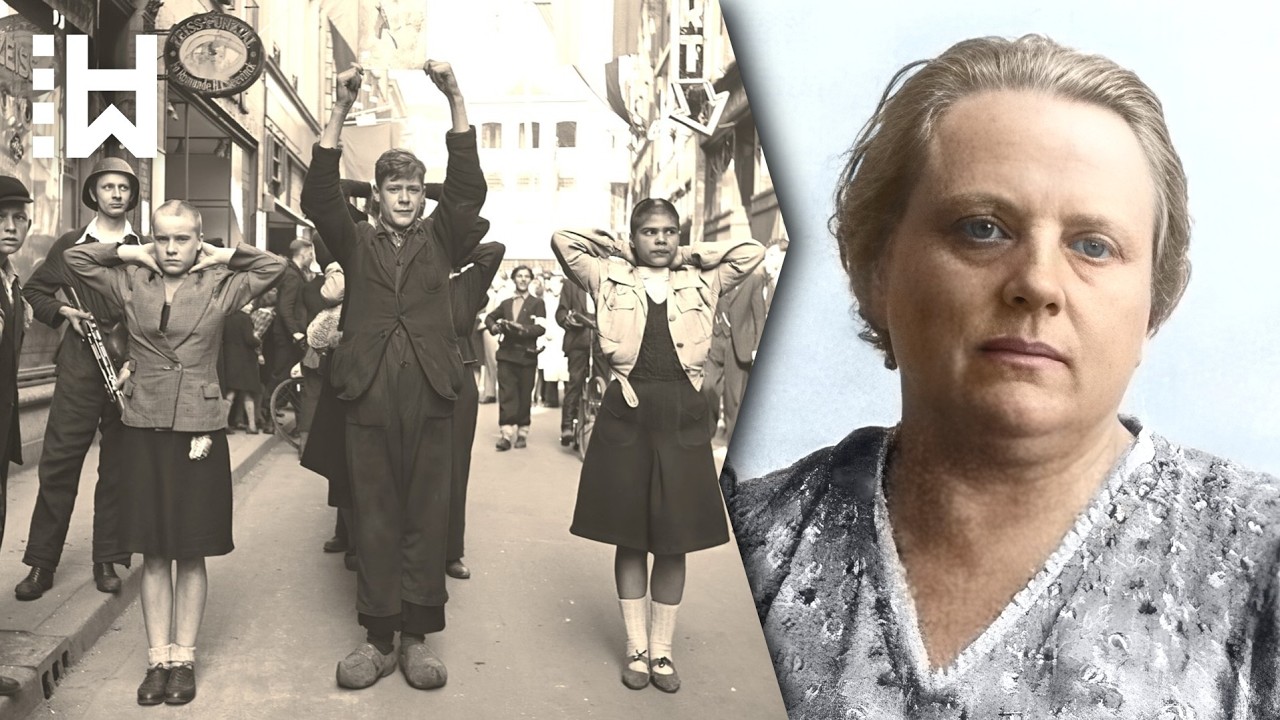
Her arrest marked the end of a career in betrayal that had sent dozens of people to their deaths, and it opened the final chapter in the life of a woman who had gone from brothel keeper to one of the most notorious collaborators in occupied Holland. Adriana Valkenburg was born Adriana Schoen Valkenburg on June 10, 1894, in the Dutch city of Schiedam. She was the fourth of fourteen children born to Jacob Valkenburg, a butcher, and his wife Adriana Cornelia de Ligt. Her childhood was marked by constant conflict.
Her father was strict and often violent, and her mother neglected the children. Hatred, jealousy, and frequent quarrels among family members became part of daily life. Valkenburg attended primary school until the age of thirteen, then spent one year in a domestic science school. After that, she helped her mother manage the household, but she also began attracting the attention of the police.
In 1911, she was reported for a public indecent act. The following year, she was accused of stealing a gold ring. Around the same time, her parents divorced, adding further instability to an already troubled childhood. At eighteen, Valkenburg found work as a seamstress at the Hirschmann fashion store in Rotterdam.
In 1916, she began a relationship with a wealthy shipbuilder named Jan Bot, who provided her with financial support and a place to live. Later that same year, she unexpectedly married a Jewish businessman, Jacob Stip, whom she had met only shortly before. The marriage lasted just a few weeks before Stip disappeared without a trace. After spending several months with one of her sisters, she settled in Amsterdam in 1918, where she resumed her relationship with Jan Bot.
By the early 1920s, Valkenburg had built a second source of income alongside her arrangement with Bot. She worked as a prostitute and later became the owner of several brothels in Amsterdam and The Hague. During this period, she became involved with a bartender named Arnoldus van Lerzem, who soon began living off her earnings. Valkenburg tried repeatedly to prosecute him for pimping, but her efforts failed.
After years of legal battles, she finally ended the relationship in 1933, though the long court fights had drained much of her wealth. Despite these setbacks, Valkenburg became a well-known figure in Amsterdam’s criminal underworld. A former police commissioner, Hendrik Voordewind, later described her as strikingly beautiful, tall, blonde, with a very handsome face and a regal bearing. The police and the criminal underworld knew her by the nickname “Zwarte Jan” or “Jan the Fake,” a reflection of her reputation for manipulation, deceit, and intrigue.
Over the years, she accumulated twenty-one police records for prostitution, drunkenness, brawling, and other offenses. By the mid-1930s, Valkenburg had also begun performing illegal abortions alongside her brothel operations. In December 1938, she was sentenced to nine months in prison for these activities. When she was released in June 1939, her circumstances had changed dramatically.
Jan Bot had withdrawn his financial support. The brothels she had managed were closed, and she was left with almost nothing. Forced to seek help from social services, Valkenburg returned to working as a street prostitute to survive. The Second World War began on September 1, 1939, when Nazi Germany invaded Poland.
For eight months, the Netherlands remained neutral, hoping to stay out of the conflict. That hope vanished on May 10, 1940, when Adolf Hitler launched a surprise attack on the country without a declaration of war. German paratroopers seized key bridges and airfields, while the Luftwaffe, the German air force, bombed Rotterdam, killing hundreds of civilians and destroying the city’s historic center. Faced with the threat of similar destruction elsewhere, the Dutch army surrendered after only five days.
Queen Wilhelmina and the government fled to London, and the Nazi occupation began. Over the following months, the Nazis imposed increasingly restrictive measures against the Jews. Jewish businesses were seized, and their civil rights were stripped away. On February 22 and 23, 1941, German troops raided the Jewish quarter of Amsterdam, arresting and deporting more than 400 Jewish men to the Buchenwald and Mauthausen concentration camps.
The Dutch people’s reaction was unique in Nazi-occupied Europe. They organized the February Strike, a general strike that lasted two days, beginning on February 25, 1941. German officials brutally suppressed the strike. This was followed by a tightening of Nazi policy.
German authorities, along with collaborating Dutch civil authorities and services, isolated Jews from the general Dutch population and imprisoned 15,000 of them in German-run forced labor camps. The Germans then ordered Jews to concentrate in Amsterdam and sent foreign and stateless Jews to the Westerbork transit camp in the northeast of the country. Some of the remaining Jews in the provinces were sent to the Vught camp. Signs reading “Jews Forbidden” appeared on the doors and gates of cafés, swimming pools, sports fields, museums, zoos, libraries, theaters, markets, and many other public places.
Jews had to surrender their valuables, and their businesses were confiscated. On April 29, 1942, regulations were announced in the Netherlands forcing Jews to wear the yellow Star of David on their clothing as a means of identification. Anyone caught without the badge after May 5, when the regulations took effect, was arrested and held for six weeks of labor at the Mauthausen camp. In the Netherlands, everyone knew this meant a death sentence.
The deportation of Jews from the Netherlands began in July 1942. The last train left Westerbork for Auschwitz on September 3, 1944. During those two years, the Germans and their Dutch collaborators deported approximately 107,000 Jews, most of them to Auschwitz and Sobibor in German-occupied Poland, where they were killed. Only 5,200 survived.
In addition, between 25,000 and 30,000 Jews went into hiding with the help of the Dutch resistance, and two-thirds of them managed to survive. For Adriana Valkenburg, the war reached a turning point in 1942. By that time, she was living on Vonen Oosterdokstraat in Amsterdam with Jacob Akohien, a Jewish market trader she had first met in 1931. Their relationship had begun as one between a john and a prostitute, but it had developed over the years into a romantic partnership.
Valkenburg planned to marry Akohien on April 2, 1942, hoping that a mixed marriage would protect him from deportation. But before the marriage could take place, German authorities arrested him and deported him to the Mauthausen concentration camp, where he later died. After his arrest, Valkenburg began presenting herself as someone willing to help persecuted Jews. She arranged hiding places, helped organize escape routes, and quickly gained the trust of many desperate people seeking to avoid deportation.
However, she also demanded huge sums of money for her help, exploiting those who had no other options. By the spring of 1943, these activities attracted the attention of the Sicherheitsdienst, known as the SD, the intelligence service of the SS. Facing the risk of arrest herself, Valkenburg agreed to work with the Jewish Affairs Bureau, the German-controlled organization responsible for identifying and arresting Jews in occupied Holland. From that moment, the woman who had presented herself as a rescuer became a kind of Nazi poison within Amsterdam’s Jewish community.
Exploiting the trust she had built with Jewish families, she directed many of them to fake hiding places or addresses under her control. These traps allowed the so-called Jew hunters to arrest victims who thought they were on their way to safety. In return, Valkenburg received financial rewards, along with sums tied to property confiscated from those she had betrayed. As Valkenburg’s cooperation with the German occupation authorities intensified, she established close relationships with some of the most notorious Jew hunters in the Netherlands.
Among them was Pieter Schaap, one of the most terrifying collaborators in the country. She also entered into a brief relationship with Otto Campin, the German officer who headed the Jewish Affairs Bureau in Amsterdam. Through payments for each successful arrest and rewards tied to confiscated Jewish property, Valkenburg amassed huge sums from her activities. In the summer of 1943, after another Dutch collaborator was assassinated by the resistance, Valkenburg moved to a new address on Zuider Amstellaan in Amsterdam.
During the move, she met a manual laborer named Joop Boleij. The two soon became partners, both personally and professionally, and continued operating the so-called Jewish traps together. On November 16, 1943, Valkenburg and Boleij married. As Allied forces advanced through Western Europe during 1944, the German occupation of the Netherlands began to collapse.
On September 5, 1944, a day known in Holland as “Dolle Dinsdag” or Mad Tuesday, false reports spread that Allied forces had already crossed the Dutch border. Panic broke out among many Dutch collaborators who feared immediate retribution. Valkenburg and Boleij fled south and found temporary refuge with one of her sisters in the city of Bergen op Zoom. Their flight did not last long.
Based on information provided by Valkenburg’s own sister, Dutch authorities arrested the couple on March 31, 1945, and took them to the internment camp at Meijlust in Bergen op Zoom. The Second World War in Europe ended on May 8, 1945. By that time, it is estimated that Valkenburg had betrayed around fifty Jews, including relatives of one of her former lovers. At least thirty-three of the people she betrayed died during the Holocaust.
On July 3, 1947, the special court in Amsterdam sentenced Valkenburg to death for her wartime crimes. Two years later, in 1949, the special Court of Cassation upheld the sentence. However, later that same year, she received a pardon, and her sentence was commuted to life imprisonment. In 1959, her sentence was reduced to twenty-two years, and in January 1960, she was released after serving nearly fifteen years in prison.
After her release, Valkenburg lived a largely isolated life in Amsterdam, then in the border village of Put. Apart from occasional contact with her half-brother Jules de Ligt, she had little contact with her family. During the 1960s, her excessive obesity confined her to a wheelchair.
When Adriana Valkenburg died in Bergen op Zoom on February 19, 1968, she was seventy-three years old.






