The needle went in, and the heart that had survived twenty years of chemical assault fluttered and stopped. For days, the body lay on the floor of the velvet-draped flat in Chelsea while London hummed outside the drawn curtains. The post piled up behind the door. The sun rose and set over the rooftops.
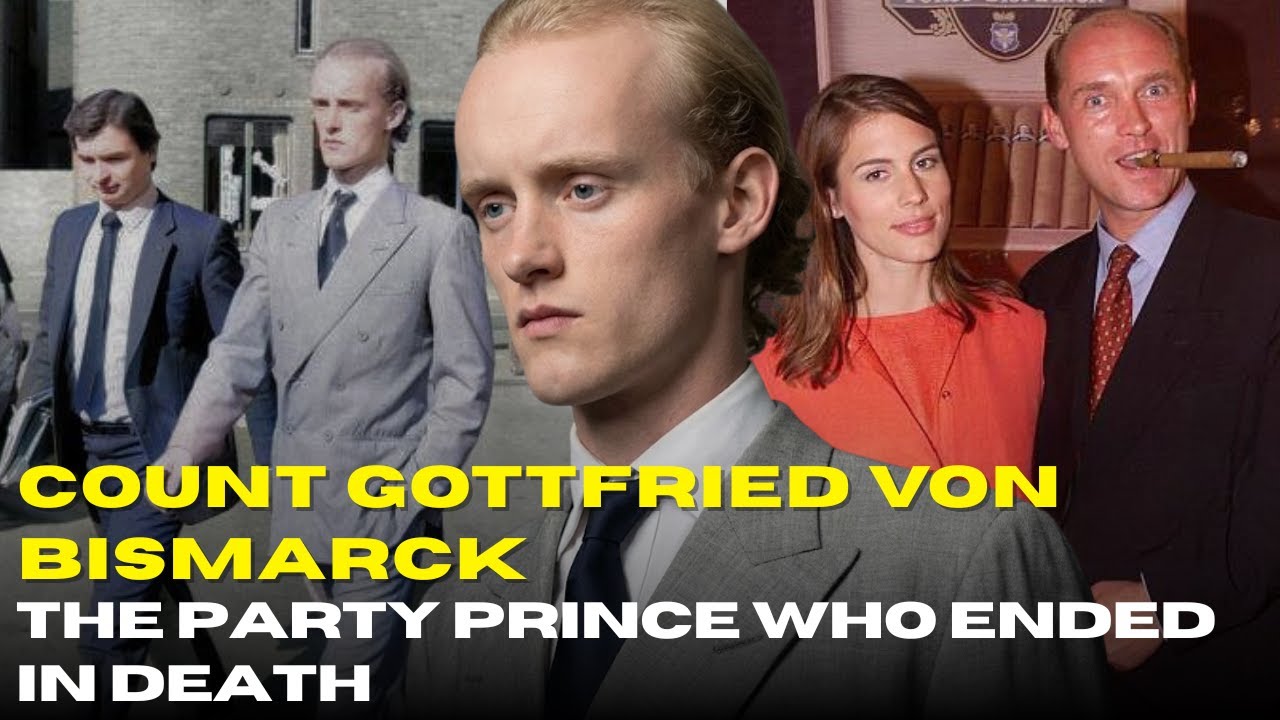
No one came. It was an estate agent, arriving for a business appointment about a property sale, who finally found Count Gottfried von Bismarck on July 2nd, 2007. The third body in the count’s story had claimed him at last. The tabloids had long since given him a name that stuck like a curse: the Count of Death.
Two decades before that final overdose, a cabinet minister’s daughter had been found dead in his bed at Oxford. Twenty years later, almost to the day, a guest had plunged sixty feet from his terrace during a drug-fueled gathering. Now the curse had come full circle. The man who had once been the unofficial minister of fun for the young British royals lay dead in his own flat, an arm punctured by a needle, surrounded by the debris of a lonely, lethal overdose.
Gottfried Alexander Leopold Graf von Bismarck-Schönhausen was born in 1962 into the shadow of his great-great-grandfather, Otto von Bismarck, the Iron Chancellor who had forged a German empire through war and discipline. The name was not merely a surname. It was a monument, carrying expectations of duty, stoicism, and military precision. But Gottfried was not built for granite.
He was built for velvet. Growing up on the family’s vast estates near Hamburg, he felt the suffocation of his heritage. Germany in the 1960s and seventies was a serious place, a nation engaged in a somber reckoning with its past. There was little room for a boy who wanted to wear silk scarves and recite poetry.
His family, sensing he would never fit the mold of the Prussian Junker, sent him away to school. Like many European elites before him, Gottfried found his spiritual home not in the forests of Saxony but in the dreaming spires of Oxford. He arrived at Christ Church College in the early 1980s, and the timing was fateful. Britain was under Margaret Thatcher, the economy was booming, and a new, aggressive confidence swept through the upper classes.
Oxford in those years was dominated by a specific breed of golden youth: Sloane Rangers and aristocrats reenacting the world of Evelyn Waugh’s Brideshead Revisited. It was a world of tailcoats, champagne breakfasts, and an arrogance so profound it felt like a force of nature. Into this hothouse stepped Gottfried von Bismarck, and he did not just fit in. He took over.
He was magnetic, incredibly intelligent, speaking with a languid, drawling accent that sounded more English than the English. He was openly, defiantly eccentric. While other boys wore rugby shirts, Gottfried wore Bavarian hunting capes, monocles, and lederhosen with a sense of irony that was devastatingly cool. He cultivated an air of androgynous mystery, a Bond villain persona he played for laughs but which hinted at something darker underneath.
He was rich, he was titled, and he was dangerous. The English boys, repressed by their public schools, were mesmerized by him. He was the Sebastian Flyte to their Charles Ryder, the catalyst who could turn a boring Tuesday night into a legendary bacchanal. Gottfried quickly ascended to the very top of the social food chain.
He joined the Bullingdon Club, the notorious dining society known for trashing restaurants and burning fifty-pound notes in front of homeless people. But the crude vandalism of the Bullingdon was too blunt for his tastes. He preferred the Piers Gaveston Society, a dining club with a reputation for sexual excess and decadent themes. Here, in the secret rooms of Oxford, the sons of dukes and bankers indulged in fantasies of absolute power and pleasure.
Gottfried was the ringmaster. He had the best wine, the best connections, and the best drugs. This was the era when the Windsor circle was forming, the group of friends surrounding the young princes of the royal family. Gottfried was at its heart.
He was close friends with Prince Edward, and his social orbit intersected constantly with the young Prince Andrew and, later, Prince Harry’s crowd. He was the fun German cousin, the one you called when you wanted to escape the gray men in suits at Buckingham Palace. But while his royal friends had bodyguards and protocols to restrain them, Gottfried had no brakes. He had an unlimited allowance and a hunger for sensation that was bottomless.
His rooms at Christ Church became the epicenter of the university’s nightlife. They were not dorm rooms but a salon, decorated with heavy drapes, decanters of spirits, and strange artifacts. It was a place where day was turned into night, where the music never stopped, and where the boundaries of acceptable behavior dissolved in a haze of smoke. Beneath the glamour of the parties, a chemical darkness was taking root.
Champagne and marijuana gave way to harder substances. Cocaine became the fuel of the night, and heroin, the dark, sleepy killer, began to appear at the fringes. Gottfried, with his intellectual curiosity and disregard for danger, was fascinated by the opiates. He saw himself as a romantic experimenter, a De Quincey or a Baudelaire, exploring the edges of consciousness.
He did not see himself as a junkie. He was a count. Junkies lived in squats. Counts used silver spoons.
It was in this atmosphere of escalating excess that he met Olivia Channon. She was twenty-two years old, the daughter of Paul Channon, a serving cabinet minister in Margaret Thatcher’s government, and an heiress to the Guinness brewing fortune. She was beautiful, bright, and fiercely ambitious, studying modern history at St. Hilda’s College.
But like Gottfried, she had a shadow. The pressure to succeed, the weight of her family name, and the frantic pace of the social scene had worn her down. She was struggling with bulimia and had begun to self-medicate with alcohol and heroin. Gottfried and Olivia were drawn to each other like moths to a flame.
They were mirrors, both burdened by famous names, both hiding fragility behind masks of hedonism. They became inseparable in the final term of 1986. The date that would change everything was June 3rd, 1986. The exams were over, and relief was palpable across Oxford.
Olivia had finished her last paper that afternoon. She was euphoric, celebrating her freedom with champagne at a garden party. As the evening wore on, the party moved, as it always did, to Gottfried’s rooms at Christ Church. It was not a massive rave but an intimate gathering of the inner circle: Gottfried, Olivia, and a friend named Rosie Johnston.
They retreated to unwind, but unwinding in Gottfried’s world meant vodka and powders. The details of that night have been picked over by coroners and tabloids for decades, but the essential tragedy is clear. Olivia, already weakened by an eating disorder and exhaustion, wanted to celebrate the end of her exams with a hit. Gottfried would later claim he tried to stop her, that he told her she had had enough.
But the momentum of the night was against him. In the culture they had built, saying no was an act of cowardice. The heroin was prepared. Olivia injected it.
She became drowsy. The conversation slowed. The euphoria of the opiate washed over the room. Gottfried, perhaps too intoxicated himself to recognize the signs of an overdose—the shallow breathing, the blue tinge to the lips—assumed she was just sleeping it off.
It was a common sight in his rooms, beautiful people passed out on the velvet sofas. He carried her to his bed. He tucked her in. He left her there to sleep, and he went to sleep on the sofa in the main room.
When he woke up the next morning, the sun was streaming through the gothic windows. The birds were singing in the quad. He stood up, shaking off the fog of the night before, and walked into the bedroom to wake Olivia. He touched her shoulder.
She was cold. The realization came in a creeping, freezing wave. He shook her. He called her name, but the golden girl was gone.
Olivia Channon, the daughter of a minister of the crown, lay dead in the bed of Count von Bismarck. In that moment, the entire era crashed. Gottfried stood in the center of the room, knowing with the instinctive cunning of his class that this was not a medical emergency. It was a political nuclear bomb.
He did not call the police immediately. Panic makes people irrational, and privilege makes them think they can fix things. He called his friends. He called his family.
He tried to construct a reality where this had not happened. But the reality was lying on the bed, turning waxy and still. When the authorities were finally summoned, the scene turned into a circus. Police cars screamed into the ancient quadrangle.
The paramedics rushed in, though it was hours too late. Then the press arrived. The story was irresistible: sex, drugs, aristocracy, politics, and death. Cabinet minister’s daughter dead in count’s bed.
The paparazzi besieged the college. They climbed the walls. They bribed the porters. They painted a picture of Gottfried not as a grieving friend but as a predator, a German vampire seducing the innocent flowers of English womanhood into a life of vice.
Gottfried was arrested. He was marched out of his rooms past the staring eyes of students who had once begged for invitations. He looked pale, shaken, and suddenly very young. The Bond villain persona evaporated, leaving a scared boy who had played with fire and burned the house down.
The police tore his rooms apart. They found the stash. Gottfried was charged with drug possession. There was talk of manslaughter charges.
There was talk of deportation. The Bismarck family, watching from Germany, was horrified. But the British establishment looks after its own, even its adopted sons. At the inquest, the narrative was carefully managed.
Olivia was portrayed as a tragic figure, a victim of exam stress. Gottfried was portrayed as a foolish, indulgent friend, but not a killer. The coroner recorded a verdict of misadventure. When the case came to court, the sentence shocked the public: Gottfried von Bismarck was fined eighty pounds.
Eighty pounds. The price of a good dinner. That was the legal cost of the night Olivia Channon died. He walked out of court a free man, but he was not free.
The public verdict was far harsher than the legal one. He was branded the Count of Death. He left Oxford immediately. He did not graduate.
He did not say goodbye. He fled back to Germany, to the forests of his ancestors, trying to outrun the ghost of the girl he had tucked into bed. For the next few years, Gottfried vanished from the London scene. He tried to live the life his family wanted.
He worked in business. He managed the estate. He wore suits and sat in meetings. But the quiet of the countryside terrified him.
The silence was too loud. In the silence, he could hear the breathing that was not there. He missed the noise. He missed the adrenaline.
He missed the edge. By the early 1990s, the pull of London became too strong. The exile ended, and the count returned. He moved into a spectacular flat on Tite Street in Chelsea, the artistic heart of the city.
He reinvented himself. He shaved his head. He wore even more flamboyant clothes. He embraced the techno boom, investing in the new mobile phone networks.
He made millions, and he opened his doors again. The Tite Street flat became the new Christ Church. The parties resumed, bigger, louder, and darker than before. He had survived the first body.
He thought he was immune. He thought the curse had been paid in full. He was wrong. London in the 1990s was a city inhaling its own hype.
It was the era of Cool Britannia, a neon-lit renaissance where rock stars dined with princesses and artists like Damien Hirst pickled sharks in formaldehyde and sold them for millions. Into this playground stepped the reinvented count. The long, foppish hair was gone, replaced by a shaved head that gave him a severe, almost monastic appearance, a techno monk in bespoke Savile Row suits lined with crushed crimson velvet. He looked like a Bond villain, a caricature of aristocratic decadence, and he played the role with a knowing, cynical wink.
Tite Street was heavy with history. It was where Oscar Wilde had lived before his own fall. Gottfried’s apartment was not a home. It was a stage set.
He decorated it with a dark, baroque sensibility that unnerved the casual visitor. There were stuffed animal heads mounted on the walls, boars and stags with glass eyes staring down in eternal judgment. There were heavy velvet drapes perpetually drawn, obliterating the sun and creating a timeless, artificial twilight. There were erotic artworks, statues of pugs, his favorite breed, and the latest high-tech gadgets humming in the corners.
It was a hermetically sealed world, a fortress of sensation designed to keep reality at bay. For nearly fifteen years, Gottfried von Bismarck was the unofficial king of a certain slice of London’s underground elite. He was sharp, possessing a predatory intelligence for business. He invested early in the mobile phone market and the dot-com boom.
He made millions of his own. He was not a junkie. He was a quirky tycoon. His parties became urban legends.
They were democratic in the most dangerous sense of the word. On any given Tuesday, you might find a minor royal sitting on a sofa next to a club kid, a hedge fund manager chopping lines of cocaine beside a struggling drag queen. Gottfried was not merely a guest at these gatherings. He was their gravitational center.
He was openly queer now, living a fluid hedonistic lifestyle that added another layer of taboo to his persona. He loved the shock value. He loved the mix. In his living room, the rigid class system of Britain dissolved into a puddle of chemical euphoria.
Yet beneath the thumping bass and the clinking crystal, the darkness was gathering again. Addiction is a patient hunter. What looks like youthful experimentation in your twenties looks like a desperate habit in your forties. The drugs were no longer a garnish to the evening.
They were the main course. Gottfried was functioning, but the machinery was straining. His face, once handsome, had become gray and drawn. His eyes were often glassy.
He was surrounded by people, but he was profoundly alone. The friends who filled his flat were often sycophants, moths drawn to the light of his title and his wallet. They laughed at his jokes, drank his wine, and snorted his coke, but they did not know him. They knew the count.
They knew the provider. The crash came twenty years after the first one, almost to the day. It was August 2006. The summer heat lay heavy and humid on London.
Gottfried was hosting a smaller affair than the raves of his youth, an intimate gathering of the inner circle. Among the guests was Anthony Alessandrini, forty-one, a handsome, successful anesthetist. He was not a naive student. He was a medical professional who knew exactly how the human body worked and exactly how to manipulate it.
He was a regular at Tite Street, part of the furniture of Gottfried’s life. The night followed the usual script. The curtains were drawn. The music played.
The trays were passed around. Sometime in the early hours, the party moved or stumbled up to the roof terrace. The terrace was the jewel of the flat, offering a stunning view of the London skyline, the lights of the city twinkling like diamonds on black velvet. Anthony Alessandrini was intoxicated, a cocktail of cocaine and alcohol coursing through his veins.
He was leaning against the railing, or perhaps he climbed on it, or perhaps he simply lost his balance in the disorientation of the high. There was no scream, just the sickening sound of a body hitting the concrete courtyard sixty feet below. When the paramedics arrived, there was nothing they could do. Anthony Alessandrini was dead.
For Gottfried, the moment the police walked through the door must have felt like a recurring hallucination. It was 1986 all over again. But this time, the script was different. The police were not the deferential constables of Oxford who tipped their hats to a count.
These were hard-nosed London detectives who saw a dead body and a flat full of drugs. They tore the place apart. This time, they did not just find a small stash. They found a significant quantity of cocaine.
They found the paraphernalia of a serious, habitual user. Gottfried was arrested and led out of his home in handcuffs past the paparazzi who had already smelled blood. The flash bulbs popped, illuminating a man who looked like a ghost. He was unshaven, gaunt, his eyes wide with terror and disbelief.
The headline writers dusted off the old files. Count of death strikes again. Party host arrested after guest plunges to death. One death in your home is a tragedy.
Two is a pattern. To the public, Gottfried was no longer a tragic figure. He was a menace, a black widow in a bespoke suit. The Windsor circle connection, which had once protected him, now became a liability.
The press dragged up his friendship with the princes, asking uncomfortable questions about the company the royals kept. The inquest into Anthony Alessandrini’s death recorded a verdict of misadventure. The coroner found that the mixture of drugs and alcohol had caused him to become confused and lose coordination. Gottfried was cleared of murder or manslaughter, but he was charged with possession of class A drugs and faced a potential prison sentence.
The legal jeopardy, however, was nothing compared to the psychological annihilation. The second death broke him in a way the first had not. In 1986, he had the arrogance of youth and the support of his family to shield him. In 2006, he was a middle-aged man who had just watched his life loop back on itself with cruel mathematical precision.
He realized he was the common denominator. He was the carrier of the virus. He returned to the empty flat on Tite Street on bail, but the party was over. The phone stopped ringing.
The fair-weather friends vanished into the mist. They were terrified of the curse. They did not want to be the third body. Gottfried was left alone with his animal heads and his velvet curtains.
His proximity to power had always been a double-edged sword. The relationship between the Bismarcks and the British royals was woven from threads of history and blood. Gottfried was a distant cousin to half the crowned heads of Europe. He arrived in England not as a foreigner but as family.
His entry point into the inner sanctum was Prince Edward and Prince Andrew, contemporaries moving in the same rarefied circles of polo matches and country house weekends. While the princes were bound by the suffocating protocols of monarchy, Gottfried was free. He was rich and titled but had zero responsibility. He was the naughty cousin, the jester who could say the things they could not say and do the things they could not do.
He capitalized on this envy. He created environments, first at Oxford, then at Tite Street, designed as safe zones for the royals. In his flat, there were no paparazzi, no judgmental courtiers. A prince could get drunk, smoke a joint, or kiss the wrong person, and Gottfried ensured it never left the room.
He operated a strict omerta, the mafia code of silence applied to the aristocracy. If you leaked a story to the press, you were exiled. Social death was swift and absolute. This made him indispensable.
When Olivia Channon died in his bed in 1986, the shockwaves reached Buckingham Palace. Many observers believed the leniency shown to Gottfried, the paltry eighty-pound fine, reflected a system protecting its own interests. If Gottfried had been dragged through a long public manslaughter trial, what secrets might have spilled out? Which other famous names had been snorting lines off the Bismarck silver?
The establishment closed ranks. Gottfried was the lightning rod who absorbed the shock so that others could stay dry. He took the shame, and in exchange, he was allowed to stay in England. But as Gottfried descended deeper into addiction in the 2000s, the royals had to pull back.
The institution of monarchy is ruthless when it comes to self-preservation. When the second body fell from the roof in 2006, the bridge was burned. The princes could no longer be associated with the Count of Death. The isolation Gottfried felt in his final year was not just the loss of drinking buddies.
It was an exile from the only tribe he had ever known. He had been the loyal keeper of their secrets for twenty years. He had provided the venue. He had taken the fall in 1986.
And now, when he was truly drowning, the drawbridge of the castle was pulled up. The year between August 2006 and July 2007 was the longest year in his life. It was a year lived in suffocating underwater silence. The Windsor circle, the aristocrats, the hangers-on who had drunk his cellar dry for twenty years evaporated with a speed that was almost impressive.
The social calculus of the British upper class is ruthless. Scandal is tolerable, but mortality is not. A dead body at a party is a story. Two dead bodies in a lifetime is a curse.
No one wanted to be the third. The legal noose was tightening. Unlike 1986, the climate of 2006 was unforgiving. The police were not charmed by his title.
They looked at the middle-aged man with shaking hands and saw a career criminal. He was charged with possession of class A drugs, and the sentencing guidelines were clear. He was facing prison. The prospect terrified him.
He was a creature of extreme comfort, a man who required silk against his skin. He knew, with bone-deep certainty, that he would not survive the brutality of the British penal system. His great-great-grandfather had forged a nation through war and discipline. Gottfried was terrified of a communal shower and a locked cell door.
In this vacuum of isolation, the Bond villain mask began to crumble. Friends who saw him briefly described a man who was disintegrating. The sharp, cruel wit was replaced by maudlin sentimentality. He spoke of his parents with new-found regret.
He spoke of Olivia Channon, the ghost who had never really left his side. He seemed to be conducting a life review, sifting through the debris of forty-four years, looking for something solid to hold on to, and finding only dust. He tried to keep up appearances. He met with his lawyers.
He put the flat on the market, ostensibly to pay legal fees, but perhaps subconsciously to liquidate the stage of his failure. Internally, he had already checked out. It was in this state of profound psychic fragility that he returned to the needle. Heroin is a jealous lover.
You can leave it for years. You can build a wall of cocaine and alcohol and social distraction to keep it at bay, but it waits. It waits for the moment when the noise stops. Gottfried had not been a habitual heroin user for years.
He preferred the manic energy of stimulants. But cocaine is a drug for the hopeful, or at least the energetic. Heroin is the drug for those who want to resign. It offers a warm, fuzzy negation of reality.
It does not solve problems. It dissolves the person having them. In the weeks leading up to July, the Tite Street flat became an opium den of one. The curtains remained drawn against the summer sun.
The air grew stale. Gottfried moved through the rooms like a ghost in his own life. He was self-medicating not to party but to survive the passing of time. He was engaged in a slow-motion suicide.
The end, when it arrived, was quiet. There was no final grand party. There was no dramatic manifesto left on the mantelpiece. There was just a man who was tired.
On the night of his death, London hummed outside his window. Inside, Gottfried prepared his final escape. He was an expert chemist of his own blood. He knew the dosages.
He knew the risks. The toxicology report would later reveal a lethal cocktail of heroin, cocaine, and alcohol, but the sheer quantity of heroin suggested intent. This was not a recreational dose. This was a dose designed to slam the door shut.
He lay down on the floor. The needle went in. The heart, battered by twenty years of chemical assault, fluttered and stopped. The count was dead.
For days he lay there. The post was pushed through the letterbox. The sun rose and set over the Chelsea rooftops. It is a testament to his utter isolation that no one missed him enough to break down the door.
The man who had hundreds of friends lay decomposing on his own carpet, undiscovered. It was the estate agent who found him on July 2nd, 2007. The banality of the discovery, a business appointment for a property sale, added a final layer of grim absurdity to his life. The reaction this time was different.
In 1986, there had been outrage. In 2006, judgment. In 2007, just pity. The Count of Death narrative felt exhausted.
Even the tabloids seemed weary of kicking the corpse. The tragedy was too complete. The autopsy confirmed what everyone suspected. His body was a map of his addiction.
He had destroyed himself from the inside out, but the physical ruin was secondary to the spiritual void. He died because he had run out of roles to play. The host had no guests. The rebel had no cause.
The aristocrat had no dignity left to lose. His funeral took place in Germany, far from the London scene that had consumed him. He was buried in the family mausoleum in Friedrichsruh, near Hamburg, alongside the Iron Chancellor and the other stern-faced ancestors who had served the state with duty and honor. As the heavy doors of the crypt closed, shutting out the light, Gottfried von Bismarck finally found the one thing he had been chasing for twenty years, the one thing that neither the drugs nor the parties could ever provide.
He found peace. The noise was finally gone. The death of Gottfried was not just the end of a man. It was the closing of a chapter in the history of the British upper class.
He was the final casualty of a specific brand of aristocratic decadence that had flourished in the shadow of the twentieth century but could not survive the glare of the twenty-first. The Windsor circle had moved on long before the needle went into his arm. By 2007, the young princes he had entertained were becoming serious men, joining the military, marrying, assuming the heavy mantle of duty. They had treated their time with Gottfried as a temporary excursion into the wild side before settling down to the business of being royal.
But Gottfried never settled down. He was the Peter Pan of the aristocracy, the boy who refused to leave the playground even as the lights were turned off and the gates were locked. For his royal friends, he was a phase, a tourist destination in the land of rebellion. For him, the rebellion was home.
This is the cruelest function of the court jester in high society. They are encouraged to be outrageous, to provide the thrills for the protected class, but when the consequences arrive, they face the firing squad alone. Gottfried was the designated lightning rod. He absorbed the voltage of the scandals so that the future kings could remain unscathed.
He died a junkie in a lonely flat so that others could live to cut ribbons and wave from balconies. His legacy serves as a grim autopsy of the British class system itself. It reveals a world that is seductive but ultimately carnivorous. It grants immense leeway to its members, allowing them to dodge prison sentences that would crush a commoner, allowing them to rehabilitate their reputations after lethal scandals.
But it exacts a terrible price in return. It demands a performance. Gottfried’s entire life was a performance of the count. He felt compelled to be the most eccentric, the most shocking, the most dangerous person in the room because he believed that was the only way to be loved.
He mistook the applause of the audience for the affection of friends. In the years since his death, the legend of the Count of Death has faded into a dark cautionary tale whispered in the clubs of Mayfair. He has become a ghost story told to young debutantes and heirs: Don’t go too far. Don’t become Gottfried.
But beneath the sensationalism lies a simpler, sadder truth. He was not cursed by supernatural forces. He was cursed by the void. He was a man of immense intelligence and sensitivity trapped in a life of terminal boredom, trying to fill the emptiness of his soul with people, noise, and chemicals only to find that the hole was bottomless.
There is a profound irony in his lineage. Otto von Bismarck spent his life building a fortress of a nation obsessed with order, strength, and legacy. His great-great-grandson spent his life dismantling himself, obsessed with chaos, sensation, and the moment. One built an empire of steel.
The other left behind a ruin of velvet and dust. The final image of Gottfried is not the body on the floor but the view from his roof terrace on a summer night. London is spread out below, a glittering ocean of lights, promising infinite excitement and infinite connection. The party is happening down there somewhere, but up on the roof, the air is thin and cold.
The count stands at the railing, looking down at the drop that claimed his friend, looking out at the city that consumed his life. He lights a cigarette. He adjusts his monocle. He smiles that crooked, cynical smile one last time.
He knows the truth now, the secret he kept from everyone, even himself. The party does not end when the music stops. The party ends when you are the only one left dancing.
And in the end, Gottfried von Bismarck danced himself to death, terrified that if he stopped even for a second, he would have to hear the beating of his own broken heart.






