The document sits in the Charleston County archive, a single page dated March 1848, stained by water and deliberately unfinished, ending in the middle of a sentence. The last legible words read: “The testimony of the nine deceased cannot be accepted because their deaths occurred under circumstances the court finds…” The rest of the page has been carefully removed with a sharp blade. Local historians avoided this document for generations. Those who examined it noticed something strange.
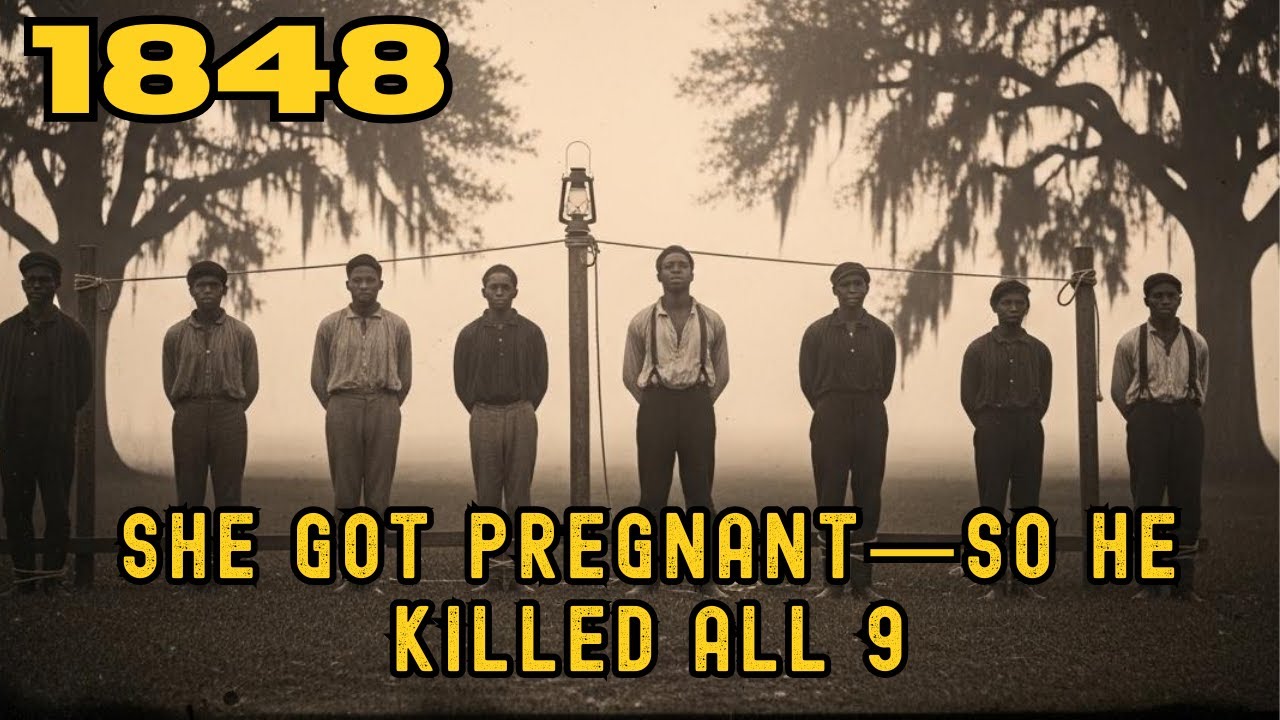
Nine death certificates were filed within seventy-two hours. All listed the same plantation as the place of death. All bore the same physician’s signature. All recorded the cause of death with a single word: “executed.
” The plantation records from that period show nine names crossed out in red ink on March 14, 1848. Nine men simply ceased to exist in any official record. What crime warranted such swift, coordinated justice? What testimony was so dangerous it had to be silenced before it could be spoken?
The answer lies not in what these nine men did, but in what they knew about the woman who lived in the big house and the baron who owned them all. What made this case particularly disturbing to those who faced it was not the execution itself. Extralegal killings of enslaved people, though horrific, were tragically common in the antebellum South. What unsettled them was the precision of the execution.
Nine men, no more and no less. That specificity indicated calculation and deliberation, not anger. It pointed to a secret that required exactly nine deaths to contain. Ashburn Plantation sprawled across two thousand acres in the South Carolina lowcountry, twelve miles inland from Charleston, where the Ashley River widens into wetlands and the air grows heavy with the smell of salt and decay even in winter.
The estate was founded in 1789 by the Vanderhorst family, Dutch merchants who made their fortune in indigo before switching to cotton when the market shifted. By 1845, when Baron Wilhelm Vanderhorst inherited the property from his uncle, Ashburn was considered one of the most progressive plantations in the region, a classification that meant little more than slightly better food rations and fewer public whippings. Wilhelm Vanderhorst was not born with the title of baron. He purchased it in 1843 during a tour through the fractured German states, a vanity deal that nonetheless carried legal weight in certain European circles and lent a veneer of aristocratic legitimacy to his status as a southern planter.
He was thirty-seven when he inherited Ashburn, a man of medium height with pale eyes that watered in bright sunlight and hands that trembled slightly when he thought no one was watching. The trembling had worsened since his return from a sanatorium in Berlin in 1844, where he had been treated for what his correspondence vaguely referred to as nervous exhaustion. The baron arrived at Ashburn in April 1845 accompanied by a wife. Margaretha Vanderhorst was twenty-three, the daughter of a Bremen merchant whose maritime trade had collapsed in the economic turmoil of the 1840s.
The marriage had been arranged through intermediaries. Wilhelm and Margaretha had met only twice before their wedding. Plantation records note her arrival with unusual precision. She brought seven trunks, two maidservants, both German, who were dismissed within six months and sent back to Europe, and a personal physician named Dr.
Ernst Keller, who remained at Ashburn continuously until the events of March 1848. Margaretha was, by all contemporary accounts, beautiful, pale-skinned, dark-haired, with a kind of fragile delicacy that southern society misread as refinement. But she was also unwell. She suffered from what the baron’s correspondents called “female complaints,” most likely endometriosis or chronic pelvic inflammation, conditions the medicine of that era could neither accurately diagnose nor effectively treat.
She spent her days in her room, under the care of Dr. Keller, who gave her laudanum and various herbal tinctures that made her lethargic and compliant. But the baron’s obsession was not with his wife’s health, but with her fertility, or rather, the lack of it. Ashburn Plantation operated with approximately one hundred and thirty enslaved people in 1845.
Among them, nine men worked in what plantation records euphemistically called household service, maintenance, groundskeeping, and personal service to the Vanderhorst family. These nine men ranged in age from nineteen to thirty-four. They had not been chosen for agricultural skill but for physical traits: height, build, health, and what one inventory coldly classified as “breeding quality. ” This was not unusual.
Enslaved people were often evaluated like livestock. What was unusual was the baron’s particular attention to these nine, documented in his personal ledgers with measurements, health assessments, and lineage tracking, suggesting he was keeping breeding records. The nine men were Thomas Ridley, twenty-eight, born on the plantation to parents sold away when he was seven; Marcus Finch, twenty-three, purchased from a Virginia estate in 1844, who could read and write despite the laws forbidding it; Isaiah Brennan, thirty-one, a blacksmith’s apprentice with distinctive scars on his hands from working the forge; Daniel Pruett, twenty-six, formerly of a Savannah household, sold south after his previous owner’s bankruptcy; Jacob Worth, twenty-two, born in Charleston, son of a German immigrant who died in debt, leading to his enslavement; Samuel Hoyt, thirty-four, the oldest, who had attempted escape twice and carried the scars of punishment on his body; Levi Church, twenty-nine, a carpenter who had built many of the plantation’s outbuildings; Nathaniel Cross, twenty-five, who worked in the stables and could calm the most nervous horses; and Robert Foster, nineteen, the youngest, who had been at Ashburn only eight months. These men lived in a peculiar hell reserved for domestic servants: better fed and better clothed than field hands, but subject to closer surveillance and more direct forms of exploitation.
They slept in separate quarters near the main house, not in the field cabins. They ate better food. They wore livery when serving in the main house. They understood that their proximity to power made them both privileged and endangered.
The white community surrounding Ashburn in 1845 was small and insular. The nearest neighboring plantation, Brickyard Estate, lay four miles to the east. The town of Middleton, barely a town at all, consisting of a church, a general store, a blacksmith, and about thirty families, sat six miles north. Charleston, with its society and oversight, seemed far more distant than twelve miles when the roads were bad.
This isolation was deliberate. Planters preferred to stay out of the public eye, even the eyes of their peers. The social structure of the region was rigid. White planters maintained elaborate fictions of honor, chivalry, and paternalism while profiting from systematic brutality against human beings.
White women, particularly those of the planter class, were placed on pedestals that were in reality gilded cages, expected to be decorative, obedient, and above all, fertile. Producing heirs was not merely a personal matter. It was an economic and social necessity. Inheritance laws, property consolidation, and family standing all depended on the production of legitimate male offspring.
This was the world in which Wilhelm Vanderhorst lived, a world where his value as a man was measured largely by his ability to produce an heir, and where his wife’s failure to conceive reflected on both of them with mounting social urgency. By the autumn of 1847, after two and a half years of marriage, Margaretha had not conceived. The baron’s correspondence from that period, preserved in the archives of the South Carolina Historical Society, reveals growing desperation despite careful redactions in several places. Letters to physicians in Charleston, Baltimore, and even a specialist in Philadelphia, all asking the same question: what could be done about a barren wife?
The replies, where they exist, recommended the usual treatments: dietary changes, reduced laudanum, more rest, or perhaps less, prayer, patent medicines. One Philadelphia doctor suggested the problem might lie with the husband, an idea the baron rejected with such fury that his reply was removed from his personal papers, surviving only because the recipient kept it as a curiosity. Then, in December 1847, something changed. The overseer’s records at Ashburn, routine logs of work assignments and discipline, show an unusual entry.
On December 18, by order of the baron, nine of the household men were reassigned to work exclusively in the big house. No field work until further notice. The nine men were isolated from the rest of the enslaved community. The winter of 1847 to 1848 was mild in the lowcountry, temperatures rarely dropping below forty degrees even at night.
The swamps did not freeze. They simply grew quieter, the usual chorus of insects and frogs muted by the cool season. At Ashburn, smoke rose constantly from the main house’s chimneys, and lights in the upper windows stayed lit late into the night. During that winter, the nine men began to disappear from view.
Thomas Ridley was the first. On December 20, he was summoned to the main house in the evening. Unusual, but not unprecedented; domestic servants were often called at late hours. What was unprecedented was that he did not return to the quarters that night or the next.
When he reappeared three days later, he was silent. Not merely quiet. Silent, like a person who had seen something language could not describe. The other enslaved people noticed.
They noticed how his movement had changed, how he avoided eye contact, how he trembled at the mention of the baron’s name. Marcus Finch was next, summoned on December 27, then Isaiah Brennan on January 3. One by one through January and into February, each of the nine men was called to the big house for periods ranging from two to five days. When they returned, they were altered.
Some bore marks, not whip marks, but bruises in odd places, scratches, injuries consistent with restraint or struggle. But they did not speak of it, not among themselves, and certainly not with anyone else. The enslaved community at Ashburn developed whispered theories. Some thought the baron was conducting medical experiments; there were rumors of such things at other plantations where enslaved people were used as subjects for surgical procedures or disease testing.
Others thought it was some form of punishment, though none of the nine had committed any infraction. Still others believed it was sexual exploitation, common enough to be almost ordinary, though it usually targeted enslaved women rather than men. But there was something else, something that did not fit the usual patterns of plantation horror. The baron’s wife began appearing in public again.
Margaretha Vanderhorst, who had spent most of 1846 and 1847 confined to her room, emerged in late January 1848. She attended church services in Middleton, rode in the baron’s carriage to visit neighboring plantation families, and appeared at a dinner party at Brickyard Estate in early February. The women who saw her noted her improved health, the restoration of color to her face. Some remarked that she looked radiant, a word many used independently in surviving letters and diaries from that period, but also haunted.
Sarah Prescott, the wife of a neighboring planter, wrote to her sister in Charleston in February 1848: “I saw Mrs. Vanderhorst at the Brickyard dinner. She looked physically well, but she was strange in her manner. When I complimented her on her improved health, she smiled in a way that made me feel she was playing a part in a play.
She kept looking toward her husband as if asking his permission to speak. And at one point, when I mentioned my children, she squeezed my hand so hard I thought she might leave a mark. She said nothing, only held my hand and stared at me with eyes that seemed to be begging for something I could not understand. ”
By late February, the truth was spreading through the enslaved quarters in barely audible whispers.
The nine men had been ordered, over weeks of isolation and horror, to perform an unspeakable task. Not commanded as one commands labor, but commanded with the absolute authority that defines the master-slave relationship. They were ordered under threat of death, with all the weight of legal and physical authority that permits a planter to do literally anything to the people he owns. The baron had ordered each of the nine men, in succession, to impregnate his wife.
The horror was not merely in the act itself, though that was profound enough: forcing enslaved men to commit what would be considered rape under any other circumstance, while simultaneously forcing his wife into these sexual encounters. She had no ability to refuse. The horror lay in the calculation of it. The baron had reasoned with a logic that could only arise from the monstrous moral corruption of slavery.
If his wife could not conceive by him, the problem was his, not hers. And if the problem was his, the solution was to use other men. Men he owned. Men he could compel and then dispose of.
Men whose children would legally be his regardless of biological paternity. He had devised a system in which nine men were violated, and his wife was violated, so that the resulting child, if any, would be his in every legal sense, while the truth could simply be erased by killing everyone who knew it. Dr. Keller, the German physician who had accompanied Margaretha from Bremen, facilitated this horror.
Correspondence discovered later suggests he may have proposed it based on his readings of agricultural breeding practices applied to humans. He monitored Margaretha’s menstrual cycles, determined her fertile periods, and scheduled the encounters accordingly. He was present during them, ostensibly for medical oversight, which meant he witnessed and documented systematic rape orchestrated by his employer. The nine men had no choice.
When Thomas Ridley initially refused, he was taken to the cellar and shown the tools that would be used against him if he persisted in refusal. They were not tools of ordinary beating, but of mutilation. He was given a choice between rape and castration. Each of the nine men was placed before this choice in turn.
Each one, when faced with it, chose survival. Margaretha, according to what remains of Dr. Keller’s notes, was under heavy sedation during these encounters. She was conscious enough to comply but drugged enough to be obedient, a state of chemically induced submission that the baron and Dr.
Keller apparently believed absolved them of the additional crime of forcing her conscious participation in the destruction of her marriage and dignity. By early March 1848, Margaretha Vanderhorst was pregnant. Dr. Keller confirmed it on March 8.
His note in his medical ledger, preserved because it was written in German and overlooked by those who later cleaned the plantation records, reads: “Pregnancy confirmed. Sixth week. All protocols followed. Patient responding well to pregnancy.
Employer satisfied. Disposal protocols begin immediately. ” The baron had always intended to kill them, all nine. The moment the pregnancy was confirmed, the men who could establish the child’s true paternity became a liability to be eliminated.
On March 12, 1848, the nine men were summoned together for the first time since the nightmare began. They were brought to the ground-floor parlor of the main house, a room they had cleaned and tended but had never been permitted to enter. The baron stood before them, Dr. Keller at his side, to deliver what he apparently believed was good news.
He said, “Gentlemen,” a word he had never used with enslaved men before, a word that should have warned them. “You have served this household with distinction. You will be rewarded. ” The reward, he explained, was freedom.
Manumission papers had been prepared. Each man would be freed, given twenty dollars in cash, and transported by wagon to Charleston, where they could begin their lives as free men. They would leave the following morning, March 13. They should prepare themselves.
The nine men knew he was lying. They knew because they understood the essential truth of their existence. They were witnesses to something the baron would never allow to be revealed. They knew because many of them were educated enough to realize that freeing nine healthy enslaved men at once represented a financial loss the baron would never accept.
They knew because they had seen his eyes during the winter months: the cold calculations of a man who viewed humans as problems to be solved, not souls to be valued. Marcus Finch, who could read and write despite the laws forbidding it, later told a story that was never entered into any official record but circulated among enslaved communities in the lowcountry for decades. He said that on the night of March 12, as the nine men sat together in their quarters waiting for morning, they discussed escape. They knew the swamps, knew the roads north, knew which free black communities might shelter them.
They discussed it seriously, calculating odds and distances. But they also knew that escape would confirm their guilt, guilt of something, even if the baron had to invent the crime. Escape would bring pursuit, and pursuit in South Carolina in 1848 meant dogs, patrols, and violence that would extend far beyond the fugitives to everyone they knew. Planters used collective punishment as a control mechanism.
If these nine escaped, others at Ashburn would suffer for it. So they made a different decision. They decided to testify. The conversation that night, as relayed decades later by those who heard it from survivors, centered on a dangerous question.
What if they told the truth? Not to the baron, but to the authorities. What if they went to Charleston and found a judge, a lawyer, someone in the legal system who might listen? It was a desperate plan born of desperation.
Enslaved people had almost no legal standing in southern courts, but “almost none” did not mean “none at all. ” There were rare cases, very rare, where the testimony of enslaved people was accepted, particularly in cases involving white victims or crimes that threatened the social order. And this crime did threaten the social order. The baron had not merely raped his slaves; he had used them to rape his wife.
He had defiled the sanctity of white womanhood, the foundational myth of southern society. If this were exposed, it would be a scandal that could destroy even a man of his standing and wealth. The nine men reasoned that if they could reach Charleston together, if they could tell their story publicly in a way that was difficult to ignore, they might survive. The baron could not kill them in the streets of Charleston without consequences.
He could not make nine free men disappear in a city without raising questions. It was a terrible plan, relying on systems and institutions that had proven inherently hostile to Black testimony, but it was the only plan they had. They were scheduled to leave for Charleston at dawn on March 13. They never reached the wagon.
At approximately four in the morning of March 13, 1848, while the plantation still slept and the sky was that purple-black color that precedes dawn, seven white men arrived at Ashburn on horseback. They came from Middleton and from Brickyard Estate: planters and their adult sons, men who were the baron’s peers and in some cases his friends. They had been summoned the previous night by urgent messages delivered by the baron’s personal courier. The messages, which no longer exist but were referenced in later correspondence, spoke ostensibly of a conspiracy: a slave rebellion, the messages claimed, nine men planning to kill the family and burn the plantation.
The messages said the baron had discovered the plot through an informant. He needed help containing the situation before dawn, the time the conspirators had planned to attack. This narrative, slave rebellion conspiracies, was the greatest fear of every planter. The nightmare that justified their most extreme violence.
Whether the seven men who responded to the baron’s call believed the story or simply agreed to participate in something they recognized as fictional did not matter. They came. They came armed. The nine men were pulled from their quarters before sunrise.
They were not arrested; slavery did not require arrest, and there were no charges. Slavery did not require charges. They were simply taken, bound, and led to an area behind the main house where the ground slopes toward the swamps and three live oak trees stand in a rough triangle, their branches spreading wide and strong enough to bear weight. What followed was an execution as theater, an execution as social ritual.
This was not violence hidden in a cellar. It was public, deliberate, witnessed by all. The remaining enslaved people at Ashburn were forced to watch. This too was customary practice.
Public punishment served as a warning, a display of power, a reminder of what happens to those who step out of line. But something went wrong with the baron’s script. As the ropes were being prepared, Thomas Ridley began to scream. Not pleas for mercy; that was expected and usually ignored.
He screamed his testimony. He screamed the truth about what had been done to them, about the baron’s wife, about the pregnancy, about the systematic rape orchestrated by the man who now claimed they had plotted rebellion. The other eight joined him. They screamed over each other, their voices carrying across the plantation in the dawn air.
They cited dates, described the room where it happened, Dr. Keller’s presence, Margaretha’s drugged compliance. They made sure everyone heard. The enslaved people watching heard.
The seven white men who had come to help heard. And somewhere in the big house, windows were abruptly closed as Margaretha heard her violation screamed to the world. The baron’s response was to accelerate the executions. The historical record becomes fragmentary here, and that itself is telling.
No official report was filed. The local sheriff in Middleton was informed after the fact and made a note in his records: “Baron Vanderhorst reports suppression of slave rebellion at Ashburn. Nine conspirators executed. No white casualties.
Matter resolved. ” That is all. That is the only official document of the deaths of nine men. But other evidence exists.
Letters exchanged between planters in the weeks following March 13 contain vague references to the situation at Vanderhorst’s estate and questions about whether those measures had been necessary. One letter from a Charleston lawyer named Edmund Berkley to his brother, a Georgia planter, dated March 20, 1848, was more explicit: “The Vanderhorst matter has created considerable unease. The manner was public enough to generate talk, and the claims made by the dead, however absurd on their face given their source, were curious enough to spread. Several families have declined social invitations from the baron.
I am told his wife has secluded herself in her room and will receive no visitors. ”
The nine men were buried in unmarked graves somewhere on Ashburn’s grounds. The plantation records list the burial site as “south swamp boundary,” a description covering hundreds of acres of wetlands. No headstones were placed, no minister performed burial rites.
They were erased as completely as the baron could erase them. But their testimony had been heard. The enslaved community at Ashburn now knew the full truth. So did the enslaved people on neighboring plantations, because information traveled through networks the white community barely knew existed: market talk, letters carried between plantations by visiting servants, stories told by those who had witnessed the executions and later met people from other places.
Within days, the story was spreading through Black communities across the lowcountry. Within weeks, it had reached Charleston. And in Charleston, something unexpected happened. A free Black woman named Ruth Dineen, who worked as a seamstress and had connections to both the free Black community and several white families sympathetic to abolition, heard the story from her cousin, who heard it from someone who had been at Ashburn on the morning of the executions.
Ruth Dineen did something extraordinary. She wrote the story down. Not just the basic facts, but a detailed account including names, dates, and the testimony the nine men had shouted as they died. Then she took it to a lawyer.
Edmund Berkley was forty-three in 1848, a Charleston attorney with a respectable practice in property and estates law. He was not an abolitionist; quite the opposite. He owned two enslaved people, a fact he would later struggle to reconcile with his actions. But he was also a man who believed, perhaps naively, that the law meant something, that even in South Carolina, at the heart of slave power, there were limits to what could be done without consequence.
When Ruth Dineen appeared at his office on March 25, 1848, he initially refused to see her. Free Black people were permitted to retain lawyers for limited purposes, but a woman seeking to bring charges against a white planter on behalf of dead slaves was not merely unprecedented; it was dangerous. But Ruth Dineen did not leave. She waited outside his office for three hours.
When he finally agreed to speak with her, she presented him with something he could not ignore: a written account, in precise handwriting, of events that, if true, constituted crimes even under South Carolina law. The law was complicated and contradictory. Enslaved people had no rights, but they were not entirely unprotected under the law. Planters could not simply kill enslaved people without cause.
There had to be at least a pretense of justice, a claim of crime and punishment. The baron had provided that pretense: conspiracy to rebel. But if the rebellion conspiracy was false, if it could be shown that the nine men were killed not for conspiring against the baron but for the knowledge they possessed, then the baron had committed murder. Nine counts of it.
Moreover, if Ruth Dineen’s account was accurate, the baron had committed what some courts might consider rape of his wife. It was not a crime under most legal interpretations, since wives could not legally refuse their husbands, but combined with the forced impregnation scheme, it constituted a moral violation that even pro-slavery society found disturbing. Berkley agreed to investigate. He did so, as he later wrote, not out of sympathy for the enslaved or opposition to slavery, but because the rule of law had to mean something or society descended into barbarism, “which our peculiar institution must not become.
”
His investigation took him to Ashburn Plantation in early April 1848. He was received by the baron with hostility barely concealed beneath a veneer of social courtesy. Berkley asked questions about the executions, claiming to be following up on routine legal matters concerning the estate. The baron’s answers were curt.
The slaves had plotted rebellion. He had discovered it. He acted swiftly to protect his family and property. Everything was perfectly legal.
The men were his property. He had disposed of them as the law allowed, consistent with the testimony they gave while dying. Berkley asked, “What about the claims concerning your wife? ” The baron’s face went blank.
“Lies of desperate men trying to sow discord. I do not believe them, and no one else should either. ” Berkley noted that many witnesses had heard these claims: “Free men, white men, who were present at your request, and every one of them knows that slaves will say anything when facing punishment. ” The baron replied, “Their words are worthless.
” Berkley then asked to speak with Margaretha Vanderhorst. The baron refused. She was unwell, bedridden under Dr. Keller’s care.
She could not receive visitors. Berkley said carefully, “She is also a witness to the events in question. If the slaves’ claims are false, her testimony would disprove them conclusively. ” The baron said, his voice carrying a coldness Berkley later described as absolute, “My wife will not be subjected to questions about lies told by animals who committed treason against this house.
I will not have her name dragged through the mud over a legal proceeding that should never have existed. If you persist in this, Mr. Berkley, you will find that influential men in Charleston have long memories. ” It was a threat delivered politely, and it should have ended there.
But Berkley made a crucial discovery. While reviewing public records at the Charleston courthouse, he found something the baron had not anticipated: Dr. Ernst Keller’s 1845 medical license application, which included references and correspondence. Among them was a letter from a medical facility in Berlin where Keller had trained.
The letter described Keller’s special field of study: applied genetics and breeding improvement in mammalian stocks, with theoretical extensions to human betterment. Eugenics before the term existed. Those pseudoscientific theories that would later become a full horror in the next century, but they already existed in embryonic form in the 1840s among certain European medical circles. Berkley also found records of Keller’s purchases from Charleston apothecaries: large quantities of laudanum, chloral hydrate, and various other sedatives, far more than a single patient would need, unless that patient was being kept perpetually drugged.
Armed with this, Berkley did something extraordinary. He filed a formal complaint with the Charleston District Court requesting an inquiry into the deaths of nine enslaved people at Ashburn Plantation on the grounds that their execution may have been carried out to conceal crimes committed by Wilhelm Vanderhorst against his wife and against the deceased. The filing of this complaint on April 18, 1848, caused an immediate scandal. Charleston society split sharply.
Some planters were outraged that one of their own was being questioned on the word of slaves and a free Black woman. Others, particularly those with daughters or wives, found the allegations disturbing enough to warrant investigation. Not out of concern for the enslaved men, but out of concern for what it might mean if planters could do such things to white women with impunity. The court, under pressure, agreed to hold a preliminary hearing, not a trial.
Enslaved people could not testify in trials against whites, but this was a hearing to determine whether sufficient evidence existed to warrant further investigation. The hearing was scheduled for May 2, 1848. The baron hired three lawyers. He mobilized every social and political connection he possessed.
He sent letters to newspaper editors, ministers, and fellow planters, all making the same argument: this hearing was an attack on property rights, on the foundational order of southern society, on the sanctity of a man’s right to manage his household and property without interference. The night before the hearing, someone broke into Edmund Berkley’s office and destroyed his files on the case. The written account held by Ruth Dineen was stolen. The documents he had gathered from pharmacy records were burned.
Only the copies he had made and kept at his home survived. That same night, Ruth Dineen disappeared. She was never seen again. Her disappearance was never investigated.
Free Black people disappeared in southern cities with disturbing regularity, and authorities rarely made an effort to find them. And at Ashburn Plantation, Margaretha Vanderhorst went into early labor. The hearing on May 2, 1848, lasted less than four hours. Edmund Berkley appeared with what remained of his evidence.
The baron appeared with his three lawyers and his seven witnesses: the same seven men who had participated in the executions. Each testified that they had responded to the baron’s call for help against a rebellion conspiracy, that they had witnessed the slaves’ threatening behavior, and that the execution was necessary for public safety. They acknowledged that the nine men had shouted various claims during the execution but described them as desperate lies. The courtroom was packed beyond capacity.
The Charleston District Courthouse, a three-story brick building on Meeting Street, had a main hall that comfortably held eighty people. On May 2, nearly two hundred crammed inside: planters and their wives, merchants, lawyers, a few free Black people standing in the back where they were permitted, and numerous newspaper correspondents from as far away as Richmond and Baltimore. The air was stifling despite the open windows, heavy with the smell of sweat, tobacco, and the perfume wealthy women wore to cover the stench. Judge Samuel Winthrop presided from a raised bench of dark mahogany, his white hair carefully combed, his black robe pristine despite the heat.
He was known as a fair man within the narrow bounds of what fairness meant in South Carolina in 1848: he followed the law as written, and the written law protected property above all else. The baron’s lead attorney, Clayton Merrick, was fifty-six, and had defended planters in similar cases for three decades. He was tall, silver-haired, with a voice that carried equal parts authority and contempt. His opening statement lasted forty minutes and focused entirely on property rights.
“This hearing,” he said, pacing before the judge’s bench, “is based on a dangerous precedent. That a man’s management of his own property, his legal, documented property, can be questioned based on the dying words of convicted criminals caught in conspiracy. If we allow this, gentlemen, where will it end? Can any slave facing punishment accuse his master of invented crimes and expect the courts to believe him?
The fabric of our society depends on order. And order depends on the authority of property owners to manage their holdings without interference based on the word of livestock. ” Edmund Berkley’s counterargument was more measured, more careful. He stood before a simple wooden table, spread his remaining documents before him, and spoke for about twenty minutes.
“This court is not asked to prefer the word of the enslaved over the word of a white landowner. This court is asked to examine whether the circumstances surrounding nine simultaneous executions suggest crimes that justified those executions, or crimes that motivated them. I have evidence, incomplete due to recent theft and destruction, suggesting that Baron Vanderhorst orchestrated a scheme that violated not only moral law but the bounds of acceptable conduct even under our peculiar institution. Evidence suggesting the rebellion conspiracy was fabricated after the fact to justify executions planned in advance.
” Judge Winthrop asked, “What evidence, Mr. Berkley? ”
Berkley presented what he had: copies of pharmacy records showing Dr. Keller’s purchases of sedatives in quantities far exceeding normal medical practice; a statement from a Charleston merchant who had sold the baron nine sets of iron restraints in January 1848, not the usual plantation restraints used to punish or control field hands, but smaller ones, the kind used in medical or psychiatric facilities; testimony from a free Black carpenter named Moses Green, who had been hired to install heavy locks on the interior of a ground-floor room at Ashburn in December 1847, locks that secured from the outside.
“These are merely circumstantial fragments,” Merrick objected. “They prove nothing except that a family purchased medical supplies and made security improvements. ” “They establish a pattern,” Berkley replied. “A pattern of preparation for something that required sedation, physical restraint, and containment, combined with testimony, yes, the testimony of enslaved men, which I acknowledge is not admissible under our law, but which was heard by multiple witnesses, including the seven gentlemen present here today.
It points to a coordinated effort to use enslaved men for purposes having nothing to do with rebellion, and everything to do with the baron’s private obsession. ”
The seven witnesses were called one by one. Each told essentially the same story. They had received urgent messages from the baron on the evening of March 12 describing a rebellion conspiracy.
They had responded as neighbors and fellow planters, arriving before dawn to help suppress the threat. They had witnessed the nine men being brought out, witnessed their executions, and heard their shouted claims. “What exactly did they claim? ” Berkley asked during cross-examination of James Hartwell, a planter from Brickyard Estate.
Hartwell shifted uncomfortably. He was forty-two, thick-necked, his hands scarred from years of plantation management. “They said, claimed, that the baron forced them to have relations with Mrs. Vanderhorst for breeding purposes.
They claimed it was done over weeks under threat, and that the baron planned to kill them to cover it up. ” “And what was your reaction to these claims? ” “I thought they were lies. Desperate lies from men facing punishment.
” “Did you ask the baron about them? ” Hartwell hesitated. “Later. Privately.
He said they were fabrications, attempts to create scandal. ” “Did you believe him? ” Another hesitation. “I had no reason not to.
” “Have you ever heard of such a scheme being attempted before? A planter using enslaved men to impregnate his wife? ” Merrick objected: “The question calls for speculation about unproven crimes. ” “I’ll rephrase,” Berkley said.
“Mr. Hartwell, from your experience as a planter, have you ever heard of breeding schemes involving enslaved men and white women? ” “No,” Hartwell admitted. “I have not.
” “Because such a scheme would be not merely immoral but a social catastrophe, would it not? It violates every principle of racial hierarchy and white womanhood purity that our society claims to uphold. ” “Objection. Counsel is making speeches, not asking questions.
” “Sustained,” Judge Winthrop said. “Mr. Berkley, confine yourself to relevant questions. ”
Berkley moved to his most important witness: a woman named Catherine Mills, who had been Dr.
Keller’s housekeeper at his Charleston residence before he moved permanently to Ashburn. She was elderly, white, and respectable, the type of witness whose testimony carried weight. Mrs. Mills testified that Dr.
Keller kept extensive records, working on them late into the night. “I saw them sometimes when I brought him tea,” she said. “He called them medical notes. But once I saw an open page on his desk.
It contained drawings, human figures with measurements and mating charts like you see in agricultural texts about livestock. I asked him about it. He closed the book very quickly. He told me it was research for a theoretical paper.
” “Did he ever discuss his work at Ashburn Plantation? ” “Only once. He had been drinking. Dr.
Keller did not usually drink, but on that night in January, he did. He said he was part of something important. An experiment that would prove his theories about controlled heredity. He said the baron was a visionary willing to do what others dared not.
” “I did not understand what he meant at the time. ” “Hearsay,” Merrick objected. “Testimony from a housekeeper about private conversations. ” “Mrs.
Mills is a free white woman of good standing,” Berkley replied. “Her testimony is admissible. ” Judge Winthrop allowed it but noted it was circumstantial and interpretive. None of the enslaved people testified.
South Carolina law forbade it in cases involving white defendants, but their absence was conspicuous. A gap in the proceedings Berkley took care to point out repeatedly: “We cannot hear from the men who were executed. We cannot hear from the enslaved people at Ashburn who witnessed their master’s actions during those winter months. We are forced to reconstruct the truth from fragments and from the testimony of those the law permits to speak, which provides a convenient shield for those who commit crimes against people who have no legal voice.
” At eleven-thirty in the morning, after two hours of testimony, Dr. Ernst Keller stood up. He had been sitting in the back of the courtroom behind the baron’s legal team, barely noticed by anyone. He was a small man, narrow-shouldered, with thin brown hair and wire-rimmed spectacles that reflected the window light.
He wore a dark suit slightly too large for him, as if he had recently lost weight. “I have information relevant to these proceedings. ” The baron’s lawyers moved immediately to stop him. Clayton Merrick half-rose from his chair.
“Your Honor, Dr. Keller is not a scheduled witness. ” “Whatever he intends to say—” “I am a physician with direct knowledge of the events in question,” Keller said, his voice stronger than his appearance suggested. “I have medical records documenting the treatments, conditions, and procedures undertaken at Ashburn Plantation from 1845 to the present.
I request permission to testify. ” Judge Winthrop studied him for a long moment. “Do you understand that anything you say may be used against your employer? ” “I understand.
” “And do you understand that violating physician-patient confidentiality may carry professional consequences? ” “I understand. I also understand that nine men are dead, and their deaths weigh on my conscience as much as anyone’s. ” Silence fell over the chattering courtroom.
“Very well,” Judge Winthrop said. “Approach the witness stand. ”
What Keller said over the next forty-five minutes was recorded by three different court stenographers and later cross-referenced. The accounts match almost perfectly, indicating either extraordinary accuracy or prior coordination; the explosive nature of the testimony makes accuracy seem the more likely probability.
Keller began by establishing his credentials. He had trained in Berlin, specializing in reproductive medicine and what he called genetics, the study of how traits pass from parents to children. He had been hired by Margaretha’s father in 1845 specifically to address her reproductive difficulties, which were never clearly diagnosed but manifested as chronic pelvic inflammation that made pregnancy unlikely. “When I arrived in South Carolina with Mrs.
Vanderhorst,” Keller testified, “I believed my role would be therapeutic: to treat her condition, improve her health, and hopefully enable her to conceive naturally. ” The baron, however, had different interests. “What were those interests? ” Berkley asked.
“He was obsessed with heredity. He had read European texts on animal breeding and believed the same principles could be applied to humans. He wanted an heir, but he harbored doubts about himself, about his ability to father healthy children. He believed his family line carried weaknesses.
There was madness in his family history: a cousin who died in an asylum, an uncle with severe depression. He feared passing these weaknesses to his offspring. ” “So what did he propose? ” Keller removed his spectacles and cleaned them slowly, a gesture that seemed to give him time to gather his courage.
“In late 1845, he asked me whether it was theoretically possible to impregnate his wife using another man’s seed. Not through direct contact; he found that idea revolting. But through medical intervention. I told him it was theoretically possible but absolutely morally unacceptable.
He asked me to consider it anyway, to research available methods. And did you? ” “I did. I convinced myself it was purely theoretical, mere academic curiosity.
But in 1846, the baron’s requests became more specific. He wanted to know whether his wife could be made temporarily infertile by chemical means, then made fertile again at will. He wanted control over the conception process. ” “Why would he want that?
” “Because he was planning something. Something that required time to prepare. He asked me to give her compounds to prevent conception. Not permanently, but reliably.
Herbal preparations, certain chemicals. I did it, God forgive me, for nearly a year. I told Mrs. Vanderhorst I was treating her inflammation.
She trusted me. ”
The baron’s face paled in the defendant’s seat. His lawyers whispered urgently to him, but he sat motionless, staring at Keller with an expression many observers later described as murderous. “In December 1847,” Keller continued, “the baron revealed his full plan.
He had selected nine enslaved men based on physical and mental characteristics he considered superior. He intended to use them in succession to impregnate his wife while she was under sedation. The child would legally be his, genetically improved according to his theories, and the men would be disposed of afterward to ensure secrecy. ” The courtroom erupted.
Judge Winthrop had to pound his gavel repeatedly for order. Several women left the room. Two planters stood and shouted that this was pure fabrication, a conspiracy by abolitionists. The baron’s lawyers stood objecting, demanding Keller be held in contempt, demanding the testimony be stricken from the record.
Judge Winthrop, visibly shaken, called a thirty-minute recess. When the hearing resumed, Keller was asked to continue. He described the winter of 1847 to 1848 with precise clinical detail: how each man was taken to a specific ground-floor room in the mansion; how Margaretha was given increasing doses of laudanum and chloral hydrate to keep her in a semi-comatose state; how he monitored her menstrual cycles to determine optimal timing; how the baron supervised the entire process. “I convinced myself I was conducting medical research,” Keller said, his voice cracking at last.
“I convinced myself I was advancing scientific understanding of heredity. But I was facilitating rapes. Repeated rapes. I was drugging a woman to make her compliant and enabling the violation of men who had no choice.
” “And when Mrs. Vanderhorst became pregnant in early March, you knew what would happen to those nine men. ” “I knew. And I said nothing.
” “Why are you speaking now? ” Berkley asked. “Because they died telling the truth. Because Thomas Ridley looked at me as they put the rope around his neck and said, ‘You know what was done.
’ Because I am complicit in an evil I can no longer pretend is science. And because the baron plans to do it again. ” That phrase, “plans to do it again,” caused another uproar. “Explain,” Judge Winthrop demanded.
“Mrs. Vanderhorst lost the child. It was stillborn. The baron blames the stress of the hearing, but I believe it was the cumulative effect of the drugs I gave her over two years.
He told me two weeks ago that we would repeat the procedure, that he would select new men, that we would try again. He said the first attempt was a learning experience and we would refine the methods. I cannot. I cannot participate again.
”
The baron spoke at last. He stood, pushing his lawyers aside, addressing the court directly. “This man is lying. He has fabricated this fantasy to deflect attention from his own medical incompetence.
My wife lost our child because of his negligent care, and now he invents this grotesque story to avoid responsibility. I demand he be arrested for perjury and defamation. ” “Do you have the medical records you mentioned? ” Judge Winthrop asked Keller.
“I did. I brought them to Charleston yesterday and placed them in a secure location at my boarding house. When I went to retrieve them this morning to bring to court, they were gone. My room had been broken into during the night.
The journals were the only thing stolen. ” “How convenient,” Clayton Merrick said. “He claims to have evidence but cannot produce it. ” “I have one page,” Keller said.
He reached into his coat and produced a folded document. “I kept this separate, in my pocket. It is a single record from February 1848 documenting Mrs. Vanderhorst’s condition and the confirmation of her pregnancy.
It contains details that only someone with private medical access could know. ” The page was examined. Judge Winthrop read it, his face darkening. He showed it to the baron’s lawyers, who conferred hastily with their client.
Then Judge Winthrop delivered his ruling, that compromise that would determine how this atrocity would be remembered, or rather, forgotten. “Dr. Keller’s testimony raises serious questions. However, the core matter before this court, the legality of the executions on March 13, remains unchanged.
Under South Carolina law, a planter has the right to execute enslaved people who pose a threat to his household. The baron acted within those rights regarding his property. I find no basis for charges relating to those nine deaths. However,” he paused, choosing his words carefully, “regarding the allegations of crimes against Mrs.
Vanderhorst and regarding Dr. Keller’s claims about plans to repeat these alleged acts, I order a separate inquiry to be held in closed session with limited participation to examine Dr. Keller’s claims and determine whether charges should be brought relating to the treatment of a white woman. ” It was a masterpiece of legal maneuvering.
The deaths of the nine men would remain legal, but a small door had been cautiously opened to investigate the baron’s treatment of his wife. It acknowledged that something terrible had happened without overturning the racial and property hierarchies on which the system depended. The transcript of the hearing ends with this notation, written in the court clerk’s precise hand: “Hearing adjourned at 2:47 in the afternoon. Closed inquiry scheduled for May 16, 1848.
The testimony of the nine deceased cannot be accepted because their deaths occurred under circumstances the court finds…” And there it stops. The rest of the page was carefully removed with a blade, leaving a clean edge where words once were. Because that night, May 2, 1848, everything that could have led to justice was systematically destroyed. Dr.
Ernst Keller left the courthouse and returned to his boarding house on Queen Street. He ate dinner alone in the common room. The proprietress would later remember that he seemed agitated and barely touched his food. He retired to his room around eight o’clock.
At some point during the night, he died. The official report filed by the city coroner listed the cause as heart failure. Keller was thirty-nine with no history of heart problems. The examination was superficial, a visual inspection only, no autopsy.
The coroner who signed the report, Dr. Marcus Webb, was a regular guest at the baron’s Charleston home and had financial ties to several planter families. Keller’s room was found in order, his belongings organized, but there was a conspicuous absence of one thing: his medical journals, which he had reported stolen, remained missing. The single page he had presented in court as evidence was also gone.
The proprietress swore she heard no disturbance during the night and saw no visitors entering or leaving. Edmund Berkley’s house was burglarized the same night. The break-in occurred between eleven and two in the morning while Berkley slept. He was struck viciously on the head with something heavy and left unconscious in his study.
His wife found him at dawn surrounded by scattered papers. Every document relating to the Ashburn case was gone: the copies he had made of pharmacy records, the affidavits, his notes from interviews. All stolen. The injury caused a fracture of his temporal bone and bleeding in his brain.
Doctors treated him, but he never fully recovered. He suffered severe headaches, memory problems, and gradual decline that led to his death in 1850. In his lucid moments, he tried to reconstruct the case from memory, but without documents, without witnesses, without even the partially destroyed account, he had nothing concrete to work with. At Ashburn Plantation in the early hours of May 3, Margaretha Vanderhorst went into premature labor.
She was six months pregnant. The child, a boy, was born alive but died within hours. Only a midwife from Middleton attended the birth, given Dr. Keller’s death and the baron’s absence.
No detailed records were kept. The midwife, a woman named Ellen Byers, told her daughter years later that something about that birth was suspicious: Mrs. Vanderhorst appeared not merely physically devastated but emotionally shattered. She refused to look at the infant and wept, not from grief at losing a child, but for some other reason.
Perhaps relief. Perhaps horror at what the child represented. Many people at the time noted the coordinated nature of these three events: Keller’s death, Berkley’s assault, Margaretha’s premature labor. But noticing and proving were different things.
The baron had been in Charleston for the hearing and remained overnight at his townhouse, providing him an alibi. If he had orchestrated the attacks, he had done so through intermediaries who were never identified. The closed inquiry scheduled for May 16 never happened. With Keller dead and Berkley incapacitated, there was no one to present evidence.
Judge Winthrop quietly canceled the proceeding, noting in his personal diary that pursuing the matter served no purpose other than creating a scandal that would harm all parties without possibility of resolution. The trial transcript was filed in the Charleston District archive, where it remained for six years until the fire of 1854 destroyed a large portion of the historical records. The fire was attributed to a tipped-over lamp, although the night watchman who discovered it swore he had checked that section earlier in the evening and found no lamps burning. The portions of the transcript that survived were those one clerk had copied and kept in a separate location, and even those copies were missing the final page.
The infant was buried in the Vanderhorst family cemetery at Ashburn, three days after his death on May 6, 1848. The baron commissioned a white marble headstone from a Charleston mason, simple and expensive. The inscription read: “Beloved Infant, May 3, 1848. Too pure to remain on earth.
” No name was given. The baron held a brief burial service attended only by household staff and a minister from Middleton, who recited the traditional funeral prayers without any personal touches. Margaretha did not attend. She remained in her room, reportedly so consumed by grief she could not leave her bed.
But Ellen Byers, the midwife, later said that when she checked on Mrs. Vanderhorst the morning after the burial, she found her sitting by the window staring into space, her face completely devoid of expression. “She wasn’t crying,” Byers told her daughter. “She wasn’t doing anything.
She was completely empty, as if someone had reached inside her and removed everything that makes a person alive. ”
The enslaved community at Ashburn understood what the rest of the world was being encouraged to forget. Nine men had been killed because they knew the truth, and the truth had died with them, or at least been buried so deep it could never be officially acknowledged. But stories do not die simply because the powerful wish them to.
The testimony of the nine men, shouted as they died, was heard by approximately seventy people: enslaved workers forced to watch the execution, the seven white planters who participated in it, and various overseers and managers. That testimony spread through the networks connecting enslaved communities across the lowcountry: Sunday church gatherings where people from different plantations met, market days in Charleston and the small towns, nighttime visits between plantations that occurred despite restrictions. By the summer of 1848, the story was being told in slave quarters from Georgetown to Beaufort. Details varied.
Some versions claimed there were twelve men. Others said the baron had done this before with other slaves. But the core remained constant: a baron who used enslaved men to impregnate his wife, then executed them to conceal the act, and got away with it because the law valued property rights above human life and a white man’s reputation above Black testimony. Free Black communities heard it too.
Ruth Dineen’s disappearance was noted, mourned, and understood for what it was: silencing. But before she vanished, she had told others what she knew. The stories circulated in Charleston’s free Black churches, in mutual aid societies, in the careful conversations free Black people held when they felt safe enough to speak honestly about the horrors around them. Some of these stories were written down.
A minister named Peter Thompson, who served a congregation of free Black people in Charleston, kept a diary that survived through his descendants. An entry from July 1848 reads: “Heard again the story of the nine men at Ashburn. Sister Ruth, who brought this testimony to light, has not been seen for three months. We fear the worst.
The story itself confirms what we have always known: that slavery corrupts everything it touches, that there is no limit to the depravity it produces, and that white society will protect its own no matter what crimes they commit. I pray God that people will remember these men. I pray God their names are not forgotten. Thomas, Marcus, Isaiah, Daniel, Jacob, Samuel, Levi, Nathaniel, Robert.
Nine men who told the truth and died for it. ”
Margaretha Vanderhorst remained at Ashburn for three more years, but she was a ghost in her own life. Women who visited her, and visits became increasingly rare as the echoes of scandal made social gatherings awkward, reported that she had changed radically. Sarah Prescott visited in September 1849 and wrote to her sister: “I saw Mrs.
V again. She has changed so much. She speaks very little, and when she does, her manner is flat, as if reciting lines she has memorized. She moves through her house like a guest who has stayed too long.
I mentioned the garden she once loved, and she looked at me as if I were speaking of a place that exists only in dreams. When I mentioned the child, meaning to comfort her, she looked at me as if I were speaking a language she did not know, then excused herself and did not return. The baron joined us for tea and behaved as if nothing had ever happened. But the house has an atmosphere of gloom I cannot precisely describe.
” Other visitors noted similar things. Margaretha had aged noticeably. She was twenty-seven but looked forty. Gray was appearing in her hair.
She moved slowly and with pain, as if her body ached constantly. She was regularly taking liquid opium. The baron claimed it was for her health, but those in the know suspected it was the only way she could endure her life. She never spoke publicly about what had been done to her.
No one knew whether it was because she did not remember, drugged as she had been throughout the winter of 1847-1848, or because she remembered but could not bear to acknowledge it, or because she had been threatened into silence. Dr. Keller’s testimony had indicated she was barely conscious during the assaults, so heavily sedated as to be near unconsciousness. Perhaps she never fully realized what had happened to her, or never allowed herself to realize it.
But her body knew, and her mind knew, and she began slowly to fade. In 1851, Margaretha contracted what was diagnosed as tuberculosis, though the diagnosis was made without thorough examination and based primarily on her gaunt appearance and persistent cough. Modern medical historians reviewing the truncated records suggest she may have been suffering from severe depression, possibly what we now know as post-traumatic stress disorder combined with the long-term effects of chronic opium use. Her death on November 14, 1851, at age twenty-nine, was attributed to tuberculosis, but the rapidity of her decline suggests she may simply have given up: stopped eating, stopped fighting to remain in a life that had become unbearable.
She was buried beside the unnamed infant in the Vanderhorst family cemetery. The baron commissioned an elaborate white marble headstone carved with angels and flowers, inscribed: “Margaretha Vanderhorst, 1822-1851. Beloved wife. Her gentle soul has found peace.
” The hypocrisy of the phrase “beloved wife” seemed apparent to everyone except the baron himself. After Margaretha’s death, the baron’s social standing began its slow collapse. The scandal was never officially acknowledged, but it spread through Charleston society in whispers. Social invitations dwindled.
Business relationships soured. Other planters found reasons to avoid him. By 1852, the baron was largely isolated, running Ashburn alone, rarely coming to Charleston except for the most necessary business. In 1853, apparently unable to bear solitude, and perhaps genuinely believing he could rebuild his life, the baron remarried.
His second wife was Anne Elizabeth Hartwell, twenty-two, from a Virginia planting family that had fallen on financial hardship. The marriage was arranged through intermediaries. Anne’s father needed money. The baron offered a generous settlement, and Anne herself had little say in the matter, which was common for women of her era and class.
They had no children. Whether the cause was the baron’s infertility as he had feared, or Anne somehow prevented conception, or their marriage was never consummated, or conception simply never occurred, the records do not say. What is recorded is that Anne spent most of her time in Charleston, where she maintained a separate residence, visiting Ashburn only on rare occasions. The marriage was a legal fiction.
The baron lived at Ashburn increasingly alone, managing the plantation with a succession of overseers, none of whom lasted long. The enslaved people who had been at Ashburn during 1847 and 1848 were gradually sold off. Whether because they knew too much or because the baron could not bear their presence, the result was the same. By 1860, almost none of the original population remained.
When the Civil War broke out in 1861, Ashburn Plantation continued to operate, though with difficulty as young white men left for the Confederate army and the labor force became harder to control. The baron was too old to fight, fifty-three in 1861, and his health had been deteriorating for years. The trembling in his hands had worsened. He suffered from severe headaches, digestive problems, and what contemporaries called melancholia.
In 1865, as the war ended and Sherman’s troops moved through South Carolina, Ashburn Plantation was occupied by Union soldiers. The baron remained in the main house, nominally protected by military order against looting or violence, though the protection was unevenly enforced. On April 23, 1865, the baron was found dead in his study. The Union medical examiner who investigated ruled it a suicide: a single gunshot wound to the head, the weapon found near the body, powder residue on the baron’s right hand.
But the circumstances were ambiguous enough that some suspected murder. The formerly enslaved people at Ashburn, newly freed by the Union occupation, offered no information in either direction. If they knew something, they did not tell the Union soldiers. The baron’s will, filed in Charleston, left Ashburn to Anne Elizabeth, who had remained in Virginia throughout the war.
She never returned to South Carolina. She sold the plantation property through intermediaries in 1866 to a Baltimore investment company that planned to use it for cotton cultivation with free labor. That plan failed. The plantation was abandoned by 1868.
The freed people who had been enslaved there refused to work the land even for wages. They called it cursed, haunted by the spirits of the nine men who died there. White laborers also refused to stay. The isolation, the atmosphere of the place, something kept driving them away.
The main house stood empty for three years. On the night of March 13, 1871, exactly twenty-three years after the execution of the nine men, the house burned down. The cause was never determined. No one lived within three miles of it.
No thunderstorms were reported that night. The fire was not discovered until neighbors saw smoke the following morning. By the time anyone reached Ashburn, the main house had been reduced to ashes and chimneys. The fire was so intense and complete that only the foundations and some melted glass remained.
Some whispered it was divine justice. Others said freed people had burned it deliberately. Still others claimed it was simply an accident, perhaps a stray campfire or spontaneous combustion of old dry wood. The property was eventually divided and sold in parcels during the 1880s and 1890s.
Parts became private residences for people who knew nothing of the history. Other parts remained undeveloped swamp. By 1900, no physical trace of the main plantation buildings remained except some foundation stones and a few outbuildings that gradually faded into the landscape. The Vanderhorst family cemetery, where Margaretha and the infant were buried, was maintained intermittently until the 1920s, when the last Vanderhorst heir died childless and there was no one left to tend it.
Vegetation gradually swallowed the cemetery, stones fell or shattered, inscriptions were erased by weather and time. The graves of the nine men were never found. Multiple searches were conducted: in the 1930s by WPA historians documenting the legacy of slavery, in the 1960s by civil rights activists attempting to honor those who had resisted the system, in the 1990s by archaeologists from the University of South Carolina using ground-penetrating radar. The boundaries of the south swamp where they were supposedly buried had changed due to a century and a half of tidal shifts, erosion, development, and natural processes.
The swamp had grown and receded, been drained and re-flooded. Whatever markers existed, if any had ever existed, were long gone. They remain missing. Nine men whose names are known, whose stories are recorded, but whose bodies were denied even the dignity of identifiable graves.
But their testimony was not entirely erased, despite the efforts of the powerful. The Black community of South Carolina carried the story for generations. It became part of oral tradition, teaching stories told by elders to children about the true nature of slavery. Some versions were more accurate than others.
Some details changed or were added, but the essential truth remained. Nine men were executed, not for rebellion, but for knowledge. They were killed because they were witnesses, and they spent their final moments screaming that truth for all to hear, to ensure it could not be entirely silenced. In 1889, forty-one years after the events, a book was published in Boston titled “Legal Anomalies and Suppression in the Courts of Antebellum South Carolina.
” The author was listed as “An Anonymous Southern Lawyer,” common for works criticizing southern practices during that period of North-South reconciliation. The book included a brief section on an 1848 case involving allegations of forced breeding practices at a Charleston-area plantation. The account runs no more than three paragraphs, but it is remarkably accurate given that most records had been destroyed. It mentions a baron, nine enslaved men, a hearing, and systematic attempts to destroy evidence.
It concludes: “The records of this matter were deliberately destroyed or removed from the archives. What remains indicates a systematic effort to eliminate evidence of crimes that threatened not merely one planter’s reputation but the foundational principles on which plantation society rested. ”
Those principles claimed slavery was paternalistic, that white women were protected and honored, that the system had moral limits no one would cross, that there were red lines even the harshest masters would not cross. This case proved those claims were lies, complete and absolute lies.
It proved that the essential logic of slavery, that human beings could be property, owned and exploited without moral restraint, inevitably led to atrocities that even slavery’s defenders found difficult to justify. And so the case itself had to become a lie. It had to be erased so completely that forgetting the erasure itself became possible. But we must remember.
We must bear witness for those who bore witness. The nine men who died at Ashburn in March 1848 deserve at least that much. The nine men who died at Ashburn on March 13, 1848, were: Thomas Ridley, twenty-eight; Marcus Finch, twenty-three; Isaiah Brennan, thirty-one; Daniel Pruett, twenty-six; Jacob Worth, twenty-two; Samuel Hoyt, thirty-four; Levi Church, twenty-nine; Nathaniel Cross, twenty-five; and Robert Foster, nineteen. Their names now appear in only four places: the plantation records where they were crossed out in red ink on March 14; the destroyed notes of Edmund Berkley, fragments of which his widow preserved; the testimony records that partially survived the destruction of the 1854 fire; and in the memory of communities that refused to let them be forgotten.
They were killed for the crime of being witnesses. They were killed because they threatened to expose atrocities the system could not acknowledge without admitting its complete moral bankruptcy. They were killed because their testimony revealed that there was no bottom to slavery’s depravity, no line that could not be crossed, no human dignity that would be respected if it conflicted with the master’s will or convenience.
And they spent their final moments, those minutes between the preparation of the rope and the taking of their lives, screaming a truth most of the powerful refused to hear, but a truth that could not be entirely silenced.






