In August 1881, in the redwood forests of Humboldt County, California, engineer John Dolbeer built the machine that had been taking shape in his mind for two decades. It was not impressive to look at: a vertical boiler, a single cylinder, and a spool mounted horizontally, which the men called the “gypsy head” because it resembled a ship’s anchor. The entire contraption sat on two heavy wooden beams so it could be dragged. Around that spool, Dolbeer wrapped 150 feet of manila rope four and a half inches thick.
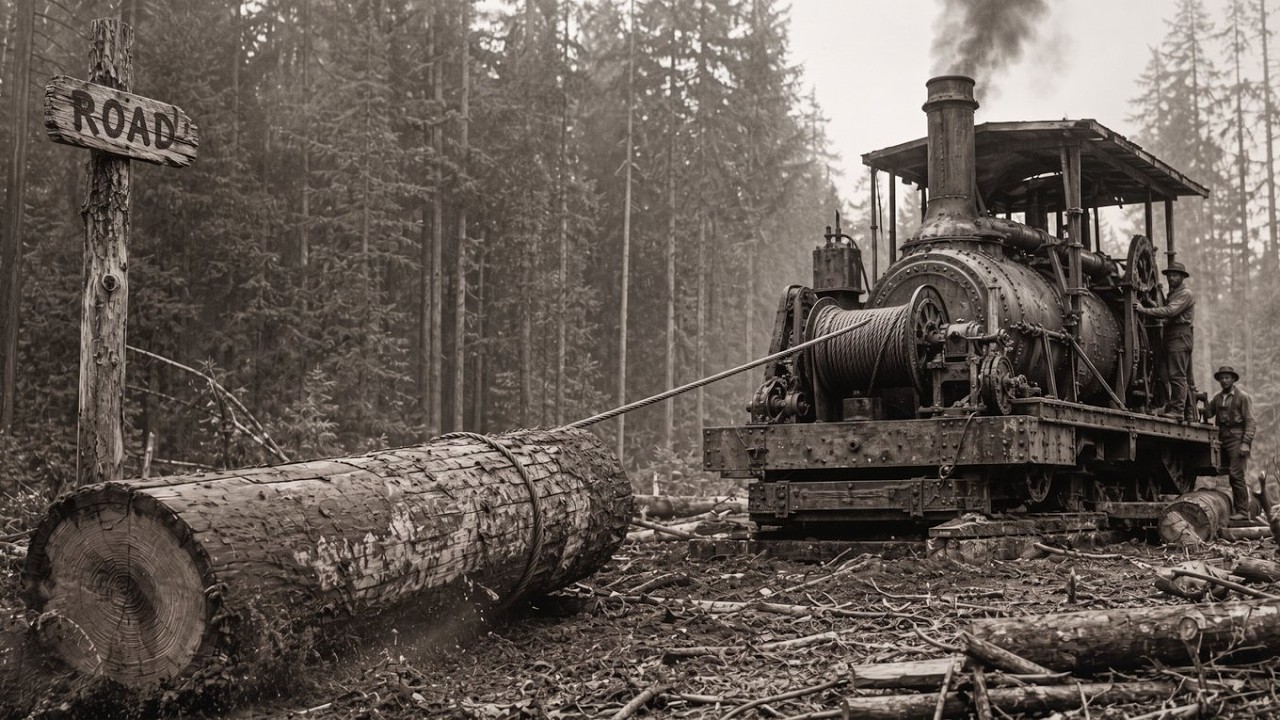
He tied the far end to a log. Then he opened the steam valve. The log came. It came faster than any team of oxen had ever moved one, and it kept coming.
Dolbeer filed a patent the following year. What he had built was almost embarrassingly simple, and that was exactly why it worked. A steam engine cannot go anywhere. That is the great weakness of stationary power, and the reason the steam locomotive had to be invented separately.
But a steam engine does not need to go anywhere if it can pull the world toward it. Dolbeer had grasped that a winch does not care about the nature of the ground. A rope goes where a wheel cannot. It climbs hills, crosses ravines, skirts fallen trees, and penetrates thickets no wagon could ever enter.
So the machine stayed in place, and the forest came to it. For two hundred years, American logging had been governed by a brutal equation. Before Dolbeer’s machine, moving a felled tree meant animals. Teams of oxen, often six, eight, or twelve pairs, were hitched head to tail in a line that could stretch seventy feet from lead animal to load.
A man called the bull driver walked alongside with a goad stick. Ahead of the entire procession, another crew had already built a road. Not a road in any familiar sense. A skid road was a corridor of logs, half-buried crosswise in the dirt, spaced like the rungs of a ladder pressed into the ground.
The cut timber slid over those rungs. A boy called the greaser ran ahead of the load with a bucket, wiping every rung with oil or tallow so the log would not snag. Every foot of that road had to be built before a single log could move, and every foot had to be maintained. When the timber near the road ran out, which it always did, the road had to be extended or the whole operation moved.
The result was simple and enormous at once: the best timber in North America, standing in dense, towering forests on steep ground, was worthless. Not because nobody wanted it, but because nobody could get it out. Dolbeer came west like tens of thousands of men, and he did not find gold. What he had instead was a trade.
He understood engines. By the 1860s he had settled on the north coast of California and entered the lumber business as a partner in a mill at Eureka. He was not an inventor who stumbled into logging by accident. He was a lumberman who happened to understand steam, and he spent twenty years watching oxen fail at a job he believed a machine could do.
The workers refined his basic idea. The manila rope became wire cable, because manila burned and snapped under the strain. One spool became two, then three. Now the machine could pull in a log on one line while casting the empty line back out on another, without stopping.
The cable was lifted off the ground and run through pulleys suspended high on a standing tree, so the front end of a log rode clear of the stumps instead of slamming into them. That method was called the high lead. With the right anchor point and the right angle, a crew could bring in a log from a mile away, across ground an ox team could not have crossed a single step. So the machines grew.
Dolbeer’s first engine was small enough that a few men could wrestle it into place. By the turn of the century, the yarders coming out of Portland were something else entirely. The Willamette machine, built around a boiler ten feet tall and sixty-eight inches in diameter, weighed thirty-eight tons dry, before a drop of water or a single foot of steel cable was on the drums. That returns us to that clearing with no road leading to it, and this is the part that is hard to believe.
They did not haul those machines into the forest. They could not have. Instead, they aimed the machine at the place they wanted it, paid out its own cable to a stump or a standing tree, anchored it fast, and engaged the drum. The cable began to take in.
The anchor point did not move. So the machine moved. Thirty-eight tons of iron dragged itself forward across the soil on its sleds, pulling itself toward its anchor, one hundred feet at a time. When it arrived, the crew paid out the cable again, found another tree, and repeated the process.
A machine with no wheels entered the deepest woods of North America by grabbing the forest and pulling itself along. That was the whole trick: a drum, a cable, and enough steam to move something that weighed as much as a loaded freight car. What the machine could not do was see. The man at the throttle sat behind the boiler, and the boiler was six feet of solid iron directly between him and everything that mattered.
He could not see the log. He could not see the men. He worked entirely on trust, and that trust passed through a long wire and a steam whistle. At the far end, amid the wreckage of cut timber, stood the rigging slinger.
His job was to crawl under and around a fallen log, drag a loop of heavy cable beneath it, and cinch it tight. It was hard, filthy work amid a tangle of broken branches and smashed tops. When he had it secured, he had to get clear, because what happened next came fast. Between the man and the machine stood a boy.
They called him the whistle punk, and he was often the youngest person in camp, a kid of thirteen or fourteen. Sometimes a logger’s son was put on the payroll because the job required good eyes and no physical strength at all. He stood where he could see the rigging slinger and reach the whistle cord. When the slinger signaled that the choker was set and the men were clear, the boy pulled the cord, the whistle blew at the machine, and the engineer opened the throttle.
That was the entire safety system. One boy, one wire, one burst of steam. Old logging crews understood the danger around them and devised their own response to it. In 1894, one logger described it to a magazine writer, and the detail he chose to explain was clothing.
The men wore outer garments in the brightest colors they could find, blue, green, red, yellow, and it was not vanity. It was so they could see each other through the brush and shout a warning in time. Seeing each other was everything. That was how men stayed alive in the woods.
Then came a machine that moved the load faster than a man could turn his head and placed the only person whose hand was on the throttle behind a wall of iron. A cable under full tension stores an astonishing amount of energy. When it broke, and it did break, the free end whipped through the air faster than the eye could follow. It did not knock men down.
It cut them. A log that snagged on a stump and then broke free did not roll toward the crew at a speed anyone could react to. It simply arrived. The cable did not care which of them it hit: the rigging slinger if he had not backed off far enough, the whistle punk if he stood in the line of the line, the engineer himself, sitting six feet from a drum winding steel under a load he could not see and had no way to gauge.
Nobody kept proper count. By 1906, nearly half a million men worked in American logging, and no federal agency recorded what happened to them. What exists are the general industrial figures of that era, and they are bad enough. In 1889, the average across all American industries was eight and a half deaths per thousand workers every year.
Coal mines, the occupation that became the national symbol of dangerous work, killed three and a half per thousand in 1913. Metal mines ran about the same. Logging, everyone in the trade knew, was worse than both. There simply was no one keeping the books.
The thing that killed the steam donkey was not a better steam engine. The Willamette Iron and Steel Works in Portland produced more than three thousand of these machines between 1901 and 1930. That is an entire era in a single number: thirty years of work, a vast base of machinery, and then a sudden stop. What stopped it all was the internal combustion engine.
Gasoline- and diesel-powered yarders needed no boilers, no firemen, no water supply hauled to them, and no forty minutes to raise steam before the first log moved in the morning. Then came the crawler tractors, and a machine reached the woods that did not need to anchor itself to a tree to move, because it had finally solved the problem Dolbeer had worked around. It could simply drive. The donkey engines were left where they stood.
They were too heavy to be worth recovering and too worn to be worth repairing. A great many are still out there, sunk into the soil on hillsides the trees have grown over again, rusted boilers and cables still wound on the drums. John Dolbeer did not live to see the end of it. He died in 1902, twenty-one years after that morning in Humboldt County, at a time when his machine had remade the industry and had not yet begun to be replaced.
The machines changed. The arithmetic did not. What the loads bought was access. Before Dolbeer, American logging was limited to timber that could be reached.
After him, everything was reachable: the steep ground, the distant ridges, the forests that had stood intact because no animals could get to them. All of it came within the range of the rope. That is why the old-growth timber came down the way it did and as fast as it did. Not because someone invented a better saw, but because someone figured out how to move what the saw had already cut.
The cost of that access remained remarkably steady. In the 1990s, researchers examined 780 logging deaths in the United States. Machines, the yarders and loaders and skidders, all the descendants of Dolbeer’s engine, accounted for only 12 percent. The rest, more than eight in ten, were killed the same way the men were killed in 1881: by trees and logs.
A century of engineering had been spent on moving timber. None of it had changed what timber does when it starts to move on its own.






