In 1982, a thirteen-year-old standing at the entrance of a shopping mall arcade held the entire week’s allowance in his pocket. Four quarters. Behind him stretched the bright corridor of the mall, white tile and fluorescent lights, but ahead the room was dark, a wall of electronic noise pouring from the doorway. Neon strips pulsed along the ceiling, and thirty arcade cabinets glowed in rows like an electric cathedral.
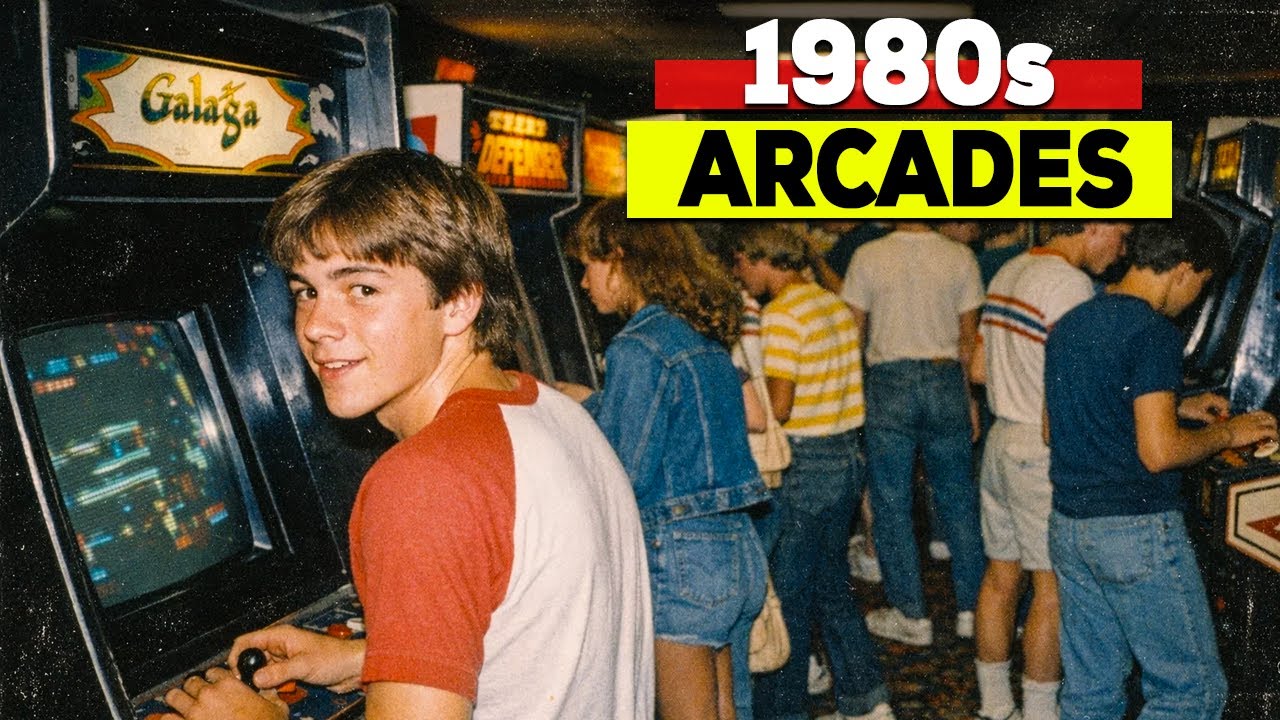
He stepped inside. That year, Americans dropped over eight billion dollars in quarters into machines just like these. That was more than Hollywood made at the box office. More than the entire music industry.
The mall arcade had become the most profitable entertainment venue in the country, and almost nobody over the age of thirty understood why. The sound hit first. It was not one sound but a wall of sound. Pac-Man’s rhythmic wocka wocka layered over the deep thrum of Defender, the shriek of Galaga dive bombers, the synthetic jingle of a credit screen resetting.
Every machine had its own voice, and they all spoke at once. There was no volume control and no reason to have one. The noise was the point. It pulled you in from the mall corridor like a tractor beam.
Then came the light. Mall arcades were deliberately dark. The overhead fluorescents were kept off or dimmed low, so the only real illumination came from the screens themselves and the strips of neon tubing that lined the walls and ceiling in blue, pink, and purple. The cabinets had their own backlit marquees.
Donkey Kong in bold red. Tron in electric blue. Dragon’s Lair in glowing gold. Standing at the entrance, the whole room pulsed like an electronic carnival.
The floors were almost always carpeted, and that carpet was almost always dark, usually black or deep maroon, patterned with geometric designs that hid every stain imaginable. Spilled sodas, dropped nachos, gum, melted candy. Nobody was mopping between rounds of Joust. The carpet was a survivor.
So was the temperature. Arcades ran hot. Dozens of CRT monitors and motherboards generated heat in an enclosed space with questionable ventilation. In the summer, even with the mall’s air conditioning working overtime, the arcade was noticeably warmer than the rest of the building.
You walked in from the cool of the J. C. Penney corridor and felt the temperature shift on your skin like stepping into a greenhouse. But the sensory experience was only the surface.
What kept kids coming back, what turned a casual visit into a daily ritual, was the economy that ran underneath it all. Everything in the arcade ran on one currency, the quarter. A single game cost twenty-five cents. Some of the newer, flashier cabinets, like Dragon’s Lair when it arrived in 1983, charged fifty cents, which felt like highway robbery at the time.
For most of the decade, a quarter was your ticket to ride. Kids typically showed up with a dollar, maybe two if they had saved their allowance or done extra chores. In 1982, the average weekly allowance for a twelve-year-old was somewhere around two to three dollars. That meant eight to twelve lives.
Eight to twelve chances to prove yourself. You did not casually browse. You watched. You stood behind someone who was good and studied their patterns, their timing, how they handled level three of Donkey Kong or the blue ghost pattern in Pac-Man.
Because when your quarter went in, there was no tutorial, no practice mode, no second chance. You performed or you were done. The change machine was the beating heart of the operation. A big metal box, usually near the entrance, that swallowed dollar bills and spat out four quarters with a satisfying metallic clatter.
That sound, the chunk chunk chunk of quarters dropping into the tray, was the starting gun. You scooped them up, felt their weight in your palm, and you were loaded. The machines themselves were serious business. A single Pac-Man cabinet could pull in around four hundred dollars a week in quarters.
Namco sold 400,000 of those cabinets, and Pac-Man alone generated over one billion dollars in quarters by 1981. Space Invaders pulled in even more, two billion dollars in quarters by 1982 from its 360,000 machines worldwide. These were not toys. They were ATMs that played music.
The cabinets were works of art in their own right. Full-size uprights stood about six feet tall and weighed anywhere from 250 to 350 pounds. They were built from plywood and particle board wrapped in printed side art designed to grab your eye from across the room. Bright colors, action scenes, characters in mid-battle.
The marquee at the top was backlit, glowing like a miniature billboard. A new cabinet cost the operator around three thousand dollars, a serious investment that needed to pay for itself in quarters within a few months. The controls were industrial grade. Leaf switch joysticks with a short throw and a decisive click.
Concave buttons made of hard plastic worn smooth by thousands of sweaty thumbs. These machines were built to survive teenagers, and mostly they did. By 1982, over 1. 5 million arcade machines operated across North America, spread across 24,000 dedicated arcades and another 400,000 street locations in bowling alleys, laundromats, pizza joints, and of course, shopping malls.
Pac-Man was the undisputed king. Donkey Kong, which had sold over 60,000 cabinets, introduced the world to a jumping carpenter originally called Jumpman, later renamed Mario. Galaga refined the space shooter formula into something almost hypnotic. Defender, with its 55,000 cabinets, was the game for people who wanted punishment disguised as fun.
The mall arcade had a rotation. Games came and went. An operator might swap out an underperforming cabinet every few weeks, trucking in the latest title to keep the quarters flowing. One month it was Centipede.
The next it was Dig Dug. Then Q*bert showed up, and suddenly everyone was clustered around that weird pyramid game with a sound effect that sounded like it was swearing. The lineup was never static. But the games were only half the experience.
What really defined the mall arcade, what made it different from dropping a quarter into a machine at the laundromat, was who was playing and where they stood. For teenagers in the 1980s, the mall was already the center of the universe, the place you went after school, on weekends, all summer long. You grabbed a slice of Sbarro pizza for a dollar seventy-five, a Coke from the vending machine for fifty cents, and then you drifted toward the arcade like it was pulling you by gravity. Chains like Tilt, Aladdin’s Castle, and Time Out had locations in malls across the country.
By 1981, there were over 13,000 dedicated arcades in America, and a huge number of those were tucked inside shopping malls. The high score board was everything. Three initials. That was all you got.
If you were good enough to put your initials on the machine, everyone who played after you would see them. It was the original social media, a public declaration that you were the best, at least until someone knocked you off. Kids would ride their bikes three miles to the mall just to check if their initials were still on the Galaga machine. There was an unspoken etiquette.
You put your quarter on the cabinet’s ledge to claim next game. If someone was on a serious run, you did not talk to them. You did not bump the machine. You watched respectfully, maybe nodded when they pulled off something impressive.
If you were new, you earned your place by losing quietly and learning fast. Nobody taught you the rules. You absorbed them. The serious players, the ones who could stretch a single quarter into a forty-five minute session on Robotron, had their territory.
They knew the staff by name. They knew which machines had the tightest joysticks. Then there were the casual kids, cycling through whatever was available, burning through their quarters in fifteen minutes. And then there were the kids who were mostly there to hang out, leaning against the change machine, watching the room, killing time before their mom picked them up from the Sears entrance at five.
For a few years, the mall arcade was the undisputed kingdom of American teenagers. But not everyone was happy about it. As the arcades grew louder and more crowded, parents organized. Teachers complained about truancy.
Local news ran breathless segments about teenagers wasting their lives in dark rooms full of blinking machines. In 1982, Surgeon General C. Everett Koop publicly warned that arcade games were producing abnormal behavior in young people. The statement made national news and gave local officials the ammunition they had been waiting for.
One city in Texas tried to ban anyone under seventeen from entering an arcade without a parent. Another in Massachusetts banned coin-operated amusement machines entirely. Other towns required special licenses, restricted hours, even imposed rules about how close an arcade could operate to a school or a church. What most people never realized at the time was that the Surgeon General later admitted he had been speaking off the cuff.
There was no study, no formal research behind the claims. By then, it did not matter. The damage was done. And at the exact same moment, something far more destructive was building from within.
By 1983, the boom was over. Too many machines, not enough innovation. Revenue fell thirty percent in a single year. A third of operators went bankrupt.
Then the real killer arrived, from a living room in suburban America. The Nintendo Entertainment System launched in 1985. One cartridge, forty dollars, unlimited plays. The arcades had no answer.
They did not vanish overnight. They faded. The neon flickered. The carpet surrendered.
By the late eighties, the room that once roared was a sad cluster of machines next to a frozen yogurt stand. For those who remember, the mall arcade was more than entertainment. It was a proving ground, and for a lot of kids, the first place they ever felt genuinely good at something. A quarter and fast hands, that was enough.
The machines are gone. The malls are disappearing. But the sound of quarters dropping, the glow of a high score screen, the feeling of putting your initials up on that board, those memories never faded.






