For nearly four decades, the Spokane police were convinced they had already caught the person responsible for the murder of nine-year-old Candy Rogers. They had a name. They had a physical detail linking him to the clothing found at the crime scene. The man was already in prison, serving a life sentence for two other murders.
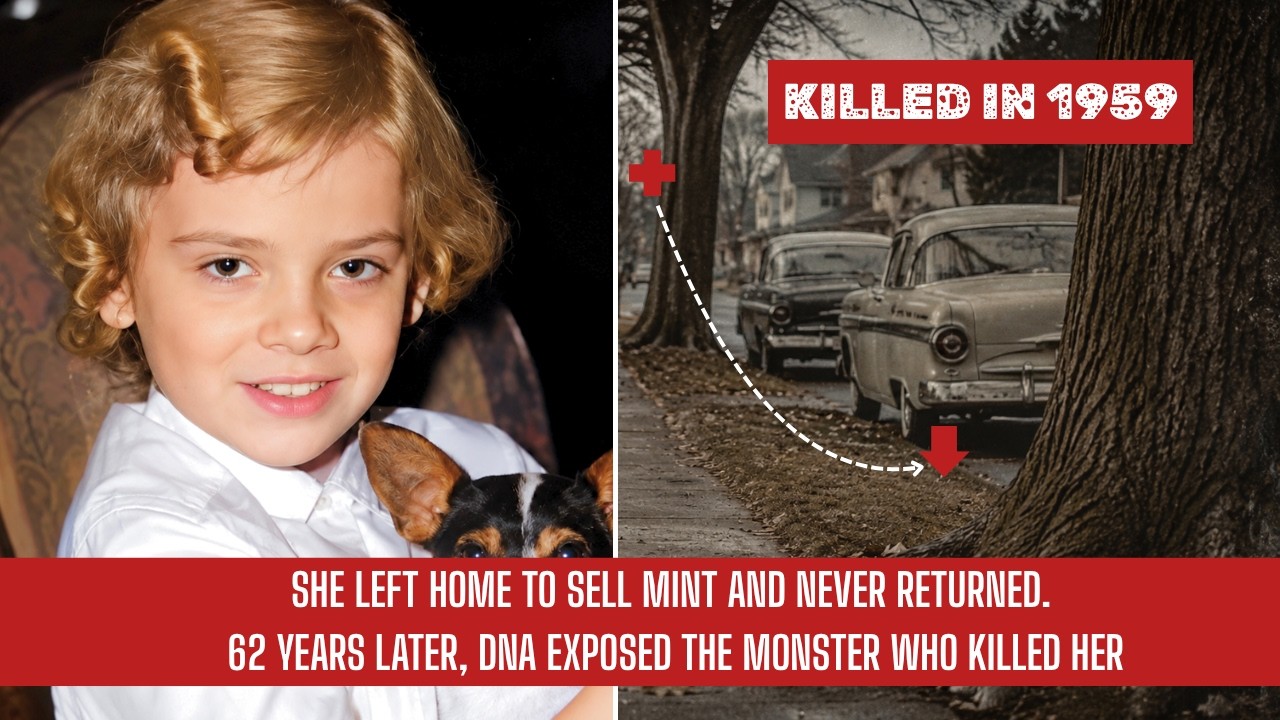
He was not the killer. The person who actually left the evidence that day was never arrested, never named as a suspect, and never appeared in any of the thousands of reports investigators received over the following six decades. At one point, his name was already inside the case file, but it was not connected to the crime. Candy Rogers was nine years old and in the fourth grade at Holmes Elementary School in Spokane, Washington.
Her father was Carl Rogers Jr. , and her mother was Eileen Newton. She lived with her mother above a grocery store in the West Central neighborhood of Spokane, in a small upstairs apartment on a street lined with working-class family homes. She belonged to the Bluebirds, the youngest division of the Camp Fire Girls of America.
On Friday, March 6, 1959, the organization launched its annual fundraising drive, a door-to-door candy sale held every spring in Spokane’s neighborhoods. That evening, Candy collected seven boxes of mints from her troop leader. Before leaving, she sat down and planned her selling route, deciding which streets to try first and which neighbors were likely to buy. It was not a burden for her.
She wanted to qualify for a sales badge, which would give her a chance to attend summer camp. At four o’clock, she left her apartment and began walking her route, moving from door to door through the surrounding blocks. By six-thirty that evening, several neighbors remembered seeing her on West Maxwell Avenue, still working her way through the neighborhood, carrying the boxes of mints. No one who knew her saw her after that.
As darkness settled over West Central Spokane and Candy failed to come home, her mother grew increasingly worried. Girls of nine selling door to door in that neighborhood were expected home long before dark. When enough time passed without word, Candy’s mother alerted the neighbors, and within the hour, she notified the police. By nine o’clock that night, a group of volunteers found something on the Fort George Wright Bridge.
They discovered several of Candy’s mint boxes scattered across the roadway. They were not stacked, and they had not been dropped in one place. They were spread out, a pattern suggesting they had fallen from a moving vehicle rather than been placed by hand. Word of the discovery spread through the neighborhood within hours.
By the next morning, the Spokane Police Department had escalated the case into a large-scale search, and the city responded in a way many had never seen before. Military personnel from Fairchild Air Force Base joined the effort, along with postal workers, scout troops, and ordinary citizens on horseback. Two of the city’s religious leaders, Catholic Bishop Bernard Topel and Episcopal Bishop Russell Hubbard, went on local radio and publicly asked anyone with information to come forward, even secretly through a priest or minister, if that was the only way someone would feel safe speaking. Among those who joined the search that first night was a fifteen-year-old student from Gonzaga Preparatory School.
A friend’s father drove him, and they spent hours combing the Fort George Wright area in the dark, looking for footprints in the thin layer of snow that had fallen that evening. The search was later described as disorganized, not a coordinated operation, but a citywide effort of people doing everything they could wherever they thought someone should look. The next day, March 7, the search took an unexpected and devastating turn. A United States Air Force helicopter assisting in the aerial search struck power lines and crashed into the Spokane River.
Three men aboard were killed: pilot Marles Ray, Sergeant William McDonald, and Lieutenant Kenneth Vacek. What had begun as a search for one missing child turned within twenty-four hours into a loss felt by three additional families. The search continued for the next sixteen days without any confirmed results. Then, on March 21, two off-duty pilots from Fairchild Air Force Base were walking through a wooded area off Old Trails Road when they found a pair of small shoes lying in the brush.
The shoes were not tossed randomly. They had been deliberately placed side by side. The following morning, March 22, a search team returned to that same stretch of woods. It did not take long to find what the shoes had been left near.
Candy’s body, hidden under a covering of pine branches. The examination confirmed she had been strangled and sexually assaulted. Her ankles and neck had been bound using strips of her own clothing. Investigators moved to preserve every piece of physical evidence found at the scene, including a biological sample collected from her clothing.
It was sealed and stored carefully, even though in 1959 no forensic technology anywhere in the world could make use of it. For nearly four decades, investigators believed they already knew who was responsible. His name was Hugh Bion Morse, a convicted serial killer active throughout the Pacific Northwest during that period. He was eventually sentenced to life in prison for two other murders committed around the same time.
The link to Morse rested on a single detail. During Candy’s original autopsy in 1959, examiners noticed a spot on her clothing they believed was grape-flavored gum. Morse was known to favor that exact flavor, and investigators found other cases connecting him to it. On the strength of that one detail, Spokane investigators spent years building their case around him as the prime suspect.
By the standards of criminal investigation in that era, it was a reasonable conclusion, a personal habit tied to physical evidence linked to a man already convicted of similar crimes. It gave the department something to hold on to for decades when almost nothing else advanced. But it also turned out to be wrong. In 2001, investigator Mindy Connelly authorized new forensic testing on the sample that had remained sealed since 1959, testing made possible by DNA technology that did not exist at the time of the crime.
The lab developed the case’s first complete genetic profile from that evidence and compared it directly to Morse. There was no match. Morse was formally ruled out as a suspect. He denied any involvement in Candy’s death and was never connected to her case in any official capacity.
He died in prison in 2003, having spent the last two years of his life cleared of a crime investigators had tried to attach to him for forty years. With Morse eliminated, the new DNA profile was entered into CODIS, the FBI’s national criminal database used to compare unknown genetic samples with convicted offenders across the country. The search returned nothing. No name, no lead.
By 2007, the case against Hugh Bion Morse had completely collapsed, and Candy Rogers’s file had grown far beyond a single suspect. When investigator Brian Hammond sat down with a local news crew that year, he opened a case file that had swelled into one of the largest in the history of the Spokane Police Department. Volumes and boxes containing more than 750 reports gathered over nearly four decades. Some came from neighbors.
Some came from strangers hundreds of miles away who had read about the case in a newspaper. Several came from people claiming psychic abilities, each confident they had the answer investigators had spent decades searching for. Hammond looked into the camera that day and said what nearly every investigator who had worked the file before him truly believed. Someone would eventually solve this case.
Not if, but when. In the years that followed, Hammond described the investigation as work that stayed with him, the kind of case that never fully leaves an investigator’s mind, even when there is nothing new to work on. The case remained in the background of his career for more than a decade, returning to it whenever time allowed or a new thread emerged, never fully set aside. Hammond stayed with the case until his retirement in 2021, the same year it was finally solved.
Looking back, he described the remaining DNA sample from 1959 as a stroke of luck. No one working the case that year could have counted on it. The investigators who preserved it had no way of knowing what science might later do with it. Without that sample, Hammond said plainly, he did not believe Candy Rogers’s murder would ever have been solved.
In 2018, a case on the other side of the country changed what was possible for files like Candy’s. Investigators in California identified a man known as the Golden State Killer, a serial offender who had evaded capture for more than four decades, using a method called investigative genetic genealogy. Cold case units across the country paid immediate attention because the implications were enormous. A suspect no longer had to be inside a criminal database.
All that was required was a distant relative who had at some point taken a commercial genealogy test out of simple curiosity. The method works by comparing DNA extracted from a crime scene against commercial genealogy databases, not to search for the suspect directly, but to identify people who share part of their genetic material. These are usually distant relatives, third or fourth cousins, people who may never have met the suspect or even known he existed. From there, genealogists work backward, building the family tree branch by branch until the list of possible names narrows to a few, and sometimes to a single name.
That same year, the Spokane Police Department reassigned the Candy Rogers case for a fresh review under this approach. The file reached Britney Wright, a forensic scientist at the Washington State Patrol Crime Laboratory. There was an immediate obstacle. The sample preserved since 1959 had degraded severely over more than six decades in storage.
In 2020, Wright sent it to a private forensic laboratory, hoping they could work with what remained. They rejected the case outright, noting the damage was too severe. By then, the original sample had shrunk to the last usable quantity. There would be no second attempt if this one failed.
In early 2021, Wright learned of a laboratory in Texas called Othram, a company created specifically to handle DNA evidence too old, too scarce, or too damaged for standard forensic genealogy work. She contacted them in February. By March, what remained of the sample had been shipped to Texas for analysis. The Othram team spent the next six months working on the degraded material.
Then, on the weekend of September 6, 2021, they delivered a result no Spokane investigator had obtained in sixty-two years. The genetic profile pointed to three brothers, all originally from Spokane, all of whom had died by that time. The profile narrowed the search to three brothers: John Ray Hoff, James Andrew Hoff, and Terry Allen Hoff. All three were deceased.
Of the three brothers, only John was known to have a daughter. Sergeant Zack Storment made the call himself. On the other end was a woman named Kathy, John Ray Hoff’s daughter. Storment did not immediately explain why he was calling.
He simply asked whether she was willing to help with an old investigation. She did not wait for details. Within forty-five minutes, Kathy had arrived in person at Spokane Police headquarters. In the time between ending the call and reaching the department’s doors, she had searched online, found news coverage of a nine-year-old girl killed in 1959 while selling Camp Fire candy, and understood exactly why investigators wanted to speak with her.
She agreed to provide a DNA sample without hesitation. On September 8, 2021, the results came back. The comparison showed that the likelihood of Kathy being biologically related to the unknown suspect’s genetic profile was approximately 2. 9 million times greater than the likelihood of her being related to any random individual from the general public, a statistical result consistent with a father-daughter relationship.
The result pointed directly to her father. But John Ray Hoff had died in 1970. There would be no arrest, no interrogation, no trial. No defense attorney would ever cross-examine this evidence in a courtroom.
Any certainty investigators reached from this point forward would have to come entirely from their own standards, applied without the adversarial process a living case would ordinarily require. One piece of confirmatory evidence remained notably absent: direct genetic evidence linking Hoff personally to the case. There was only one place that evidence could come from. On September 23, 2021, the Spokane Police Department obtained a court order to do something the case had never required before: exhume the remains of John Ray Hoff.
Investigators traveled to the cemetery where Hoff had been buried since 1970, and his grave was opened under legal authorization for the sole purpose of collecting a direct DNA sample from his remains. The sample was sent for examination. The results came back on October 1, 2021. The comparison showed that it was approximately 25 quintillion times more likely that the genetic material found on Candy’s clothing in 1959 belonged to John Ray Hoff than to anyone else on earth.
Twenty-five followed by eighteen zeros, a number so large it effectively eliminated any statistical possibility of error. For the first time in sixty-two years, the Spokane Police Department had direct physical confirmation, not based on a relative’s DNA, not inferred through probabilities, but extracted directly from the man himself. On November 19, 2021, Spokane Police Chief Craig Meidl stood before reporters and delivered the department’s official conclusion. He described the crime in blunt terms: the abduction of an innocent nine-year-old girl who did not know that this kind of cruelty could exist in the world.
With that statement, the investigation that had spanned three generations of investigators was officially closed. John Ray Hoff was born in Spokane on August 11, 1938. He grew up in the 2500 block of West College Avenue, less than two miles from the home where Candy Rogers would later live. In 1955, at age sixteen, Hoff escaped from a state juvenile facility near Olympia.
He was captured shortly afterward near Yakima and returned to custody. The following year, he enlisted in the United States Army at seventeen and was stationed near Spokane, assigned to a missile defense site responsible for protecting Fairchild Air Force Base. By March 1959, Hoff was twenty years old, living on West Broadway, about a mile from where Candy Rogers lived with her mother. Two years after Candy’s death, in 1961, Hoff was arrested in Spokane’s Browns Addition neighborhood.
He had attacked a woman, using pieces of her clothing to restrain her, and attempted to strangle her with another piece. She survived the attack and reported him to police. Hoff served six months in prison for that assault. As a result of the conviction, the army discharged him for desertion.
Hoff spent the rest of the decade moving between jobs. He sold goods door to door, worked at a sawmill, and later held a job at a meat canning plant where he suffered chemical burns to his face. There remained a connection to Candy’s case that no one noticed for sixty-two years. In 1959, Hoff had a ten-year-old half-sister who was also a member of the Camp Fire Girls.
She had been assigned as Candy’s older sister in the program, given the task of mentoring her. The two girls knew each other personally. When Candy disappeared, this half-sister grieved publicly, telling Hoff how much she missed her friend. He listened to her.
He never told her why he knew exactly what she had lost. In 1970, Hoff’s wife fled their home, screaming that he was carrying a gun. Their children were called inside. Hoff ended his own life on the doorstep.
He was thirty-one years old. A neighbor named Judy Tierney helped in the aftermath. She was a young mother who happened to be Candy Rogers’s cousin, though neither she nor anyone else in the neighborhood knew that connection at the time. Her daughter, Karen Jo, grew up in that same house years later, unaware of the full story until the Spokane Police Department announced the case had finally been solved in 2021.
There were no convictions, no courtroom, no verdict read aloud. John Ray Hoff had been dead for more than five decades by the time his name appeared in the case file. What the Spokane Police Department offered instead of punishment was something more limited: confirmation. At the November press conference, investigators played a recording of a statement from Kathy Hoff, his daughter.
She did more than acknowledge what her father had done. She apologized directly, saying she was deeply sorry for what he had taken that day, not just Candy’s life, but the years that followed for Candy’s parents as well. She said she understood this resolution did not offer justice in the legal sense. But she hoped what it offered instead was an ending the family could finally point to.
Word soon reached the Hoff family that their father had been buried in the same Spokane cemetery where Candy Rogers had been buried for more than fifty years, without either family knowing it. Without anyone asking, the Hoff family arranged to have his remains moved to another cemetery. Joan Boss, Candy’s cousin, said the gesture told her something important: that the decision had affected the Hoff family too, in its own way. Boss had her own memory of that night.
She was thirteen years old at a Girl Scout sleepover when she learned her cousin was missing. The case reached further than either family had expected. Emily Evers, a young relative of Candy’s studying at Gonzaga University, said watching the case be solved through DNA analysis was part of what drove her toward a career in forensic science, a line running directly from a sixty-two-year-old case file to someone who had not even been born when it was finally closed. Sergeant Zack Storment, reflecting on the case afterward, was careful about the language he used.
He said this was not closure. Peace was not something a case like this could offer either family. What it could offer was something narrower: a measure of relief from the weight both families had carried, each in very different ways. For Candy’s relatives, that relief came from finally having an answer.
For the Hoff family, it came loaded with something harder, the knowledge that the man they had known their entire lives had carried this secret in silence until the day he died. In the years that followed, the case continued to draw attention beyond Spokane. It was featured in a 2025 episode of a true crime documentary series and again in a podcast devoted to cases solved through forensic science. More than six decades after Candy Rogers disappeared while selling mints door to door, her case is still cited as an example of what patience, preserved evidence, and the slow arrival of new technology can accomplish together.
For forty years, investigators were convinced they already had their answer. They did not. The truth had been quietly in Spokane all along: a name never reported, a connection unnoticed for six decades, and evidence preserved long before anyone understood what it might one day prove.
Closing the case took sixty-two years, not because no one kept looking, but because the tool capable of finding the answer had not yet been built, and the evidence had to survive long enough for that tool to finally catch up.






