By the spring of 1857, the young Empress Elisabeth had been married for barely three years, and already the walls of the Viennese court were closing in on her. The Hofburg’s rigid etiquette, the ceaseless scrutiny, the suffocating presence of her mother-in-law—all of it pressed down on a girl who had grown up running free through the Bavarian countryside. So when the imperial family prepared its grand journey to Hungary, Elisabeth saw more than a political mission. She saw an escape.
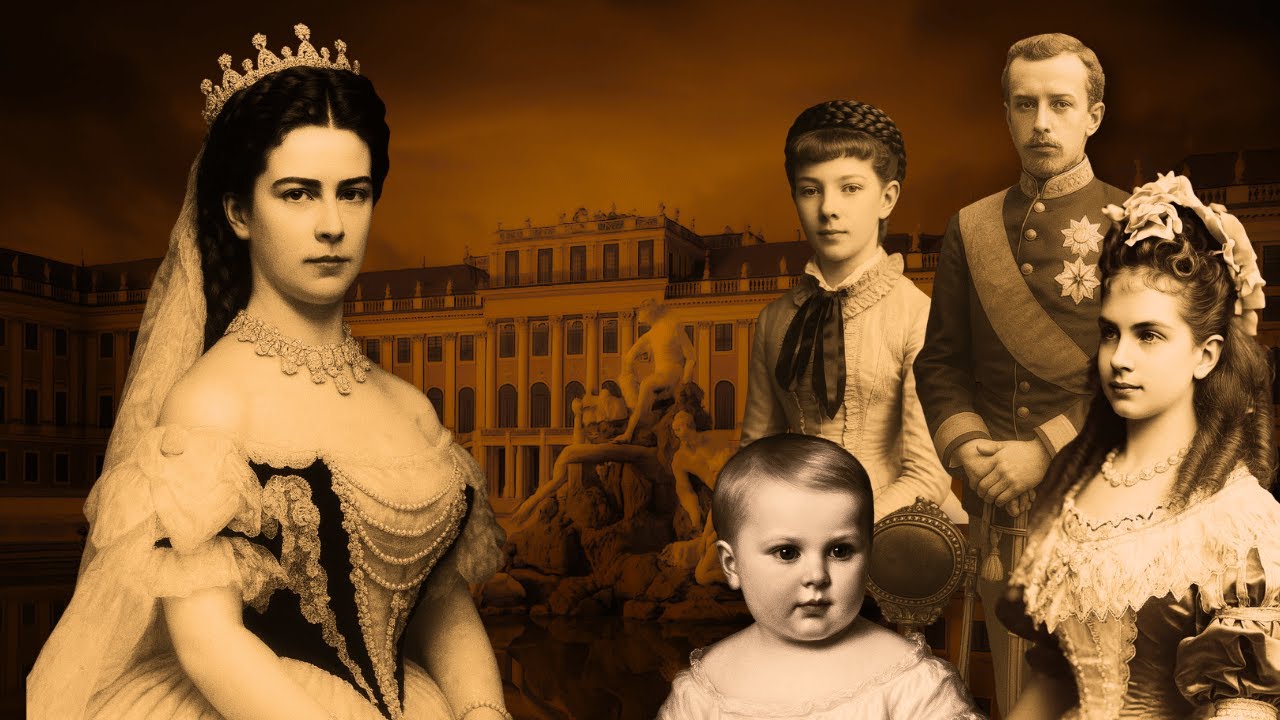
And she insisted, against all advice, that her two small daughters come with her. Her mother-in-law, Archduchess Sophie, warned her plainly: do not take the children, it is far too dangerous. But Elisabeth did not listen. Hungary had already cast its spell on her—a wild, romantic frontier within the empire, a land that had risen against Austrian rule only a few decades earlier and been crushed for it.
Elisabeth found herself deeply moved by the Hungarian people and their culture. She understood their grievances in a way her husband’s court never could. For a brief, shining moment, she was happy. Then both daughters fell ill with diarrhea.
Little Gisela began to recover. Two-year-old Sophie only weakened, burning with fever. Within hours, the journey had become a death watch. The child died in her mother’s arms, probably from typhus.
Franz Joseph remained in Hungary and continued his tour. Elisabeth was forced to travel back to Vienna alone, two days on the road with her dead daughter beside her. From a distance, Franz Joseph sent a telegram to his mother: our little one is now an angel in heaven. After long suffering, she passed away peacefully at half past nine.
He was devastated. In Vienna, Elisabeth was barely recognizable. The loss of her child plunged her—already prone to melancholy—into a deep depression. She returned to court more somber than ever.
And then Archduchess Sophie delivered her verdict: the child’s death was proof that Elisabeth was an incapable mother. Her husband and mother-in-law ignored her grief. Only her own mother worried for her safety. Elisabeth visited little Sophie’s grave in the imperial crypt every day, standing silent, hollow, and absent.
But the world around her kept turning, and at court the pressure only mounted. The succession was not secure. An heir was needed, and quickly. Finally, Elisabeth gave birth to a son.
Rudolf. The crisis was over. The heir to the throne had arrived. Elisabeth believed she had fulfilled her imperial duty.
Soon afterward, she fell ill with a lung condition—but the illness became a pretext. She fled the Viennese court, choosing Madeira, about as far away as one could travel in that era. In Vienna, little Gisela and Rudolf grew up without their mother. For two full years she was absent during their most formative months and years.
When she returned, her children barely recognized her. Every time they were brought to see this woman who had become a stranger, they cried bitterly. She tried to take them in her arms, but they only cried harder, because Sisi was a complete stranger to them. Yet a deep bond remained between Rudolf and Gisela throughout their lives, even after they were separated at age six.
A new chapter began for Rudolf. His father, Emperor Franz Joseph, wanted a strong, brave son—a soldier. Shortly after his birth, the emperor appointed the boy a colonel in the army. He had no interest in the child’s frailty or poor health.
The heir was handed over to a count, a close friend of the emperor, who was meant to toughen him up through harsh measures. Rudolf was forced to dig in snow and ice and was exposed to wild boars in the Tiergarten. Military training became a nightmare. He woke at night to pistol shots.
It was education through fear. A secret report reached the empress, describing her son’s suffering. Elisabeth acted. With all her determination, she deployed her power—against the emperor’s will—and succeeded in driving out the brutal tutor.
But her maternal care did not last long. Soon afterward, she left the Viennese court again. The children stayed behind, with their father. Elisabeth was obsessed with her health and her beauty, because these were among the few aspects of her life she could control.
She stood 1. 73 meters tall—unusually tall for a young woman of her time—and kept her weight below fifty kilograms for the rest of her life. She exercised excessively. Every palace the family visited had a gymnasium fitted out for her.
There were even mats and balance beams in her bedroom. She would often go riding for hours. She followed a permanent diet and usually ate only raw beef in the form of beef juice, milk, and raw egg yolks, sometimes mixed with wine. She often refused to eat anything at all for days.
She wore a tightly laced corset, and in some years her waist measured only forty centimeters. Today, without doubt, she would be diagnosed with anorexia. She developed an aversion to overweight women and passed this attitude on to her daughter. She employed a former theatrical hairdresser who spent three hours a day combing and braiding her long, chestnut-brown hair—which reached down to her ankles—into elaborate styles.
Every two weeks she washed her hair with a concoction of eggs and cognac. On washing days, she canceled all other obligations. On April 22, 1868, her daughter Marie Valerie was born in Hungary, and she held a special place in the family. Sisi showered her with love and affection.
At the Viennese court, Marie Valerie quickly acquired the nickname “the only one. ” Sisi wanted to make up for everything she had missed with her older children. She always wanted the little girl close to her. So mother and daughter traveled together to Corfu, Rome, Merano, Ischl, to Vienna for the death of her grandfather, then to Possenhofen in Bavaria, and finally back to Budapest, to Gödöllő Palace.
The child suffered under her mother’s helicoptering. Marie Valerie grew increasingly stubborn. Her diary became a mirror of her soul. She kept it meticulously and preserved it for the rest of her life.
She understood early on that she was her mother’s only confidante, that Sisi poured all her weariness with the world into her. In the end, Marie Valerie emotionally distanced herself from her mother and sought closeness with her father instead. The emperor sat at his desk, absorbed in his work. In the corner of the room sat Marie Valerie, perfectly silent, watching her father for hours without saying a word.
The eldest daughter, Gisela, also felt the shock of her mother’s sudden enthusiasm. The fate of the fifteen-year-old girl was decided: she would marry Prince Leopold of Bavaria, a royal relative from her mother’s homeland. The girl was not consulted. Gisela rarely saw her brother Rudolf.
She married her Bavarian prince and moved with him to Munich. When she gave birth to a child shortly afterward, her parents reacted very differently. Franz Joseph embraced his new role as grandfather completely. For Sisi, it was a shock.
The eternally young and beautiful empress, who preferred to be alone, became a grandmother at the age of thirty-six. She could not bring herself to envy her daughter’s family happiness. Rudolf grew into an intelligent, liberal young man. He was interested in politics, science, and literature—all things his conservative father mistrusted.
The crown prince secretly wrote revolutionary articles for newspapers, criticized the emperor’s policies, and dreamed of a modern, democratic Austria. In 1881, he married Princess Stephanie of Belgium for political reasons. The marriage was unhappy. Rudolf suffered from depression, drank heavily, and had numerous affairs.
He felt trapped between his ideals and the constraints of monarchy. Tragedy struck at his hunting lodge at Mayerling. Rudolf first shot his seventeen-year-old mistress, Marie Vetsera, then turned the gun on himself. The news shocked Europe.
For Sisi, her world collapsed. She would never see her son again, and she wore only black for the rest of her life. On September 10, 1898, at the age of sixty, Sisi fell victim to an assassination attempt by an anarchist in Geneva. Her daughters rushed to their father.
The news of Elisabeth’s death was a shock, but it was also a kind of liberation for those who had truly known her. Marie Valerie, in particular, quickly realized that a long life—and perhaps illness—was something her mother would never have endured. So Sisi leaves behind a contradictory legacy: the legend of beauty, and the fate of children who suffered from her self-obsession. Gisela, sold into an arranged marriage.
Rudolf, who took his own life. Marie Valerie, crushed by a mother’s love that had become a burden. The real empress was not the loving mother of the films, but a woman who placed her own needs above those of her children. Her children paid the price for her self-worship.
That is the true story of Empress Elisabeth and the tragic fate of her children.






