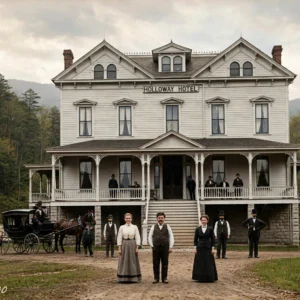
Mary Victoria Leiter was born in Chicago in 1870 into a house of walnut and discipline, the daughter of Levi Ziegler Leiter, a quiet man who had walked away from his Maryland village at nineteen and built a fortune in the city that was still half swamp and half speculation. When the Great Chicago Fire burned the city sixteen months after her birth, Levi did not panic. He saved what he could and bought back the rest, blackened lots and collapsed ceilings, rebuilding from instinct while others saw only ash. By the time Mary could walk, people referred to the city as Leiter’s Chicago.
Her mother, Mary Theresa Carver, was a different kind of presence. She loved an audience, filled rooms with flickering, performative energy, and treated social life as warfare conducted through smiles. Mary grew between her parents, learning early what neither ever articulated: how to endure a room. She learned to stand in doorways without being noticed, to listen for what was not said, and to understand that composure was rewarded above all else.
At night, she wrote stories of heroines who vanished in Act Two, who bled in silence and killed with beauty. In 1882, the family moved to Washington, where her mother glittered beneath chandeliers and her father nodded from behind his newspaper. Mary studied languages and posture at Madame Bertin’s Academy, but the real curriculum was elsewhere: in how girls arranged themselves in a room, how silence could be worn like jewelry, how certain girls were born to be seen and others trained to disappear beautifully. She memorized hierarchies instead of maps.
Her heroines never married. They evaporated. By the 1888 season, Washington had taken permanent notice of her. She was not the most admired, one columnist wrote, but the most observed.
She carried herself like punctuation, exact, silent, and necessary. When Ward McAllister, gatekeeper of Mrs. Astor’s 400, sent an invitation to the Patriarch Ball, her place in society was confirmed. She had learned what restraint could do.
She had not yet learned what it would ask in return. London received her with the cold endurance it reserved for American girls. No one expected much. On her official presentation at the Court of St.
James, she curtsied to the Queen deep, precise, without tremor, then rose and paused just long enough to be registered. The invitations began immediately. At a dinner, the Prince of Wales asked about Chicago. She answered briefly and said nothing more.
He observed her through the second course. A note appeared beside her plate: You are unlike anyone here, which means you’ll stay. She pressed it flat in her lap and later burned it. The name that would define her life entered at a formal dinner.
George Nathaniel Curzon of Kedleston, brilliant, exacting, decorated by Oxford and damaged by ego, spoke in quotations and corrected titles. They had met once before and she had answered without interest. This time he arrived with intention. Their courtship was conducted in letters dense with reference and certainty, in returned copies of Cicero and Marcus Aurelius, in a silent dance at a ball where his final request was that he be allowed to know her.
She returned his copy of Burke with a single line written on the title page: To serve without vanishing, to follow without kneeling. That was the answer. The wedding took place on a cold Monday in April. Mary wore ivory silk, high-necked, embroidered at the hem with lotus flowers in old gold thread.
She carried no bouquet. When Curzon extended his arm, she took it without hesitation. Asked how she felt, she said, “Sewn in. ” In her ledger that night she wrote, Today I was renamed, but I did not vanish.
Two daughters followed, Irene and Cynthia. Marriage did not slow Curzon. It clarified him. He spoke of India not as a country but as a problem, vast and mismanaged, in need of intelligence equal to its scale.
When the appointment came, it was delivered without ceremony, a letter at breakfast that rearranged geography. He was to become Viceroy and Governor-General of India, responsible for three hundred million people. Mary poured the tea and asked whether she would need new gloves. They arrived in Calcutta in 1898, and the heat was white and merciless.
Curzon was sworn in on February sixth. The Government House loomed enormous, Palladian and panicked, its marble floors glittering with effort. Mary walked through twelve salons before reaching her own quarters, which smelled of camphor, roses, and loneliness. At her first banquets, she mispronounced names and was corrected with tight lips.
The gossip came gently, like mildew: she was pale, delicate, not suited to the sun. She fainted standing still at a garden party. The doctor called it exhaustion. She withdrew, then recalibrated.
She began studying not politics but people, how Indian noblewomen signaled with glance and veil, which servants spoke Hindi, which officials bowed and which nodded. She read from dawn to lunch: etiquette, Sanskrit phrases, Mughal architecture. At her next public appearance, she wore a pale sari-inspired gown embroidered with swans, Indian in shape, English in restraint. The British wives fumed.
The Indian papers took note. A minor prince said, “She does not mimic. She listens. ”
By 1900 she had become the empire’s most powerful absence.
She ruled nothing, signed nothing, led no councils. But when Mary Curzon entered a room, it rearranged itself. Officers’ wives who had called her fragile corrected each other about her titles. Indian court officials arrived early and asked for her by name.
She raised funds for plague hospitals, wrote anonymous editorials on women’s sanitation, corrected translators gently. The reforms passed anyway. “She doesn’t issue orders,” one official said. “She makes obedience feel voluntary.
”
Curzon was proud, then puzzled, then quiet. He began quoting her in speeches without credit. He escorted her to ceremonies like a man showcasing his own monument. In the spring of 1903, Mary began to fail.
Not dramatically, not publicly, just enough to unsettle the air around her. She fainted after garden parties. Her gowns were taken in twice, then three times. She never collapsed in public.
That was her rule. Fall only where no one sees the dust. The spring of 1903 brought the Delhi Durbar, the imperial spectacle to honor the coronation of Edward VII and crown Curzon as viceroy in pageant. Mary had been measured for it, every inch.
The dress, white satin embroidered with gold thread and cut beetle wings stitched into mirrored shards, weighed over thirty pounds. It had been designed not to flatter but to dazzle. She rode in an open carriage, stiff-backed and luminous. She walked thirty steps alone, slow and exact.
A colonel whispered that she looked like Britannia risen from marble. That night her maid found her fainted on the floor beside the dressing screen, her skin burning, her pulse thready, blood seeping through the silk. In late 1904 she was taken to England for an operation on her uterus. George wrote daily, not with love but with directives, schedules, numbers, requests for her to return.
He had grown deeply unpopular in India, abrasive, condescending, refusing advice, micromanaging constantly. When he split Bengal into Muslim-majority east and Hindu-majority west, many saw it as a divide-and-rule tactic. Protests erupted. The independence movement rose.
He needed her to soften his image, to save his career. Against her doctor’s advice, she rose from bed weak and returned to India in 1905. A telegram arrived in spring: your resignation will be accepted. Curzon had refused compromise in a bitter power struggle with Lord Kitchener, who insisted on greater military autonomy, and London had recoiled.
Mary attended the final banquet in Calcutta wearing amethyst silk, no diamonds, no fanfare. When Curzon spoke, the applause was lukewarm. But when Mary rose, weak and unsteady, and bowed her head, the room erupted. Someone said, “To her excellency, the soul of the Raj.
” She walked to the train without looking up, her daughters beside her, Curzon behind. Back in England, London did not greet them. Curzon’s hair had gone gray. Mary trembled when she walked.
She no longer dressed for breakfast. She no longer replied to letters. A former ambassador once called to pay respects. The butler said, “You have.
She was behind the curtain. She did not rise. ” In June, her father arrived from America. He sat beside her and said nothing.
At the end of the second day, he placed in her lap the folded fan from India, painted silk, silver handle. She touched it once and never touched it again. On her final night it rained steadily. Her daughters were asleep.
Curzon had gone to a meeting. She reached for her ledger and wrote slowly, each stroke deliberate. This is not death. This is the final costume.
No one saw the pain, because I made it part of the pose. Then, below it, her last line: I was not England’s queen, but I wore her silence. On July 18, 1906, just before dawn, Mary Curzon died. She was thirty-six.
Condolences came from the queen, from Washington, from Delhi, from palace courtyards and village verandas. Curzon wept openly, publicly, as if the machinery of empire had cracked. A maharani near Simla sent a note on perfumed paper with one line: She bowed lower than expected. We noticed.
Years later, Curzon spoke of her during a speech on India and said his finest act of governance had been to let her be seen. When he was passed over for the role of prime minister, those who knew him said he dimmed. Weeks before her death, Mary had opened her old Washington ledger, crossed out her name, and written, They say history forgets women like me. Let it try.
There are no statues to her today. But for a moment in history, India remembered her not as a ruler, but as a presence, soft as the monsoon, and just as impossible to hold.