In January 2020, in the mountains of Sinaloa, Mexico, a wedding took place that would soon dominate global headlines. Within 48 hours of the first images appearing online, millions of people across the world were sharing the same claim: this was a one hundred million dollar wedding. The celebration belonged to Alejandrina Guzmán Salazar, the daughter of Joaquín Archivaldo Guzmán Loera, El Chapo, the most powerful drug lord the modern world had ever known. The event quickly became two entirely separate things.
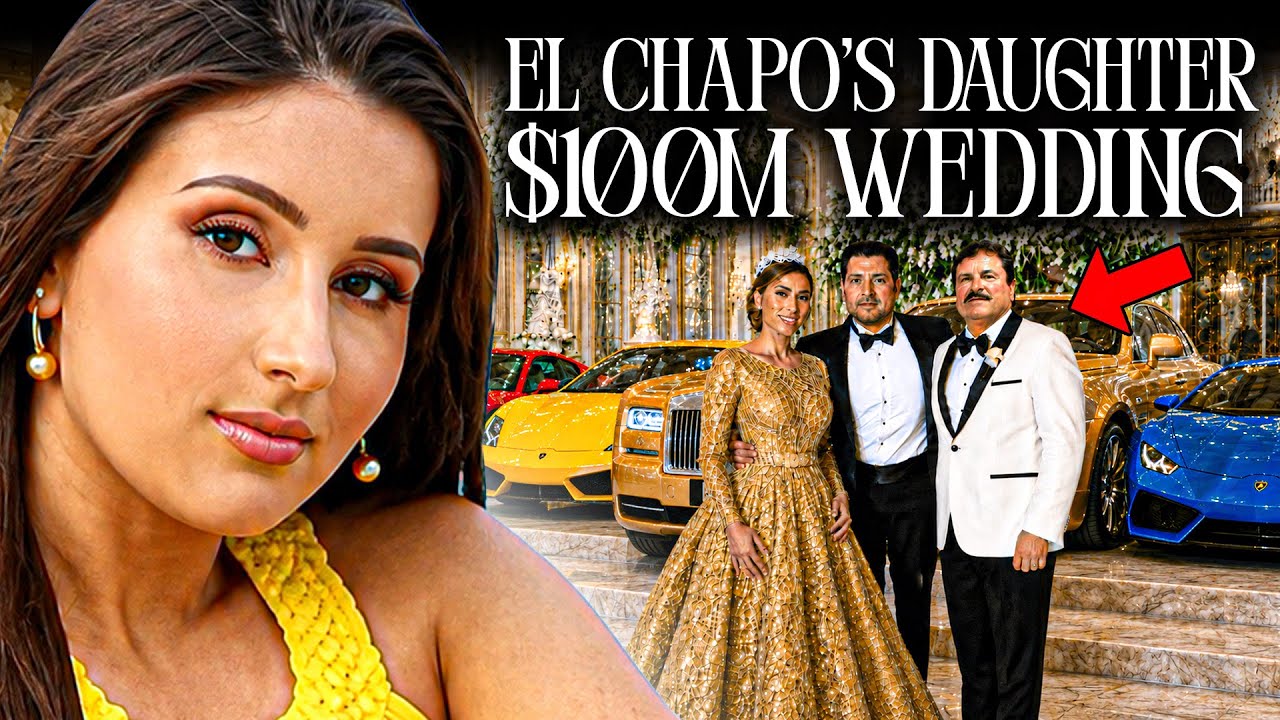
There was the actual ceremony, a private gathering in one of the most isolated and fortified regions of Mexico. And then there was the version that lived online, a viral myth that spread across social media platforms and news outlets with breathtaking speed. Almost nobody stopped to ask what was actually real. To understand why this private wedding became one of the most talked-about events of early 2020, it is necessary to understand the father whose name his daughter carries.
El Chapo was born on April 4, 1957, in La Tuna, a small village in the municipality of Badiraguato, Sinaloa, located in the foothills of the Sierra Madre Occidental. It is a rugged region that has been a center of opium poppy cultivation for generations, a place with little infrastructure and few opportunities. For a young man with ambition and no formal education, the options were essentially two: grow poppies or help move what poppies produced. Guzmán chose the latter path early, and by his teenage years he was embedded in the regional drug trade.
He rose through the Guadalajara Cartel during the 1980s, and after that organization fractured following the torture and murder of DEA agent Enrique Camarena in 1985, he emerged as one of the founders and eventually the undisputed leader of the Sinaloa Cartel. Under his leadership, the cartel built a logistics infrastructure that rivaled legitimate multinational corporations. Tunnels were bored beneath the US-Mexico border with rails, ventilation, and electricity. Maritime routes crossed the Pacific.
Distribution networks reached every major American city and extended into Europe, Australia, and Asia. The US Department of Justice estimated the Sinaloa Cartel moved more drugs into the United States than any other organization in history. DEA estimates placed annual revenue in the billions. He was arrested three times.
First in Guatemala in 1993, then imprisoned in Mexico until he escaped from the Puente Grande maximum security prison in January 2001, reportedly concealed in a laundry cart. He remained a fugitive for 13 years before his capture in Mazatlán in February 2014. He escaped again in July 2015 through a tunnel that began in the shower of his cell at the Altiplano Federal Prison and extended more than a mile, complete with lighting, ventilation, and a modified motorcycle on rails used to remove excavated dirt. He was captured a third time in January 2016, in part because of a meeting with actor Sean Penn for a Rolling Stone interview in a jungle safe house.
He was extradited to the United States in 2017, convicted in Brooklyn federal court on all ten counts in February 2019, and sentenced to life in prison plus 30 years in July 2019. Alejandrina Guzmán Salazar was born to Alejandrina María Salazar Hernández, El Chapo’s first wife. She grew up in the shadow of that name, a context where it meant resources, protection, and proximity to the most wanted man in the Western Hemisphere. Unlike some children of powerful men who retreat into invisibility, she made public choices that kept her name in circulation.
She launched a fashion and accessories brand called El Chapo 701, a reference to Forbes magazine listing her father as the 701st richest person in the world in 2009. In Sinaloa, that ranking had become cultural currency, a badge of distinction. The brand sold belts, caps, shirts, and merchandise bearing her father’s imagery. She registered trademarks, maintained a social media presence, and gave interviews.
She was clearly not trying to disappear from the Guzmán name; she was constructing a commercial identity on top of it. In the months following her father’s life sentence, she was quietly preparing for a major life event. The ceremony took place on January 25, 2020. Alejandrina married Edgar Sharras, a man whose full identity remained largely shielded from public reporting.
He was not a public figure. What was confirmed through images that later circulated online was that the wedding was elaborate and heavily attended. The venue was not a luxury hotel in Guadalajara or a beachfront resort in Los Cabos. It was in Sinaloa, in the territory where the Guzmán name still carries operational weight.
Holding a visible, decorated, publicly photographed celebration there carried an implicit message: the environment accommodates you. The regional security infrastructure, whether formal law enforcement or the parallel apparatus alongside it, had either been made aware of the event or chosen not to interfere. The images that emerged showed deliberate luxury. Enormous floral arrangements in deep reds and whites dominated the reception space.
Centerpieces sat on tables covered in pristine linens. The bride wore a white gown that was clearly custom, expensive, the work of a designer with both skill and budget. Guests were dressed in formal attire that signaled real financial comfort. The lighting was sophisticated.
Music was reportedly live. This was not a family gathering that happened to be well decorated; it was a production, a curated spectacle. The photographs leaked gradually over days and weeks following the event. They appeared on social media from private accounts before being screenshotted and redistributed, or through local Sinaloa media, which operates under very different pressures than international outlets.
Once the images were out, they moved with the speed only social media can generate. And threaded through the reactions was a single number: one hundred million dollars. It appeared in caption after caption, headline after headline, as though it had been officially announced. It had not.
The number came from no official source. There was no government statement, law enforcement estimate, financial disclosure, or investigative report behind it. It came from the mechanics of viral storytelling. Someone looked at the photographs, absorbed the context, and attached a round, enormous, psychologically satisfying number to them.
Once in circulation, it achieved a self-reinforcing momentum. To put the figure in perspective, the royal wedding of Prince William and Catherine Middleton in 2011, which involved the full ceremonial resources of the British monarchy and required state-funded security operations, was estimated at approximately 34 million dollars total, much of that public security costs. The wedding of Kim Kardashian and Kanye West in 2014, considered one of the most extravagant celebrity ceremonies in American pop culture, was estimated at between two and three million dollars. Even the most lavish documented Indian billionaire weddings, involving thousands of guests and days of ceremony, have been verified in the range of 50 to 80 million dollars.
A hundred million dollars for a private ceremony in rural Sinaloa exists in the realm of mythology, not finance. What can be stated with reasonable confidence is that the wedding was genuinely expensive by any normal measure. The floral installations alone would represent a significant investment, likely running into five and potentially six figures. A custom haute couture gown costs tens of thousands of dollars.
Catering and entertainment for an event of that scale would add substantially. And security in Sinaloa for people connected to the Guzmán network represents a cost difficult to quantify but impossible to ignore. The actual figure was significant. It was just not a hundred million dollars.
The exaggeration served a narrative purpose. It confirmed existing beliefs about cartel wealth as limitless. It validated the idea that criminal empires generate money so vast and untraceable that it flows freely regardless of international law enforcement. It reinforced the cultural narrative of El Chapo as a figure of almost supernatural power.
A headline reading El Chapo’s daughter’s wedding may have cost several hundred thousand dollars does not produce the same click-through rate as Inside El Chapo’s Daughter’s 100M Wedding. The mechanics of attention in the digital media environment reward the larger number, the bolder claim, regardless of evidence. Established news outlets faced a familiar pressure: the story was trending, audiences were searching for it, and covering it with rigorous skepticism produced a less engaging article than repeating the figure. Coverage proliferated across dozens of countries and languages, from outlets that repeated the claim as fact to those that used careful language like reportedly while still leading with the number that drove engagement.
The context of the location mattered as much as the name. The wedding took place just three months after one of the most embarrassing episodes in the Mexican government’s recent relationship with the Sinaloa Cartel. In October 2019, Mexican security forces in Culiacán briefly detained Ovidio Guzmán López, one of El Chapo’s sons. Within hours, cartel forces launched a coordinated military-style assault on the city.
Armed convoys blocked roads, gunmen took positions throughout the city, and the confrontation paralyzed Culiacán for hours. The government released Ovidio, justifying the decision in public safety terms. The episode communicated that the Sinaloa Cartel retained both the will and the capacity to deploy significant military force in response to state action. A large, documented, festive wedding in Sinaloa four months after that episode communicated that the family associated with the cartel continued to operate and celebrate its home territory with confidence.
Mexican law enforcement did not publicly announce any action taken in connection with the wedding. Following El Chapo’s imprisonment, the organization did not collapse. His sons, collectively known as Los Chapitos, assumed expanded roles. The cartel diversified into synthetic drug production, particularly fentanyl, which generated revenues on a scale that dwarfed the trade that had made El Chapo famous.
The family name persisted as both mythology and functional organizational identity. What was buried underneath the viral story was a simpler reality. The person at the center of it all was a woman who had gotten married. She did not hold a press conference.
She did not invite international press. She did not announce the cost of her event. The photographs leaked from a private gathering were stripped of context, attached to a number nobody verified, and sent around the world to tell a story that was really about everyone’s pre-existing ideas about the Guzmán family. The violence, corruption, and suffering produced by decades of drug trafficking under that name are documented and real and cannot be separated from any account of this story.
But the viral inflation did not serve those truths. It served its own logic, confirming existing beliefs and telling the audience what it already expected to hear. The irony is that the internet’s insistence on making the story bigger than the facts ensured the story would outlast any accurate account. A genuinely private ceremony would have faded.
The hundred million dollar myth will persist in the public record indefinitely. When people search for Alejandrina Guzmán years from now, they will find the number before they find the caveats. The most honest thing that can be said about what happened in Sinaloa in January 2020 is not that a hundred million dollars was spent.
It is that a hundred million dollars was imagined, believed, shared, and preserved, and that the real event, whatever it actually cost and whatever it actually meant to the people who were there, was quietly swallowed by a myth the internet needed to be true far more than it needed to be accurate.






