For thirty years, a child carried only scattered memories of the days before he vanished. His full name was Joel Manilla. His father drove a jeepney, and his mother worked as a seamstress. Across the decades and an ocean, she never stopped wondering if her missing son was still alive.
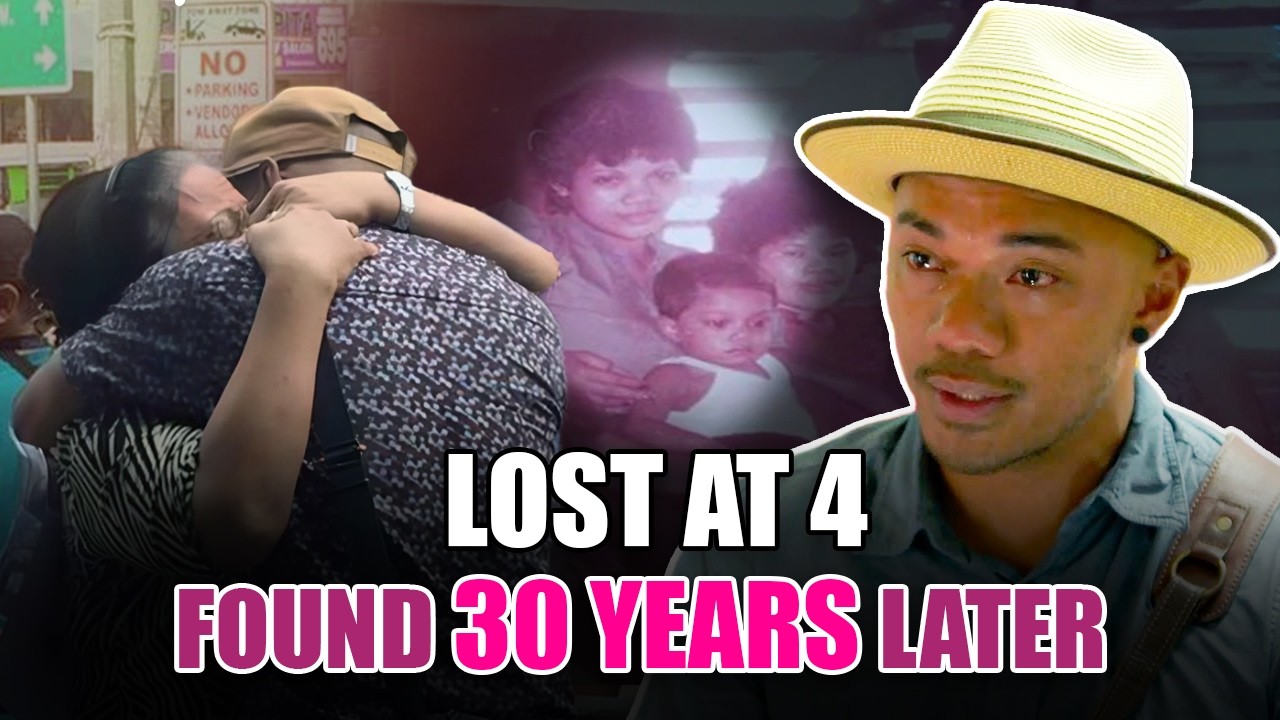
Then, on an extraordinary day, hope answered them both. Long before he became Jojo Darter, an Australian film director, he was simply a cheerful four-year-old growing up in Quezon City, Philippines. His family lived modestly. His father earned a living navigating a jeepney through Manila’s crowded streets, while his mother spent long hours behind a sewing machine to help support the household.
They did not have much, but for a small child, home was not measured in money. It was measured in familiar sounds, warm meals, and the comfort of knowing his parents were always near. Everything changed in the summer of 1985. Like many curious children, Jojo climbed upstairs carrying matches he had found around the house.
He struck one out of innocent curiosity. Within moments, a small flame spread to the wall and quickly reached a nearby bed. To a four-year-old, the fire seemed enormous. Fear took hold before anyone could explain what to do.
Instead of calling for his parents, Jojo ran out of the house. The frightened boy went down the stairs and outside. When he finally stopped, the only place he wanted to return to had disappeared behind a maze of busy roads and crowded markets. The city continued around him as if nothing had happened.
Vendors kept selling food. Jeepneys pushed through the traffic. People hurried home from work. Yet in the middle of that ordinary day, a frightened little boy stood alone as his entire world quietly collapsed.
A jeepney driver eventually noticed him wandering by himself. Sensing that something was seriously wrong, the driver took the child to a local orphanage, believing his parents would come looking for him soon. They did. His family searched desperately, hoping someone had seen their lost son.
But every lead ended in disappointment. Without modern technology, missing child cases often depended on word of mouth, handwritten reports, and luck. As days turned into months, hope gradually faded into grief. Meanwhile, Jojo remained at the orphanage, too young to understand why no one came for him.
Eventually, an Australian couple, Julie and George Darter, opened their hearts to the small boy. They welcomed him into their family and gave him a fresh start thousands of miles away. Australia became his home. He grew up surrounded by kindness, encouragement, and unconditional love.
His adoptive parents treated him as their own son. They celebrated his achievements, comforted him through life’s challenges, and supported his dream of becoming a filmmaker. Even in a happy childhood, though, one void could not be filled by any amount of love. Every adopted child carries questions that only time can answer.
Where did I come from? Who do I look like? Did my biological parents stop looking for me? These questions haunted Jojo into adulthood.
His memories were disturbingly fragmented, just disconnected shards of another life. He remembered his father driving a jeepney and his mother sewing clothes. Most people would have accepted that the past was gone forever. Jojo could not.
Deep down, he believed that someone somewhere in the Philippines had spent the same thirty years wondering what happened to the little boy who disappeared without saying goodbye. As an adult, Jojo built a successful life in Australia with a loving family and a career as a film director. Yet one unanswered question lay behind every achievement. Who had been waiting for him all this time?
Finding the answer seemed nearly impossible. His adoption records revealed little. There were no family photographs, no letters, no traceable names. All that remained were a few childhood memories.
His father drove a jeepney. His mother was a seamstress. Still, those fragments were enough to bring him back to the Philippines. He walked through neighborhoods that felt strangely familiar, speaking with longtime residents, community leaders, and anyone willing to listen.
Every conversation carried a glimmer of hope, but most ended in dead ends. Then a spark appeared. Jojo met Danilo and Vicky, a couple whose young son had disappeared decades earlier. The events matched.
The child’s age matched. Even parts of Jojo’s memories seemed consistent. For the first time, everyone believed the search had finally ended. But a DNA test shattered that hope.
They were not related. The disappointment affected Jojo and another family forced to relive the pain of losing a child. Many people would have given up. Jojo did not.
Instead, he treated every failed lead as proof that more people were hearing his story. Eventually, two new names emerged: Herminia Rio and Cardenio Coladilla. Many locals believed they might be Jojo’s biological parents. There was one problem.
Coladilla had left the Philippines years earlier to work as a mechanic in the United States, and no one knew where Herminia was. When Jojo finally contacted him, the conversation began cautiously. As Jojo described the jeepney, his mother’s sewing machine, the house fire, and the day he disappeared, the older man fell silent. Then he revealed something that changed everything.
He had never stopped searching for his lost son. For years, he followed every rumor and every possible lead, refusing to believe the child was gone forever. For Jojo, this was the closest he had come to the truth. But one piece was still missing.
Herminia could not be found anywhere. With his departure to Australia approaching, the possibility of leaving without meeting his mother became a painful reality. With few options left, Jojo turned to national radio. He shared his story with listeners across the Philippines, hoping a familiar memory or even a single name would reach the woman who had spent decades wondering what happened to her little boy.
What he did not know was that his voice, at that very moment, was making its way toward the person he had been searching for his entire life. Shortly after Jojo told his story on a Filipino radio program, a woman listening at home suddenly stopped what she was doing. Every detail sounded familiar. For more than thirty years, Herminia Rio had carried those memories.
She searched whenever she could, but eventually found no leads. Still, she never stopped wondering if her son was still alive. As the broadcast continued, one question pressed on her: Could it be him? She immediately contacted the television team helping Jojo search for his family.
But there was one problem. Jojo was scheduled to return to Australia the next day. If they could not confirm the truth before his departure, they might lose the chance to meet again. A DNA test was arranged immediately.
Then they waited. Jojo had been through this painful experience before, so he tried not to get his hopes up. Herminia faced the same uncertainty. After thirty years of searching, neither dared to believe the answer would finally be yes.
When the results arrived, there was no doubt. The DNA matched. After thirty years apart, the mother and son had finally found each other. Their meeting took place on a quiet street in the Philippines.
Jojo saw an elderly woman waiting for him. Herminia saw the little boy she had lost so many years ago. For a brief moment, they exchanged looks. Then they ran into each other’s arms.
Herminia held her son tightly, refusing to let go. Jojo buried his face in his mother’s shoulder, overwhelmed by emotions he had carried since childhood. Through his tears, he whispered, “I missed you, Mom. ” Herminia smiled through her tears.
“I missed you too. ”
The reunion touched millions of hearts in the Philippines and Australia, not because it was extraordinary, but because it reminded people that family love can endure even after decades of separation. Shortly afterward, Jojo invited Herminia to Australia. There she met Julie, the woman who had raised him.
The meeting was not awkward or bitter. Instead, the two mothers embraced with gratitude. One had given Jojo life. The other had given him a future.
Together, they became part of one story, a reminder that love can come from more than one family, and that sometimes the longest journeys lead home.






