In the summer of 1943, the Allied high command looked at Italy and saw a shortcut. Winston Churchill had called it the soft underbelly of Europe. Sicily was falling, Mussolini had just been overthrown, and Italy was about to change sides. The road to Rome appeared wide open, and the planners in London and Washington expected a quick campaign up a friendly peninsula.
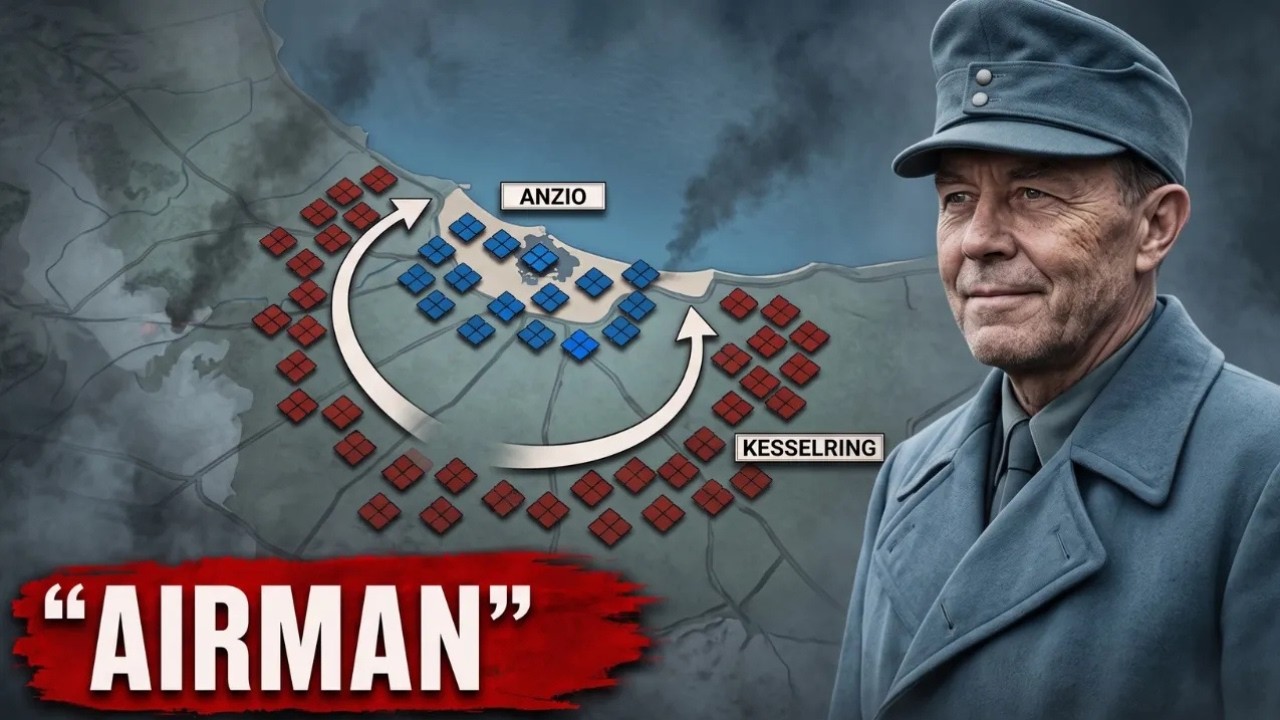
They could not have been more wrong. Italy became one of the longest and cruelest grinds of the entire war, dragging on for almost twenty months and costing the Allied armies hundreds of thousands of casualties. The single greatest reason for that had a name: Albert Kesselring. The Allied soldiers called him Smiling Albert for the wide, easy grin he wore in nearly every photograph.
His own troops called him Uncle Albert. He was not a panzer commander, nor even a career army officer. He was a man of the Luftwaffe, a field marshal of aircraft and airfields who had learned to fly at the age of forty-eight. And yet this airman became the most stubborn and most dangerous defensive general the Western Allies faced anywhere in the entire war.
His rise had been extraordinary. Kesselring had helped build the German air force almost from nothing and was raised to field marshal in the summer of 1940. He led air fleets in the conquest of Poland, the battle for France, and the great air battle over Britain, then flew east for the opening of the invasion of the Soviet Union. At the close of 1941, he was sent south to take charge of the entire Mediterranean theater.
Nothing in that record marked him out as the man who would master the slow, grinding art of holding ground. His legend rests on three tactical achievements. The first came in August 1943, when the battle for Sicily was already lost. The Allies had put ashore a vast force, and the Axis defenders were being squeezed into the northeastern corner of the island, backed against the narrow Strait of Messina.
The lesson of Tunisia was fresh and bitter: only three months earlier, more than 200,000 German and Italian soldiers had marched into captivity when the front finally gave way. Kesselring was determined that Sicily would not end the same way. He made his first great decision early, approving a full evacuation across the strait. The plan was approved on the 2nd of August, and on the 8th, Kesselring authorized his ground commander, General Hans-Valentin Hube of the XIV Panzer Corps, to begin pulling the army out.
He did not wait for Hitler to approve it. He set the withdrawal in motion on his own authority, acting first and answering to Berlin later, so that no delay from headquarters could trap his men on the island. The operation was codenamed Lehrgang. At its narrowest point, the Strait of Messina was only about three kilometers across, but that water was watched by overwhelming Allied air and naval strength.
On paper, moving an army across it in daylight should have been impossible. The key was a defensive shield. Under Colonel Ernst-Günther Baade, the crossing was ringed by a dense belt of anti-aircraft guns. By one detailed account, roughly 500 guns guarded the strait, more than 300 of them anti-aircraft weapons layered so thickly that Allied bombers paid a heavy price for every attack run.
The crossing ran around the clock with fast ferries and barges shuttling back and forth on tight schedules while the gunners held the sky open above them. The German fighter ace Adolf Galland admitted that the fact anything at all reached the Italian mainland was due entirely to those flak batteries. The numbers back him up. Of some 10,000 bomber and fighter-bomber sorties flown in the Mediterranean in the weeks around the evacuation, only about a quarter actually struck targets around Messina.
Between the 11th and the 17th of August, the Germans ferried across 39,569 of their own troops, including more than 4,000 wounded. They saved close to 10,000 vehicles, 47 tanks, 94 heavy guns, over 1,000 tons of ammunition, and hundreds of tons of fuel. Alongside them, the Italians evacuated some 62,000 of their own soldiers. In total, more than 100,000 Axis troops slipped across the water, taking most of their equipment with them.
The last German rearguard stepped off the Sicilian shore in the early hours of the 17th of August, almost exactly as the first Allied troops entered Messina. The Germans lost only a handful of small craft. Kesselring had turned a certain disaster into an orderly withdrawal. The Allies took Sicily, but they did not take the army in Sicily.
His second move came at Salerno. On the 9th of September 1943, the Allies came ashore south of Naples in an operation codenamed Avalanche. General Mark Clark commanded the Allied Fifth Army, a force built around the British X Corps and the United States VI Corps that would swell to around 170,000 men. Against them, at first, stood only about 35,000 Germans.
On paper, the Allies had overwhelming strength. Yet within days, they came within a hair of catastrophe. Sitting directly above the landing beaches was the 16th Panzer Division, a full-strength armored division of roughly 17,000 men and more than 100 tanks dug into a chain of coastal strongpoints. Kesselring and his army commander, General Heinrich von Vietinghoff of the Tenth Army, did not wait to be pushed.
They began concentrating force at once, funneling in elements of six divisions over the following days. The blow fell on the 13th of September. A mixed German force of tanks, assault guns, and infantry drove hard into a weak seam in the Allied line along the Sele River and smashed through positions held by the United States 45th Infantry Division. The spearhead pushed to a point only about two miles from the beaches.
From there, the Germans could very nearly see the sea they meant to reach. Clark’s headquarters came so close to disaster that his staff drew up contingency plans to pull one entire corps off its beach and re-embark it to reinforce the other. What saved the Allies was firepower. American field artillery was rushed forward and fired over open sights at almost point-blank range, breaking the German armor in the open ground.
In one four-hour stretch, two American artillery battalions alone hurled more than 3,600 shells into the advancing Germans. Offshore, Allied warships added the crushing weight of naval gunfire. The German thrust was stopped just short of the water. Unable to break through, Vietinghoff asked permission to disengage on the 16th of September.
Kesselring granted it the next day, and the Germans pulled back in good order to begin a fighting withdrawal up the peninsula. The losses capture the whole battle. The Germans lost around 840 men killed, about 2,000 wounded, and roughly 600 missing. The Allies, who technically won and held the beachhead, lost far more: roughly 2,100 killed, over 7,000 wounded, and some 4,000 missing.
The side that won the battle bled three to four times as heavily as the side that lost it. That imbalance became the grim signature of the entire Italian campaign. Salerno did more than bloody the Allies. It settled a great argument on the German side.
Field Marshal Erwin Rommel had wanted to give up southern and central Italy without a serious fight and hold only a short line far to the north. Kesselring argued the opposite. Italy was a ladder of rivers and mountain ranges running straight across the peninsula, each one a natural wall, and he meant to make the Allies climb every rung under fire. The near disaster at Salerno proved his case.
On the 4th of November 1943, Hitler backed Kesselring’s strategy of defending the south line by line. On the 21st of November, he made Kesselring commander-in-chief southwest with full command of the theater, and Rommel was sent away to France. Kesselring built his defense in depth. Ahead of his main position lay a series of delaying lines.
Behind them stood the strongest of all, the Gustav Line, anchored on the mountain mass around the town of Cassino, which towered over the Liri Valley and the main road to Rome. That single position would hold the Allies for months and cost them terribly. His third and greatest move came when the Allies tried to leap over his mountains entirely and land behind him. On the 22nd of January 1944, in an operation codenamed Shingle, the Allies put the United States VI Corps ashore at Anzio on the coast well behind the Gustav Line and only a short drive from Rome.
About 36,000 men landed under Major General John Lucas, and they achieved complete surprise. Kesselring’s own intelligence had failed him. Days earlier, Admiral Wilhelm Canaris had visited and assured him there was not the slightest sign of an imminent landing. The stretch of coast where the Allies came ashore was almost undefended, held by fewer than 20,000 scattered troops.
For a few hours, the road to Rome lay genuinely open. What Kesselring did next was the finest improvisation of his career. Within a single day, he began stripping reserves from every direction, pulling units from across Italy, from France, from Yugoslavia, and from Germany itself. He threw the nearest mobile forces, the 4th Parachute Division and the Hermann Göring Panzer Division, straight across the exits from the beachhead to seal the roads.
He ordered both of his armies in Italy to feed reserves toward Anzio. It was a gamble of his own: to build the ring, he thinned the very mountain front the landing had been meant to unhinge, betting that the Allies ashore would hesitate long enough for the wall to hold. By the 24th and 25th of January, he had assembled around 40,000 men drawn from elements of five divisions. He placed the newly formed Fourteenth Army under General Eberhard von Mackensen in direct command of the encirclement.
Within another week or so, the German ring had grown to roughly 100,000 men organized under the I Parachute Corps and the LXXVI Panzer Corps. The Allied commander gave him the time to do it. Rather than driving hard for the hills inland while the door stood open, Lucas paused to consolidate his beachhead and build up his strength. Those lost days were exactly what Kesselring needed.
Anzio did not become a springboard to Rome. It became a besieged pocket. The Germans held the high ground in a ring around the beachhead, and their observers could see almost everything below. Supply dumps, field hospitals, and headquarters all lay under aimed fire.
Men lived in the mud for months, shelled around the clock in conditions that recalled the trenches of the earlier world war. Kesselring then tried to finish them. His main counterstroke, codenamed Fischfang, struck between the 16th and the 20th of February. Six German divisions drove down the axis from the village of Aprilia straight into the United States 45th Infantry Division and punched a wedge more than a mile deep into the Allied lines.
For a moment, it looked as though the beachhead might be crushed altogether. It was saved once again by overwhelming firepower. Massed Allied artillery, naval guns offshore, and air power overhead shattered the German attack in the open. The Germans lost around 5,400 men against roughly 3,500 Allied casualties.
A further German attempt at the end of February broke down the same way under a storm of shellfire so lopsided that the Allies held something like a twenty-to-one advantage in artillery. Kesselring could not drive the Allies into the sea, but they could not break out either. For four months, the two sides were locked together at Anzio. By late February, both sides had already suffered close to 20,000 casualties each.
Over the full campaign, the Allied VI Corps suffered around 29,000 combat casualties. Kesselring had turned a bold flanking stroke into a stalemate of blood, and he had held Rome. While Anzio burned, his mountain line held just as grimly. Around the town of Cassino, the Allies battered themselves against the Gustav Line in four separate battles between January and May of 1944.
In one attempt to force a river crossing below the town, the United States 36th Infantry Division, made up largely of Texas National Guardsmen, was cut to pieces. It suffered around 2,100 casualties in barely forty-eight hours for no gain at all. On the 15th of February, the Allies bombed the ancient monastery that crowned the mountain, believing German troops were inside. In truth, the Germans had kept out of the abbey until then.
The bombing killed around 230 Italian civilians sheltering in the ruins and handed the German paratroopers a fortress of rubble that proved even harder to take. The mountain fell only to a massive offensive that threw British, American, French, Polish, and Indian troops against the German line in a single coordinated blow. On the 18th of May 1944, soldiers of the Second Polish Corps finally raised their flag over the shattered ruins of the monastery. The road to Rome was open at last, and the city fell on the 4th of June.
It had taken the Allies the better part of five months and a mountain of casualties to break a line that one airman had designed and held. Mark Clark, the American general who fought him the longest, rated Kesselring one of the ablest officers in Hitler’s armies, a commander who ran the defense of Italy with great skill for two years. Clark admitted plainly that he was glad when the field marshal was finally transferred away. But the same command that made him formidable also made him guilty.
On the 23rd of March 1944, Italian partisans in Rome attacked a column of German police, killing more than thirty men. Hitler demanded a savage reprisal. The order that came down set a ratio of ten Italians to be killed for every German who had died. On the 24th of March 1944, German security forces shot 335 Italian men and boys at the Ardeatine caves outside Rome.
Among the dead were 75 members of the city’s Jewish community and a Catholic priest. Kesselring stood in the chain of command through which that reprisal order passed. As theater commander, he also issued anti-partisan directives in the summer of 1944 that pushed his troops toward harsh collective reprisals against Italian civilians. After the war, a British military court tried him in Venice from February to May of 1947 on charges tied to the Ardeatine killings and the broader reprisal policy.
He was found guilty and sentenced to death on the 6th of May 1947. The sentence was later commuted to life imprisonment. With the Cold War hardening and old enemies turning useful, pressure for his release grew. He was freed in 1952 on grounds of ill health, published his memoirs presenting himself as a soldier who had merely done his duty, and died in 1960.
That self-image did not survive later scholarship. The historian Kerstin von Lingen, who examined his case in depth, concluded that he bore responsibility for the deaths of nearly 9,000 Italian civilians, and that the clean, chivalrous war his memoirs described had never really existed. This is the man in full: a commander of rare defensive brilliance and a field marshal whose orders carried a terrible civilian cost. The Allies came to Italy expecting a shortcut and found instead a man who made them fight for every ridge and every river for nearly two years.
He was underestimated as an airman and proved himself a master of the ground. He was praised by the generals who fought him and condemned by the court that judged him. History does not get to keep only the half it likes.






