Princess Helena Augusta Victoria, the fifth child of Queen Victoria and Prince Albert, was barely noticed by history. Of all the Queen’s children, hers is the name most often forgotten, and the reasons for that obscurity were woven into her life from the very beginning. It started with a difficult birth. Helena arrived on the 25th of May, 1846, and her father described the newborn princess as quite blue.
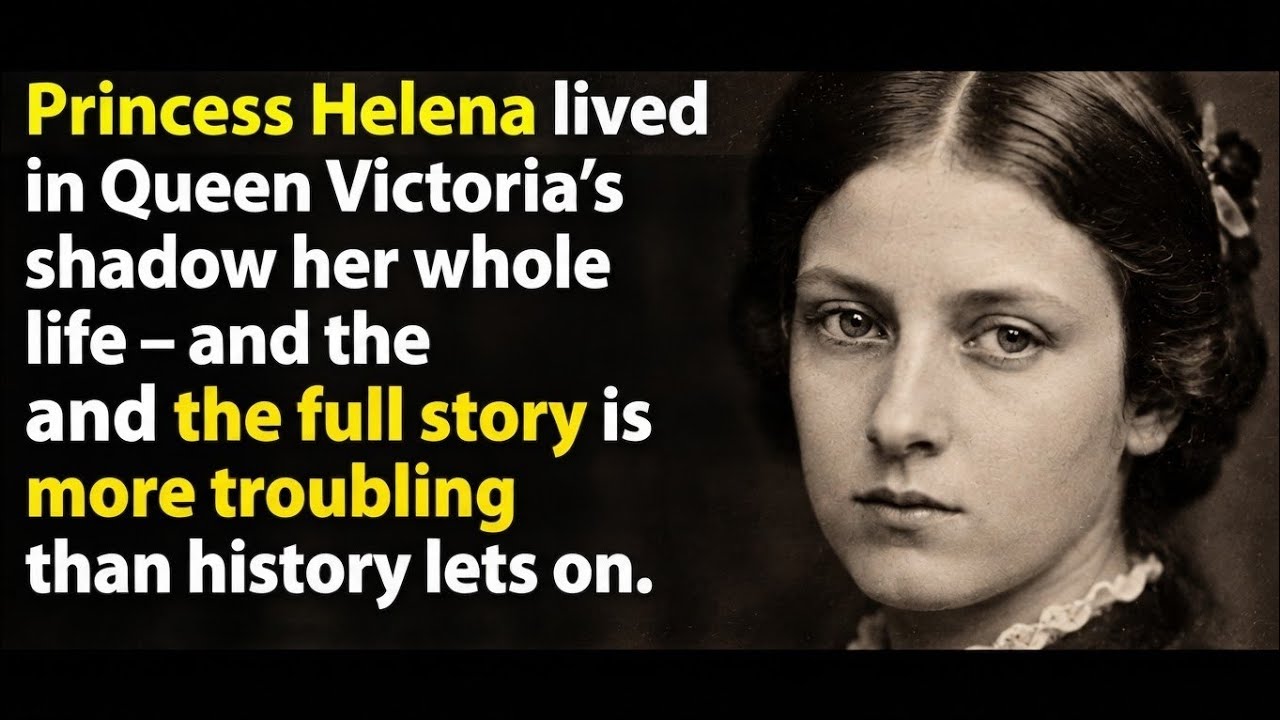
She recovered under the care of the royal doctors, but the labor had taken a serious toll on her mother. Queen Victoria, a woman famous for showing little patience for interruptions to her royal duties, was forced to step back from public life to recover. Helena grew up in a large household with eight siblings competing for attention, affection, and status, and the rivalry among them was fierce. As a child, she was frequently teased by her brothers, but she was no passive victim.
According to accounts of her childhood, if the teasing went too far, Helena would respond by punching them squarely on the nose. Her rivalries were not limited to her brothers. Like most of her sisters, Helena was raised to be accomplished. She played piano, could draw, rode horses, and at her father’s insistence, learned practical skills such as cooking, cleaning, and farming.
By most measures, she was one of the more capable of Victoria and Albert’s children. That reputation, however, was soon overshadowed by the arrival of a younger sister, Princess Louise. Louise not only displaced Helena as the family’s youngest child, but quickly proved to have talents that outshone her sisters. Helena found herself pushed further into the background of a large and competitive family.
On the 14th of December, 1861, tragedy struck the royal family. Prince Albert, Helena’s father, died of typhoid fever. The loss devastated the entire household, and Helena was no exception. In a letter to a friend, she wrote of her grief, saying that she had adored her father, that she loved him more than anything on earth, that he had been her helper and her adviser, and that the time she had with him had been the happiest of her life, but that it was now over.
Queen Victoria’s response to her own grief only deepened her daughter’s pain. In her mourning, the Queen ordered Helena and her sisters out of Windsor entirely, moving the royal household to Osborne House, where the family entered a long period of isolation from public life. At a moment when Helena might have needed the comfort of her family, that same family became a source of further loneliness. With Prince Albert gone, Queen Victoria came to rely heavily on her daughter, Princess Alice, as an unofficial secretary.
But Alice needed help managing the workload, and as the next eldest unmarried daughter, Helena would have seemed the natural choice. Victoria disagreed, reportedly judging Helena unsuitable. She was known at the time for bursting into tears. Instead, the Queen turned to Helena’s younger sister, Louise, for assistance.
Once again, Helena was passed over. Isolated within her own family and searching for connection, Helena found companionship in Carl Ruland, her father’s former private secretary. The relationship was, from the start, unlikely to succeed. Ruland was roughly 13 years older than Helena.
When Queen Victoria discovered the relationship in 1863, she reacted with fury, dismissing Ruland from his position and sending him back to Germany. Whatever Helena felt about the sudden end of the relationship is not recorded in detail, but the episode marked a turning point in how her mother would handle her future. Following the Ruland affair, Queen Victoria decided the safest course was to see Helena married as soon as possible. And, naturally, the Queen intended to choose the husband herself.
Helena, however, faced obstacles in the royal marriage market. According to her own biographer, she was described in less than flattering terms as chunky, dowdy, and double-chinned. Being a middle child in a large family of daughters also complicated efforts to arrange a strategic match. There was an added complication.
When Victoria had married off her older daughter, the Crown Princess, in 1862, the role of unofficial secretary to the Queen had fallen to Helena, and Helena had proven remarkably capable in the position. As a result, Victoria set a condition for Helena’s marriage. Whoever married her would have to move into the royal household. Few eligible suitors were willing to meet that demand.
The man who eventually agreed was Prince Christian of Schleswig-Holstein. The match was controversial. Christian was significantly poorer than most royal suitors, considerably older than Helena, and his family’s claim to the Duchies of Schleswig and Holstein sat at the center of an ongoing territorial dispute between Prussia and Denmark. Opinions within the royal family were sharply divided.
Helena’s eldest sister, the Crown Princess, supported the marriage, while Princess Alice spoke out openly against it. Alexandra of Denmark, Helena’s sister-in-law and daughter of the Danish king, was especially outraged, believing the disputed territories rightfully belonged to her father. To her, Victoria’s decision to marry Helena to Christian was nothing short of disgraceful. Despite the political storm surrounding the engagement, Helena herself appeared content with the match.
She described Christian as pleasing, gentlemanly, quiet, and distinguished, and both mother and daughter agreed the union suited them. The wedding took place on the 5th of July, 1866, though the day itself was far from smooth. Helena’s eldest brother, the future Edward VII, nearly refused to attend in protest of the marriage. One guest suffered a sudden attack of gout during the ceremony, and another was overheard remarking that Helena appeared to be marrying an aged uncle.
It was an inauspicious start. Yet, against expectations, Helena and Christian built a relatively calm and devoted marriage, even as the wider royal family remained divided over the political implications of their union. Of all Queen Victoria’s daughters, Helena, considered by many the least desirable marriage prospect, found a quiet, lasting happiness with her husband. Helena had promised to remain close to her mother after marriage, a promise that proved difficult to keep.
Within a year of her wedding, she became pregnant, and the combined demands of motherhood, her ongoing role as her mother’s secretary, and her responsibilities as a wife began to wear on her health. Like her mother, Helena had several children in quick succession. Christian Victor in 1867, Albert in 1869, Helena Victoria in 1870, and Marie Louise in 1872. The repeated pregnancies, paired with declining health, left her frequently ill.
Queen Victoria showed little sympathy, at one point accusing her daughter of hypochondria, a tendency she believed Christian encouraged rather than discouraged. Whether or not the Queen’s assessment was fair, Helena’s medical troubles were real. Between 1869 and 1871, she suffered from rheumatism, joint pain, and severe lung congestion. Compounding these physical ailments was a more troubling problem.
Helena developed a dependency on opium and laudanum, substances that had been prescribed to her by a doctor, a common practice at the time, though one with serious consequences. Seeking some distance from her mother and the pressures of court, Helena attempted to build a life of her own away from the immediate royal household. That effort brought her some relief, but it did not shield her from further personal tragedy. On the 12th of May, 1876, Helena and Christian welcomed their fifth child, a son named Harold.
The joy was short-lived. Harold died at just eight days old. The following year, on the 7th of May, 1877, Helena gave birth to a stillborn child. The back-to-back losses were a severe blow.
According to her mother’s own account, Helena became touchy and irritable in the aftermath, an understandable reaction to profound grief compounded by her already fragile health. Notably, Helena reportedly showed little inclination to actively treat her declining health during this period, appearing to leave matters largely to fate. Further sorrow followed close behind. On the 14th of December, 1877, Helena’s sister, Princess Alice, died of diphtheria.
Despite Alice’s earlier opposition to Helena’s marriage, the two sisters had remained close in important ways. It was Alice who had convinced their brother Edward to attend Helena’s wedding after his initial refusal. Alice had also expressed concern about their mother’s influence over Helena, a concern that in hindsight appears to have been well-founded. As Helena recovered from her losses, she began to focus more of her attention on her husband and children, which meant spending less time in her mother’s service.
Queen Victoria, who had specifically arranged Helena’s marriage in part to keep her close, was displeased by the shift. Matters were made worse, from the Queen’s perspective, when Helena developed a strong interest in the women’s rights movement, a cause her mother notably opposed. Helena became an active supporter of causes, including nursing reform and needlework education, using her royal position to advance them. In 1887, Helena became president of the British Nurses Association.
In that role, she championed the establishment of an official nurse registry aimed at improving the training, recognition, and professional status of nurses. She was not a passive figurehead. When members of the organization pushed back against her proposals, she was known to assert her authority firmly, reportedly telling dissenters, “It is my wish that is sufficient. ”
In public, Helena projected confidence and control.
In private, she continued to struggle. By 1894, Helena’s opium addiction had grown severe enough that even her mother took notice and became genuinely concerned. Christian eventually went to Helena’s doctor and asked him to help break her dependency. When Helena learned of this, she reacted with fury and reportedly demanded more of the drug rather than less.
Her doctor instead cut off her supply entirely. The withdrawal that followed was brutal. Helena became seriously ill and, according to accounts, even complained of losing her eyesight during the process. With encouragement from her eldest sister, Helena ultimately succeeded in overcoming her addiction, a significant personal achievement, though it was soon followed by another family tragedy.
By 1900, Helena’s eldest son, Christian Victor, had built a career as an ambitious officer in the British army, eventually rising to the rank of major. Helena took great pride in his achievements and thought little of it when he was deployed to South Africa. It would be the last time she saw him. On the 25th of October, 1900, Queen Victoria received a telegram informing the family that Christian Victor had contracted malaria in South Africa and was gravely ill.
Five days later, a second telegram arrived confirming that he had died of the illness. Helena reportedly bore the loss with considerable composure. Her elderly mother did not cope as well. The news of her grandson’s death appears to have accelerated Queen Victoria’s physical decline.
Helena, along with her youngest sister, Beatrice, spent much of the following months at their mother’s bedside. On the 22nd of January 1901, Queen Victoria died. The Queen’s death did not bring an end to family conflict for Helena. That same year, her eldest sister, the former Crown Princess, by then 60 years old, was suffering from a serious illness.
Helena received letters describing her sister’s intense suffering, but there was little she could do to help. By August 1901, the illness had taken her sister’s life as well. One by one, Helena’s siblings were disappearing from her life, but the loss of her relationship with her brother, now King Edward VII, affected her differently, not through death, but through estrangement. Edward’s wife, Alexandra of Denmark, had never forgiven Helena for her marriage to Christian, given the earlier dispute over the Schleswig-Holstein Duchies.
As Queen, Alexandra developed a sudden interest in nursing and moved to take over the presidency of the Army Nursing Service that Helena had led. According to royal protocol, Helena had little choice but to step aside, and she resigned her position, handing leadership over to Alexandra. Though the situation strained her relationship with her brother, Helena continued to support the monarchy in whatever capacity remained available to her. Edward VII, a heavy smoker, died on the 6th of May, 1910, after 9 years on the throne, having suffered multiple heart attacks.
Four years later, the outbreak of the First World War brought yet another painful chapter for Helena. Her son Albert had, by this time, settled in Germany and served in the Prussian army, meaning that during the war, he fought on the side opposing his own mother’s homeland. Contact between Helena and her son was severely limited for the duration of the conflict. In 1917, amid the ongoing war, Helena received unexpected news.
None of her children had produced children of their own, and by this point, she had largely resigned herself to never becoming a grandmother. That year, however, Albert revealed that he had fathered a daughter named Valerie Marie through an affair whose details, including the identity of the child’s mother, were never disclosed. In this unusual way, Helena became a grandmother. Despite the personal and political turmoil surrounding her son, Helena remained active during the war years.
Her long-standing commitment to nursing found new purpose, and she spent much of the war visiting hospitals and supporting wounded soldiers, work that made her popular among the public. In the midst of the war, in 1916, Helena and Christian also celebrated their 50th wedding anniversary, a milestone that made theirs the longest-lasting marriage among all of Queen Victoria’s children, despite having been the most politically controversial at the outset. Their marriage was not without its shortcomings. While accounts describe Christian as a devoted father and husband, he contributed little of substance to the workings of the British royal family throughout his decades of residence within it.
In 1917, after decades of marriage, Prince Christian died at the age of 86. The loss was compounded by further hardship. Royal commissioners moved to evict Helena from her two residences, Schomberg House and Cumberland Lodge, citing the cost of maintaining them. It was, by most accounts, a difficult and undignified period for Helena to endure in the final years of her life.
In the spring of 1923, Helena contracted influenza. By the end of May, her health had deteriorated further, and she suffered a heart attack. She died on the morning of the 9th of June, 1923. Following her death, biographers wrote comparatively little about Helena, a reflection of just how private and guarded she had remained throughout her life.
Much of what became known about her character came filtered through her mother’s letters and journals, accounts that were not always generous. Descriptions of Helena often focused on her appearance and temperament, criticisms that, while not entirely without basis, may not present a fully fair picture of who she was. While Helena, like some of her siblings, did gain weight later in life, many of the harshest characterizations of her originated from her own mother’s private writings, later taken at face value by biographers. Despite this quiet historical footprint, Helena was far from the passive, retiring figure she is sometimes portrayed as.
She used her royal position deliberately and effectively, particularly in support of causes such as nursing reform and the Royal School of Art Needlework, which she helped establish. To draw attention and support for the school, Helena hosted tea parties designed to attract society women eager for access to royal company. The strategy worked, generating lasting interest in the institution, one that remains active to this day. Princess Helena’s life was marked by a difficult relationship with her mother, personal loss, and a private struggle with addiction that she ultimately overcame.
Yet, through her advocacy work, she carved out a legacy distinct from the shadow of Queen Victoria, one defined not by the fairy-tale narrative expected of a princess, but by quiet persistence in the causes she believed in.






