In the royal collection there is a photograph of a thirteen-year-old princess. Her feet rest on a footstool. Her eyes are turned away from the lens. Her name was Gurama of Coorg, the daughter of a deposed Indian king baptized at Buckingham Palace.
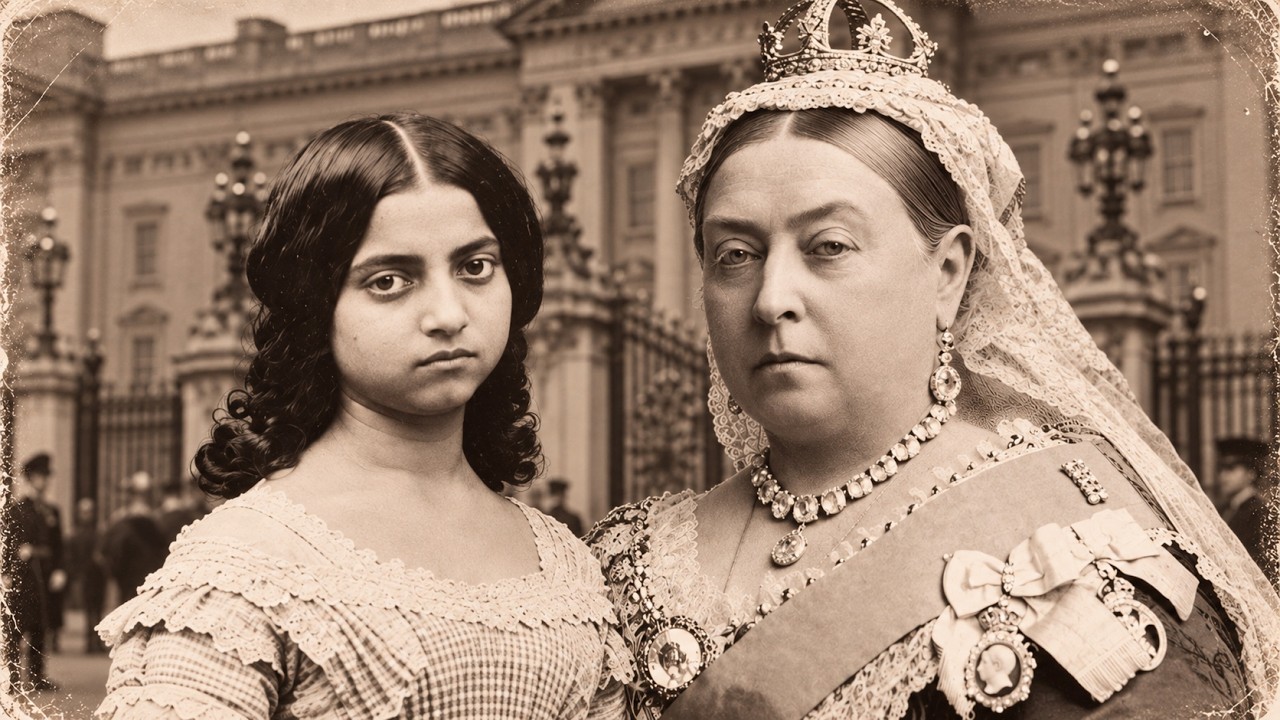
Her godmother was Queen Victoria. The queen had her painted, photographed, watched, and matched with a Maharaja. When she died at twenty-two, the queen saw to her memorial. Yet no one has ever found a single letter she wrote.
Queen Victoria kept a journal for most of her life, recording the people who passed through her palaces. In the early 1850s, one child began to appear in those pages again and again: an Indian princess, the daughter of a king the British had deposed, baptized in the chapel at Buckingham Palace with the queen herself as godmother. A historian studying those entries noticed something small. When the queen wrote about this girl, she almost always placed two words in front of her name: poor little Gurama.
On the 23rd of November 1854, the queen wrote an instruction about the child. The girl was thirteen. Her father was living in London, and the queen wrote that she was not to go and see him without her English guardian at her side. He might visit her.
She was not to go to him. A godmother who wrote of a child so tenderly had chosen to stand between that girl and her own father. The story begins with a king who had lost his throne, his treasury, and his country. On the 17th of May 1852, a man who had once been a king walked into the presence of the Queen of England at Buckingham Palace.
His kingdom had been gone for eighteen years. His treasury sat in the accounts of the East India Company. What he brought with him was the last thing that was still entirely his: a girl of ten, almost eleven. He had come, the queen understood, to leave her behind.
The girl’s name was Gurama. Her father was Chika Viraendra, the last Raja of Coorg, a small mountain kingdom in southern India ruled for generations by one royal house. In 1834, after a short war with the East India Company, he surrendered. The company took his lands, his revenues, and his palace, and the deposed king was sent north under guard to Benares, the holy city on the Ganges, as a political prisoner.
He would never see Coorg again. It was there in exile that Gurama was born on the 4th of July 1841. She was born a princess of a kingdom that had already ceased to exist. She never walked through her father’s palace or saw the hills her family had ruled.
Everything she inherited was a title, a grievance, and a father still fighting to recover what had been taken from him. For years the deposed king pressed his claim against the company. By his own reckoning, it had seized possessions worth £160,000 and owed him more. The claim went nowhere in India, so in 1852 he decided to go over the company’s head.
He would sail to England, argue his case in London, and appeal if he could to the queen. He did not travel alone. With him went his daughter and an English couple, Major Drummond of the Bengal cavalry and his wife. Mrs.
Drummond was to be the girl’s companion on the voyage. She would become a great deal more than that. The queen’s journal gives the Raja’s answer for bringing a child of ten halfway around the world: he wanted his daughter raised as a Christian in England under English protection. For a deposed Hindu king, it was an astonishing decision.
Perhaps he believed it was the only door left open. A daughter under the queen’s wing might marry well and recover by favor some of what her father had lost by war. The girl did not go home with her father. She stayed first within the palace itself, then under the constant care of Mrs.
Drummond on the queen’s instructions. Within weeks she was being prepared for baptism. The ceremony took place in the summer of 1852 in the private chapel of Buckingham Palace, with the Archbishop of Canterbury officiating. Prince Albert stood beside the queen, and the queen herself stood as the child’s sponsor, her godmother.
By most accounts, she was the first Indian royal ever christened at Buckingham Palace. Then came the name. From that morning on, she would be Victoria Gurama. The name of the most powerful woman on earth was placed in front of her own, and it would stay there for the rest of her life.
The queen recorded the moment in her journal with brisk pride: she gave the child a Bible and a handsome diamond and ruby bracelet. Victoria was thirty-three, a mother of seven young children, and she seems to have been genuinely taken with this child. But a name given at a font is not only a gift. It is also a claim.
Gurama was the name her own family had chosen. Victoria was the name the queen chose. Whenever she was announced, the queen’s choice would be spoken first. Within days of the christening, the queen opened her journal again.
The entry was not about gifts but about trouble. On the 2nd of July 1852, she wrote: We have had a great deal of trouble about poor little Gurama. The ex-Raja, strengthened, I think, by the intrigues of some priests who wish to get hold of the child, has turned restive. The man who had handed his daughter over was now, in the queen’s eyes, a danger to her.
Two years later the arrangement was set down in plain words. The queen wrote that Gurama was not to go and see her father without Mrs. Drummond, and that he might go and see her. A king who had crossed the world with his daughter could call on her as a visitor at a house that was not his, in front of a woman who answered to the queen.
She could not walk out of that house and go to him alone. From the queen’s side it was protection. From the girl’s side, she was thirteen, and her own father was now a man she could see only under supervision. That same month, November 1854, Gurama sat for another likeness.
The photographer was Roger Fenton, and the print went into one of the albums of Queen Victoria and Prince Albert, where it survives to this day. In it, a thirteen-year-old princess sits very still as those early cameras demanded. Her feet rest on a footstool. She faces three quarters to the right, and her eyes are not on the lens.
She is looking past it at something outside the frame. Of everything Gurama herself said that November, not one sentence was kept. The queen had other plans. Earlier that same year, a boy of fifteen had arrived in England from India.
He too had lost a kingdom and been converted to Christianity under British guardianship. His name was Duleep Singh, the last Maharaja of the Punjab, and the Koh-i-Noor, the greatest diamond of the East, had been surrendered from his treasury to the British crown. The queen hoped that Duleep Singh and Gurama would marry. A Christian Maharaja and a Christian princess joined before the whole empire, proof that the crown’s care could make something new out of what it had conquered.
The Maharaja did not want her. According to Lady Login’s account, he said such a marriage was not calculated to make him happy. He did not feel confidence in her. The historian Priya Atwal puts it bluntly: the Maharaja regarded Gurama as an unsafe choice for a wife because she kept trying to run away.
For years the documents had given us a pretty little girl, a Christian convert, a royal curiosity. And now suddenly from the side comes this: she kept trying to run away. From what, from whom, to where? No one wrote it down.
The girl in the portrait holding her Bible so still had not been still at all. Gurama was passed from household to household. The Drummonds eventually asked to be relieved of her, of a charge growing, in Lady Login’s words, somewhat anxious and embarrassing. She moved to the household of the Harcourts, then finally in 1858 to Lena Lady Login, the Scottish wife of the doctor who had been Duleep Singh’s own guardian.
Three households in six years, each one chosen by someone else, each one reporting upward. While in the Harcourts’ care, Gurama formed an attachment to an underbutler in the household named George Christmas. It was discovered and punished. Even Lady Login admitted she felt for the girl: my sympathy went out more to the ignorant child rigorously punished for faults due to early upbringing in an Indian zenana.
The queen, meanwhile, wanted to know everything. In one of her letters to Lady Login, the duties were set out plainly: the queen begged that upon the first appearance of the formation of any mutual attachment between the princess and any gentleman, all particulars be communicated to her majesty. A girl who carried the name Victoria could not so much as look at a young man without the queen expecting a report. In the autumn of 1859, Gurama’s father died in London on the 24th of September, still without the money he had come to reclaim.
He was buried at Kensal Green Cemetery, a king without a kingdom in a grave far from the hills he had ruled. The sources do not tell us whether his daughter was at his side or whether she was even told in time. Of all the silences in this story, this may be the hardest to sit with. The queen’s instruction still stood: find the girl a husband.
The candidate was close at hand, Lady Login’s own brother, Lieutenant Colonel John Campbell, a soldier who had served years in India and was by several accounts a friend of Duleep Singh. He was nearly thirty years older than Gurama. How the match came about depends on which account you follow. According to Atwal, it was Duleep Singh who noticed a growing attachment between the two and told the queen, who moved quickly to see them married.
Whichever way it happened, one detail does not change: the young man who had declined to marry her helped to choose the man who would. In July 1860, Victoria Gurama of Coorg married Lieutenant Colonel John Campbell. She was nineteen. He was approaching fifty.
After the wedding, Lady Login wrote of her: it was pathetic, the eagerness with which poor Gurama identified herself with her husband’s family. A girl who wanted very badly to belong somewhere had at last found a family whose name she could share. On the 2nd of July 1861, a year after the wedding, Gurama gave birth to a daughter in London, named Edith. But beneath the surface, the marriage was already shifting.
In England in 1860, when a woman married, almost everything she owned passed into her husband’s control: her money, her goods, her jewels. The queen’s goddaughter had just placed everything she possessed into her husband’s hands, including the jewels of the royal house of Coorg that she had kept from her father’s lost world. According to Bellyappa and others, the marriage soon became a distant one. Her husband was often away, and when he did make contact, one account says it was mostly to ask her for money.
Before Edith was three years old, her mother was showing the first signs of consumption. By the last months of her life, Gurama was seriously ill, living in London with her small daughter, her husband more often absent than present, her father dead, the queen deep in widowhood at Windsor and Osborne. For perhaps the first time since she was ten, no one had been formally assigned to watch her, and no one, it seems, was writing her down. There is no deathbed letter, no final message to her child.
On the 30th of March 1864, Victoria Gurama died in Marylebone, London. She was twenty-two years old. Her daughter Edith was not yet three. When the news reached the queen, she thought about the grave.
She asked that it be marked by a suitable memorial, and gave her reason: she wished that the fact of me having been godmother to the poor Indian child may not be forgotten. Notice what the queen remembered: not the girl’s name, not her father’s kingdom, not the life she lived. The queen remembered that she had been the godmother. On the 5th of April, Gurama was buried at Brompton Cemetery in southwest London.
The stone raised over her still stands, and the words on it were drafted by the queen herself. The inscription reads that she was brought early in life to England and was baptized into the Christian faith under the immediate care and protection of Queen Victoria, who stood sponsor to her and took a deep interest in her throughout her life. Even in stone, the girl is described. She does not speak.
And the man she had married. According to several writers, John Campbell did not stay to raise his daughter. After his wife’s death, he disappeared, and the jewels of Coorg, the last treasure the princess had carried out of her father’s lost world, are said to have gone with him. A girl who had arrived in England with a kingdom’s jewels left her daughter, by these accounts, nothing of them.
There is one more question that has hung over this story from the beginning: why is there not a single word in her own hand? She was taught to read and write. Girls of her class wrote constantly. And yet, as the historian Chandrika Barua has found, not one piece of her own writing is known to survive.
The answer, if we have one, comes from Priya Atwal: we can only guess at why Gurama kept trying to escape, because the queen ordered her papers to be burned. If Atwal is right, the silence at the heart of this story was not an accident of time. Someone chose it. The portrait survives.
The photograph survives. The queen’s journal survives with its entries about the child. Lady Login’s recollections survive with their judgments. The Maharaja’s refusal survives.
The stone survives with the queen’s words cut deep into it. Everything that was said about her was kept. The one thing that was not kept was her. But something of her escaped after all.
Not in a letter or a diary, but in a name passed quietly down a family and onto another continent. Edith Campbell, who lost her mother before her third birthday, was raised in other people’s houses, as her mother had been. In 1882 she married Captain Henry Edward Yardley, and she died in Portsmouth in 1932. Her son Henry Victor immigrated to Australia and raised a family of his own.
More than a century later, Gurama’s biographer C. P. Belliappa was sent a photograph by one of her descendants in Australia showing Henry Victor Yardley sitting on his motorbike, and with it came his full name: Henry Victor Rajendra Yardley. Rajendra, the name of the last king of Coorg, the father who had sailed to England with his daughter and then been allowed to see her only under supervision.
Somebody in that family had remembered. The queen chose the name on her grave. Her family chose the name her father gave.






