The screams carried up the stairwell, and the women in the barracks below knew better than to look up. A new arrival, an old woman, had asked for work, and Elisabeth Volkenrath had answered by seizing her and hurling her down the concrete steps. The body landed at the bottom and did not move again. In the Auschwitz camp, where Volkenrath served among a handful of female guards, she had already earned a reputation that placed her above the rest in cruelty.
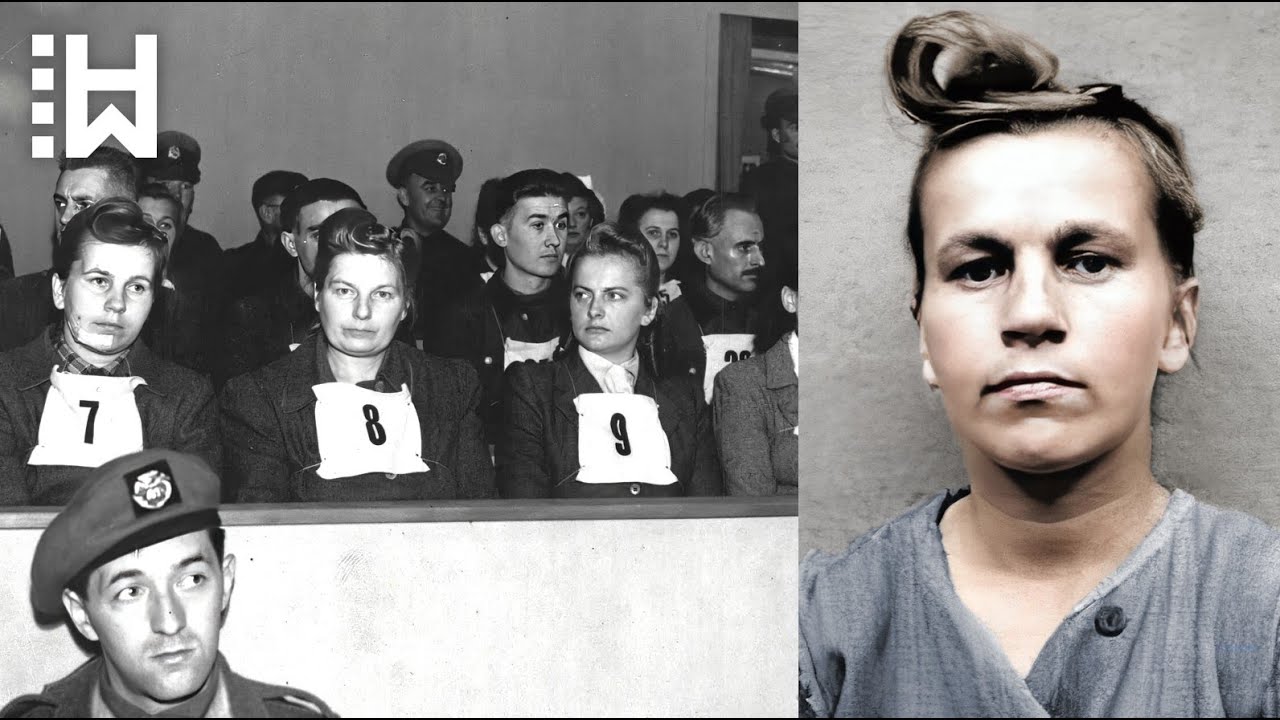
The inmates whispered her name with a dread they reserved for the worst of their tormentors, and they counted the days until the war would end and someone would call her to account for what she had done. She had not always seemed destined for this. Elisabeth Volkenrath was born on 5 September 1919, and by her own later admission she had struggled as a student. She had found work before the war in a small hairdressing saloon, a modest trade that gave no hint of the path ahead.
But when the war came, she stepped into a different world. In 1941 she became a guard at Ravensbrück concentration camp, the vast women’s camp in northern Germany, and there she learned the routines of the SS. Within months she had mastered its cruelties well enough to be noticed. In March 1942 she was transferred to Auschwitz, where her career took on its darkest shape.
At Auschwitz, Volkenrath moved among thousands of prisoners with a truncheon in her hand and a willingness to use it that stunned even her fellow guards. Female prisoners learned to avoid her gaze, because to be seen was to be singled out. She beat with a fury that went beyond the standard discipline of the camp. One inmate later testified in detail about the scale of her violence: on some eighty separate occasions, Volkenrath had personally beaten prisoners until they lost consciousness or until they died.
She did not seem to distinguish between the two outcomes. When she wanted to inflict worse suffering, she forced prisoners to undress first, stripping them of whatever dignity they had left before bringing the truncheon down on their bare skin. The routine was deliberate. The humiliation was part of the punishment.
Her cruelty reached further than the beatings she administered with her own hands. Volkenrath was also given a role in the selections, the terrible process by which prisoners were sorted for death. She stood among those who decided who would be sent to the gas chambers and who would be left alive, at least for a while longer. On one such occasion, a selection of fourteen hundred prisoners was held.
When the counting was finished, only three hundred had been allowed to remain in the camp. The other eleven hundred were taken away. The number was recorded and later remembered by those who survived, a precise figure that carried the weight of what the selections meant. By late 1944, the eastern front was collapsing, and the SS began to evacuate the camps ahead of the Soviet advance.
Volkenrath was moved from Auschwitz to Bergen-Belsen, deep in northwestern Germany. She arrived there in what the SS still described as a posting, joining a camp that was already filling with prisoners transferred from evacuated camps across the east. Bergen-Belsen had no gas chambers, but it had its own horrors. Disease and starvation swept through the overcrowded compound, and the dead lay where they had fallen.
In this setting, Volkenrath continued to treat prisoners with the same brutality she had practiced in Poland. Up until the very last days of the war, she took pleasure in abusing the people under her control. The camp fell into chaos as the German administration began to break down, but she did not soften. She remained violent to the end.
Even when the British Army finally arrived, Volkenrath found one last opportunity to strike. The Allies had come to liberate the camp, and the guards knew their time was over. Yet in those first hours, with British soldiers present and the liberation underway, she was witnessed beating a prisoner with her fist, striking so forcefully that the prisoner collapsed and did not move again. The beating happened in plain sight, in the midst of the camp she had helped to ruin, as if the habit of cruelty had become impossible to break.
The British forces moved into Bergen-Belsen in mid-April 1945 and took the camp’s staff into custody. Volkenrath was captured alongside her colleagues, including Irma Grese, Johanna Borman, and the camp commandant, Josef Kramer, the man known to the British press as the Beast of Belsen. The group was held and prepared for trial before a British military court. The proceedings opened in Lüneburg in September 1945, in a courtroom that had once served the German military, now turned to a different purpose.
The charges against Volkenrath included ill-treatment of prisoners, participation in selections, and responsibility for the deaths of those under her authority. Witnesses testified to her beatings, to the forced undressing, to the selections, and to the violence that had continued even as liberation approached. Volkenrath refused to admit to the substance of the charges. When she was given the chance to speak in her own defense, she claimed that she had done little more than slap a few prisoners with her hand.
She denied the truncheon beatings, denied the selections, denied the deaths. The testimony of the survivors stood against her, and the history she had written across the camps was not something her words could erase. The court did not believe her. Elisabeth Volkenrath was found guilty and sentenced to death by hanging.
She was twenty-six years old when she was executed on 13 December 1945. The sentence was carried out by Albert Pierrepoint, the English hangman who had performed more executions than most men in his profession. She went to the gallows with Irma Grese and Johanna Borman, her colleagues from Bergen-Belsen, in one of the mass executions that followed the Belsen trial. There were no tears shed for Elisabeth Volkenrath.
The war had ended eight months earlier, and the record of what she had done to the prisoners in her charge stood as her only legacy. The camps were closed, the survivors were going home, and the guards who had served there were being held to account one by one. Elisabeth Volkenrath was among the first of them to be hanged.






