Lisbon in October 1755 was the richest capital in Europe. Gold from Brazil arrived by the shipload every week. Churches glittered with silver and jewels, and the port moved more spice, sugar, and diamonds than almost any other in Europe. By the morning of November 2nd, most of it was gone, buried, burned, drowned, and shattered beyond recognition.
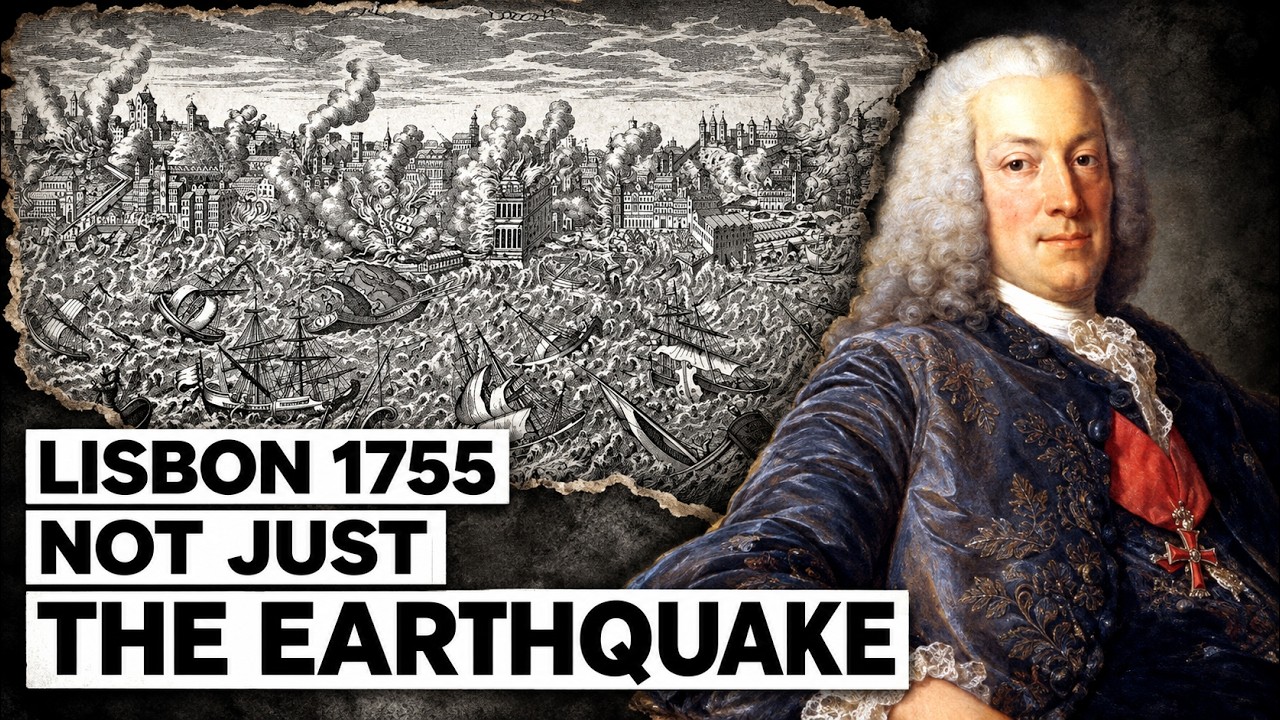
The official story has always been simple. On the 1st of November, 1755, All Saints’ Day, a massive earthquake struck off the coast of Portugal, followed by a tsunami, followed by a fire that burned for days. Between 30,000 and 50,000 people died in Lisbon alone, and the city was flattened. But that is not the whole story.
The earthquake did not destroy Lisbon on its own. It exposed and accelerated something already rotting underneath. Lisbon in the mid-18th century was the capital of a global empire stretching across four continents. Portugal had been the first European power to break into the wider world.
Portuguese sailors rounded the Cape of Good Hope, reached India by sea, and built trading posts from Mozambique to Macau. By the 18th century, much of that early maritime dominance had faded, but something else replaced it: gold. In the 1690s, prospectors in the Brazilian interior discovered one of the largest gold deposits ever found. Over the next seven decades, vast amounts of Brazilian gold flowed across the Atlantic to Lisbon, followed by diamonds in the 1720s.
The city swelled to between 200,000 and 275,000 residents, making it one of the largest cities in Western Europe. It had grand palaces, dozens of monasteries, hundreds of churches, and a new royal opera house that had opened only months earlier. Travelers from London, Amsterdam, Paris, and Rome described a city stunned by its own wealth. But beneath the opulence, Lisbon was not a healthy economic engine.
It was a conduit. The gold flowed in from Brazil, passed through Lisbon, and flowed almost immediately back out to one country: Britain. In 1703, Portugal signed the Methuen Treaty with England. In exchange for favorable terms on Portuguese wine, Portugal gave Britain preferential access for its woolen cloth.
In practice, the agreement destroyed Portuguese manufacturing. Artisans could not compete with cheaper, higher-quality British textiles. Portuguese cloth production collapsed, and soon Portugal imported almost everything manufactured, paying with Brazilian gold. By some estimates, a large share of the gold that arrived in Lisbon ended up in London within months, fueling Britain’s industrial takeoff.
Even Adam Smith later cited the Methuen Treaty as a textbook case of a smaller trading partner being hollowed out by a larger one. So Lisbon in 1755 was outrageously wealthy on the surface and economically hollow underneath. The city produced little. The nobility consumed luxuriously.
The church owned an enormous share of national wealth. A tight cluster of foreign merchants, mostly British, ran the import and export trade. A sharp observer in 1750 could see that Portugal’s prosperity was borrowed time. The gold mines were showing early signs of exhaustion.
The industrial base had never been built. When the gold stopped, the entire structure would come apart. What nobody expected was that it would come apart in a single morning. The 1st of November was All Saints’ Day, one of the most important dates in the Catholic calendar.
Churches were packed. Thousands of candles burned on altars. At approximately 9:40 in the morning, the ground began to move. The first shock lasted perhaps a minute.
There was a brief pause, then a second, much stronger shock, then a third. Contemporary witnesses described three distinct tremors over roughly ten minutes. Modern seismologists estimate the earthquake’s magnitude at between 8. 5 and 9.
0, among the largest in European history, with the epicenter in the Atlantic roughly 200 kilometers southwest of Cape St. Vincent. Churches collapsed on top of their congregations. Palaces crumbled.
Dense residential districts folded in on themselves. By the time the shaking stopped, roughly a third of the city’s buildings were destroyed or heavily damaged. Then, perhaps 30 or 40 minutes later, as survivors gathered along the waterfront, the sea receded, exposing the muddy riverbed. Minutes later, a wall of water came roaring up the Tagus estuary.
The tsunami, estimated at around six meters high, swept away everything along the waterfront, including a newly built marble quay crowded with refugees. No bodies were ever recovered. The same wave crossed the Atlantic and struck Morocco, where thousands more died. Smaller waves were recorded as far away as Ireland, Cornwall, and the Caribbean.
But even that was not the end. Cooking fires and the thousands of candles lit for All Saints’ Day had been overturned by the quake. Within an hour, dozens of small fires merged into a massive firestorm that burned for roughly five days. Lisbon was built largely of wood and plaster above stone foundations, and the fire consumed much of what the earthquake and tsunami had spared.
The Royal Palace was destroyed. With it burned the royal archives, including irreplaceable documents going back to the age of Vasco da Gama, thousands of paintings, and the vast royal library, one of the largest in Europe. The brand new opera house was gone. When the smoke cleared, roughly 70 to 85 percent of Lisbon’s buildings had been destroyed or rendered uninhabitable.
The death toll remains contested. Older estimates place the figure at 30,000 to 50,000 in Lisbon alone, while recent scholarly re-examinations of parish records suggest perhaps 12,000 to 20,000. Either way, in a city of around 250,000, somewhere between 1 in 20 and 1 in 6 residents was dead within a week. The earthquake’s deeper consequences were political.
They revolved around one extraordinarily shrewd man: Sebastião José de Carvalho e Melo. In November 1755, he was 56 years old, serving as Secretary of State for Foreign Affairs and War. He was the son of a minor noble family, a cold, methodical, deeply intelligent administrator who had absorbed Enlightenment ideas during diplomatic postings in London and Vienna. He was not loved by the old aristocracy or the Jesuit order, but he was trusted by King José I, a timid man who disliked actual governance.
When the earthquake struck, King José and the royal family were at the summer palace in Belem, several kilometers west of Lisbon. They survived unharmed, but the king was so traumatized by the collapse of his capital that he developed a lifelong phobia of enclosed spaces, preferring to live in a complex of tents and wooden pavilions in the hills. In his fragile state, the king reportedly asked Carvalho what should be done. Carvalho’s response became immortalized in Portuguese history: bury the dead and feed the living.
Within hours, Carvalho was effectively in charge of the government. He ordered the army to prevent looting, with executions carried out on the spot. Dozens were hanged in the first week. He commandeered ships to keep the labor force in place.
He requisitioned food and set fixed prices. He had the dead collected and loaded onto barges and dumped at sea, both to prevent disease and to avoid religious disputes over burial. He commissioned a detailed survey of the damage, sending questionnaires to every parish about shaking intensity, duration, and tsunami height, a document now considered one of the founding texts of modern seismology. By early December, less than five weeks after the disaster, his chief engineer submitted detailed plans for rebuilding Lisbon from scratch.
Carvalho then set about rebuilding Portugal itself. He was elevated to Count of Oeiras and later to Marquis of Pombal, the name by which history remembers him. The new Lisbon was designed on a grid pattern. The old medieval districts were erased.
In their place came the Baixa Pombalina: wide, straight boulevards, uniform building heights, standardized facades. The buildings contained a revolutionary wooden lattice structure hidden inside the walls, the gaiola pombalina, essentially the first large-scale earthquake-resistant construction system in European history. Prototype buildings were tested by having battalions of soldiers march around them to simulate seismic vibration. Those cage structures still stand across central Lisbon today.
But the reconstruction was also a weapon. Pombal decided who got land back and who did not, which noble families could reclaim their palaces, and which would be dispossessed. Over the next two decades, he used reconstruction to shift the entire balance of Portuguese society in his favor. His biggest target was the Jesuit order.
The Society of Jesus ran most of the schools, controlled much of the overseas missionary infrastructure, held vast landholdings, and had the allegiance of many nobles. Within days of the earthquake, Jesuit preachers declared the disaster God’s punishment for Portuguese sin. One priest, Gabriel Malagrida, published a pamphlet in 1756 arguing that the earthquake was divine judgment and that reconstruction defied God’s will. Pombal built a case against the Jesuits piece by piece.
In September 1758, a failed assassination attempt against King José gave him his pretext. Members of the aristocratic Tavora family had allegedly shot at the king’s carriage. Pombal arrested the entire Tavora clan, extracted confessions under torture, and had them publicly executed in January 1759. He then publicly accused the Jesuits of masterminding the plot.
By September 1759, less than four years after the earthquake, Pombal expelled the entire Society of Jesus from Portugal and all its colonies, seizing their schools and property. Malagrida was eventually tried by a reorganized Inquisition and executed by garrote in 1761, the last person killed by the Portuguese Inquisition in its traditional form. The expulsion set off a chain reaction across Catholic Europe. France expelled the Jesuits in 1764, Spain in 1767.
In 1773, under pressure from the Bourbon courts, Pope Clement XIV formally suppressed the Society of Jesus entirely, restoring it only in 1814. A direct causal line traces that chain back to the November morning in Lisbon. Meanwhile, the reconstruction cost an enormous amount of money, absorbing much of the Portuguese royal income for roughly two decades, just as the Brazilian gold boom was beginning to decline. By the 1780s, gold production was clearly in retreat.
The crown borrowed heavily, often from British bankers, deepening Portuguese dependency. By the end of the century, Portugal was effectively a British economic protectorate. When Napoleon invaded the Iberian Peninsula in 1807, the Portuguese royal family fled to Brazil aboard British warships. Pombal attempted to reverse the trajectory.
He established state monopolies for Brazilian trade, created a royal company for the Douro Valley wine trade in 1756, and tried to build up Portuguese manufacturing. He reformed the universities, especially Coimbra, dragging them toward Enlightenment science. He abolished the legal distinction between old Christians and new Christians, descendants of forcibly converted Jews. He curbed the Inquisition and brought it under state control in 1774.
Most of these reforms were only partially successful, and many were reversed after King José died in 1777 and Pombal was pushed out of power by his enemies, including the new Queen Maria I, who detested him. He died in internal exile in 1782. No single minister could reverse structural economic dependency built over half a century of unequal trade with Britain. Then there was the intellectual earthquake, perhaps the longest-lasting consequence.
News of the disaster traveled across Europe within weeks. The problem was theological. Europe in 1755 largely believed in a providential God who ordered the world for benevolent purposes. The dominant philosophy was optimism, articulated most famously by Gottfried Wilhelm Leibniz in his 1710 Theodicy, which argued this must be the best of all possible worlds.
The Lisbon earthquake broke this consensus. The earthquake struck a Catholic city on a Catholic holiday during religious services, destroying churches on top of worshipers while leaving less reputable districts intact. If God was punishing sin, his aim was dramatically off. Voltaire responded almost immediately.
In 1756, he published his Poem on the Lisbon Disaster, a furious attack on optimistic providentialism. Three years later, in 1759, he published Candide, which effectively killed Leibnizian optimism as a mainstream intellectual position. Jean-Jacques Rousseau wrote to Voltaire arguing that the real tragedy was human choice, packing into dense cities built of fragile materials, anticipating modern thinking about urban planning and disaster preparedness. A young Immanuel Kant wrote three essays attempting to explain the earthquake in purely naturalistic terms.
His specific theory was wrong, but his approach was path-breaking. Many historians of science date the beginning of modern seismology to Kant’s essays and to Pombal’s parish survey. The clearest winners were Britain and Pombal. The earthquake deepened Portuguese dependency on British finance, manufacturing, and shipping.
British merchants, whose warehouses were conveniently located outside the worst damage zones, were among the first to resume operations. Britain sent aid, around 100,000 pounds in gold and silver, which looked generous but reinforced the relationship. Pombal converted the disaster into roughly two decades of near absolute power. The losers were the Portuguese nobility, the Jesuits, the common people who died, and most of all, Portugal itself as an independent great power.
The Portuguese empire staggered on for another two centuries, holding Brazil until 1822 and parts of Africa until the mid-1970s, but the days when Portugal was a central player in European affairs were over. There is no credible evidence of human agency behind the earthquake itself. But powerful actors absolutely used the disaster to accelerate agendas they already held. Pombal used it to break the Jesuits and the aristocracy.
British merchants benefited from the collapse of their Portuguese competitors. The disaster did not create these outcomes from nothing. It accelerated trends already in motion and gave ambitious men political cover to do things they could never have done in peaceful times. Darker still, the empire’s wealth was never purely about gold.
It was about an entire slave economy, hundreds of thousands of enslaved Africans transported to Brazilian mines and sugar plantations to produce the wealth that paid for Lisbon’s gilded churches. The earthquake took down the churches but not the system that built them. The Brazilian slave trade continued for another century, and Pombal’s reforms doubled down on the colonial model. Walk around central Lisbon today, and you can still read the signature of November 1st, 1755, in the stones: the uniform grid of the Baixa district, the standardized building fronts, the wooden cage structures over 250 years old and still doing their job.
In the national archives, you can still read Pombal’s parish surveys. Portugal entered 1755 as the capital of a global empire. It emerged from the rubble as the junior partner of someone else’s. The ground only shook for a few minutes.
The consequences are still unfolding.






