Louis Edward Curtis was born in 1912 and grew up in Fort Wayne, Indiana. His father considered himself an aviation buff and often helped friends work on their aircraft in his spare time. That early exposure stayed with the boy and eventually fueled a desire to fly. Curtis attended Purdue University for several years before he finally bit the bullet and enlisted in the army.
He signed up on Saturday, December 6, 1941—the very day before the Japanese attack on Pearl Harbor plunged the United States into the war. A few months later, in March 1942, he received a commission as a second lieutenant and joined the U. S. Army Reserves.
He graduated from flying school that December, joined the 329th Fighter Group of the U. S. Army Air Forces, and was then transferred to the 82nd Fighter Group. His first assignment put him in the twin-engine P-38 Lightning against the German Luftwaffe in North Africa and Italy.
On April 29, 1943, Curtis got his trial by fire—and made an incredible showing. He shot down his first enemy aircraft, a Messerschmitt Bf-109. But he did not stop there. Later in that same mission he downed two more of them and damaged a fourth.
With three kills almost immediately, he kept pressing his advantage. A month later, in the skies over Sardinia, he took down two more German 109s, making him an ace in less than a month. In the following weeks, he added an Italian MC202 fighter and then two more German 109s. Within a short span, Curtis had shot down seven German planes and one Italian.
Then his luck turned. On August 27, 1943, Curtis was locked in combat with a German fighter over the Italian coast near Salerno. He came out on the losing side of the dogfight and was shot down. He managed to bring his plane in for a controlled crash landing and walked away from the wreck.
The Italians captured him and placed him in a prisoner of war camp near Rome. Mere days after his capture, Italy surrendered to the Allies. Curtis and a few other pilots escaped, and for the next eight months he eluded recapture by the Germans. He finally made it back to American lines in May 1944.
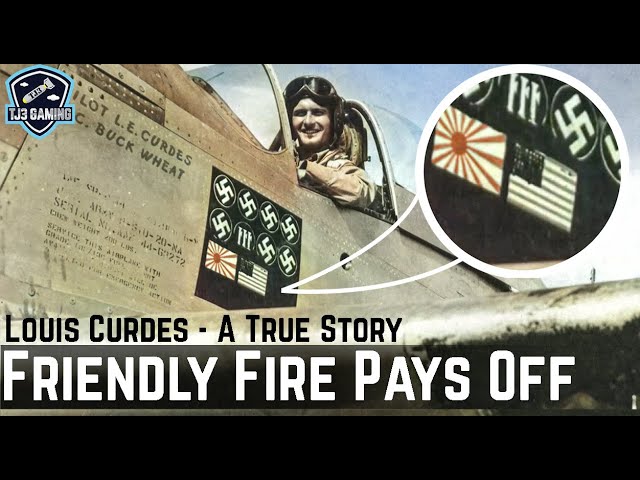
After a short rest, he was sent back into the air—but this time on the other side of the globe, in the Pacific Theater. He joined the 4th Fighter Squadron in the Philippines, now assigned to the P-51 Mustang. On February 7, 1945, Curtis showed he still had his flying edge, shooting down a Japanese Mitsubishi Ki-46 reconnaissance aircraft. That gave him a rare accomplishment that only two other American pilots in World War II can claim: he had downed at least one plane from each of the Axis countries—Germany, Italy, and Japan.
By now he had destroyed nine enemy aircraft and built a reputation as a flying ace and a hero. Only three days later, things took a strange turn. On that day, Curtis and three other P-51s set out to reconnoiter and attack enemy airfields in the area. They found a small Japanese airfield and began their attack.
During the engagement, one of the P-51s was shot down by anti-aircraft fire. The pilot bailed out safely into the Pacific waters off the coast. As the squadron circled overhead, Curtis could see his companion alive and safe in the water below. While recording the location of the downed pilot, he spotted a twin-engine plane off in the distance.
This was not just any plane. Squinting, he made out a C-47 transport with American insignia—but it was heading straight toward the landing strip they had just attacked, which was occupied by Japanese forces. Realizing he had to intervene, Curtis tried repeatedly to radio the transport. He received no response.
He was unsure what to do. It was possible the cargo plane had been seized by Japanese forces but was still flying with American colors. Or it could be Americans flying straight toward an enemy airfield. Either way, he knew the aircraft was unarmed, and he felt he had to do something.
He tried again and again to wave and signal the pilots to change course. He had no success. Finally, seeing no other option, he decided it was better to try to take down the plane than to let it fly directly into an enemy airstrip. He lined up his P-51 directly behind the transport and fired his .
50 caliber machine guns into one of the C-47’s engines, hoping to make it fail. The plane stubbornly kept its course. Curtis now knew he was out of options. With a final blast, he pummeled the remaining engine, causing the plane to lose altitude and land in the sea.
Luckily, it came to rest without breaking apart, and the crew evacuated into a lifeboat with minimal injuries. Curtis watched as the transport settled in the water relatively close to his downed wingman. As the downed P-51 pilot approached them in the water, he found out they were indeed Americans. The transport crew pulled him onto their life raft and explained their situation.
Their plane had been lost in an intense storm, which knocked out the radio. Running low on fuel, the pilot had headed directly to the nearest airstrip he could find—not knowing it was under Japanese control. So it turned out Curtis’s bold move had saved the crew from flying straight into Japanese territory. They avoided what would very likely have been a terrible fate, possibly joining the infamous American prisoners of war at Bataan.
The following morning, Curtis came back escorting a PBY rescue plane to pick up his wingman and the crew of the C-47. To his surprise, one of the crew members was a nurse named Svetlana Valeria—a woman he had gone on a date with the night before the incident. By then, Valeria and Lou had already fallen for each other, and they continued their relationship. The couple married in April 1946 and remained together for the rest of their lives.
This absurd coincidence made Curtis the only pilot in history to shoot down a plane with his future wife on board. It was also decided that he would be awarded an air-to-air victory for the takedown of the American C-47. The victory was painted on the side of his Mustang—an American star marking an American plane brought down by an American ace. Curtis continued his service and retired from the U.
S. Air Force in 1963, his accomplishments recognized with several awards, including two Distinguished Flying Crosses. He passed away in 1995 at the age of 75.






