The night sky over central France split open, and Nancy Wake fell through it. For a few eternal seconds there was nothing but the roar of the dying engines and the wind screaming past her ears. Then the parachute cracked open above her, the world went silent, and below her the forests spread out like a shadowed sea. She landed hard in a clearing, rolled, and cut herself free.
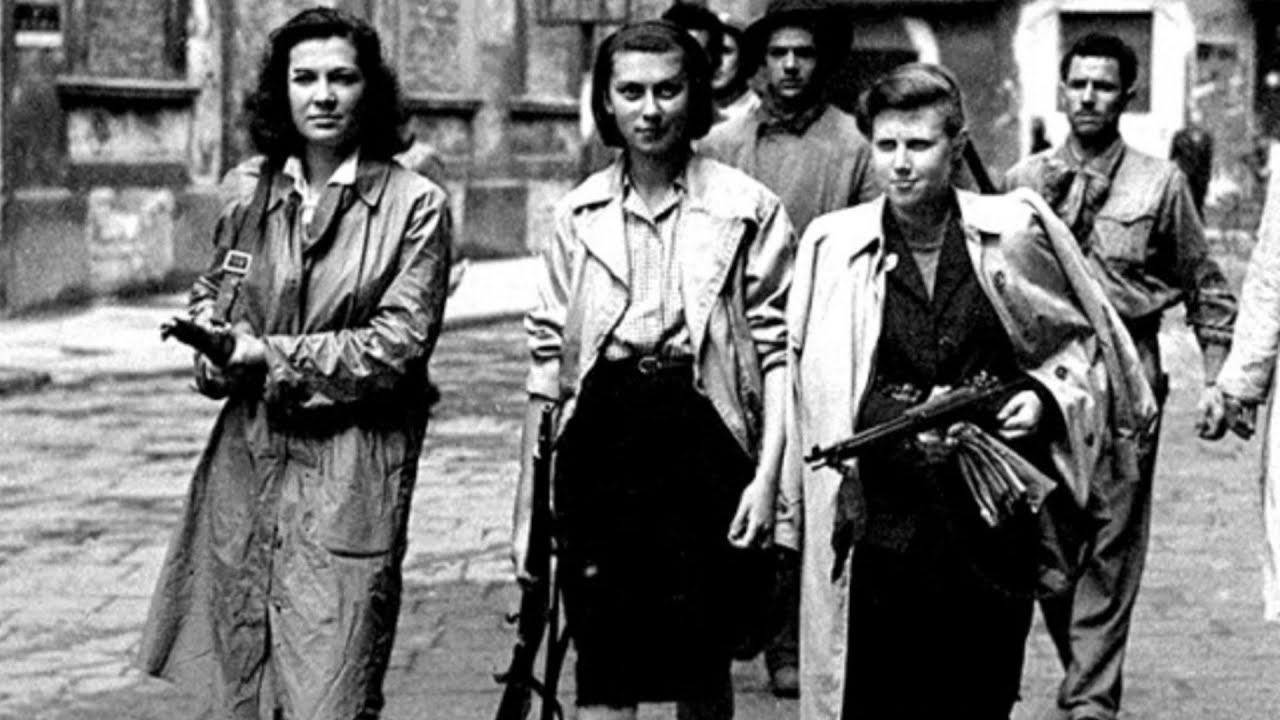
A man in a beret emerged from the trees with a Sten gun raised. “You are Madame André,” he whispered. Nancy brushed snow off her sleeve and smiled in perfect French. “No, I’m the woman who’s going to win this war for you.
”
She had come a long way to reach that clearing. In 1939, before she became a legend, Nancy Wake was just another foreigner in love with France. Born in New Zealand and raised in Australia, she had come to Europe as a journalist—young, independent, and hungry for adventure. Her dark hair and sharp wit made her stand out, but it was her courage that would one day make her unforgettable.
In those early days, the world still believed war could be avoided. Nancy did not. She had been to Vienna as a reporter and had seen Nazism up close: the terror in people’s eyes, the marching boots, the way neighbors vanished overnight. She wrote about it, and the Gestapo took note.
By the time she settled in Marseilles and married Henri Fiocca, a wealthy French industrialist, her name was already in a German intelligence file. When war finally came in 1940, France fell faster than anyone had believed possible. The Nazi flag flew over Paris, and southern France became a patchwork of occupation and collaboration. Nancy could have fled, but she did not.
“I couldn’t just sit there and do nothing,” she would later say. So she began small—smuggling messages, helping British airmen escape through the Pyrenees, guiding fugitives to Spain. Her charm and perfect French made her invisible to the enemy. German officers she passed in the street never suspected that the smiling woman with red lipstick and a bicycle basket full of baguettes was carrying forged papers and coded notes.
Soon the Gestapo realized someone was working against them—a woman, unknown, clever, and impossible to catch. They gave her a nickname: La Souris Blanche, the White Mouse. Nancy played the part well. To most people in Marseilles, she was still Madame Fiocca, a glamorous young wife who hosted dinners and wore fine dresses.
But at night she helped resistance networks grow, sheltering Allied pilots and organizing supply lines for the British Special Operations Executive. She learned to trust no one—not the baker, not the policeman, not even the priest who smiled too easily. “In the resistance,” she would say later, “if you made a mistake, you didn’t get a second chance. ”
By 1943, the Gestapo had made her one of their most wanted spies.
Posters with her face appeared across southern France. A bounty of five million francs was placed on her head. Then, in early 1943, disaster struck. German raids closed in on resistance networks across the South, and one by one her friends were arrested.
The Gestapo began to trace her movements. Nancy received a warning from a trusted contact: her name was no longer a secret. The White Mouse had run out of holes to hide in. Henri begged her to flee.
Together they made plans for her escape through the Pyrenees into Spain—the same route she had used for so many others. But this time the hunters were faster. As Nancy prepared to leave Marseilles, German troops raided the city. She barely escaped through the back door of a safe house, running barefoot through the streets while gunfire echoed behind her.
She did not stop until she reached the countryside. For three days she hid in barns and ditches, starving, exhausted, hunted. She was eventually captured near Toulouse by French Milice collaborators working with the Gestapo. They accused her of espionage, beat her, and demanded names.
She gave them nothing. By sheer luck and cunning, she convinced them she was just a frightened housewife running from the war. They released her. She did not waste a minute.
The moment she was free, Nancy Wake disappeared into the mountains, heading for Spain—and for revenge. It was early spring 1943, and the Pyrenees were still choked with snow. Nancy, disguised as a peasant woman, carried a forged travel pass and a bag of bread, cheese, and a small pistol. Somewhere beyond those jagged peaks lay Spain and freedom.
Behind her lay Marseilles, burning under the weight of Gestapo raids. She joined a group of refugees led by a smuggler named Pat O’Leary, part of an underground escape line that had once been hers to organize. Now she was the one being smuggled. They moved at night, climbing narrow mountain paths, always listening for dogs or German patrols.
Nancy had to bite her tongue to keep from crying out when her boots tore open her feet. On the third night, one of the guides panicked and fled when they heard gunfire in the distance. Nancy took the lead herself. “I knew where we were going,” she later said, “and I wasn’t about to die on the wrong side of the mountain.
”
By dawn, she and the survivors stumbled into Spain—frostbitten, filthy, but alive. Spanish authorities arrested them almost immediately, as they did all illegal border crossers, and threw them into a jail in Figueres. It was cramped, crawling with lice, and rife with despair. But Nancy had endured worse.
When a British consular officer finally secured her release weeks later, she was nearly unrecognizable—thin, bruised, but her eyes still burned with defiance. Within days she was on a train to Gibraltar, and from there on a ship bound for England. London was a different world—bomb-scarred, gray, and weary from years of war, but alive with purpose. Nancy was taken to the headquarters of the Special Operations Executive, the same secret organization she had unknowingly served in France.
The British had heard of her exploits. They called her one of the bravest couriers in occupied Europe. She was offered a chance few civilians ever received: formal training as an SOE agent. She accepted without hesitation.
Training was brutal. At a secluded estate in the Scottish Highlands, Nancy learned sabotage, unarmed combat, radio transmission, and demolition. She memorized codes, learned how to kill silently, and practiced parachute jumps in the freezing rain. Her instructors quickly realized she was exceptional—calm under fire, physically tough, utterly fearless.
Most of the men could not keep up with her. One instructor later recalled that she could drink them under the table, then outrun them the next morning. The British gave her a new identity—an official one this time—and a mission. She would be parachuted back into France to organize resistance groups ahead of D-Day.
Her code name was Hélène; her radio call sign, Madame André. Before she left, the SOE officer who briefed her warned, “Once you go back, you’ll be hunted again. The Gestapo knows your face. ” Nancy smiled.
“Let them come,” she said. “I’m ready this time. ”
In April 1944, under cover of night, she boarded a black-painted Halifax bomber bound for central France. In her pack: weapons, explosives, and enough gold to pay an army of partisans.
She wore a khaki jumpsuit, a sidearm, and a small silk handkerchief with her husband’s initials—the only thing she had left of Henri. As the aircraft crossed the French coast, enemy searchlights swept the sky. Nancy stood by the hatch, heart pounding, waiting for the green light. When it flashed, she jumped.
The drop zone was deep inside the Auvergne region near Montluçon—remote, mountainous, and crawling with German patrols. When Nancy Wake landed that April night in 1944, she entered a France that was bleeding but still alive. All around her, the resistance—the Maquis—was rebuilding. Small scattered groups of fighters had formed across central and southern France, hiding in forests, caves, and farms.
They were farmers, students, deserters, and old soldiers: brave, angry, half-starved. What they lacked was leadership and coordination. That was what Nancy had come to provide. Her mission, assigned by the Special Operations Executive, was to unite the fractured Maquis cells under one command, organize supply drops, and prepare them for the Allied invasion.
She was to be the liaison between London and the resistance. Her local contact was Major Henri Tardivat, a wiry, sharp-eyed man who had spent years dodging the Gestapo. When she met him for the first time, she still wore her parachute harness, a pistol at her hip, and a smirk that said she was not afraid of anyone. Tardivat would later recall, “When I saw her, I thought, this is no woman.
This is a force of nature. ”
Nancy immediately took charge. Within days she set up a command post in a farmhouse near Saint-Santin, equipped with a radio transmitter that connected directly to London. Her operator, codenamed Hubert, handled the encrypted traffic.
Every night under blackout conditions they sent coded messages requesting weapons, money, and medical supplies. When London asked for progress updates, Nancy replied curtly: “Supplies good, morale high, Germans nervous, so am I. ”
She was not exaggerating. German patrols scoured the region daily.
Villages suspected of aiding the Maquis were burned to the ground. Anyone caught with a radio was executed. But Nancy’s network grew. She recruited local farmers, railway workers, and even priests.
Her authority was absolute—partly because she earned respect, partly because she demanded it. She had no patience for disobedience or arrogance. When one resistance leader refused to take orders from a woman, she calmly walked up to him, pulled her pistol, and told him he was free to leave if he could dodge the bullet first. He stayed.
Under her leadership the Maquis became a real fighting force. By June 1944 she commanded nearly 7,000 fighters in the Auvergne region. They attacked German convoys, derailed trains, and blew up bridges to disrupt troop movements toward Normandy. One of her most daring operations came in late May, when she learned a German column of trucks and fuel tankers was heading toward the front.
With just thirty men and two Bren guns, she ambushed the convoy near Châteauneuf. The firefight lasted only minutes, but when it ended the road was littered with burning vehicles. Nancy’s men vanished into the forest before reinforcements arrived. Her courage became legend among the Maquis.
They began calling her Madame Fiocca, though few knew the meaning behind the name, or that her husband Henri was still missing somewhere in Marseilles. Every night as she sent her radio transmissions, Nancy thought of him. Was he alive? Was he captured?
She did not know. But she promised herself that when this war ended, she would find him no matter what. By June, the Allies were preparing for D-Day, and Nancy’s operations intensified. London sent word: “When the invasion begins, all hell must break loose.
” Nancy smiled grimly. “Then we’ll give them hell. ” She ordered simultaneous attacks on German lines of communication—telephone exchanges, railway stations, bridges. Her network detonated over twenty tons of explosives in a single week, cutting German supply routes to Normandy by half.
In retaliation, German SS units swept through nearby villages, executing civilians and setting homes ablaze. Nancy watched from the treeline, fists clenched, as smoke rose over the valley. Her men wanted revenge. She gave it to them by leading the next raid herself.
That night she and a small team infiltrated a German ammunition depot disguised as supply workers. Once inside, she planted detonators under fuel drums and walked out without a word. Minutes later the explosion shattered the night sky. The Germans called her the Witch of the Auvergne.
Her men called her something else: La Patronne—the boss. In just six weeks Nancy Wake had become one of the most effective resistance commanders in occupied France. But her greatest challenge and her most dangerous mission was still ahead, because London had just sent her a message marked URGENT—and by the time she read it, her radio operator was dead. The line to London had gone silent.
At first Nancy thought it was just bad weather or radio interference. Then she learned the truth. German forces had triangulated her radio signal. The operator, Hubert, had been caught and executed.
The transmitter—their only link to London—was destroyed. Without contact, the entire resistance network would collapse. Weapons, ammunition, and medical supplies depended on those coded messages. If they could not send coordinates for the next airdrop, their fight would starve before it could ever reach D-Day.
Nancy gathered her commanders in the farmhouse that served as her base. “We need another radio,” she said. “And I’ll get it myself. ” The men protested.
The nearest working transmitter was over 500 kilometers away near Châteauroux, through German-held territory swarming with checkpoints and patrols. But Nancy’s mind was made up. At dawn she borrowed a bicycle from a local courier—a battered, rusting frame with no brakes and one good pedal. She slung a small pack over her shoulder, hid a pistol in her waistband, and started pedaling north.
What followed became one of the most remarkable solo missions of the entire war. She rode almost nonstop for three days, sleeping only in barns or roadside ditches. The June sun baked the asphalt by day; the cold mountain wind froze her bones by night. Her legs cramped until she screamed.
But she did not stop. She could not. Every few miles she passed German convoys—trucks filled with soldiers, tanks on flatcars, officers sipping coffee at roadside cafés. She smiled at them, waved politely, and kept riding.
No one ever suspected the cheerful woman on the bicycle was carrying the fate of the Maquis in her hands. On the second day, outside Montluçon, she ran into a German roadblock. An officer stepped out, asked for her papers, and eyed her suspiciously. Nancy flashed a wide grin and said in flawless French, “I’m late for market, and my husband will have my head if I don’t bring back bread.
” The officer laughed and waved her through. She pedaled away, heart hammering, until the road bent out of sight. When she finally reached the resistance safe house near Châteauroux, she collapsed. Her knees were bleeding, her clothes were torn, but she handed the guards her credentials and demanded to see their radio.
Within hours she was back on the air, tapping out the first coded message London had received from the Auvergne in weeks: “Have reestablished contact. Need supplies immediately. Morale high. Send everything.
” The reply came fast: “Well done. You’re the best courier in France. ”
Nancy smiled, but there was no time to rest. She turned the bicycle around and started back—another 500 kilometers through hell.
On the return trip the roads were worse. German troops were jumpy, expecting sabotage after a wave of attacks near the Loire. At one checkpoint a soldier asked where she was headed. Without missing a beat she said, “To fetch my husband.
He’s useless with directions. ” The guard laughed. She rode on, pretending to hum a song. When she finally returned to her unit three days later, her men could hardly believe it.
“We thought you were dead,” one of them said. Nancy laughed and tossed her hair. “I’d never let the Germans have that satisfaction. ” Her hands shook as she unpacked food and maps from her bag.
The bicycle—bent, mud-streaked, nearly broken—fell against the wall. It had carried her over 1,000 kilometers in less than a week. That single mission reconnected the entire resistance network in central France and allowed London to restart airdrops ahead of the Allied invasion. Supplies rained from the sky once more: Sten guns, grenades, explosives, even silk parachutes that the Maquis later used to make wedding dresses.
When a British officer later asked how she had managed such a feat, Nancy shrugged. “I didn’t do it because I wanted to,” she said. “I did it because no one else bloody could. ”
Her legend grew overnight.
In London’s reports she was described simply as “exceptionally brave under pressure. ” Among her men she was something else entirely—a symbol of resistance, a living embodiment of defiance. As June turned into July, the thunder of distant artillery rolled through the mountains. D-Day had begun.
Allied troops were in France. The end was coming. But Nancy Wake’s war—the dirty, desperate, personal one—was far from over. The Gestapo was closing in, and her fight was about to turn from sabotage to survival.
By mid-July 1944, the sound of war echoed across the mountains. The Allied invasion in Normandy had ignited a chain reaction through occupied France. Resistance groups everywhere rose up, sabotaging railways, ambushing convoys, blocking retreating German columns. The countryside was on fire.
For Nancy Wake and her fighters in the Auvergne, it was the moment they had been preparing for. Her radio link to London now worked flawlessly, and supply drops poured in weekly. The Maquis were no longer a scattered band of partisans. They were a small army—nearly 7,000 strong—armed, trained, and commanded by a woman the Gestapo still called La Souris Blanche.
But success had its price. The Germans were furious. The SS sent entire battalions into the region to crush the rebellion. They burned villages suspected of helping the Maquis and hanged civilians as warnings.
Nancy’s name was again whispered across Gestapo headquarters in Vichy and Lyon. This time they did not just want to catch her. They wanted to make an example of her. One evening word came that a German column of nearly 500 men was moving toward her main camp near Chaudes-Aigues.
Nancy called an emergency council. “We can’t outrun them,” one commander said. “We’ll scatter into the woods. ” Nancy shook her head.
“No. We fight. ” The Maquis were not trained soldiers. Many had never fought a battle like this.
But Nancy’s certainty was contagious. She moved among them, checking rifles, handing out ammunition, cracking jokes. When one young recruit trembled as he loaded his weapon, she touched his arm and said, “Don’t be afraid. You’re about to do something that matters.
”
At dawn the German column advanced through the valley—trucks, armored cars, and infantry snaking along the dirt road, confident they were chasing disorganized rebels. Then the hills erupted. The Maquis opened fire from both sides, Bren guns chattering, grenades exploding among the trucks. Nancy stood at the center of the chaos, directing fire with a Sten gun in hand.
She moved like a ghost, shouting orders, reloading, firing again. The ambush lasted hours. When the smoke cleared, the road was littered with wreckage. Dozens of German soldiers lay dead or wounded.
The survivors retreated, leaving behind burned vehicles and crates of ammunition, which Nancy’s men claimed as trophies. It was a stunning victory—the kind of open battle the resistance had dreamed of. But Nancy knew what would come next: retribution. That night German aircraft bombed the surrounding forests.
SS patrols swept nearby villages. Anyone caught aiding the Maquis was executed on the spot. Nancy’s men hid in caves, surviving on rainwater and ration crumbs. She refused to abandon them.
When one of her officers suggested fleeing to England, Nancy replied, “I didn’t come here to hide behind the Channel. I came here to kill Nazis. ”
Days later she received devastating news. In Marseilles, hundreds of kilometers away, her husband Henri Fiocca had been captured months earlier by the Gestapo.
He had refused to reveal her location, even under torture. He was executed. Nancy locked herself in her tent for hours. When she finally emerged, her face was pale, but her eyes were burning.
“Let’s get back to work,” was all she said. From that day forward, her fight became personal. She led more raids than ever before—blowing up bridges, derailing trains, attacking German supply depots. In one daring mission she disguised herself as a milkmaid to scout a garrison, then returned that night with explosives.
The blast could be heard miles away. Every German loss felt like a tribute to Henri’s memory. The Gestapo doubled the bounty on her head to ten million francs. But no one betrayed her.
Even villagers who had lost everything protected Madame André. She had become more than a leader. She was a symbol of vengeance and hope. By late August, word spread that Paris had been liberated.
The Maquis celebrated with wine, laughter, and gunfire. But Nancy knew the war was not over. The Germans still held parts of central France, and her orders from London were clear: keep fighting until they’re gone. She rode her bicycle again, this time through liberated towns, leading columns of ragged but triumphant fighters.
Wherever she went, people cheered, throwing flowers at the woman who had defied the Reich. When a British officer finally arrived to make contact, he found her cleaning her Sten gun beside a campfire. He saluted and said, “Madame Wake, London sends its congratulations. You’ve done more than anyone expected.
” Nancy smiled wearily. “Tell London I’m not finished yet. ”
When liberation finally came, it did not arrive with trumpets or glory. It came with silence—the kind that follows exhaustion.
The German army was retreating in chaos. Villages once occupied by SS patrols were now filled with Allied trucks and jubilant crowds. The tricolor flew again over the town halls of France. For Nancy Wake, the war had lasted five relentless years.
She had crossed mountains, fought battles, buried friends, and watched an empire crumble. Now, as the guns fell quiet, she stood on a hill overlooking the valleys she had once defended, unsure what came next. Her fighters—the Maquisards—gathered around her one last time. Many were young enough to be her students, others old enough to be her father.
They called her La Patronne, Madame André, or simply Nancy. To them, she was not just their commander. She was the woman who had made them believe they could win. When an Allied officer arrived to take command of the liberated region, he asked Nancy to hand over her weapon.
She looked at him, smiled thinly, and said, “If you want it, darling, you’ll have to take it from me. ” He did not. In September 1944, Nancy finally returned to Paris. The city was alive again—cafés open, music in the streets, champagne uncorked in defiance of years of terror.
But amid the celebration, Nancy carried a wound no one could see. There she learned the confirmation she had dreaded: her husband Henri Fiocca had been executed by the Gestapo months earlier. He had refused to betray her, even under torture. He had died with her name on his lips.
Nancy said little about it for the rest of her life. When a journalist asked her years later if she ever forgave the Germans, she answered quietly, “I’ll forgive them when they bring back Henri. ”
After the war, the British, French, and American governments recognized her bravery. From France she received the Croix de Guerre three times, the Médaille de la Résistance, and was made a Chevalier de la Légion d’Honneur.
From Britain she earned the George Medal. From the United States, the Medal of Freedom. From Australia, eventually, the Companion of the Order of Australia. No woman in Allied service received more decorations than Nancy Wake.
But medals meant little to her. When she returned to London after the war, she pawned some of them to pay her rent. She said she preferred champagne to ceremony. Nancy stayed restless.
She briefly worked for the British Air Ministry, then returned to Australia, where she ran unsuccessfully for Parliament several times. The country that had once ignored her during the war now hailed her as a national heroine. She never married again. For decades she avoided interviews.
She despised being labeled a female spy. “I wasn’t a spy,” she once snapped. “I was a bloody soldier. ” In her later years she moved back to London, where she lived alone in a small apartment, spending her pension on good wine and laughter.
When she was over ninety, someone asked her what had kept her alive through all those years of danger. She thought for a long moment and said, “I was never brave. I just didn’t have time to be scared. ”
When she died in 2011 at the age of ninety-eight, the French government draped her coffin in the tricolor and played the Marseillaise.
Her ashes were later scattered in the mountains of France—the same mountains she had once crossed on foot, hunted, starving, and unbreakable. Today the villagers of the Auvergne still tell stories of the woman who rode her bicycle through German lines, who fought with fire in her heart and laughter on her lips. The White Mouse, who turned fear into fury and led men twice her age into battle, never saw herself as a legend.
But history made her one.






