The dying Grand Duke Nicholas Alexandrovich of Russia, known to his family as Nixa, lay in a villa in Nice in the spring of 1865, his once-handsome frame wasted by cerebrospinal meningitis. His betrothed, the Danish Princess Dagmar, had raced south to join the Imperial family at his bedside, and in those final hours, according to the accounts that would sweep across Europe, Nixa took her hand and made a desperate request: marry his younger brother Alexander instead, so that the engagement might still bind Denmark to Russia. Dagmar, who had already begun learning Russian and converting to the Orthodox faith for the man she loved, agreed. When Nixa died on April 13, she found herself promised to a brother she barely knew.
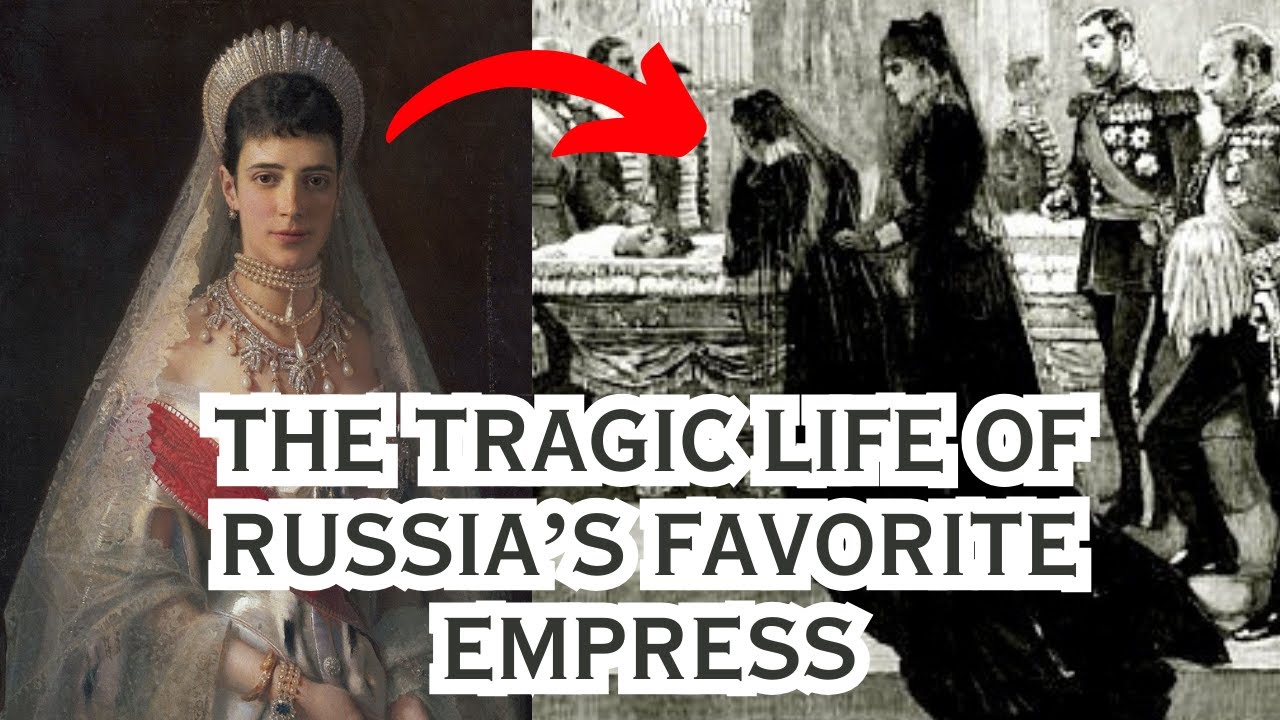
It was a story that captivated Europe—a real-life Cinderella tale in which an obscure Danish princess was catapulted into the extravagant world of Imperial Russia, only to lose her prince and win an empire. Princess Marie Sophia Frederika Dagmar of Schleswig-Holstein-Sonderburg-Glücksburg, always known simply as Dagmar, had grown up the daughter of Prince Christian of Denmark, who became King Christian IX in 1863. The family lived in happy but relatively modest circumstances for royalty. Even after her father’s accession, the princesses did much of the housework themselves—skills they would never require in adulthood.
Their fortunes changed decisively in 1863, the same year Christian took the throne, when Dagmar’s elder sister Alexandra—widely considered the most beautiful princess in Europe—married Albert Edward, the Prince of Wales. Queen Victoria and Prince Albert had knitted together a sprawling network of alliances across the royal houses of Europe, with a decidedly Germanic bent: their eldest daughter Vicky married the heir to Prussia and became the mother of the future Kaiser Wilhelm II; another daughter, Alice, married the Grand Duke of Hesse and by Rhine, and in time produced a daughter, Alix, who would one day marry Nicholas II of Russia. For their son Edward, however, Victoria and Albert had made an aesthetic rather than a political choice, and Alexandra of Denmark became Princess of Wales. As the sister of the Princess of Wales, Dagmar’s prospects as a royal bride rose considerably.
She was not as classically beautiful as Alexandra, but she was pretty and lively, and suitors soon came courting. None was more ardent than Grand Duke Nicholas Alexandrovich, the eldest son and heir of Tsar Alexander II of Russia. Nixa embodied everything a nineteenth-century princess could want in a prince charming—handsome, romantic, and heir to the vast, colorful, wealthy, and powerful Russian Empire. Dagmar accepted his proposal in 1864 and immediately began instruction in the Russian Orthodox faith and in Russia’s language and culture.
Queen Victoria gave her approval, remarking that the princess was generally agreed to be very fit for the position in Russia. The transfer of Dagmar’s affections from the romantic and ethereal Nixa to the more down-to-earth, robust, solid, and stubborn Alexander took place over the following year, and their wedding was held in 1866. The match would later serve as the main precedent for another royal marriage: that of Edward and Alexandra’s son George, Duke of York—the future George V—to his deceased brother’s fiancée, Princess Mary of Teck, in 1893. Now known formally as Grand Duchess Marie Feodorovna, but called Minnie within the intimacy of the family, Dagmar threw herself into Russian life with gusto.
She lived in the Anichkov Palace on St. Petersburg’s main thoroughfare, Nevsky Prospect, and as grand duchess she stood at the center of Russia’s opulent social life, frequently called upon to deputize for her delicate and sickly mother-in-law, the Tsarina Maria Alexandrovna. She slipped easily into the Romanov family, befriending the Tsar and Tsarina’s only daughter, Maria, who would later marry one of Queen Victoria’s sons, and her four brothers-in-law: Vladimir, Alexis, Paul, and Sergey. Childbearing, which seemed to exhaust the Princess of Wales, only increased the grand duchess’s robust good health.
Nicholas was born in 1868, followed by Alexander in 1869, who died in 1870, George in 1871, Xenia in 1875, Michael in 1878, and finally Olga in 1882. Then, on March 13, 1881, everything changed. Marie Feodorovna’s father-in-law, Tsar Alexander II, was assassinated by members of the revolutionary group The People’s Will, who threw a bomb into his open carriage. The Tsar’s legs were blown off, and he bled to death that afternoon in the Winter Palace.
For the new Tsar, Alexander III, and his wife, security became a primary concern. They moved to the suburban estate at Gatchina, where entire regiments of soldiers and plain-clothed police officers surrounded them. The Imperial family found respite from these taxing security measures only during relaxed autumnal visits to the Danish royal family at Fredensborg, where the informality enhanced the close ties between the Waleses and the Romanovs. Their children became good friends, and much was made of the astonishing resemblance between the future King George V and Nicholas II, the two cousins so alike they were often mistaken for one another.
Chancellor Otto von Bismarck of Prussia regarded these apolitical gatherings with much suspicion, concerns he shared with his protégé, Prince Wilhelm, the future Kaiser. The seeds of future conflict were sown. Elegant, intelligent, and consummately charming, Marie Feodorovna presided over the most glittering court in Europe. Always impeccably dressed, she loved clothes and wore them so superbly that she was considered the best-dressed woman on the continent.
Her love of fine things inspired her husband to commission Peter Carl Fabergé to create the first of his incomparable Imperial Easter eggs in 1885. The Hen Egg was the beginning of a tradition that her son Nicholas II would continue, gifting eggs to his mother and wife every year until 1917. As her children passed from adolescence to young adulthood, Marie Feodorovna turned her attention to finding them suitable partners. Unwilling to have her favorite daughter Xenia leave Russia, she was relieved when Xenia’s choice fell on her second cousin, Grand Duke Alexander Mikhailovich, known to the family as Sandro.
Her second son, George, caused her more trouble: diagnosed with tuberculosis as a teenager, he was sent to live in the Caucasus, where the mountain air was beneficial to his health. The Tsarevich Nicholas, the heir to the throne, usually biddable and pliant, proved unwavering in his determination to marry the shy, sullen Princess Alix of Hesse and by Rhine. Neither Marie Feodorovna nor Tsar Alexander III thought Alix suited to the role of future Empress of Russia, but they reluctantly gave their consent for Nicholas to propose in 1894. At the wedding of Nicholas and Alix’s mutual cousin, Princess Victoria Melita of Edinburgh, to Alix’s brother, Grand Duke Ernst of Hesse, Nicholas—egged on by another mutual cousin, Kaiser Wilhelm II—persuaded Alix to overcome her concerns about converting to Russian Orthodoxy.
The couple announced their engagement to the entire assembled family, which included Alix’s formidable grandmother, Queen Victoria. Fabergé was called in once again and earned his largest-ever commission on the engagement present: Alexander III and Marie Feodorovna gave Alix a suite of pearls that cost the equivalent of $2. 9 million today. Even Queen Victoria was impressed, and she reminded her granddaughter not to be too proud.
But Marie Feodorovna spent much of the early 1890s fretting about her husband’s health. Alexander III was diagnosed with nephritis in 1894, and he proved a difficult patient. In the autumn of 1894, doctors suggested a change of climate, and the Imperial family headed to Livadia in the Crimea, hopeful that the milder Black Sea climate would do him good. Alexander did not improve, and soon the Prince and Princess of Wales and Alix were summoned to Livadia, along with other members of the family, to support Marie Feodorovna as she presided over her husband’s last hours.
He died on November 1, 1894. In the aftermath of Alexander III’s death, Alix was accepted into the Russian Orthodox Church and became Grand Duchess Alexandra Feodorovna. Following the ordeal of a lengthy funeral procession from Crimea back to St. Petersburg, Marie Feodorovna oversaw the wedding of Nicholas and Alexandra in the Imperial Chapel of the Winter Palace.
Now Dowager Empress, she returned to her beloved Anichkov Palace, with Nicholas and Alexandra, Xenia and Sandro, and her two youngest children, Michael and Olga. Relations with the new Empress were not easy. Egged on by the Princess of Wales, Marie Feodorovna refused to hand over the crown jewels and insisted on retaining precedence over Nicholas’s wife on state occasions. As the 1890s progressed, Marie Feodorovna was active both in St.
Petersburg and around Europe. She joined in the general national rejoicing in 1904 when Alexandra finally gave birth to a son and heir, Alexei, after producing four daughters in succession, none of whom could inherit their father’s crown. Marie Feodorovna relished her growing brood of grandchildren, particularly Xenia and Sandro’s seven children. She ruled once again supreme at the heart of St.
Petersburg’s glittering society, and comparisons between her innate social finesse and her daughter-in-law’s painful lack of it became a constant topic among society gossips. As the years passed, Nicholas and Alexandra retreated further from St. Petersburg, particularly after their son Alexei was diagnosed with hemophilia. They made their home in the suburban Alexander Palace, doing everything they could to hide the Tsarevich’s fatal illness from the public.
It was here that Nicholas and Alexandra received frequent visits from the infamous Grigori Rasputin, who was the only person who could bring relief to Alexei during his frequent hemorrhages. Nicholas II remained close to his mother, writing to her often, and they consoled one another in the aftermath of another family crisis in 1912, when Marie Feodorovna’s youngest son, Michael—second in line to the throne after the fragile Alexei—married his longtime lover, Natalia Wulffert, a twice-divorced commoner and the mother of Michael’s only child, George, who had been born in 1909. Marie Feodorovna continued to seek consolation in travel, joining her sister, Dowager Queen Alexandra, each autumn at Hvidøre, a house in their native Denmark that the sisters had purchased in 1906. But in 1914, Russia—woefully underprepared—declared war on Germany, setting the stage for the demise of the dynasty.
In 1916, Rasputin was assassinated by Marie Feodorovna’s nephew, Grand Duke Dmitri Pavlovich, and Felix Yusupov, the husband of the Empress’s niece Irina. Marie Feodorovna spent much of the war in Kiev, where she received the devastating news in 1917 that Nicholas II had abdicated on behalf of himself and his son Alexei, in favor of Grand Duke Michael. She hurried to Mogilev to join Nicholas, where they learned that Michael had himself renounced the throne, signaling the end of 304 years of Romanov rule in Russia. Marie Feodorovna returned to Kiev on her train.
She would never see either son again. In early April 1919, with the Red Army pushing ever closer, Marie Feodorovna, accompanied by her two daughters, Grand Duchess Xenia and Olga, and their families and her household, left Kiev for the Crimea. The British government, badgered by Queen Alexandra, ordered HMS Marlborough to evacuate the Dowager Empress and her family. Marie Feodorovna refused to leave unless the Marlborough also carried all of the Russian refugees who were desperate to escape.
Captain Charles Johnson wavered but finally relented, and only after all the refugees and their belongings had been loaded would Marie Feodorovna agree to board. As HMS Marlborough steamed out of the harbor, another British ship carrying officers of the Imperial Guard, en route to Sevastopol, passed by. Marie Feodorovna stood on the quarterdeck, and across the water came the strains of the Russian Imperial Anthem, sung by the officers in tribute to their beloved Empress. It was the last time the anthem would be heard in its native land.
Marie Feodorovna initially settled in England, where she lived with Queen Alexandra at Marlborough House, but later resettled in her native Denmark. To her dying day, she refused to believe the increasing evidence that Nicholas and his family had been killed in Ekaterinburg, or that Michael had met his end in Perm. She acknowledged no successor to her son and refused to meet any of the claimants purporting to be her granddaughter Anastasia. Marie Feodorovna died in 1928, and the tattered remains of the Russian nobility joined European royalty to bid farewell to the last remaining link with Imperial Russia.
Her remains were interred in Roskilde Cathedral, the traditional resting place of the Danish royal family. But in 2006, her coffin was returned to Russia via the same route the Sea King’s daughter had taken 140 years earlier, and she was laid to rest beside her husband, Alexander III, in the Peter and Paul Fortress.