On February 14, 1945, President Franklin Roosevelt and King Abdul Aziz of Saudi Arabia met aboard the USS Quincy in Egypt’s Great Bitter Lake. The meeting lasted eight hours, and its substance was never fully revealed, but its outcome reshaped the global balance of power. Roosevelt promised American military protection for the Saudi kingdom. Abdul Aziz committed his nation’s vast oil reserves to American and allied energy needs.
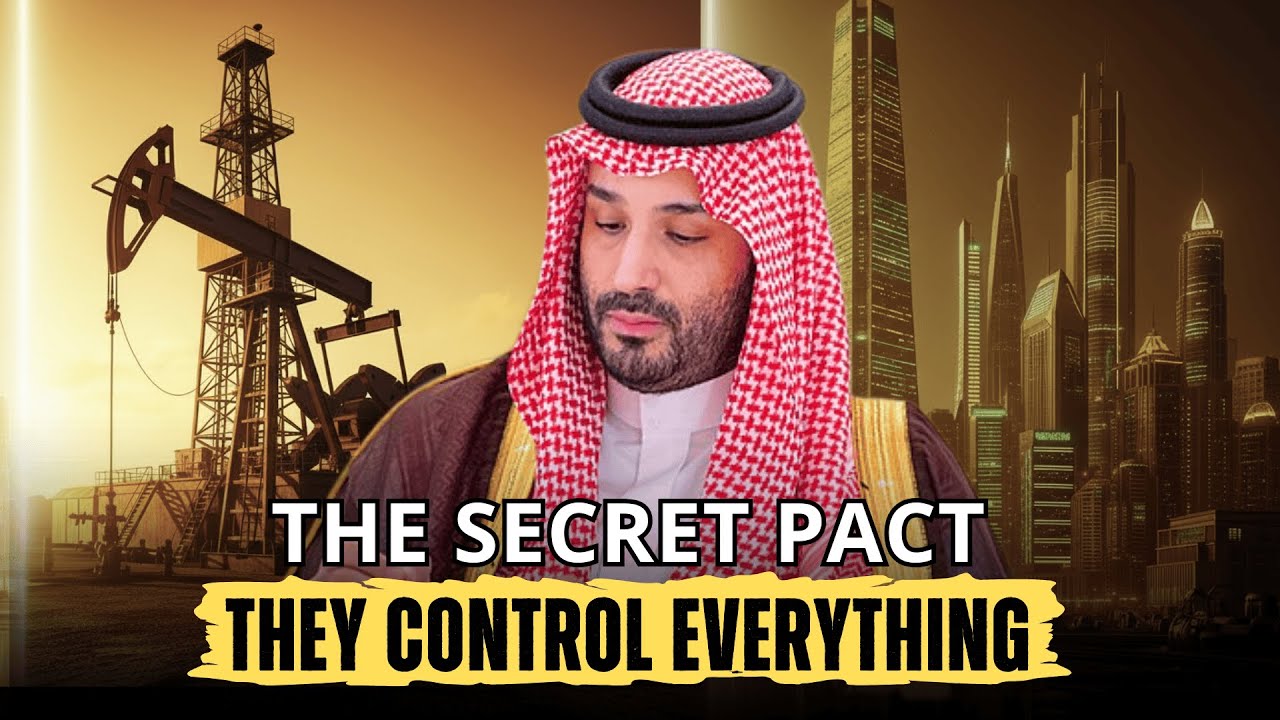
That informal accord became the foundation of an eighty-year partnership that would convert Saudi Arabia from a poor desert kingdom into the most financially potent monarchy in recorded history. The partnership did not emerge from a vacuum. Its origins lay in a religious and political alliance forged in 1744, when Muhammad ibn Saud, a minor tribal chieftain ruling a few isolated settlements around Diriyah, joined forces with Muhammad ibn Abd al-Wahhab, a puritanical religious scholar who had been driven from multiple communities for his uncompromising reforms. Ibn Saud needed ideological legitimacy to expand beyond kinship-based politics.
Ibn Abd al-Wahhab needed protection from his religious adversaries. Their pact merged tribal military organization with strict Islamic doctrine, creating a revolutionary state that expanded rapidly across the Arabian Peninsula. By 1800, the first Saudi state controlled most of Arabia, including the holy cities of Mecca and Medina. That expansion alarmed the Ottoman Empire, which considered itself the supreme authority over Muslim territories.
In 1818, Ottoman forces under Muhammad Ali Pasha crushed the Saudi state, leveled its capital of Diriyah, and took Imam Abdullah ibn Saud to Constantinople for public execution. The first Saudi state dissolved, but the alliance’s religious and political foundations survived. Survivors retreated into the Najd and rebuilt, inaugurating a second Saudi state in 1824 that focused on consolidating control over the central region while avoiding direct confrontation with the Ottomans. Internal succession disputes and rivalry with the al-Rashid family of Ha’il weakened the second state throughout the nineteenth century.
During the 1890s, the Rashids, backed by Ottoman forces, drove the Saudis into exile in Kuwait. Abdul Rahman ibn Faisal al-Saud fled with his young son Abdul Aziz. The defeat looked final, but it created the conditions for an extraordinary comeback. Born in 1875, Abdul Aziz spent his formative years in exile observing the political shifts redefining the region.
The Ottoman Empire was weakening, British influence was expanding across the Persian Gulf, and oil had been discovered in Persia in 1908. In 1902, Abdul Aziz recaptured Riyadh in a daring raid, then spent years systematically rebuilding Saudi control over central Arabia. He understood that the future would be decided by global powers, so he cultivated strong relationships with the British, who recognized his state during World War I. Later, he would trade British backing for an even more rewarding partnership with the United States.
On March 3, 1938, at Dammam Well Number 7, American geologist Max Steineke struck oil at a depth of 4,727 feet. The well initially produced 1,585 barrels per day, but further drilling revealed the extraordinary scale of the find. The Ghawar oil field, stretching 280 kilometers long and 30 kilometers wide, remains the largest conventional oil field ever discovered, holding an estimated 88 billion barrels of recoverable oil. Together with other fields in eastern Saudi Arabia, the kingdom came to control roughly 17 percent of the world’s proven petroleum reserves.
The oil concession had been signed on May 29, 1933, between King Abdul Aziz and the Standard Oil Company of California. SoCal had mapped the geological formations of the region and concluded that the oil-bearing limestone of Iraq and Iran likely extended beneath the Arabian Peninsula. The British companies competing for the concession assumed their imperial connections made aggressive bidding unnecessary. SoCal offered better financial terms and more generous royalties.
The agreement covered 360,000 square miles of eastern Arabia, and in exchange for exclusive exploration rights, the Saudis received an immediate gold payment, annual rentals, and scalable royalty rates. Initial exploration efforts were deeply disappointing. By 1937, SoCal executives were ready to abandon the venture, but Steineke persuaded management to drill one final test well at greater depth. That decision confirmed one of the largest and most accessible oil reserves on Earth.
World War II transformed the relationship. Roosevelt declared Saudi Arabia eligible for lend-lease assistance despite its neutrality, and American military planners recognized the strategic necessity of protecting Saudi oil fields from Axis attack. Secretary of State Cordell Hull advised Roosevelt that control over Saudi oil would allow the United States to influence its European allies, who would depend on American-controlled energy for recovery and security. Navy Secretary James Forrestal called Saudi Arabia one of the greatest material prizes in world history.
The petrodollar agreement of 1974 formalized the arrangement that had been developing for three decades. During the Arab oil embargo, with oil prices surging from three dollars to twelve dollars per barrel, Treasury Secretary William Simon initiated a historic call to Saudi Oil Minister Ahmed Zaki Yamani. The proposal was a quid pro quo. Saudi Arabia would price all oil sales exclusively in U.
S. dollars and invest its revenues in American Treasury securities. In return, the United States would guarantee military protection and provide unfettered access to American financial markets. The agreement was signed in secret in 1974 after months of delicate negotiations involving the highest levels of both governments.
President Richard Nixon ratified the American framework, and King Faisal made the final Saudi decision after consulting with Crown Prince Fahd and senior royal family members. The deal cemented the dollar as the world’s primary reserve currency, generated perpetual global demand for American currency, and allowed the United States to finance massive federal deficits without the usual consequences of inflation. Saudi Arabia received security guarantees that neutralized its vulnerability to regional adversaries and gained financial influence far exceeding its oil output. The wealth transformed the kingdom domestically.
Between 1970 and 1980, annual oil revenues increased from 2. 3 billion to 112 billion dollars. King Faisal, who governed from 1964 until his assassination in 1975, used the revenues to build a comprehensive welfare state providing free education, health care, housing subsidies, and employment. The system deliberately tied citizen welfare to government provisioning rather than establishing individual economic rights that could threaten monarchical control.
Citizens received remarkable material advantages in exchange for political loyalty and social conformity. The assassination of King Faisal in 1975 by his nephew could have triggered a devastating succession crisis. Instead, within hours, the royal family selected King Khaled and confirmed Crown Prince Fahd, demonstrating a political discipline that transformed the family from a tribal confederation into one of the world’s most resilient ruling dynasties. The family managed its thousands of princes through informal consultation mechanisms and eventually the Allegiance Council, established formally in 2006, allowing senior princes to select monarchs through consensus processes.
In November 2017, Crown Prince Muhammad bin Salman launched an unprecedented anti-corruption purge, detaining hundreds of princes and billionaires at the Ritz-Carlton in Riyadh. The operation seized assets valued at over one hundred billion dollars and signaled that the era of independent power centers within the royal family was over. The crown prince had been elevated to heir apparent in June 2017 through a carefully orchestrated palace coup that removed his cousin Muhammad bin Nayef from the succession line. Muhammad bin Salman’s agenda, known as Vision 2030, represents an attempt to transform an oil-dependent economy into a diversified global power.
Women gained the right to drive, attend public sporting events, and travel abroad without male guardian permission. Entertainment restrictions were lifted, enabling concerts, cinemas, and cultural festivals. The sovereign wealth fund, the Public Investment Fund, manages approximately 1. 4 trillion dollars in assets and aims to reach 2 trillion by 2030.
It holds significant stakes in companies including Apple, Google, Tesla, Disney, and has committed billions to SoftBank’s Vision Fund. Domestically, it funds the NEOM megacity project, a planned five-hundred-billion-dollar development along the Red Sea. Yet the transformation carries profound risks. The Saudi economy remains vulnerable to oil price volatility.
The social contract, based on government provisioning rather than representative governance, faces pressure from a young, educated population under thirty years old representing over 60 percent of the citizenry. The United States has achieved energy independence, reducing its strategic reliance on Saudi oil, while China’s economic engagement in the Middle East offers alternative partnerships. The 2018 assassination of journalist Jamal Khashoggi inside the Saudi consulate in Istanbul damaged the kingdom’s international reputation, though the crown prince threatened to seek new allies in China and Russia in response. The petrodollar system has persisted for five decades, but its foundations face mounting pressure from renewable energy, shifting global power structures, and the emergence of a multipolar international order.
The Saudi experiment now stands as a global test of whether an absolute monarchy can survive in the twenty-first century. Crown Prince Muhammad bin Salman’s Vision 2030 represents an audacious effort to modernize the economy and society while preserving royal authority and Islamic identity. Its success or failure will determine not only the kingdom’s future, but also whether traditional authority structures can integrate into a modern global system without being fundamentally transformed by the process.






