By the summer of 2020, the bison had been back in the Saskatchewan valley for roughly a year. They did what bison do: they dropped to the ground, rolled vigorously in the dirt, and worked themselves into the sod. One of them scraped the covering off a buried boulder. On it, there was a carving.
An archaeologist named Ernie Walker was called to look at it. Walker had co-founded the park in that valley, Wanuskewin, and had been excavating there for about four decades. He had walked that ground, surveyed it, dug it, and mapped it across most of a working lifetime. And here, in the summer of 2020, the animals had exposed a carving he had been walking over for forty years.
Then they found a second one. And a third. And a fourth. Four carved stones in total, and then, in the ground nearby, the stone knife that had been used to make the carvings.
That is not a metaphor. It is a literal description of what happened. The animals that this entire valley was built around, that had been absent from it for a century and a half, came back and physically uncovered a piece of the record that the animals themselves are carved into. The place is called Wanuskewin, and it sits just outside Saskatoon in a valley cut below the flat open prairie.
That valley is the key to everything about the site. The northern plains are exposed, and wind moves across them without obstruction. Winter is severe, and there is very little shelter. A valley cut down below the level of the prairie changes all of that.
It offers shelter from the wind, water in the creek at the bottom, and wood, which is scarce out on the open grass. It is a place that is several degrees warmer in winter and where animals concentrate. So people came, and they kept coming. The number attached to that is remarkable: over 6,400 years of Indigenous peoples gathering at that spot.
That occupation begins thousands of years before the pyramids at Giza. It runs continuously through the entire recorded history of every civilization, and it does not stop at any point in that span. Different groups, different centuries, different traditions returned to the same valley for the same reasons because the reasons never changed. It is worth being concrete about why a valley beats open prairie so decisively, because it explains the entire 6,000-year pattern in one go.
Out on the flat in a plains winter, wind is the thing that kills you. Cold alone is survivable with the right shelter and the right clothing. Cold with sustained wind across open ground is a different problem entirely, because it strips heat away faster than a person or a fire can replace it. Drop below the lip of the prairie and the wind goes over the top of you.
That single fact changes what is possible. A camp in the valley is viable in conditions that would make a camp on the flat lethal. Add to that running water that does not have to be carried far, wood for fire and building in a landscape where wood is the scarcest material there is, and animals that come down into the shelter for exactly the same reasons people do. None of that required anyone to be told.
Any group arriving in that region and looking at that landscape would work it out within a day, which is why the occupation is not one culture. It is culture after culture arriving separately across thousands of years, reaching the same conclusion about the same piece of ground. And the record of that is still in the ground. Campsites.
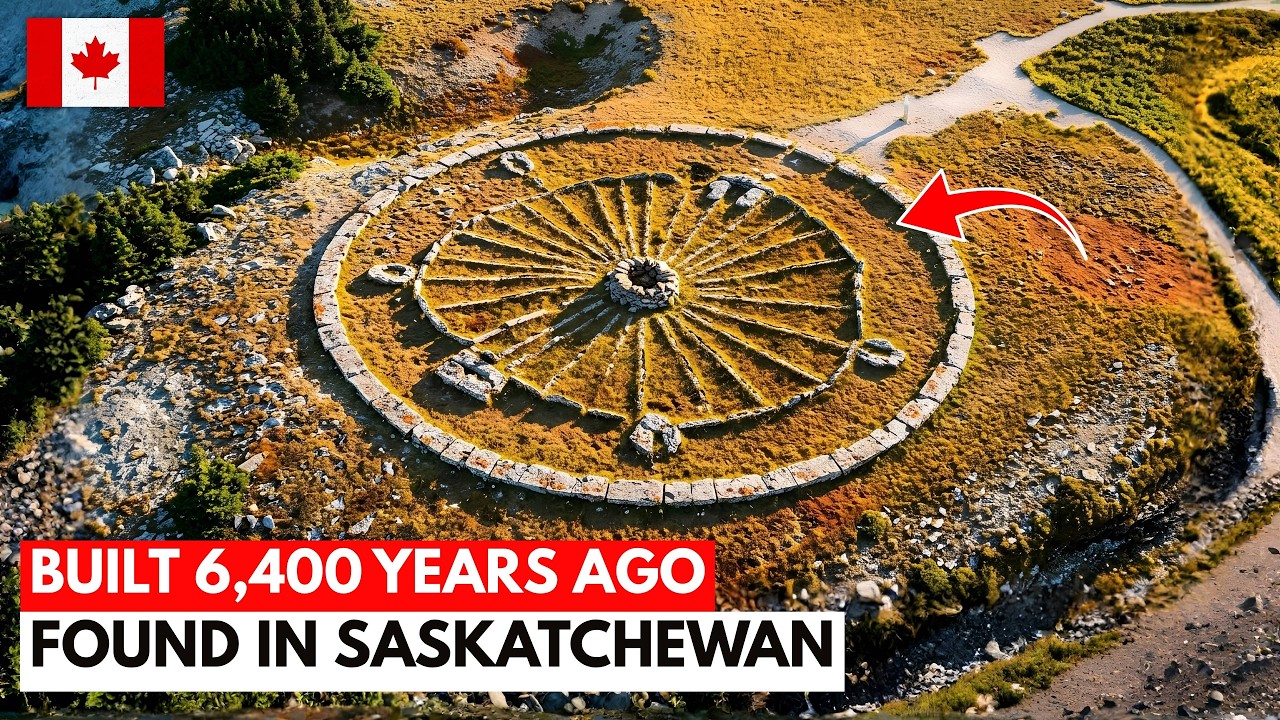
Tipi rings, circles of stone that held down the edges of a lodge cover, left behind when the lodge moved on. Bison jumps. And a medicine wheel, described as the most northerly known. The bison jump deserves particular attention, because most people have heard the term and very few have any idea what it actually involved.
The popular impression is not just wrong; it is close to insulting. The image people carry is of a stampede driven blindly off a cliff, chaos and waste. What it actually was is one of the most sophisticated hunting systems ever devised anywhere on Earth. Start with the terrain.
You need a specific kind of drop, and the one in this valley runs somewhere in the region of 40 to 50 meters from the lip of the prairie down to the valley floor. Crucially, the approach has to be shaped so that the animals cannot see the edge until it is too late. The land has to hide the drop. Then you build the drive lanes: lines of stone cairns, sometimes running for kilometers out across the prairie, forming a funnel that narrows toward the jump.
Those cairns are not fences. They are markers. People would position themselves along them, or brush and hides would be added, so that a moving herd reads the line as something to avoid and steers away from it. Then you have to move the herd, and this is the part that requires real knowledge.
You need the wind right, because bison have an excellent sense of smell and will not be pushed into a scent they distrust. You need to start the animals moving at the correct pace, not a panic, because a herd in full stampede is uncontrollable and will break the wrong way. You need people at the correct points along the lanes, all doing the right thing at the right moment, over a distance of kilometers, with no way to communicate except signals agreed in advance. And you need to have chosen the right season and the right herd, because the whole operation only works once in a given place for a while.
Then, at the end of it, the drop. And then the real work starts, because the jump is not the point. The jump is the beginning of an enormous processing operation: butchery, cutting and drying meat for storage, rendering bone for grease, which is one of the most calorie-dense foods available on the plains and essential for surviving winter. Working hides.
Making tools from bone and horn. Sites like this accumulate deep deposits of bone below the drop, built up over repeated use across centuries. None of that is waste, and none of it is chaos. It is a communal industrial operation, run by people with an extraordinarily detailed working knowledge of terrain, weather, animal behavior, and food preservation.
And it required a large number of people to cooperate precisely. One more thing about the jump that people find difficult to confront. A jump is not a sustainable technique in the sense of being usable whenever you like. It works because the herd does not know the drop is there and because a large number of people are available to run it.
That means it is seasonal, occasional, and dependent on the herd being in the right place. It is a major event, not a routine. It is also enormously efficient when it works, which is the point. A successful drive can provision a large group through a winter.
Set against the alternative of hunting individual animals on foot, with the risk that involves on an open plain in a landscape where a bad winter is fatal, the arithmetic is not close. Whether it produced more meat than could be processed in some cases is a genuine archaeological discussion, and the answer appears to vary by site and by circumstance. What is not in question is the level of organization and knowledge required to do it at all. Then there is the medicine wheel.
A medicine wheel is a stone arrangement on the ground, typically involving a central cairn and often spokes and an outer ring. Hundreds are known across the northern plains. They vary enormously in size, in layout, and in age. What they meant and what they were for does not have a single answer, and it is not primarily an archaeological question.
These are structures built by specific peoples for specific purposes, and the meaning belongs to those communities and their descendants. Various functions have been proposed, including commemoration, ceremony, and alignments with astronomical events, and different wheels may have served different purposes. The honest position is that a medicine wheel is a deliberate formal construction on a landscape made by people who chose that spot for reasons, and the interpretation of it is not anyone else’s to hand out. Which brings us back to the animals.
Bison were removed from that landscape completely. The slaughter that emptied the North American plains in the 19th century took a species that had numbered in the tens of millions down to a remnant. And this valley, like the rest of the region, went from having bison as the central fact of its existence to having none at all. For more than 150 years, this was a valley that had been shaped by bison, used by people because of bison, and carved with images of bison, with no bison in it.
That changed in 2019 as part of a major revitalization of the park, a project running to around $40 million. A herd was brought in and released into the valley. And bison do something that no other animal on that landscape does at that scale: wallowing. A bison will drop to the ground and roll vigorously, working itself into the dirt.
It does this for a number of reasons: shedding winter coat, dealing with biting insects, coating itself in dust, managing temperature, and as social behavior, especially among bulls. The result is a wallow, a shallow circular depression where the sod has been stripped away and the soil beneath churned and exposed. And a herd does this constantly, in the same favored spots year after year. Wallowing is not an incidental habit.
It is an earth-moving process. Bison were a landscape-scale disturbance across the whole of the plains, and the depressions they created still show up in aerial imagery of prairie that has not been plowed, more than a century after the animals were removed. So when the herd came back to that valley, the process came back with them. And in the summer of 2020, the wallowing scraped the covering off a boulder that had been sitting under the sod, and there was a carving on it.
It is worth appreciating how easily that could have gone the other way. A boulder in a valley is not remarkable. There are boulders everywhere across that landscape, dropped by the ice sheets that covered the region and left scattered across the prairie when the ice melted. A carving on the underside or the buried face of one of them is invisible in every practical sense.
You cannot survey for that. Ground-penetrating radar will find you a buried stone, and there are a very large number of buried stones. Nothing in a geophysical survey tells you which of them has marks on it. So the only realistic way to find something like this is for the covering to come off, and then for somebody who knows what they are looking at to be standing there afterwards.
Both of those things happened in the same valley within about a year of each other. Ernie Walker looked at what the bison had uncovered: a petroglyph. The carving is of a type associated with bison hunting. The style is described as a ribstone, with scratched lines representing the ribs of a bison, and it belongs to a rock art tradition of the northern plains.
One of the stones carries a figure with a triangular head, horns, an oblong body, and a tail. The stones are heavy, one of them running to several hundred pounds. Four were found in total. And then there was the knife.
A stone tool was recovered, understood to be the implement used to make the carvings, and its position was not random. It was found on a precise line running toward the ancient bison jump. That combination is what makes archaeologists sit up. Finding rock art is rare.
Finding four carved boulders together is much rarer. Finding the actual tool that made them in place, in a meaningful spatial relationship to the site the carvings are about, is close to unheard of. The discovery was announced in November of 2021. The age of the carvings is estimated at somewhere between 300 and 1,800 years, with around a thousand years considered the most likely figure in context.
It was reported and received by many of the people connected to that place in terms of prophecy: the idea that the return of the bison would bring something back with it, and that what the animals uncovered was not an accident. How to weigh that is a matter for those communities. What is not in dispute is the physical sequence. The bison were absent for a century and a half.
They were returned. Within about a year, they exposed carvings of bison that nobody had found in four decades of professional excavation on that exact ground. Now the honest limits. The dating is wide.
Three hundred to 1,800 years is a large range, and the figure of roughly a thousand years is an interpretation based on context rather than a direct measurement. Rock art is notoriously difficult to date, because a carving is the removal of material rather than the deposition of it, and there is often nothing datable in the carving itself. The medicine wheel description as the most northerly known is exactly that: known. It reflects what has been recorded and documented, not a guarantee that nothing further north exists or will be found.
Wanuskewin sits on Canada’s tentative list for world heritage status, with an application in progress. Tentative and pending are not the same as inscribed. And the 6,400-year figure describes gathering and use of that valley across that span; it is not a claim of continuous permanent settlement by a single group. Different peoples used that place across an enormous period of time, which is in some ways a more impressive statement than continuous occupation would be, because it means the valley kept being recognized as the right place independently across thousands of years and many different communities.
Go back to the shape of what happened, because it is genuinely one of the better stories in North American archaeology. A valley used by people for more than sixty-four centuries because it had shelter, water, wood, and bison. Bison jumps built into its edges. Stone circles from lodges on its flats.
A medicine wheel above it. And carvings of bison on boulders hidden under the grass. Then the bison were exterminated, and the valley spent five generations without the animal that everything in it had been organized around. Then somebody brought them back, and the animals walked out into the valley and did the thing bison do: rolling in the dirt.
And the ground opened up and showed them to themselves.






