Lyndon B. Johnson had already reshaped American politics with the Great Society and the civil rights laws that defined the 1960s, but his towering ambition did not stop at the Capitol. It reached into his own family, placing his two daughters at the center of the most chaotic decade in modern American history. Linda Bird and Lucy Baines Johnson spent their youth inside the White House during the Vietnam War and the civil rights revolution, living under constant Secret Service protection, relentless media attention, and the heavy shadow of their father’s controversial power.
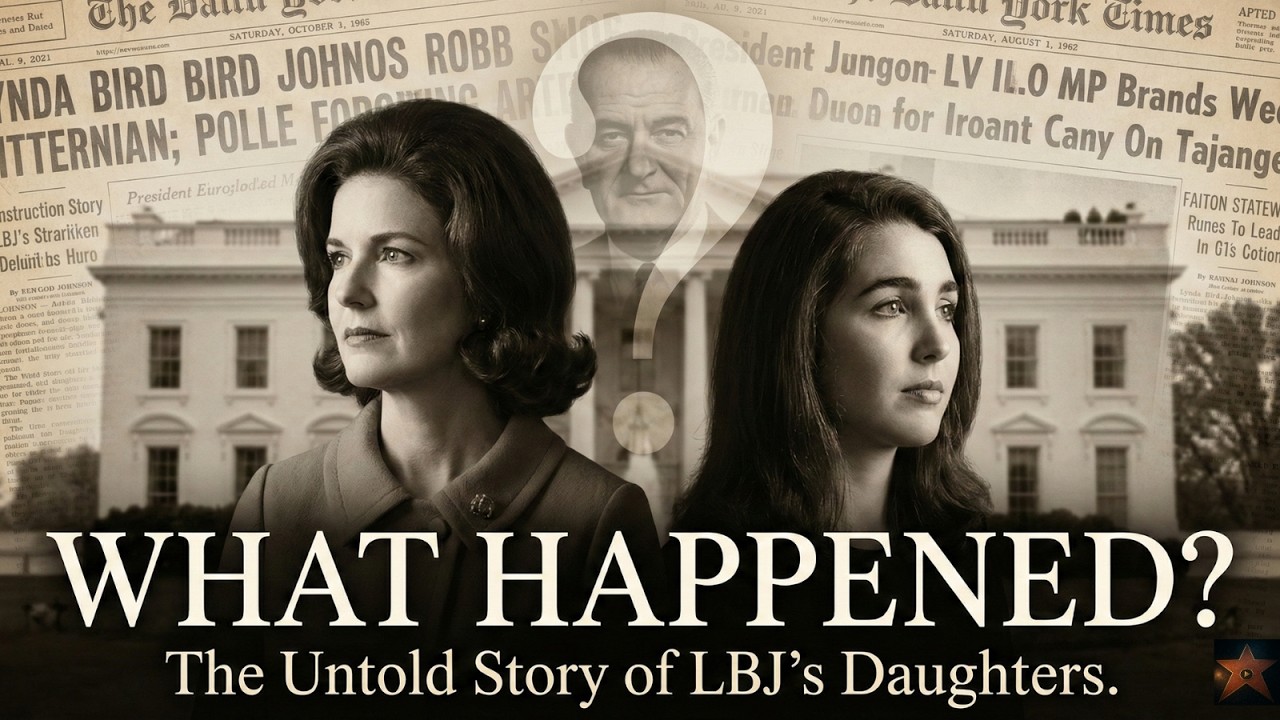
The elder daughter, Linda Bird Johnson Robb, was born on March 19, 1944, the first child of LBJ and Lady Bird Johnson. Her early years unfolded in the politically charged atmosphere of the Senate and the vice presidency, where politics was not a profession but the family’s daily life. The assassination of President John F. Kennedy in November 1963 changed everything in an instant.
At nineteen years old, Linda Bird found herself the first daughter of the United States, thrust into the White House at the start of one of the most turbulent periods in the country’s history. Her role was immediate and demanding. She became a diplomatic hostess, working alongside her mother to manage the immense social calendar required by the Great Society and the war in Vietnam. She carried the responsibility with grace and efficiency, acting as a crucial buffer between her overwhelming father and the political world around him.
Her life became permanently tied to the political arena in December 1967, when she married Marine Captain Charles S. Robb. The wedding was held in the East Room of the White House and broadcast live on television. It was a massive globally watched media event, designed by LBJ to project normalcy and strength at the height of the Vietnam War and the anti-war protests.
The marriage linked the Johnson family to a respected military background and served as a political statement in a deeply divided country. Charles Robb went on to a long and successful political career, serving as governor and later as senator of Virginia. Linda Bird became an essential political spouse, navigating the complex world of Virginia politics while frequently drawing intense media scrutiny because of her father’s controversial name. Over time, her personal commitment shifted toward advocacy.
Inheriting her mother’s passion for literacy and beautification, she served as chairman of the board of the Children’s National Medical Center and later chaired the board of the LBJ Presidential Library. In that role, she dedicated herself to preserving the historical record of her father’s Great Society achievements. Linda Bird’s personal life remained largely free of scandal. She was known for her political stability and diplomatic skill.
The deeper story is her success as the family’s chief diplomat, using her marriage and her advocacy work to translate the controversial LBJ legacy into quiet, enduring public service. Her younger sister, Lucy Baines Johnson, took a different path. Born on July 9, 1947, she spent her entire adolescence, from ages sixteen to twenty-one, inside the White House during the Vietnam War and the civil rights turmoil. She had a more outspoken and rebellious spirit than her sister.
Two highly public choices during her White House years cemented her image as the most independent daughter of the Johnson family. The first was her decision in 1965 to convert to Catholicism. The conversion caused a major stir among her family’s Southern Baptist base and became a national media story. The second was her high-profile wedding in 1966 to Patrick J.
Nugent, a Catholic military officer. The ceremony was held in the White House and became a national sensation, underscoring the generational and religious shifts occurring across America at the time. After leaving the White House, Lucy Baines channeled her energy into business. She managed the family’s assets, particularly the radio and media holdings in Texas, and demonstrated the same entrepreneurial drive that had defined her father.
She became a prominent businesswoman and executive, successfully growing the family’s wealth and influence in the private sector. Her advocacy work continued throughout her life, particularly in supporting the Lady Bird Johnson Wildflower Center, co-founded by her mother, and in promoting the legacy of the Great Society. Her personal life was not without difficulty. Her divorce in 1979 was highly scrutinized by the press, but her later years stabilized after her second marriage to Ian Turpin.
Lucy Baines’s controversies were concentrated in her early choices: faith, marriage, and divorce. The deeper story is her success as an independent entrepreneur and dedicated advocate who maintained her father’s social justice mandate. She proved that the Johnson legacy could be honored through personal freedom and powerful, quiet business leadership. Together, the lives of Linda Bird and Lucy Baines spanned the political and social revolutions of the 1960s.
They took the immense pressure of their father’s controversial power and translated it into decades of dignified public service and civic action. One became the diplomatic hostess who married into a political dynasty and spent her life in advocacy and preservation of her father’s legacy. The other forged a path of independence, faith, and business, proving that the Johnson name could carry weight beyond the political arena.
Both women carried the burden of a father whose ambition reshaped the country, and both found their own ways to live with the legacy he left behind.






