The photograph was taken on a Tuesday morning in June of 1891, at approximately twenty minutes past nine, in a town called Harrows Mill in eastern Pennsylvania. The photographer was Clement Voss, a traveling portraitist of thirty-one who made his living moving from town to town along the rail line, taking pictures of families who could afford three dollars for a sitting and a mounted print. He had been in the business for nine years and had taken, by his own estimate, more than four thousand photographs. He would take fewer than two hundred after that June morning.
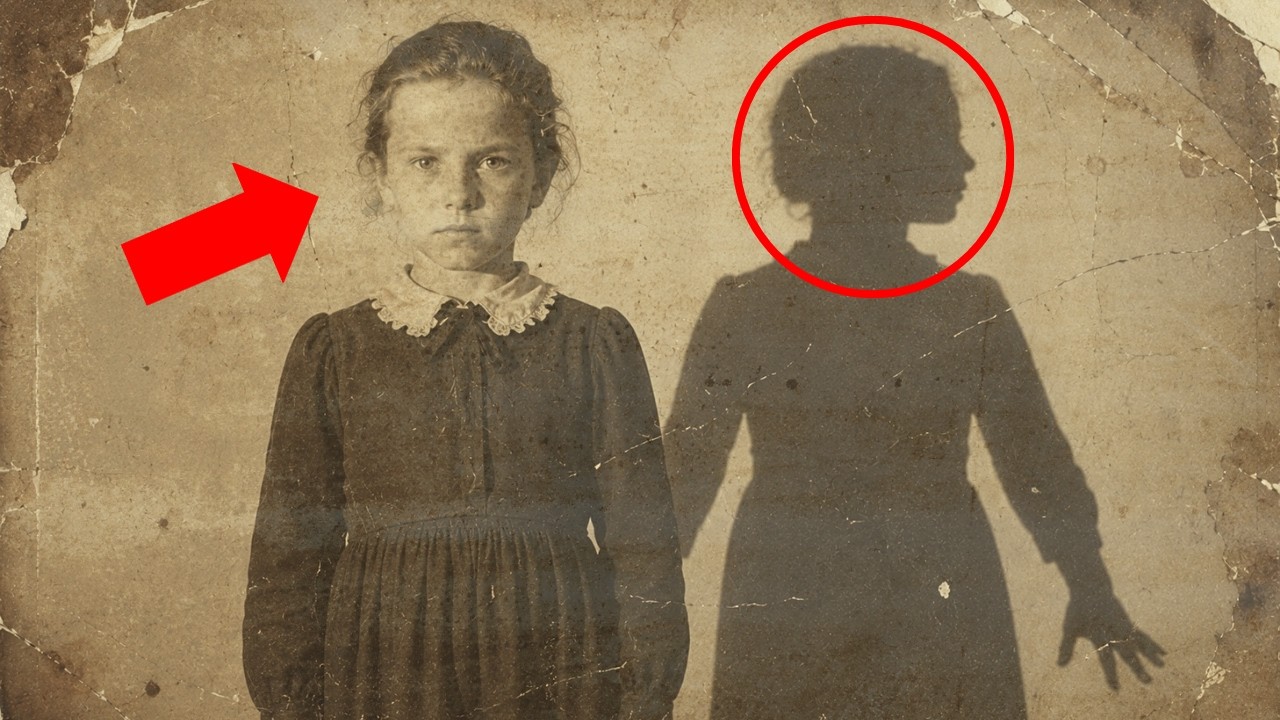
In the November of 1891 he closed his studio account in Allentown, sold his equipment to a younger man for what he said was a quarter of its worth, moved to a boarding house in a city where nobody knew him, and never once in the rest of his life took another picture. The photograph shows a girl standing in front of a white clapboard building, her hands at her sides, her face turned three-quarters to the right, away from the camera, looking at something outside the frame. She wears a dark dress, a white collar, her hair pulled back. She looks to be about nine or ten years old.
In every respect the photograph looks ordinary—except that the shadow in it does not belong to the girl. It falls in the right direction. It is the right length for the hour and season. But the body that would produce that shadow, calculated backward from its dimensions and the sun’s position, is not the body of a nine-year-old girl.
Its arms hang slightly outward from the body, elbows away, in the posture of a person who does not want her arms to touch her body. Its head is turned not to the right, toward the building, but to the left, facing the camera, facing Clement Voss. The shadow is of a girl standing in the same yard at the same moment, facing the opposite direction from Norah Vain. No such girl appears anywhere in the photograph.
The discovery of that anomaly took nearly three-quarters of a century and involved four separate people, none of whom knew each other. The first was Clement Voss himself, standing at his developing table on the morning of June 9, 1891. He could not articulate what was wrong, but he knew with the certainty of a man who had looked at four thousand photographs that something in the print was not what it should be. He did something he had never done in nine years: he did not give the customer her print.
In his notebook, next to Norah Vain’s name and the exposure time, he wrote one sentence—keep this one—and underlined keep. He kept the print through that summer, through the fall, through the November when he quit photography altogether. When he died in 1917 in a Philadelphia boarding house, the print was in a leather portfolio under his bed. The portfolio went to his brother in Ohio, who kept it in an attic for thirty years.
When the brother died in 1948, his daughter found it and put the photograph on a shelf in her sitting room, where it stayed for fifteen years. The second person to notice something was Mildred Hoss, a retired schoolteacher, who came for tea in the spring of 1963, picked up the photograph, looked at it for about three minutes, set it back down, and said quietly to her hostess that she had a queer feeling about that picture. When asked why, she said the shadow was wrong. Then she said something more: there is a child standing behind the photographer, and the child is in the picture.
She explained that the child was not in the image but in the shadow, and she was looking at the camera. The photograph passed to Mildred Hoss’s nephew, a part-time academic in Pittsburgh with an interest in photographic history. He examined it for a long time, then took it to a colleague with more experience in nineteenth-century processes. They spent an afternoon measuring and wrote a short paper, which was not accepted for publication because the journal said it was not sufficiently rigorous.
That paper sat in a filing cabinet for eleven years until a woman named Delia Marsh, completing a graduate thesis on anomalies in nineteenth-century American photography, found it in a library archive and wrote to the nephew asking to see the original. Delia Marsh is the reason this story exists in the form it does: she is the one who went to Harrows Mill. She spent three weeks there with the photograph and the surviving records. What she found when she went looking for Norah Vain’s summer was not the ordinary small-town summer it appeared to be.
It was the wrong number of children. From the records of the post office, the general store, the Methodist church, and the school district, she counted thirty-one children between the ages of six and fourteen resident in Harrows Mill and the surrounding farms in the summer of 1891. Then she found the school register from September of that year, kept by a teacher named Ruth Aller, and counted the names. Thirty-two.
One extra child appeared in the register and in no other record before or after—a child marked present at the first roll call and invisible in every other way. The child’s name was Patience. Just Patience. No last name.
Ruth Aller had left the space blank and had never filled it in. Delia Marsh found the name in two more places. The first was in Clement Voss’s notebook—not his working notebook, but a second one, small, bound in brown leather, which had been in the portfolio with the photograph. On the page dated June 9, 1891, next to the line that said Norah Vain, 5 seconds, keep, there was a second line written in darker ink, written later.
It said the other one. Below that, in smaller writing: she said her name was Patience. Clement Voss had spoken to a second girl that morning, a girl who was not Norah Vain. He had not photographed her; she does not appear in the image.
What appears in the image in the shadow may be another matter entirely. The third place Delia Marsh found the name was in the enrollment records of the Aldercroft Academy for Girls, which had run from 1847 to 1868 before closing and passing through several hands until it sat empty and bank-owned by 1891. There was an entry for a student named Patience Orin. She had enrolled in September of 1854 at the age of nine, attended for three years, and in the spring term of 1857, the word left appeared next to her name—not graduated, not completed, just left, written harder into the page than the surrounding words.
That was the last entry for Patience Orin in any record Delia Marsh could find. No graduation, no subsequent school, no marriage record, no death record, no census entry. She enrolled in 1854 at nine years old and walked off the edge of the historical record in the spring of 1857 at twelve. What she found about the ground under the building made the records worse.
The parcel on which the academy stood had been bought in 1847 by its founder, Josiah Calcraft, and the deed carried an annotation in his own handwriting: Hol advises the ground was always flat here and the local account says the stone was took out before the memory of man. I choose to take this as providence and not to inquire further. In his personal diary, kept in a historical society collection in Allentown, Calcraft recorded that before he bought the land, he had found on that flat ground an upright worked stone, about four feet above the surface. Carved on it was a figure of a girl standing with her hands at her sides, whose shadow, when Calcraft stood beside the stone at midday, did not fall in the same direction as his own.
He pulled the stone up and buried it face down three feet below the surface and built the north wall of the academy over it. In his diary, he wrote: I believe this is an old place and I believe something old has a claim on it. I also believe that claim can be superseded by a newer and stronger one if the newer claim is built on learning and prayer and the voices of children. The academy ran without incident from 1847 to 1868—except for the fall term of 1854 through the spring term of 1857, Patience Orin’s three years.
During that time, Calcraft’s diary changed. He began locking the school at night, which he had not done before. He mentioned checking the north wall four times in the fall of 1854. And in November of that year, he wrote one sentence alone in the middle of a page: I have buried the stone, but I have not buried the knowledge of the stone.
In the spring of 1857, he noted that a student had left who should not have been permitted to attend, that he had spoken to the girl’s parents, and that the parents had agreed to keep quiet about it. He did not say what had happened. In the Lutheran church records, two years later, the girl’s mother appears in a list of confirmations, with one word written next to her name: returned. Norah Vain was nine years old in the summer of 1891.
She was the daughter of Luther Vain, who ran the mill that gave the town its name, a grist and lumber operation that had been in the family since 1844. She had a cat named Fig, a habit of leaving her shoes by the wrong door, and a very specific, well-documented inability to whistle, which she had been trying to correct since she was six and had not corrected by the time she was nine. By every account, she was an ordinary child—quiet, obedient, with the habit of standing at windows close enough that her breath fogged the glass, a habit she had inherited from her mother, Cecilia, who had not been the same since her second child, Edmund, died of a fever in 1884 at eleven weeks old. Clement Voss set up his equipment in the dirt road across from the academy on the morning of June 9 because the light was right on the eastern facade in the morning.
He had taken three photographs before Norah came by, and in all three, the shadows fall consistently with a sun at approximately forty-five degrees of elevation on a clear June morning. Then Norah came from the north, from the direction of the mill, alone. She stopped in front of the academy and stood forty feet back from the porch, looking at it. Voss thought the girl standing still in front of a white building in good morning light was a fine subject for a portrait, and he asked her if she would like her picture taken.
She turned and looked at him with an expression he could not read—not shy, not pleased, the look of a person who is following words she does not yet fully understand—and said, All right. He asked her name. She said Nora. He asked her last name.
She said Vain. The exposure took five seconds. He estimated five seconds based on the brightness of the morning and the speed of the plate. She stood perfectly still for the whole of it, hands at her sides, face turned three-quarters to the right, looking at the building.
When he said done, she turned back to him, said thank you, and walked on down the road. He developed the plate an hour later, mounted the print, wrote her name on the back the way he always did—Norah Vain, June 9, 1891—and then stood at his developing table without putting it down for a very long time. After the photograph was taken, in the days that followed, Norah began to visit the old academy. She did not break in; she stood at the fence and looked at it.
In the second week, she began standing in the yard, in the same spot where she had stood for the photograph, for hours at a time, without moving, in the exact posture of the girl in the photograph. By the fifth week, in early July, a seamstress named Opal Sykes, whose shop window faced north toward the academy, went to her shop early one morning and saw Norah in the yard before dawn, moving her mouth in a repeated rhythm with her lips rounded and slightly open—the motion of practicing whistling. And she noticed that the shadow on the ground at Norah’s feet was not moving in time with the girl’s mouth. The shadow was moving a fraction of a second earlier.
Each time Norah’s lips moved into the whistling position, the shadow’s lips had already been there, holding the shape, releasing it slightly before she did—as though the motion was originating in the shadow and traveling up into the girl, as though the shadow was teaching her. When the whistling finally came, it came not from the girl but from the general direction of the building, clear and high and perfect, the kind of whistle that takes years to learn. Over the next six weeks, the changes in Norah were small and individual and entirely explicable, and only when laid together at the end did their shape become wrong. She got better at whistling; by the end of August, her whistle could carry a tune neither Opal Sykes nor anyone else in town could identify—a tune that arrived at its ending from a direction that felt wrong.
Her shoes, which she had reliably left at the wrong door her entire life, began appearing at the right door. The cat, Fig, would no longer be in the same room with her; it sat outside her door making a low, continuous sound that people described consistently as almost human. She asked her mother to stop calling her Nori, the family name she had answered to since she could talk, and to call her Nora instead; her mother felt like she was being corrected by a stranger. She ate a vinegar dish she had refused with a specific physical aversion her entire life and said she did not mind it.
Her father, Luther, said, Children change. Her mother said nothing. In August, Norah asked her mother at lunch what had been in the old Calcraft building before it was Calcraft’s. When her mother said she did not know, Norah said that a girl had told her it was always a school.
Asked the girl’s name, she said Patience. Asked Patience who, she looked at her the way you look at someone who has asked a question whose answer is very simple and very obvious, and said, Just Patience. Josephine Vain was Luther’s older sister, fifty-four years old in the summer of 1891, unmarried, living in the household on the west side of the creek. She had kept a diary for forty-one years in twelve volumes bound in dark blue cloth.
From June 9, 1891, to the twenty-seventh of January, 1892, the diary was completely different. It turned its considerable observational power on one subject: her niece. She recorded the changes in meticulous detail—the cold hand on a hot July afternoon, the face like a face that has been told not to react, the disappearance of the left hand from the table, the way the cat watched Norah come down the stairs with the expression cats have when they have decided a particular piece of furniture is not worth moving for, but they do not trust it. On August 20, she wrote: I think that my niece has been changed.
I think it started in June with the photograph and the building. I think the changes do not accumulate the way growing does. They accumulate the way replacement does, as though the things that were Nora are being taken out one at a time. On October 4, she found the key to the academy’s front door among her father’s things and went in.
The front rooms were empty. She did not describe what she found in the rooms themselves. But at the end of the diary, in two pages that were torn out and survived separately in a tin box, she described the test she had devised. The things she planned to use were the things so small and so early and so hers that whatever had moved in could not know them: the story behind the cat’s name—Norah had named Fig because the cat was the color of a dried fig, and had said it at the kitchen table with a face so pleased with itself that everyone laughed; the fact that the wrong door was not the back door but the cellar door, where she had put her shoes for three years before switching; and the specific failed sound she made when she tried to whistle, the particular small sound of air going the wrong direction.
She asked at supper. The story of Fig came back as only the practical description—the color, without the joke, without the kitchen table, without the pleased face. Asked where her shoes went, she said, The back door. Asked, And before the back door, she went very still—not the stillness of thinking, but the stillness of something recalibrating, the way a compass needle goes still when it finds north—and then answered, The side door.
There was no side door. Asked to whistle, she made the clear, perfect, unhurried tune, not the small failed sound. Then she said, Thank you, Aunt Joe. Josephine did not know if the words came from something that had heard the name and added it to its repertoire, or whether Norah was still in there, hearing her, reaching through.
She decided to act as though it was Norah. She wrote on January 27, 1892: I am going to tell Luther tomorrow morning and then I am going to tell him we are going to the academy because that is where it started and that is where it will have to finish. The next morning, Josephine Vain and Luther Vain went to the academy. They entered through the front door and walked to the center of the largest classroom.
Josephine said the name Norah once, stood in the silence of the empty room, said it again, and then said the full name—Nora Josephine Vain—which she had never in her life called her niece by, because the middle name was a formality and formalities are the last thing a family uses with a child they love. She said it as a claim, as a description of something specific: this name, this person, mine. Luther said the room went quiet in a way it had not been quiet before—not the quiet of emptiness, but the quiet of something releasing, a breath let out. He felt on the back of his neck not cold, not a presence, but the opposite: the feeling of something stepping back, a claim being let go.
They walked out into the January morning and walked home. At the house, Norah was sitting on the front step with her shoes on the wrong side of the step—not the right side where she had been putting them, but the wrong side, the way she used to. When Josephine called her name, Norah looked up and said, I was just looking at Fig. The cat was sitting two feet away, looking at her face with the direct attention of a cat that has settled a question it has been sitting with for a long time.
And Norah said, I have been trying to whistle and I cannot get it right. She had lost the whistle. That evening she called Josephine Aunt Joe, the way she had always said it. Josephine wrote at the end of the diary, in an entry that survived: I do not know if the right word for what happened is healing.
I think the right word is returned. She was returned by someone who knew her name well enough to call her back. And I think that is the most important thing I have ever done. And I think nobody will know I did it.
And I find I do not mind. The last time the building called was not in 1892. In the fall of 2019, a girl named Rue Holden, eight years old, walked past the old academy on her way back from a friend’s house. She felt the attention and stopped.
She stood at the fence for about ten minutes while an eighty-one-year-old neighbor, who knew what looking back meant in the context of that building, watched from his window. She did not go into the yard. She stood at the fence, then stepped back, turned around, and walked home. Asked later why she turned around, she said it was because whatever was there was listening for something specific, and that what it was listening for was not her name.
She said it felt like being in a waiting room where everyone knows what name is going to be called, and you know it is not yours. She is thirteen now. She is fine. She does not take the route that passes the old academy.
Norah Vain left Harrows Mill in the fall of 1893 with her parents, for a town in eastern Ohio. She appears in the 1900 census at seventeen, attending school; in the 1910 census at twenty-seven, listed as a teacher in Columbus; and in the Columbus city directory from 1910 through 1931 as Norah Vain, teacher, at a series of addresses that move modestly upward. She taught in large consolidated schools for thirty-one years, from 1910 to 1941—a choice that a person who has been through what she went through in 1891 might have made for very specific reasons. Large schools have many rooms and no accumulation of names called in the same room at the same hour for decades.
She retired to a small house in a suburb of Columbus in 1941. The 1950 census lists her in that house with a different last name—Vain-Aller—and another woman in the same household, retired, age eighty-two: Ruth Aller. The teacher who had written NV answers before called now every day in the margin of her register. The teacher who wrote the word wrong on the day the answer came from nowhere.
She and Norah lived together until Ruth died in 1953. When Norah Vain-Aller died in 1964 at eighty-one, her effects were left to a charity for the education of children—a significant gift, larger than her modest life would have suggested. The people who distributed the estate noted that no particular instruction accompanied it except that it was to be used for children and for learning. In the summer of 1892, six months after Josephine Vain went into the academy and said her niece’s full name, the cat Fig died—eight years old, which is not a remarkable age for a cat, and the spring after a hard winter is when old cats go.
Norah got a new kitten, orange, the color of a dried fig, and said, Fig, and that was the name—not after deliberation, but out of the same joke at the same kitchen table, with the same face pleased with itself. Josephine wrote: I watched her name the cat, and I thought, there she is. That is the joke I remember. That is my Nora naming a cat Fig for the second time in her life as if it were still the first time, because for her it is still the first time.
The three photographs that Clement Voss took before Norah Vain came by show the academy building in the background, partially visible, not the subject. In all three, there is a figure in the upper story—not distinct, not clear, but present. A shape standing at the glass, standing close to the glass. The first photograph, taken at approximately nine in the morning, shows one window with a figure.
The second, perhaps fifteen minutes later, shows two. The third, perhaps thirty minutes after that and perhaps twenty minutes before Norah came by, shows three. It was watching. It had been watching since the first family stopped in front of the building, watching and watching, and by the time Norah Vain came by at twenty minutes past nine, it had been watching for forty minutes, and had watched three families who were not what it was looking for.
And then it looked at a girl walking alone down the main road in June, and it felt her shape, and it was ready. The shadow’s mouth in the photograph is closed. The lips are pressed together in the particular way lips press together when a person is holding a sound in, keeping it, not releasing it—the mouth of a person who knows how to whistle but is not whistling right now. The shadow is waiting.
The attention that children describe when they pass that building is the shadow measuring them—checking height, posture, the particular quality of attention that a child who remembers names has, the particular gap in ability that a child who cannot whistle has. It is taking measurements, checking whether the child before it is the one it has been calling for. The building in Harrows Mill is still standing. The school year still runs.
There are still children in the valley. The photograph is in a drawer in a county historical society in eastern Pennsylvania, kept in the dark. It is not available for research.
The historical society is not interested in discussing the reasons why.






