The old priest gets to the question at last, on the third afternoon, after the tea has gone cold and the light has shifted off the fence. He is ninety-four. He has spent fifty-four years carrying one sentence he refused to repeat to anyone who had not sworn to keep it. The last man in the diocese who knew the details was buried in April, and there is no office and no building left that could be harmed by anything he says now.
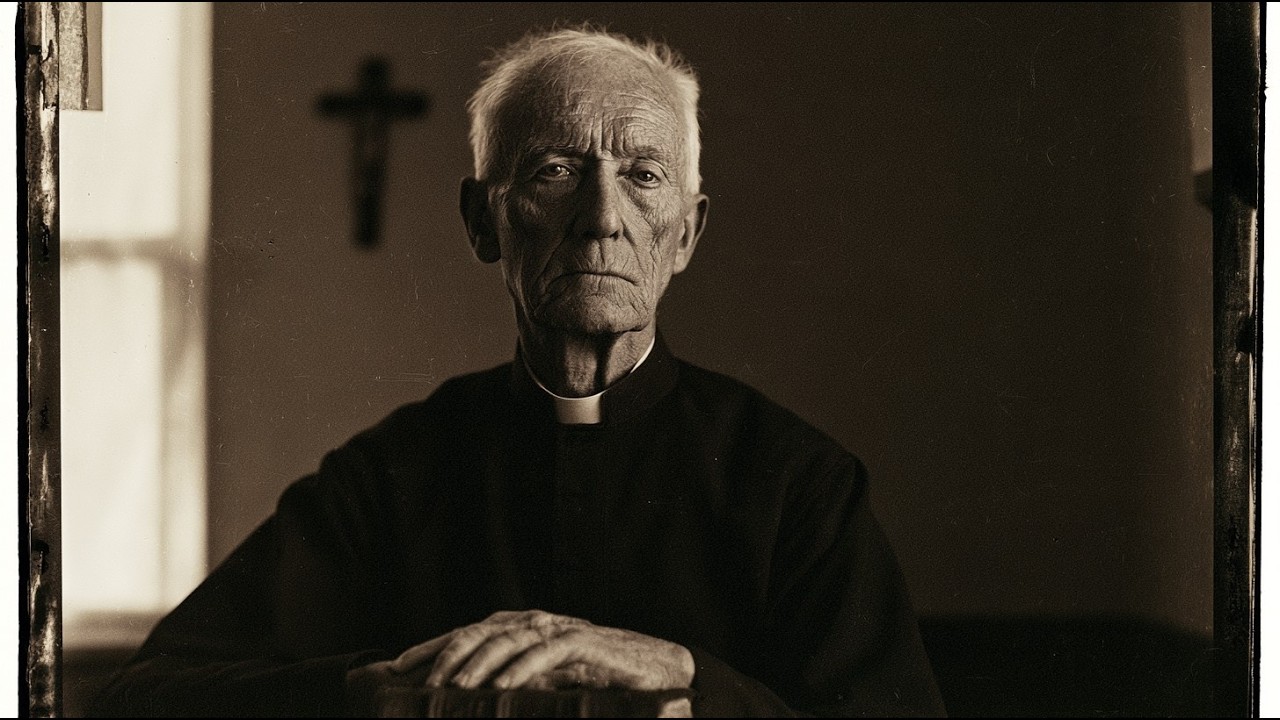
He has agreed to speak for two reasons. One, there is no one left to protect. Two, he does not want the thing he saw to leave the room with him when he goes. He said that quietly, on the first afternoon, looking at his tea and not at the man across from him.
He said he is sorry. He has been sorry since the fifteenth of October 1971, when he drove down out of the valley with the list in his head and could not, that morning or any morning after, think of a single thing he could have done to erase it. The story begins in the last week of October 1971, in a house at the head of a hollow called Winlock, in McDowell County, West Virginia. The priest is Father Amias Ormerod, forty-four years old, thin, dark-haired, graying at the temples, rector of a small stone church near Bluefield.
He prefers walking to driving, reading to speaking, and has two pairs of shoes, one for the road and one for the altar. He has spent most of the 1960s serving rural parishes, saying two Masses on Sunday, riding buses between missions, learning the names of every mine foreman and every widow within an hour’s drive. The diocese sends him on what it calls the quiet assignments. A family in a valley refuses to call a doctor, the bishop sends Ormerod.
Rumors hang over a house and the sheriff does not want them in a report, the bishop sends Ormerod. He is known for staying longer than expected and for writing nothing down while he is there. Before 1971 he attended three cases the diocese filed under a certain classification. Two of them, he says now, were not what a man might call them if he had been in the room.
They were sad houses. Houses where someone had done real harm long ago, and where the memory of it did, in some small way, the thing memory usually does. The third he will not describe. He says only that it was in the second week of Lent 1966, on a farm near Princeton, and that it ended without need of the book, because the family agreed to let it rest.
When pressed, he says it was on that farm he realized that a priest by nature could be useful in houses like that, and that a priest by nature could also, if he was not careful, enjoy that kind of usefulness. That is why he refused, on his own, three times in the sixties, invitations the bishop suggested he accept. He has been wary his whole life, he says, of any man in his profession who is too eager. On the tenth of October 1971, a Wednesday, at seven in the morning, the phone rings in the rectory while he is in the kitchen putting the kettle on.
The voice is a woman he has never met, calling from a party line in Winlock Hollow. Her name is Halcyon Trandall. She is fifty-one, the widow of a miner, the kind of woman who buried a father, two brothers, and a husband before she turned forty, and who has spent the years since tending a small garden and giving simple kindness to anyone in that valley who needed it. She is calling on behalf of her neighbor across the road, a woman named Solveig Marston.
In a slow, even voice she tells him Solveig has not slept in eleven nights. The doctor from Welch has come twice and will not come again. The husband is drinking on the porch instead of sleeping. The living room has grown so cold at night that the water in the pitcher on the sideboard froze over by morning, though it is October and the temperatures outside are in the fifties.
And finally, she says, what is in that house is not something a doctor can sign his name to. Then she asks if he can come. He asks her one question. Has Solveig ever done anything like this before—anything strange, anything the neighbors talk about?
Halcyon Trandall says no. She was born in that valley, raised in it, married in it, and for forty-three years has been the most ordinary woman on that road. Ormerod says he will come the next morning. He hangs up, writes two words on a scrap of paper, “Winlock” and “Marston,” and writes nothing else then or later.
Winlock Hollow is not a town. It is a cut in the mountain about six miles up a gravel road that branches off the two-lane between Yager and War. There is a country store at the mouth, run by a widower named Vinton, who sells gas from a hand pump and coffee in a tin cup you bring back to him. There is a Baptist church halfway up, painted a color that was white once and is now the color of a fingernail.
Past the church the road narrows, and if you do not know where you are going, you do not go. There are nine houses past the church. Ormerod knows where he is going because he baptized Mrs. Trandall’s nephew there in the summer of ’68.
He remembers the road as beautiful in October: sourwood turning early, dogwood already gone, yellow ash holding on last. He remembers the smell of woodsmoke from the porches. He remembers thinking, that summer, that if a priest wanted to disappear into a quiet and beautiful death, Winlock Hollow would be the place. He arrives on the morning of the eleventh in a borrowed brown Chevrolet, with a suitcase, a stole, a small leather case he has used four times in his life, and a bottle of water from the seminary well in Wheeling that he has kept in his room since his ordination.
He parks in front of the Marston house at nine-oh-nine. The house is up on a rise above the road, painted white, two stories, with a covered porch, a stone chimney on the north side, and a green tin roof rusting at the corners. Three white oaks stand in the yard. A rope swing hangs from the middle tree.
The rope is old. No one has swung on it in a long time. There are no dogs. That is the first thing he notices.
In that valley in 1971, every house has a dog, or two, or three. The Marston house has none. He learns later that Solveig had a small brown dog for six years, a plain creature with a torn ear, and that on the twenty-ninth of September, twelve days before Halcyon called him, the dog went out onto the porch at midnight, stretched out in front of the door with its muzzle on its paws, and died there before morning. There was no clear cause.
The dog was young. The husband buried it under the middle oak, where the swing hangs, and Halcyon tells the priest later that he sat on the porch step the rest of that day and did not go back inside until dark. The husband meets him on the porch. His name is Erasmus Marston, fifty-four, tall, stooped, formerly a surveyor for a coal company in the county, now doing what men in that valley do in the fall, checking traps and cutting firewood.
His eyes are bloodshot and he has a beard three days old. He shakes Ormerod’s hand without getting up from the porch steps. Before anything else he says his wife has not been his wife for eleven days, and that whatever is in the front bedroom upstairs is welcome to leave whenever it wants. He adds that he is sorry the priest came, because the priest is going to see something he will never be able to forget.
Then he points to the door and says, “She’s up there. ” After a pause, in a voice that suddenly goes very quiet, he adds, “She’s polite. That’s the worst of it. Just so you know before you go up, she’s polite.
”
Ormerod says he understands. He goes inside. The house is clean. That is the second thing he notices.
He mentions it twice, in two different sessions, so it is clear it mattered to him. It is clean the way a house is clean when a woman who always kept it clean keeps doing it through whatever has happened to her. The floor is swept. There are rows of canned goods on the pantry shelf, labeled in a small hand: blackberry jam, green tomatoes, apple butter, one jar of pickled beans.
He stops and looks at them a long time because the label on the beans is dated the ninth of September, two days before what began in the front bedroom began. There is dough rising under a cloth on the table. No one will bake it. And there is a smell in the house he cannot place, on the first day.
He decides later it was the smell of pond water that has sat a long time in a bucket inside a shed: cold, metallic, faintly rotten, not quite spoiled. He smelled it once at a springhouse on a farm in Pocahontas County, where a woman drowned in 1946 and stayed in the water for days before they found her. He was not thinking of that at the time, he says, but his body was thinking of it, because when he set his bag down in the front room, his hand was shaking enough to make the buckles rattle. He goes upstairs.
The front bedroom is on the north side of the second floor. It has one window facing the top of a white oak, and a smaller window on the east wall facing the hillside. There is a bed against the west wall, a plain iron bed with a white coverlet. There is a mirror on a bureau between the windows.
There is a rocking chair in the corner with a folded quilt. Solveig Marston is sitting on the bed with her back against the headboard, her hands folded in her lap, her feet flat on the floor. She is forty-three. She is a small, fair woman with graying blond hair and that high pale forehead you see in the old Norwegian settlements of Wisconsin, where her family came from before the turn of the century.
Her mother married a McDowell County man in 1926. Solveig was born in that valley and has never lived anywhere else. She is wearing a plain gray dress and a blue cardigan buttoned to the neck. Her hair is down.
Her feet are bare. When Ormerod enters, she looks completely normal. That is the part he has trouble describing later. “She looked exactly like herself,” he says, “and there was someone behind that face who was not her.
” He says, “Do you know how it is when you meet an identical twin for the first time? You realize the twin is not the sister you know, but the face is the same face, and your body relaxes even while your mind tells you otherwise. It was like that. ”
The mirror on the bureau has been turned to face the wall.
He learns later that Halcyon Trandall turned it herself on the second day of the eleven, because Solveig sat on the bed looking into it for six hours without blinking. Halcyon crossed the road, went upstairs, and turned the mirror without a word. Solveig did not object. She thanked Halcyon, in her own voice, politely.
Her mouth moved before the door closed. She said, in her own voice, “Good morning, Father. Thank you for coming. ” After a moment, in the same voice but with an extra tone, something like a smile though her face had none, she said, “I have been waiting for you since I was twelve years old.
”
Ormerod does not answer. He sets his bag aside, pulls a chair to the foot of the bed, not the head, and sits. He asks her, plainly, if she knows who he is, where she is, and what day it is. She answers all three correctly.
She names the president. She names the bishop of the Wheeling diocese. She names two hymns her mother loved. Then, in the same clear voice, without any haste, she says that on the eighteenth of March 1940, when she was twelve, she went up behind the old water mill above the house, sat at the pool below the falls for two hours, and something from the water spoke to her and asked her a question, and she answered yes.
Ormerod asks what the question was. Solveig smiles. She says, “You have to earn that. ” In that moment, he tells the man across from him now, he understood two things.
He understood he would not leave that house that afternoon. And he understood that the thing that asked her thirty-one years ago had been waiting to collect. He stays four days and three nights. The second night is the turning point.
Everything before it and after it turns on what happens in that room that night. On the first day he does what any cautious priest does when a family calls him for an unfamiliar sickness. He talks. He talks to Erasmus on the porch until the sun goes down.
He talks to Halcyon Trandall across the road in her kitchen, over cornbread and buttermilk neither of them touches. Late in the afternoon he goes up the path behind the house to see the old mill. The path is steep, through second-growth woods, past the ruin of what was once, in the last century, a springhouse. Someone had laid a set of stone steps beside the stream.
The steps are mostly there under moss and fallen leaves. He counts them going up. Sixty-one. He counts them going down and gets sixty-three.
He stops, goes back up ten of them, counts down again, and gets sixty-one. He does not know what to make of that, he says, then or since. He only says that after he came back down, he never went that way again. The mill wheel is still there, half rotted, half standing, in a pool the size of a small room, fed by a stream from the hillside.
There is a good cold black stone at the lip of the falls, worn flat, wide enough to sit on. There is moss on the stone. Moss on the wheel. Nothing else.
He puts his hand in the water. Its temperature exactly matches the temperature of the smell in the house. He comes back down and asks Erasmus whether he ever heard anything about that pool from his grandfather, or any of the old people up the road. Erasmus is silent for a while.
He says only that a relative of the Marston family drowned there in the summer of 1893, an aunt of his father, a young woman named Orthelia, who went up alone in the evening and was found the next morning face down in a foot of water. That after that, the story was that a girl from one of the tenant families up the hill went up in 1912 and never came home, and that the state police combed every inch of that hillside for a week and never found so much as a shoe. And that his own father, who died in 1959, once told him, drunk, never to go up past the mill wheel alone and never to answer if something up there asked him a question. Ormerod asks why the father never warned Solveig, who married into the family.
Erasmus looks at his hands. In a very quiet voice he says his father did warn Solveig, at their wedding in 1945, when she was seventeen, and that Solveig went completely white that day and never spoke of it again. And that Erasmus, who was twenty-eight then, understood in a way he cannot put into words that his wife had walked that path once before, before he ever met her. And that whatever she brought back from there was hers to carry and hers to be silent about, and there had been no reason for it to surface until now.
Ormerod writes none of this down. He keeps it in his memory, the way he keeps everything. On the first night he sleeps in a chair in the hallway outside Solveig’s door. She does not sleep.
She does not move. She sits on the bed all night, hands folded, feet flat, eyes open. Around three in the morning, in her usual voice, she says through the closed door, “Father Ormerod, please don’t sit in that draft. You’ll get a stiff neck.
Thank you. ” He does not answer. A little later, in the same tone, she says, “Do you know your mother is standing in the yard? ” He does not answer.
He does not go to the window. He keeps his eyes fixed on the wall. He says, in the second session, that this was the hardest moment of the whole four days, and it was hard for a reason he did not grasp at once. His mother actually died twelve years before, in 1959, and in her life she never once went to Winlock Hollow.
The hard part, he says, was not fear that someone was in the yard. The hard part was that a part of him—an ordinary part, a son’s part—wanted very badly to get up and go to the window and look. He is ninety-four now, and he says he could describe to you the exact curve of the doorframe he stared at instead. He makes it clear he did not believe anything was in the yard at that moment.
He believed only that something in the next room had identified, with precision, a small hunger a son carries after a mother’s death, and offered him a way to feed it. And he knew, with the same precision, that a small hunger fed once is the beginning of a habit. That, he says, is the defining mark of the whole business. The thing you meet in a room like that is not a liar in the usual sense.
It tells you a truth in order to open a door. Once the door is open, it hardly matters what you were told, because you have crossed a threshold you can no longer see. So he does not go to the window. He also does not pray in the usual way the rest of that night, because he realizes he has nothing to ask for.
Instead he rehearses the names of his parishioners near Bluefield, in the order they sit in the pews on Sunday, front to back, left aisle then right. When he reaches the last name he starts again. He runs through that congregation eleven times before the light shows outside the window at the end of the hallway, and on the eleventh time he understands that this was, in its own way, a prayer, and the only kind he would be able to offer in that hallway that night. Near dawn she begins to hum.
An old tune, the kind his mother sang when he was small, a tune he is certain Solveig Marston does not know, because she was raised Methodist and never sang from a hymnal in her life. In that moment he knows the second night, whatever it will be, is coming. On the second day Ormerod does almost nothing. He sits in the kitchen with Halcyon Trandall, who comes to make food no one eats.
He reads his prayer book at the kitchen table. He looks out the window at the middle oak with its old rope. He waits. Most of what a priest does, he says in the second session, is wait.
People think a priest talks for a living. In fact a priest waits. He waits until people are ready to say what they came to say. A house, he says, is no different.
A house that contains something will reveal it to you if you sit still long enough. Solveig does not eat that day. She drinks water, in her own voice, politely. She uses the bathroom, in her own voice, politely.
She lies down for one hour in the afternoon at Erasmus’s insistence, closes her eyes, and does not sleep. When Ormerod passes the door at three in the afternoon she opens her eyes without turning her head and says, “1-6-1-9. ” He does not know what it means then. He will know later.
At four in the afternoon, Halcyon Trandall tells him, at the kitchen table, about Solveig. They went to the pool together only once, on the tenth of March 1940, eight days before the day that would become that day. Halcyon was twenty. Solveig was twelve.
They walked up the trail to gather plants from the bottom, sat on the flat black stone, and ate sandwiches Halcyon’s mother had wrapped in cloth. In mid-afternoon, without knowing why she said it, Halcyon told Solveig never to come back here without her, never to sit alone at that stone. Solveig smiled and said yes. Eight days later she went up the trail alone anyway.
Halcyon knew because she saw Solveig come out of her house, cross the road, wearing a blue dress, a little after two in the afternoon on the eighteenth. She watched her turn toward the trail. She thought about calling to her. She did not call.
She says she has carried the weight of not calling for thirty-one years and will carry it for the rest of her life, and she knows there is no way to put it down. Ormerod sits with that for a long time. He says, in the second session, that Halcyon Trandall was in his best judgment entirely innocent of any fault that evening. A woman of twenty does not chase a girl of twelve up a mountain road on a sunny afternoon; she did nothing wrong, and she has been unable to believe it for thirty-one years.
That, he says, is what most guilt is like. It is why he never rushed, in fifty years in the confessional, to judge a guilt of that kind. You have to sit with it the way the person sat with it. That evening, a little after nine, he takes his stole from the bag.
He takes the small leather case from the bag. He fills a bowl with the seminary water. He goes upstairs. Erasmus stays downstairs at Ormerod’s request, sitting at the kitchen table with a rifle across his lap, the rifle Ormerod tells him plainly will be no use.
Erasmus says, “I know. I want to hold it anyway. ” He says, “All right, hold it. ” Halcyon Trandall is in her house across the road, awake, on her knees, praying, at Ormerod’s request.
He enters the front bedroom and closes the door behind him. Solveig looks at him. She has been in almost the same position for nearly thirty-six hours. In her usual voice she says, “Father, I want you to know I asked them to send you.
” He asks, gently, who “they” are. She says, “Oh, I mean Erasmus and Halcyon across the road and the church ladies. ” She says this in the voice of a completely conscious, completely present woman. Then she smiles without her eyes changing and says, “And I want you to know I didn’t ask them to.
” He says the words he has trained to say. He says them slowly, in Latin, in the order they are said. He holds his hand, palm down, over her head. He does not touch her.
He watches her face. Her face does not change. He continues. He asks her, in Latin, to identify herself.
She answers him in Latin. She never studied Latin. She attended the Baptist school through the eighth grade, then left to help her mother in the garden and kitchen, and in her adult life she opened a Latin prayer book once, at her wedding to Erasmus in a Methodist church, out of curiosity, and put it aside. She answers him in Latin, clearly, with a rural accent over the words, the way a person from that valley would sound reading anything at all.
She says, in Latin, “I am the one who was here before the road. ” She says, in Latin, “I am the one who was answered on the eighteenth of March in your Lord’s year 1940. ” And she says, in Latin, “I have a list, and I was waiting for a man to carry it. ”
He continues the rite.
He asks the usual questions in the usual order. She answers each one. She answers with such precision that he stops twice, because the answers were not the answers false things give. They were the answers of something that had been in the room a long time and had decided, for reasons of its own, to be honest.
In the middle of the rite she says, in English, in her own voice, “Father Ormerod, your mother’s name was Cordelia Ormerod. She died on the third of November 1959 at four-eleven in the morning in the front room of the house on Poplar Street in Beckley. You were in the hallway. She asked for water.
You went to the kitchen to get it. She died while you were at the sink. You never told anyone that you sat at the sink for one extra minute before you brought the water, because you were tired and you thought she was asleep. That extra minute is what you have carried since.
And I have come partly to tell you that the minute did not matter. She was already gone when you were at the sink. It was not you. ” Father Ormerod does not move.
He does not answer. He says later he felt none of the things a person is supposed to feel in that moment. Instead he felt a very quiet clarity. It was exactly how you feel when you have sat in a dark room a long time and someone turns on a lamp, and you realize you knew where every piece of furniture was all along.
He continues the rite. He continues because he was trained to continue, and because he understood with absolute clarity that what was speaking through Solveig had just told him the truth in order to buy something, and he understood, without knowing what it was yet, that the price would be the list. He says something then that is not part of the rite. He says it in English, very quietly, looking at the wall above the bed, not at the woman on it.
He says, “I am not for sale. ” He says it because he understood that if that entity was buying, it was better to be clear about who he was—a man not for sale—than to pretend he did not know what was happening. Solveig, or the thing behind her face, shows no reaction. She does not answer.
She may not have heard it. But he needed to say it aloud in that room for himself, and he has thought since that it may have been the only thing he did in those four days that was entirely his own. Then she gives him the list. She gives it in Solveig’s voice, in English, slowly, in the flat tone a bank clerk uses to read an account statement.
She gives him seven dates. She gives him a place with each date. She says: “October 18, 1972, a bridge outside Wheeling. ” She says: “June 3, 1979, a mine in Harlan County.
” She says: “March 11, 1985, a turn on the road north of Charleston. ” She says: “September 22, 1994, a hillside outside Pikeville. ” She says: “April 14, 2002, a river crossing in Cheat Gorge. ” She says: “August 7, 2011, a small plane outside Bluefield airport.
” And then a seventh, last, without a place. She says only: “And one more date that has not happened yet, but it is on the same road. When the seventh happens, you will know, because it will be the first time one of these numbers is a number you cannot count on one hand. ” Ormerod does not write the dates down.
He memorizes them, in order, because he understands that if he wrote them down, he could deceive himself later into thinking he had invented them. He does not want to be able to deceive himself. He asks the entity, in Latin, why it is telling him this. It answers in Latin.
It says, “Because you were the man sitting in the chair. ” It says it the way a person tells you the time when you ask. No weight. No pride.
Just: “You were the one in the chair. There is always a man in the chair. ” He finishes the rite. He recites the closing prayers.
He recites them, he says now, without any expectation that they will work, and they do not work. Still, he recites them the way you finish sweeping a floor even when you know a foot is about to come through the door. When he finishes, Solveig closes her eyes. She keeps them closed for what he estimates is forty minutes.
During those forty minutes he does not leave the room. He sits on the chair at the foot of the bed and listens to the house. The house is completely still, he says, the way the woods go still when a large animal approaches the edge and then stops. When she opens her eyes, her face is her own face, and in her usual voice she says, “I’m so tired, Father.
May I lie down, please? ” He helps her lie down. She is asleep before her head touches the pillow. She sleeps nineteen hours.
When she wakes, she remembers nothing from the eleventh of September—when Erasmus says she began to change—until the moment she opened her eyes in her bed with a priest in a chair by the window. She does not remember the pool. She does not remember the mill wheel. Most important, she does not remember the eighteenth of March 1940, when she was twelve.
She remembers being twelve. She remembers the spring of 1940. She remembers helping her mother plant peas that year. There is, for her, an entirely empty gap where that afternoon at the pool should be.
Ormerod does not tell her about the gap. He does not tell her about the list. He does not tell Erasmus about the list either. He blesses the house.
He blesses the pool up the trail in a way that is in no book, standing on the flat black stone in the morning light with a small metal cup of holy water, and says the words an old Jesuit in Wheeling taught him specifically for such a place. He blesses the mill wheel. He walks back down the trail. He counts sixty-one steps going down, and this time it is exactly sixty-one.
He drives out of Winlock Hollow on the morning of October 15, 1971, and does not return for eight years. Solveig Marston lives thirty-one more years. She dies in her sleep at seventy-four, in the same front bedroom, in 1998. Erasmus Marston dies on the porch of that house of a heart attack in the summer of 1983, at sixty-six.
Neither of them ever speaks to Ormerod about what happened, and he never raises it. He writes to Solveig on every birthday until she dies. She writes back every birthday, in a small neat hand, about her garden. She sends him a jar of blackberry jam in the summer of 1990.
He keeps the empty jar on a shelf in his room beside the cross and has never decided whether to throw it away. Halcyon Trandall lives to ninety-one. She is the only other person in that valley who knows what happened in the front bedroom, because she knelt in her kitchen across the road for the whole hour and heard the Latin through her open window. She repeats not one word of it.
She and Ormerod exchange letters for the rest of her life, one each direction, three times a year, at Christmas, at Easter, and on the anniversary of that day in October. He attends her funeral in 1997. In the second session he says Halcyon Trandall was the noblest person he has ever known, and that when he thinks about the mercy of God, which he says he thinks about less than he once did, he thinks of her. That is the story of the exorcism.
That is what he did. What happened in the room. But that is not why he agreed to talk this year, and not why the man across from him is here. The reason is the list.
He carried the list in his mind out of Winlock Valley, and he carried it for fifty-four years. He did not check on the first date. On October 18, 1972, he refused to read the papers, refused the radio, refused the phone. He went to bed early.
He woke. He went about his day. He did this, he says now, in the hope that if he did not look at it, the date would not happen. He says this was, of course, the wish of a very tired man and not the theology of a priest, and that he was ashamed of it as soon as it was over.
In the middle of the following week, at a diocesan meeting in Wheeling, a bishop mentioned in passing that a bridge on the access road to the city had collapsed the previous Wednesday, the eighteenth, shortly after four in the afternoon, that eleven vehicles had gone into the water, and that four adults were still missing after three days. Ormerod shows no reaction in the meeting. He returns to his lodgings that night, sits at his desk, and writes the seven dates for the first time. He puts the paper in the back of his prayer book.
He does not check on the second date. On June 3, 1979, he is in a hospital in Roanoke at the bedside of a friend, a Franciscan friar named Bertrand, known since seminary, dying slowly of cancer. He stays all day. It is in fact the day his friend dies.
In the elevator coming down at ten-thirty at night, he passes a nurse speaking quietly to an orderly. The nurse says, “They say the number of dead could reach thirty in that mine outside Harlan. ” Ormerod says he stopped in the hospital lobby and stood there a long time. He sat on a bench near the door, put his hands flat on his knees, and did not move for what he later estimates was forty minutes.
He says that on that bench he understood he would have to face these dates as they came, because pretending not to see them changed nothing, and that pretending not to see them was in some way—he could not put it into a sentence—an insult to those who had fallen into the bridge water and to those about to go down under the ground in the mine. From that night on, he reads the paper on the day of each date, reads it for a week afterward, and keeps the clippings folded inside his prayer book beside the list. He still has them at ninety-four. Three.
1985, the turn north of Charleston: a workers’ bus carrying men home from a chemical plant after the night shift, gone off the guardrail at four in the morning on March 11. Nine dead. Four. 1994, the hillside outside Pikeville: a fire on September 22 that killed a family in a trailer at the top of a private road, and then killed two people who came up from the road to help—one of them a volunteer firefighter who had sat in his church years before at a wedding.
Five. 2002, the river crossing in Cheat Gorge: spring floodwaters swept a small church bus off a low bridge on April 14. Eight people on board. Six survived.
Two did not. One of the two was the wife of that church’s pastor, whose name he recognized when he read it from a retreat he had led in 1981. Six. 2011, the small plane outside Bluefield on August 7, in weather the paper called ordinary.
It killed the pilot and two passengers, one of them a young doctor on his way to a clinic in the coalfields for a summer of volunteer work. In the second session, Ormerod says the one that stayed with him most from the six is the young doctor. He does not know why. He never met the doctor.
He read the name in the paper on a Monday morning in August 2011, clipped the paragraph, and folded it into the prayer book with the other five. He says that over the years, on certain nights, he takes out that clipping and reads it, and he can see—without ever having seen him—a young man in a khaki jacket crossing a small airfield in the dark toward a small plane, and he can imagine what a young man of that kind was thinking on that Sunday morning about the summer ahead, but he cannot imagine, and therefore does not try to imagine, the last thirty seconds of that flight. Six of six. He says every person on every day, every person at every place, had the same shape: something that could be closed with a neat word by the man who signs things, and something everyone standing at its edge knew, in the deepest part of themselves, was not neat at all.
The hardest part of those fifty-four years, he says in the second session, was not the days themselves. It was the day before each one, when he sat in his room and knew, and could do nothing. He thought twice in the early years of writing an anonymous letter to a sheriff, a mine safety office, a newspaper. He drafted one in 1978, in the spring, before the mine, and did not send it.
He did not send it because he understood, sitting at his desk with the envelope in front of him, that he had no proof. He had a story any sane man would call hallucinations. If he sent it and the mine ran anyway, he would have caused only a week of investigation of a priest in Bluefield who had clearly lost his mind. If he sent it and the mine did not run, he would have proved only that he was the kind of man who writes such letters one day.
The diocese would, rightly, quietly move him out of the kind of work he was suited for. At ninety-four, he says, he does not know whether not sending was the right choice, and he does not expect to know. He thinks that is how most hard choices in ordinary life feel at the end: not settled, but outlived. That brings him to the seventh.
He kept it to himself. He kept the seventh to himself until the third afternoon, in the small room off the priests’ quarters where he takes his tea now. When he tells the seventh, he first tells what the voice said about it: “When the seventh happens, you will know, because it will be the first time one of these numbers is a number you cannot count on one hand. ” More than five, that is, in the pattern of the other six: more than the four dead at the bridge, fewer than the thirty in the mine, the nine in the bus—anything with two digits, anything that would be, in the language of the papers, an event.
He says in that session that the reason he kept the seventh to himself, never telling anyone, never handing the list to anything or anyone, is that he did not know what a priest was supposed to do with information he could not verify, could not prevent, and could not in good conscience use to frighten people who had done nothing wrong. The reason he is telling it now is different. In the last two years he has begun to feel the seventh is near. The feeling is not an idea.
It is like that smell in that house in 1971: faint, cold, metallic, floating under everything else in the room. The seventh day the voice gave him was a date only. No place. A date alone.
He asks the man across from him not to put it in the story in a way that makes people count down. He asks him to put it as it was given: in its shape, not its number. The seventh day is in the same month, the same week, and the same day of that week as one of the six he has already lived through. The voice did not give the year.
It said only that when it comes, he will know, and he will know before the day ends. He believes now that he is meant to be alive on that day. He does not know why. He says only that he was told, at the end of the second night in Winlock Hollow, in the same clerk’s voice, without any emotional tone, that the list was given to him because he was the one who would carry it.
And that when the seventh comes, he will know, from the look on the face of the man standing beside him reading the paper that morning, that a man in a room in Roanoke knew for exactly fifty-four years what it would contain. He says one more thing on the third afternoon. At the end of the second night in Winlock Hollow, after the list and after the reason and after the matter of the chair, Solveig—or the thing behind her face for eleven days—leaned forward a little and said one more sentence in her voice, quietly. She said: “Father, when it is over, when you are past the seventh day, please do not go to the pool.
It is not a place for a man who knows. ” That is the sentence. He has not gone to the pool in fifty-four years. He has not gone back up that trail.
He has passed the mouth of Winlock Hollow twice, once in 1979 to visit Halcyon Trandall, once in 1998 for Solveig Marston’s funeral. Both times he stopped at the country store at the mouth of the hollow, and both times he bought a cup of coffee in a tin cup, and both times he returned the cup. He has never gone past the church. He says on the third afternoon he does not know whether the sentence was a warning or an instruction.
He has never been able to decide. The difference between a warning and an instruction, when they come from that thing, is not always a difference you can hear in the tone. If he had to guess, at ninety-four, he would guess it was a warning. But he was never confident enough to test it.
There is no end to this story. There is a man of ninety-four in a small room outside Roanoke. There is a list in his head, and a paper copy in the back of a prayer book he has carried since 1954. There are six dates behind him, each documented, each in the papers of its year, each neat on paper and not neat at all in the small towns where they happened.
There is a seventh date waiting, a month, a week, and a day away, which he has told the man across from him and which the man will not repeat. There is the smell of that room in Winlock Hollow, which the priest says he still wakes with in his mouth some mornings. There is Solveig Marston, thirty years dead, who never remembered any of it. There is Halcyon Trandall, thirty years dead, who remembered all of it and told no one.
There is an empty blackberry jam jar on a shelf beside a cross the man could not bring himself to throw away. And there is the pool at the foot of the falls above the old mill wheel, still there, half rotten and half standing. If you know McDowell County you can walk to it in about forty minutes from where the paved road ends. Do not go there alone.
Do not sit at the pool for two hours. And if something from the water, or from the trees, or from your own reflection asks you a question, do not answer. That is all he wanted to say.
If you were waiting for wisdom, that is as close as it comes.






