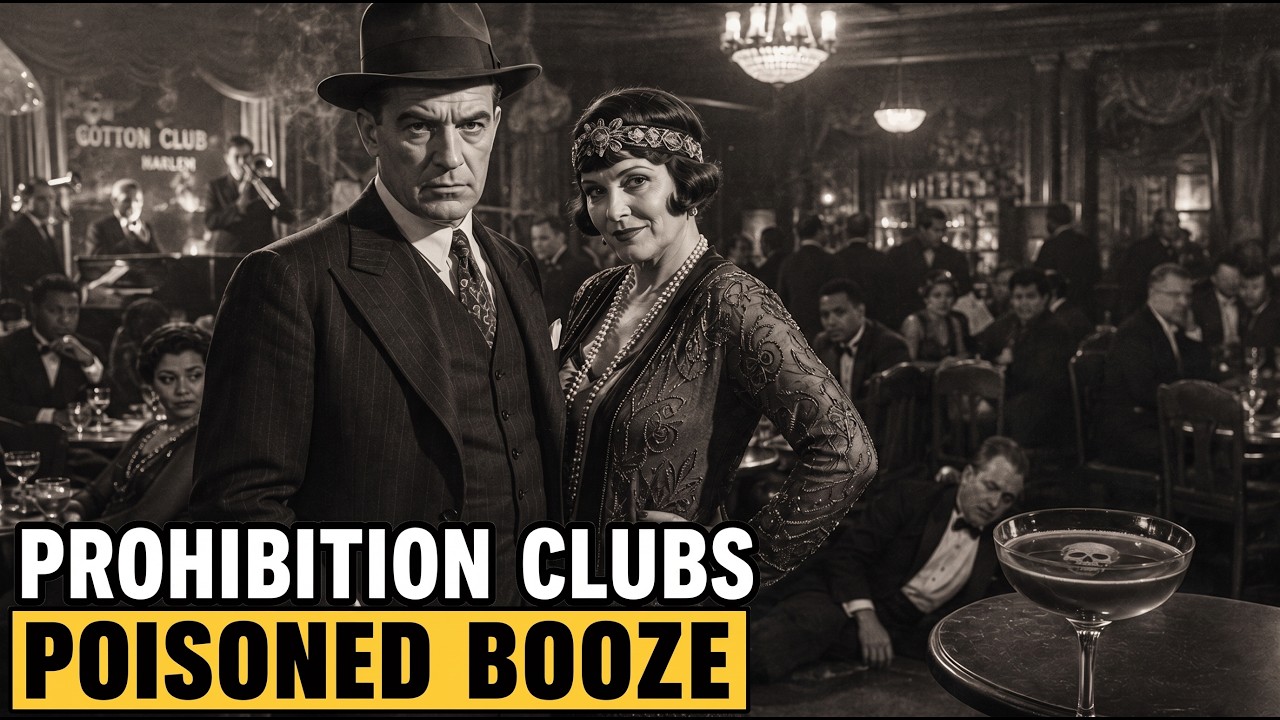
The jazz swells from the stage, girls in fringed dresses fan out across the dance floor, and someone keeps the champagne flowing beneath the chandeliers. The whole place is the hottest party in America. Everyone is in their best clothes, living what looks like the finest night out a person could wish for. But here is the part no one puts on the poster.
Nearly every one of those glittering, famous clubs was owned and run by a gangster. Not the movie kind. Bootleggers. Extortionists.
Some of them were killers without mercy. The glamour was a front, and behind it ran a criminal operation. Once you know what was really happening in the back, that beautiful night starts looking far uglier. The film version goes like this: a refined club, a noble owner in his tuxedo, clean tablecloths, top-shelf drinks, and the worst thing that happens is a little harmless rule-breaking.
Everyone glitters and no one gets hurt. That is what the movies sell. The reality is different. The man who owned your favorite nightclub had probably killed people.
His liquor was bad. He was robbing you blind with inflated prices, and the building you stood in could be a death trap. Depending on which club you walked into, that whole beautiful scene sat on top of something rotten. The legal framework behind it all came first.
The Eighteenth Amendment was ratified in 1919, and the Volstead Act followed. On paper, the government was banning alcohol. What it actually did was hand organized crime a billion-dollar industry. Lucky Luciano was quietly building what would become one of the most powerful criminal organizations in New York City, and he called Prohibition the greatest gift ever given to a criminal.
The law created the demand, and the gangsters were happy to supply it. The nightclub out front was where they laundered all that dirty money into something that looked respectable. Start with the most famous of them all: the Cotton Club in Harlem. When someone says “nightclub of the 1920s,” that is the place that comes to mind.
Duke Ellington ran the band there. Cab Calloway worked that stage, and so did Louis Armstrong. Lena Horne and Bessie Smith played the Cotton Club. It was the peak of the Jazz Age, no question.
The club was owned by a gangster named Owney Madden. He was not a businessman with a few minor offenses. His full nickname was Owney the Killer. He grew up with a violent gang in Hell’s Kitchen, survived being shot about six times in a single attack, and did hard time in Sing Sing for manslaughter.
Imagine the most glittering club in America owned by a convicted killer who was technically still on parole for ending a human life. Madden did not open the Cotton Club because he loved jazz. He opened it as a front to push his bootleg beer, a brand called Madden’s Number One. That sparkling club was really just a fancy way to distribute a gangster’s liquor.
When the place was shut down once, Madden cut a deal with the police, which is the polite way of saying he paid them off. He came back and reopened the club as if nothing had happened. But the real dark side of the Cotton Club was not the beer. It was who was allowed through the front door.
Here was a club in Harlem, the heart of Black America, with the greatest Black artists in the world on stage. And the audience was white only. Black patrons were, for the most part, not allowed to sit and watch. So you had musicians and dancers performing their best for a room full of wealthy white customers who would not let those same artists sit down among them.
Langston Hughes said it plainly. He described it as a racist club where white strangers got the best seats to stare at Black people performing as if they were, well, his words went further than that. They even decorated the place with a jungle-and-plantation theme to match. It was supposed to be a place for the elite, but it was built on exclusion.
The control went deeper than the front door. When Duke Ellington wanted to leave, the star who had made the Cotton Club famous in the first place, the story goes that Madden would not let him go until he found and paid for a replacement band. That was the real Cotton Club: a gangster saloon dressed in Jim Crow, exploiting the most talented people in the place as if they were his property. And then there was what you were actually drinking.
These clubs ran on bootleg booze, the same watered-down, adulterated liquor that ran through the entire illegal trade. The difference was that in a fancy club, they poured it into an elegant glass, dropped in a cherry, and charged you a fortune. You paid champagne prices for something that might have started as industrial alcohol mixed in someone’s bathtub right next to the toilet. Here is something most people never heard, because the government knew exactly what was in that industrial alcohol.
Federal authorities deliberately ordered manufacturers to add methanol and other poisonous chemicals to scare people off drinking it. Bootleggers tried to cook the stuff to remove the poison. They did not always succeed. Historians estimate that more than 10,000 Americans died from methanol poisoning during Prohibition, because the drinks coming out of those illegal operations were genuinely lethal.
The beautiful glass and the dim lighting were covering something that could put you in the grave. On top of that, these places were completely illegal, so no health inspector ever walked through the door. Not once. No one was watching the kitchen, the ice, or the cellar, because the whole operation was a crime to begin with.
The level of cleanliness depended on what a gangster was willing to pay for, which was usually nothing. You were eating and drinking in a place with zero oversight, run by people whose main concern was certainly not your digestive health. The famous, flashy clubs were just the top of the pyramid, the good side of it. For every Cotton Club, there were a hundred grimy little illegal dens below.
In New York City alone, people estimated there were tens of thousands of speakeasies, with estimates ranging from 20,000 to 100,000. Most of them were not glamorous at all. They had a nickname: the blind pig. A blind pig was about what it sounds like: a cramped, gloomy back room or a basement with a sticky floor and stale air, glasses that were never washed, and the cheapest poison the owner could get.
Whether you were rich in a fancy place drinking bathtub gin from crystal, or in a blind pig drinking from a mason jar and wiping your mouth on your sleeve, you were still standing inside the same unregulated, uninspected establishment. One just had better lighting. The whole system ran on corruption from top to bottom. Madden paying the police to reopen the Cotton Club was not the exception; it was the business model.
Cops were on the payroll, and so were politicians. The officer supposedly closing the place down was often the same one slipping an envelope of cash into his pocket to look the other way, or drinking in the back room himself, testing whether the poison would kill him and everyone else. He called it public service. So when you walked into one of these clubs, you were not just breaking the law a little.
You were standing inside an arrangement where gangsters, police, and downtown politicians all fed quietly off the same dirty money. The sparkle on the surface floated over a swamp of theft, and you cannot float far above a swamp before you get stuck in the mud. Speaking of getting what you paid for, consider how well these places robbed you. That means meeting the queen of the whole scene, a woman named Texas Guinan.
She was America’s most famous nightclub hostess, and her trademark was screaming at the crowds as they walked in: “Hello, sucker! ” She meant every word, because that is exactly how the place saw you: just a sucker whose pockets needed emptying. Her clubs were financed by racketeers like Larry Fay, and they ran on steep cover charges and outrageous prices for drinks that were watered down or poisoned. The entire model was getting you through the door feeling like a big shot, then taking every dollar from you before you left.
She was raided, shut down, and arrested over and over, and then she came back and opened a new place. She told you straight to your face that you were a sucker. The crowds loved her for it, and they paid plenty for the privilege. The robbery itself was an art form.
The profit margins in these places were insane, the kind of numbers that only make sense if the whole place is a trap. A bottle of so-called champagne could cost a worker roughly a week’s wages. Most of the time it was cheap, watered-down liquor that had nothing to do with what the label said. Everything in that room had a price.
You paid a cover charge just to step inside. Once you sat down, they charged you for the table, and you also had to pay a hat-check fee. Then a girl came around selling flowers and cigarettes at outrageous prices. The system was designed so that the moment a man walked in feeling rich and important, everyone in the room worked together to empty his pockets before he came to his senses or ended up in the hospital.
You could not leave a place like that with all those inflated fees without being completely broke. You left penniless, which is exactly what “hello, sucker” promised you at the front door. Then there was the building itself, because a speakeasy was a dangerous place to be. These clubs had to hide from the law, so they were designed to disappear behind secret doors and back rooms tucked behind brick walls.
The best example of how secretive these places could be was the famous “21” Club in New York. The “21” Club had an anti-raid system that looked like something out of a spy movie. When the police arrived, a bartender pulled a lever, and the entire back bar tilted, sending every bottle of liquor down a chute to smash and vanish before the cops could grab any of it as evidence. They even had a secret wine cellar that was not inside their own building.
You reached it through a hidden door in a brick wall that led to the basement of the building next door. So technically, there was not a single drop of liquor on the premises. Clever, certainly. But look at it from the customer’s point of view.
You were packed into a crowded, smoky room underground, designed specifically with hidden and disguised exits so the police could not get in easily, which meant you could not get out easily either. If a fire broke out or a panic started, what happened? In one of those cramped basements packed with people, the whole place became a death trap in seconds. The same thing that made the bar good at hiding made it terrible at keeping you alive when things went wrong.
And raids were not rare. The “21” Club alone was raided by police again and again throughout the Prohibition era. That was the whole scene everywhere. At any moment, the police could burst in, sending crowds scrambling toward exits designed to be hard to find.
You were celebrating inside a box built to be raided. Then there was the violence, because you were drinking in the middle of a gang war over territory. These were not just bars; they were mafia assets that men killed each other for. Take Al Capone’s outfit in Chicago, at a famous jazz club called the Green Mill.
By the mid-1920s, the Green Mill was partly owned by one of Capone’s top men, a killer named Machine Gun Jack McGurn. Most accounts say McGurn planned and coordinated the Saint Valentine’s Day Massacre, where seven men were lined up in a garage and shot in broad daylight. It was a hell of a gunfight. Actually, it was a one-sided gunfight.
Only one group was firing. The other group was on the receiving end. These were the men signing the checks at your favorite jazz club. There is a story from that place that tells you everything about what it meant to work for these people.
A singer and comedian named Joe E. Lewis wanted to leave the Green Mill for a better job at another club. For daring to quit, the men connected to McGurn came after him. They slashed him from ear to ear, nearly killing him and destroying his voice for years.
The charming little jazz club you went to for a pleasant evening was run by a man who would slit your throat because you got a better job. The legends around that place run deeper still, with stories of cold tunnels under the neighborhood and a secret door under the bar for moving liquor and escaping during a raid. Whether all those tunnel stories are true or not, the ownership was real. And so was the violence.
That was the world behind the jazz and the champagne. The same nightclubs that defined the Jazz Age for everyone who saw them in movies, or read about them in novels, were owned by killers, staffed by extortionists, and built on stolen money. The drinks could poison you, the building could trap you in a fire, the police could raid you at any moment, and the man at the door called you a sucker to your face while his partners emptied your pockets. The lights were bright enough to blind anyone who did not want to see what was holding up the ceiling.
But the floor underneath was never stable. It was sitting on corruption, violence, and bodies, and no amount of glitter could change that.






