On July 1, 1942, two hundred feet below the surface of the South China Sea off the western coast of Luzon, Lieutenant Commander William Wright of the United States submarine Sturgeon raised his periscope and found a seven-thousand-ton Japanese transport in his crosshairs. No escort, no markings, running full speed and dark. He fired four torpedoes. The ship went down in eleven minutes.
Wright logged it that night as a good attack on a fast merchant, and Sturgeon continued her patrol. It would take his country eighty-one years to find the wreck, four thousand meters down. It would take until September of 1945 for Australia to learn the bare truth of who had been in the hold: 845 Australian soldiers and 208 Australian civilians, prisoners taken at a place called Rabaul six months earlier. Not one survivor.
This was one of the darkest ironies of the fall of Rabaul. An American submarine, attacking what it believed was an ordinary unmarked Japanese transport, unknowingly killed more than a thousand prisoners taken when the town fell. Fourteen months later, the same country would look at the fortress those men had died holding and decide never to set foot on it. Rewind six months before Wright fired those torpedoes.
Two thousand miles east of Luzon sat a small Australian town inside the ruin of a volcano, the sea filling the crater. Rabaul was the administrative capital of the Territory of New Guinea, a League of Nations mandate handed to Australia after the First World War. The town had fourteen hundred buildings, copra warehouses, a cricket ground, colonial verandas facing a harbor deep and wide enough to hold a fleet. On the north side of the caldera, two active volcanoes still smoked: Tavurvur, low and squat, breathing sulfur into the morning air, and Vulcan, further out, silent but not asleep.
The garrison was called Lark Force: 1,400 men under Lieutenant Colonel John Scanlan, built around the 2/22nd Battalion out of Victoria. There was almost no artillery worth the name, only two ancient six-inch coastal guns and a handful of anti-aircraft weapons. Ten Wirraway trainers, Australian-built two-seaters with a top speed of 220 miles an hour and armament adequate for 1918, served as the entire fighter force. Melbourne had decided Rabaul could not be held and would not be reinforced.
The men on the ground had not been told. Before dawn on January 23, 1942, five thousand Japanese soldiers came ashore. Most were from the hard-battled 144th Infantry Regiment, supported by aircraft from carriers offshore. The Wirraways went up to meet them; eight of the ten were destroyed within the first hour.
The Japanese came ashore at multiple points along the crater wall in numbers the Australians could not match. The fighting lasted a day. Twenty-eight Australians were killed in action. More than a thousand were taken prisoner.
The Japanese lost sixteen killed and forty-nine wounded. Around February 4, at Tol plantation and at Waitavalo on the south coast of the Gazelle Peninsula, prisoners were marched into the bush in small groups. Their hands were tied behind their backs with fishing line. They were shot.
Those who did not fall were bayoneted. About 160 Australian soldiers died that morning. Six men survived, crawled out from beneath the bodies of their comrades after nightfall, and walked for weeks through unknown jungle to reach Australian lines and tell what they had seen. Nobody in Melbourne could do anything about it; the nearest Allied combat forces were a thousand miles away.
The rest of the survivors were herded into a compound at Rabaul. Officers were separated from the ranks. Civilian internees, missionaries who had run schools in the outer villages, plantation managers, and government clerks were held nearby. For four and a half months, the Japanese decided what to do with them.
Food ran short, the compounds were crowded, and disease began to spread in the pre-monsoon heat. On June 22, 1942, the answer arrived. She was called the Montevideo Maru, a 7,200-ton passenger-cargo ship taken over by the Imperial Japanese Navy for troop transport. She sailed from Simpson Harbour bound for Hainan Island off the coast of China.
She carried no markings identifying her as a prisoner transport. She carried no escort. Her holds were packed with 845 Australian soldiers and 208 Australian civilians. More than a thousand men in the dark below the waterline, going somewhere none of them had been told.
Some of the guards on deck later said the prisoners believed they were being taken to Japan for internment. Some believed they were going home. Nine days later, Wright put four torpedoes into her side. She went down in eleven minutes.
Every man in the hold drowned in the dark below the waterline. The wreck was not found until April 2023, resting on the abyssal plain of the South China Sea. It remains the largest single maritime loss in Australian history. Rabaul was worth five thousand Japanese soldiers in January of 1942 and not one warship for a relief expedition.
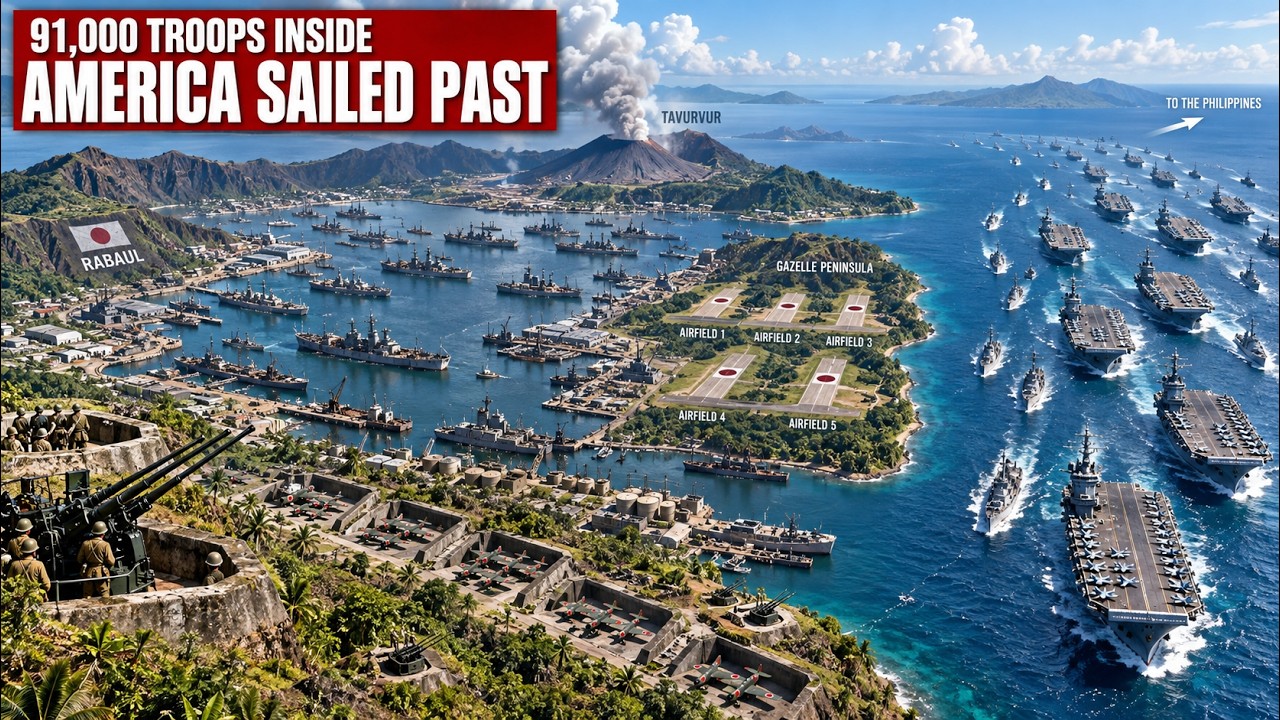
The arithmetic was ruthless. And in its terrible way, it was correct. Fourteen months later, that same arithmetic would decide the fate of Rabaul itself. Around Simpson Harbour, the Japanese expanded the two captured Australian airfields and built three more, turning the Gazelle Peninsula into a five-field air complex with shelter and dispersal capacity for 461 aircraft.
The labor did not come from Japan. It came from local villagers pressed into service, from Indian prisoners of war shipped in from Singapore, from Chinese laborers rounded up in occupied cities. They dug runway extensions with hand tools and cut revetments out of the ridge with picks. They died in numbers nobody counted and were buried in unmarked pits behind the coconut groves.
The command structure showed what Tokyo thought the place was worth. General Hitoshi Imamura, aged fifty-seven, commanded the Eighth Area Army from a bunker cut into the base of Tavurvur volcano. Vice Admiral Jinichi Kusaka, aged fifty-five, ran the Southeast Area Fleet from the same town. American planners drew the only conclusion the photographs allowed: Rabaul was a fortress, and it would have to be taken.
On July 2, 1942, the Joint Chiefs of Staff issued a directive naming Rabaul as the objective. MacArthur’s headquarters produced a plan called Elkton, which assumed casualties comparable to Guadalcanal applied to the size of the Rabaul garrison. The arithmetic was ugly enough that MacArthur’s own staff hesitated to write it down as a formal estimate. The argument over what to do about Rabaul ended in Washington in March 1943.
The theater commanders asked for the tools to take the fortress. Admiral Ernest King, chief of naval operations, told them what they could actually have. The shipping was going the other way, to North Africa, to Sicily, to the bomber offensive against the Reich. What was left for the Pacific was not enough to take Rabaul the way doctrine said it had to be taken.
On the 28th of March 1943, a new directive came out of Washington. The capture of Rabaul had not been cancelled. It had been postponed. Out of that directive came Operation Cartwheel: thirteen invasions, eight months, two theaters, one convergent objective.
The landings went in at Woodlark and Kiriwina unopposed. In the Solomons, the fight for Munda Point ground on for five weeks through coral, jungle, and rain, against a defense in depth the planners had not expected. A division commander was relieved by his own superior because the effort had physically broken him. Now put that against the target.
Rabaul was the headquarters of an area army and an area fleet, four airfields and a fleet anchorage. The Marine Corps official history later recorded: “The Allied casualty list of an amphibious assault at Rabaul would have been as lengthy and grim as any of the Pacific War. ” The planners in Washington used different language. They wrote that a considerable economy of force would result if Rabaul was neutralized rather than captured.
That sentence killed the plan to take Rabaul. In August 1943, at the Quadrant conference in Quebec, the Combined Chiefs of Staff approved the decision. Paragraph 35 of their final report ended with nine words: “Rabaul is to be neutralized rather than captured. ” Roosevelt approved it on August 24, 1943.
Churchill approved it the same day. MacArthur, who had put his professional reputation behind the plan to take Rabaul, was not told until the paper reached his headquarters days later, when the argument was already over. William Halsey, the aggressive admiral who built his reputation on loud, direct attacks, grasped what MacArthur would not accept. Once you could put fighters over an enemy airfield from ground you held, and once you could sink the barges that brought food and fuel and ammunition into the harbor, the enemy garrison could sit inside its perimeter with every gun it owned, and it did not matter.
A base that cannot project force is not a base. It is a prison with a garrison inside it. On November 1, 1943, the Third Marine Division went ashore at Cape Torokina on the west coast of Bougainville, a place chosen precisely because it was worthless. No harbor, no road net, a beach backed by swamp.
What Torokina had was flat ground within fighter range of Rabaul. The Japanese defenders numbered about 270 men. The beachhead was secure by nightfall. That night, a Japanese cruiser and destroyer force came down from Rabaul to break it up and ran into Rear Admiral Merrill’s Task Force 39 in the dark.
In fifty-nine minutes, Merrill’s cruisers and destroyers sank a Japanese light cruiser and a destroyer and sent the rest home. The Battle of Empress Augusta Bay was decided on American terms. Then the Japanese combined fleet stripped the aircraft off its own carriers and flew them into the Rabaul runways to defend the base. The pilots who came south were the last elite of the Japanese naval air arm.
They came to Rabaul to fly missions Japanese doctrine had never envisioned for them, and they came to die. Halsey’s answer was carriers. On November 5, he sent Admiral Sherman with USS Saratoga and USS Princeton to launch 97 aircraft at Simpson Harbour, hitting the newly arrived cruiser force at anchor and damaging five heavy cruisers, two light cruisers, and three destroyers. Six days later he did it again with more decks.
The Japanese carrier air groups that had come to Rabaul to save it were being destroyed on somebody else’s runways. The fighter strip at Torokina opened on December 10, 1943. From that day forward, single-engine American aircraft could fly from ground the Allies held all the way to Simpson Harbour, fight, and come home. The campaign became a schedule.
In January 1944 alone, Allied bombers flew 873 daylight sorties against Rabaul. The Japanese fighter defense, which had numbered nearly 200 aircraft in early November, was down to 60 operational fighters by the end of January. On February 17, 1944, Admiral Koga ordered Vice Admiral Kusaka to send all serviceable aircraft at Rabaul to Truk. The Americans had not landed on New Britain.
The Americans had not come. Kusaka, sitting in his bunker at the base of Tavurvur volcano, read the order twice and began to realize the Americans were not coming at all. He carried out the order. By the following morning, only a handful of aircraft remained at Rabaul.
Ten days later, MacArthur put the final chain around Rabaul’s neck. On February 29, 1944, 1,026 men of the 2nd Squadron, 5th Cavalry Regiment landed at Los Negros in the Admiralty Islands, a month ahead of schedule, outnumbered four to one. They held. The islands fell, and Seeadler Harbour became the forward staging base for the invasion of the Philippines.
In March, the assault on Kavieng was cancelled. Four old American battleships spent a morning firing more than 13,000 shells into a Japanese base no American intended to assault, purely to hold the garrison’s attention while Marines walked ashore on empty sand at Emirau to the northwest. Approximately 100,000 Japanese troops in the Southeast Area were now, for practical purposes, out of the war. They dug.
By the war’s end, the Japanese at Rabaul had built more than 350 miles of tunnels through the volcanic rock of the Gazelle Peninsula. They farmed, planted sweet potatoes and taro on the black slopes, kept pigs and chickens, fished the reef, and manufactured their own explosives and lubricants from local materials. Cut off from Japan, the garrison reverted to subsistence agriculture, and it worked well enough that the men were still fed and armed on the day they surrendered. The bombing continued for eighteen months after the base had stopped projecting power.
An average of 85 tons of bombs a day fell on Rabaul during one three-month stretch. The Marine Corps official history recorded a single brutal sentence: “Much of the bombing effort was wasted once the enemy was forced to go underground in order to survive. ” American air crews died flying against a hole in the ground, because the command system that reasoned its way past the greatest Japanese base in the South Pacific could not reason its way to stopping when the job was finished. From late 1944, the Australian 5th Division held a line across the neck of the Gazelle Peninsula against a Japanese force nearly twice the size they had been briefed to expect.
They did not attack. Australian losses on New Britain from October 1944 to the end of the war came to 53 killed. On September 6, 1945, four days after the surrender ceremony aboard USS Missouri, HMS Glory anchored off the northern tip of the Gazelle Peninsula. Vice Admiral Kusaka and General Imamura came aboard in pressed white uniforms.
Lieutenant General Vernon Sturdee of the First Australian Army accepted the surrender of 91,000 men. The Japanese soldiers walked out of the tunnels in clean uniforms with oiled rifles. Australian officers who expected to accept the surrender of a starving remnant found an organized military force that had governed itself for eighteen months without a single order from Tokyo and was still ready, if ordered, to fight. The men of Lark Force went into the water off Luzon in July 1942 because the same arithmetic said the base was worth five thousand Japanese soldiers in January and not one warship for a relief expedition.
The decision to leave them there and the decision to sail past the fortress in 1943 came out of the same calculation. The calculation was right both times, and that is exactly what makes it hard. A base is not strong because of what is in it. A base is strong because of what it can reach.
The moment you can put fighters over its runways from ground you hold and sink the barges that feed it, you have not captured it. You have made it irrelevant. And you have made every man in it irrelevant with it.






