Martha Gellhorn was born in St. Louis in 1908, the only daughter in a family of four children, raised by a college-educated mother active in the suffrage movement and a father who was one of the city’s eminent obstetricians. From her mother she absorbed the conviction that a woman could step into public life without apology; from her father she learned that talent was worthless unless made useful. At seven, she marched with her mother in a suffrage demonstration during the Democratic National Convention, one of the symbolic future voters lining the delegates’ route in white.
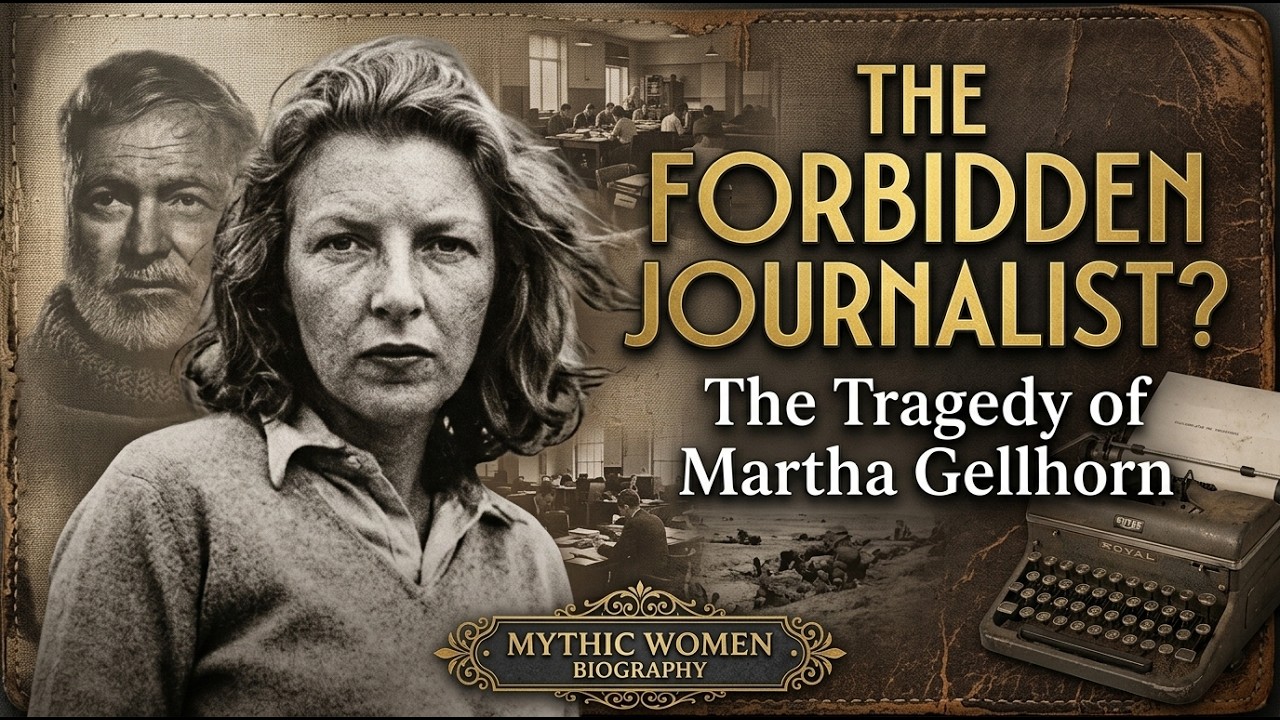
The lesson took hold early: public life was not a male inheritance from which she was naturally excluded. It was a place women meant to enter and alter. At seventeen, she went to France, where Europe offered scale and the sense that a life could be made and remade. She left Bryn Mawr without graduating and worked as a drudge reporter in Albany until she had saved enough to sail for Paris in 1930 with seventy-five dollars in her purse and a typewriter in her suitcase.
Paris gave her a literary education, a failed affair with a married journalist that ended in abortion and humiliation, and the beginning of her craft. Back home, Franklin Roosevelt’s New Deal hired her to report on suffering at close range, and the stories she gathered became The Trouble I’ve Seen, published in 1936, the book in which her voice first became unmistakably her own: plain, fierce, unsentimental, morally exact. The Spanish Civil War drew her next. By March 1937 she had crossed into Spain on foot through snow, a special correspondent for Collier’s with improvised credentials.
Barcelona struck her as a city draped in revolution, bright with conviction. Madrid, besieged through a winter of war, showed her what belief cost. She learned the trade in the hardest school available: the front cut through University City, where abandoned textbooks had been piled into gunners’ nests and lecture room doors braced the walls of trenches. Ernest Hemingway, already established in the hotel where correspondents gathered, gave her the advice that shaped her reporting.
Stop trying to write the battle as generals saw it, he told her. Write what it is like to live here. What she wrote became the pieces that made her name, urgent and present, stripped of theatrical grief. She believed then that if such scenes were rendered truthfully enough, public opinion might be moved and words could alter politics.
Later she would know better, but the naivety was part of the fire. Her relationship with Hemingway, which began in a Key West bar that winter, had already revealed its pattern. When she arrived in Madrid and found her hotel room locked from the outside during a bombardment, she broke out and discovered he had locked it himself, deciding her safety was his to manage. He mocked her in his fiction, took her place at the magazine at the moment she wanted it most, and yet she followed him through Cuba, China, and the long years of the marriage.
She married him in 1940 and found that marriage to a man the world called a genius revealed its terms quickly. His great war novel swallowed the world’s attention while hers passed with thin reviews. He could praise her work with real warmth and then remind her, when his own fears were up, that the world would go on reading him long after it had finished with her. When Collier’s offered her a long assignment in Europe in 1943, she seized it.
London, battered by the Blitz, restored her sense of purpose. The Poles she met described a country turned into machinery, girls selected for breeding farms because they were blond and blue-eyed, Jews driven into the Warsaw ghetto and left there to die by policy or by entertainment. She listened and felt the last of her exhaustion burn off into purpose. Then Ernest, furious at her absence, announced he was going to Europe after all, not as her companion but as her replacement, Collier’s special correspondent for the coming invasion.
The magazine let him take the place she had wanted most in the world. She refused to accept it. She pressured Collier’s to let her go freelance, arranged passage on a Norwegian freighter carrying military cargo, and crossed the Atlantic alone. On the sixth of June 1944, she was kept in quarantine with the world’s press, locked into a guarded briefing room and fed the invasion secondhand.
By the end of the day she had had enough. She hitched a ride to a southern port, bluffed a military policeman by saying she had permission to interview American nurses before they sailed, walked up the gangway of a hospital ship with a red cross painted on its hull, found an empty bathroom, and locked the door. When she emerged, the merchant crew chose, wisely or kindly, not to ask too many questions. Martha Gellhorn, uncredentialed and unauthorized, was heading toward the beaches of Normandy.
Dawn over Omaha was beyond anything she had prepared herself to imagine. Ships crowded the sea to the limit of vision, and the scale resolved into detail, and the detail was slaughter. Oil on the water, blood, mud churned into the surf, bodies floating swollen and indistinct. She carried water, helped organize food for those who could eat, translated for French and German casualties alike, and went ashore that night when more bodies had to be found and lifted under fire.
For that long night she worked beyond fear and beyond fatigue, holding herself to the old discipline: no performance of pity, no flinching, no theft of another person’s suffering. Only attention. Only the job. The articles she wrote from Normandy were among the best of her career.
Then the military caught up with her. Hemingway’s story appeared above hers in the magazine, her credentials were rescinded, and she was escorted to a nurses training camp outside London with orders to remain there. She waited until nobody bothered to guard her, found the gap in the perimeter fence, and crawled through it on her belly. She hitched a ride back to London and wrote a letter protesting what she called the curiously condescending treatment of women correspondents.
One rule from here on out. If they don’t want to accredit you, you just do it. Any little lie will do. France was locked down tight, but Italy had room for a woman willing to lie.
She created a story about a missing fiance, told it to a pilot who believed it or chose to, and was airborne to Naples. From there she hitched north with a convoy of Poles, trailing the German retreat toward Rome, then into the Gothic Line, where a Canadian regiment was massing for an assault on a German fortification dug deep into the Apennines. What she found on the other side of the fighting she made herself describe exactly: the interior of a crippled Sherman tank, its crew spattered across the turret walls; the body of a German soldier thrown clear of his own exploding vehicle, so badly burned he no longer looked human. She wrote, It is awful to die at the end of summer when you are young and have fought a long time and when you remember with all your heart your home and your love and when you know the war is won anyhow.
Paris was supposed to be the celebration. While Hemingway held court at the Ritz, she walked the streets with broken ribs and saw a different liberation underway. French women accused of sleeping with German soldiers were dragged from their homes, their heads shaved, stripped, beaten, paraded through the same streets where the tricolors flew. No one screamed about the businessmen who had sold goods to the Wehrmacht or the politicians who had collaborated openly.
She wrote none of it for Collier’s. The words bled into her notebooks and stayed there. In late April 1945, the American Seventh Army pushed deep into Bavaria. On the twenty-ninth, the column reached Dachau.
They smelled it five miles out. More than thirty railcars sat outside the camp, inside them the bodies of thousands of prisoners, stacked, tangled, stripped of clothing and of names. She wrote, We have all seen the dead like bundles lying on all the roads of half the earth, but nowhere was there anything like this. Nothing about war was ever as insanely wicked as these starved and outraged, naked, nameless dead.
Inside the camp, the living were almost indistinguishable from the dead. She met a woman from Auschwitz, mad-eyed, talking in a loop, telling the horror that had happened to her and her sister now gone. Martha listened because listening was the job and because this woman had no one left to tell it to. She was still at Dachau when the German armies surrendered unconditionally.
There was no celebration, just rot, stench, and the feeling of utter defeat. She wrote, Surely this war was made to abolish Dachau, and all the other places like Dachau and everything that Dachau stood for. We were blind and unbelieving and slow, and that we can never be again. Before Dachau, Martha Gellhorn believed that if you told the truth loudly enough and clearly enough, the world would choose to be better.
She walked out of that camp and did not believe it anymore. The reporting would continue for fifty more years, but the faith that had powered it was gone. It was as though I fell off a cliff at Dachau, she wrote later, and suffered a form of concussion ever since. She never settled.
She drifted through London and Washington and Mexico, wrote lurid romances to buy herself movement, adopted a toddler from an Italian orphanage in 1949 and called him Sandy, married a steady man for nine years and then left him, tearing her son away from the only home he had known. The distance between them widened into five years of silence. In 1966, at fifty-eight, she went back to war in Vietnam, writing about the hospitals and orphanages of the country her own government was destroying. In her seventies she covered the wars in Central America.
At eighty-one she covered the American invasion of Panama. The work was the same: a woman with a notebook walking toward where others were walking away, writing down what she saw in plain, hard, unforgiving sentences. Near the end, her eyes failed after a surgery went wrong. The woman who had built her life on looking could no longer read her own sentences.
Cancer came when she was eighty-nine. On the fifteenth of February 1998, in London, she swallowed a capsule she had carried for years, the small insurance policy of a correspondent against the one thing she could not abide: helplessness. No note was written. They found her the next morning, her face calm, the flat orderly.
Sandy scattered her ashes in the Thames. She had outlived Hemingway by thirty-seven years, and she had outlived most of the men who had tried to define her. As she once said, I don’t think I’ve ever found a place where I belong, but I’ve found a lot of places where I’m glad I’ve been.






