It was the image that would haunt Zenouska Moat before she was even born. Her mother, Marina—heavily pregnant, furious, and beyond caring what anyone thought—posed for the cameras not in maternity wear, but in a black rubber catsuit. She wore a cheap plastic crown on her head, a punk mockery of the real thing, and she was surrounded by corgis. It was grotesque.
It was a visual scream, a desecration of everything the British royal family stood for, and it was splashed across the tabloids for the entire world to see. Marina Ogilvy was a close relative of Queen Elizabeth II, and she had just declared war on her own blood. For the family, it was a catastrophe without precedent. By every law of the aristocracy, the child Marina was carrying should have been exiled to the fringes of society, doomed to carry the shame of her mother’s rebellion forever.
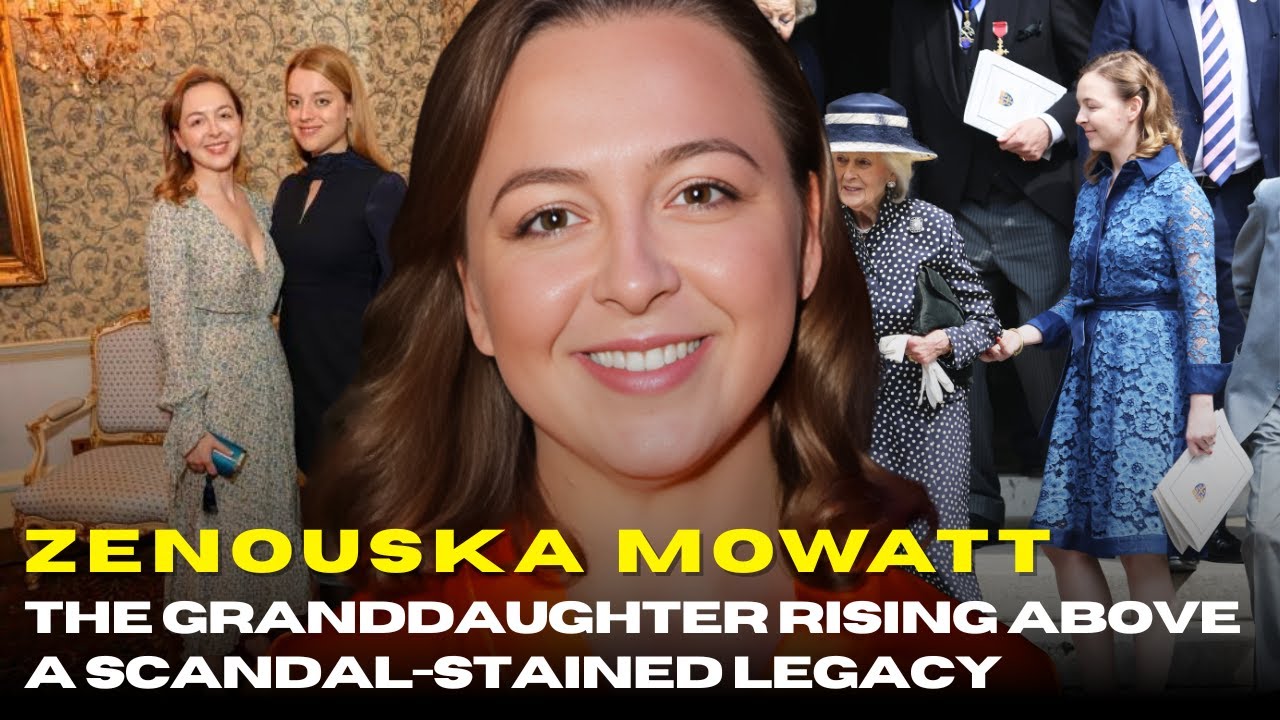
The tabloids were already writing her destiny, predicting she would be wild, damaged, the next chapter in the tragedy of the rebel royals. But decades later, that same child—Zenouska Moat—would stand on the balcony of Buckingham Palace during Trooping the Colour, looking every inch at ease. How did the daughter of the monarchy’s biggest pariah become its quietest survivor? The story does not begin with her birth in 1990.
It begins with the silence that preceded it, and the world her mother tried to burn down. In the grand architecture of the British royal family, there are the stars—the monarchs and the heirs—and then there are the pillars, the people who hold the roof up so the stars can shine. For the second half of the twentieth century, the strongest pillar was Princess Alexandra, Zenouska’s grandmother. It is impossible to overstate the reverence with which the establishment held her.
She was the daughter of the Duke of Kent, a first cousin to Queen Elizabeth II, and in many ways, the Queen’s shadow self. Where the monarch had to be regal and distant, Alexandra was allowed to be charming and accessible, yet she possessed the same ironclad discretion. She was one of the most active working royals, carrying out a heavy program of engagements year after year. In 1963, when she married the Honourable Angus Ogilvy, the son of the Earl of Airlie, it was a national event broadcast to millions.
She was the beautiful princess in lace; he, the dashing wealthy aristocrat who refused a title because he wanted to be a man of the people. They became the golden couple, settling into Thatched House Lodge in Richmond Park, a seventeenth-century residence that was less a palace and more a sanctuary of old-world values. It was a home wrapped in cotton wool, protected by high walls and even higher standards. The household was built on a non-negotiable contract: duty comes first, emotions come second, scandal does not exist.
They insisted on a normal upbringing for their two children, James and Marina. They sent them to regular schools. They took the bus. They queued in shops.
Sir Angus, a man of immense integrity and stiffness, refused to let his children use their royal connections. He wanted them to be ordinary. But there is a danger in forcing ordinary life upon extraordinary circumstances. You can take the title away from the child, but you cannot take the child out of the history.
James, the son, accepted the contract. He was the model child—quiet, studious, eventually going to Eton and the University of St Andrews, blending seamlessly into the beige tapestry of the upper class. Marina was different. Born in 1966, just as the cultural revolution of the sixties was beginning to tear down the stiff social structures her parents represented, she was sharp, loud, and physically restless, with the heavy-lidded eyes and stubborn chin of the Kents, a family line known for a certain melancholic volatility.
Growing up at Thatched House Lodge, she felt the crushing weight of her mother’s perfection. Every time she walked into a room, she was Alexandra’s daughter, expected to curtsy, to smile, to be grateful. But Marina was bored, and she was angry. The ordinariness her father insisted upon felt like a trap.
She was royal enough to be watched, but not royal enough to be protected. She was rich enough to be envied, but not rich enough to be independent. By the early 1980s, the arrival of Lady Diana Spencer shifted the tectonic plates of royalty. Suddenly, it wasn’t about opening hospitals in raincoats; it was about glamour, magazines, and emotion.
Marina saw this new world of nightclubs, paparazzi, and fame, and she wanted in. But she lacked Diana’s cunning or the resilience of a Fergie. Raised in a hermetically sealed environment, she was naive. She drifted, trying to be a survivalist—taking courses in jungle warfare, a choice the press mocked mercilessly—then a piano teacher, then a model.
Every attempt to carve out an identity was met with the same reaction from the gray men of the palace and her own parents. Don’t make a scene. Go back to Richmond. Be quiet.
They didn’t understand that by trying to silence her, they were compressing the gas in the chamber, turning a rebellious daughter into a bomb. The detonator arrived in the form of Paul Moat. He was everything the Ogilvies were not: a freelance photographer—a profession viewed in royal circles with the same suspicion as a jewel thief—streetwise, brash, and entirely unimpressed by the stiff protocols of the Kent family. When Marina met him in a bar in 1989, it was chemical.
Here was a man who didn’t care about her mother, who looked at her and saw a woman, not a problem to be solved. Dating him was an open act of defiance. They moved fast, too fast. In the late summer of 1989, Marina missed a period.
Today, an out-of-wedlock royal pregnancy would be managed with a carefully worded press release and a quiet wedding. But this was 1989. The moral code of the older generation—the Queen, Princess Alexandra, Sir Angus—was Victorian. To be pregnant and unmarried was not just a mistake; it was a sin, a degradation of the bloodline.
Marina was twenty-three, terrified of her father, a man known for his rigid adherence to propriety. She knew the news wouldn’t just disappoint them; it would destroy the carefully cultivated image of the perfect Ogilvies. When she finally gathered the courage to tell her parents that October, the reaction was, according to Marina, catastrophic. What happened inside Thatched House Lodge during those fateful days remains a matter of historical debate, filtered through the lens of trauma and tabloid sensationalism.
According to the version Marina later sold to the world, the scene was Dickensian in its cruelty. She claimed her parents offered no hug, only an ultimatum: get an abortion or get married immediately in a quiet, shamefaced ceremony. She alleged her mother, the beloved Princess Alexandra, stood by and did nothing, prioritizing the family’s reputation over her daughter’s soul. “I was told I had brought shame on the family,” Marina would later say.
“I was told I was a failure. ” Whether the account was entirely true or an exaggerated manifestation of Marina’s feeling of persecution, the outcome was the same. She felt cornered, rejected. And like an animal backed into a corner, she lashed out—not just at her parents, but at the world.
Marina contacted a newspaper. In the history of royal scandals, the moment is often overlooked, overshadowed by the later war of the Waleses. But in terms of pure raw shock, nothing compares to the morning the Today newspaper hit the stands. “Royal blackmail,” the headline screamed.
It was unprecedented. A blood relative of the Queen was not just leaking gossip; she was publicly declaring war on her own parents. She accused the Queen’s cousin of cutting off her funds. She accused them of trying to force her into an abortion.
She painted the golden couple as cold-hearted monsters who cared more about public perception than their own grandchild. The royal family was paralyzed. They had a playbook for foreign dictators and economic crises, but none for a distraught young woman taking a private family dispute to the press. Marina didn’t stop at the interview.
She invited photographers into the small cottage she shared with Paul Moat, and then came the image that would haunt Zenouska before she was even born. The aristocracy gasped. The public devoured it. The Queen was reportedly deeply saddened—a palace euphemism for absolutely furious.
Marina had crossed the Rubicon, trading her dignity for a check and a moment of vengeance. She thought she was liberating herself. She didn’t realize she was building a prison for her unborn child. As the winter of 1989 turned into 1990, the atmosphere around the family was toxic.
The press camped outside Marina’s home, analyzing her every move. Sir Angus and Princess Alexandra retreated into a shell of humiliated silence, continuing their royal duties while the pain showed in their eyes. It was in this atmosphere of scorched earth and broken trust that preparations for Zenouska’s arrival began. Marina and Paul married on the 2nd of February 1990 in Richmond, just months before the birth.
It was not a royal wedding. There was no carriage, no crowds, no televised kiss. Princess Alexandra attended while the bride notably wore black rather than traditional white. The photos from that day are chilling.
Everyone is smiling, but the smiles are tight, brittle, ready to snap. Marina stands with Paul, defiant. Alexandra stands apart, looking like a woman walking through a nightmare she cannot wake up from. By the time Zenouska’s due date approached in May 1990, the noise of the scandal had faded into a terrifying reality.
The interviews were over. The money was spent. The rubber dress was put away. Now there was just a young, volatile couple, isolated from their support system, broke and angry, waiting for a baby to fix everything.
Zenouska May Moat was born on the 26th of May 1990. In any other branch of the family, a new royal baby would trigger a symphony of celebration—gun salutes in Hyde Park, a notice on the easel at the palace gates, a christening gown made of Honiton lace used since Queen Victoria. For Zenouska, there was none of this. Her arrival was not a state occasion.
It was a ceasefire. The first few years of her life were marked by a deceptive quiet. To the outside world, it seemed Marina and Paul had won. They had defied the monarchy, married for love, and were building their own modern family.
They had a son, Christian, three years later. They were the poster children for a new kind of royal existence—independent, gritty, and real. But inside the walls of their home, the fairy tale was rotting. Rebellion is a powerful drug, providing adrenaline, purpose, and a common enemy.
Marina and Paul had bonded over their shared war against the establishment. But when the enemy stops fighting, and the press moves on, the adrenaline fades. And when the adrenaline fades, you are left with just a marriage. And the marriage was a disaster.
Zenouska’s earliest memories were likely not of royal garden parties, but of domestic volatility. The two explosive personalities, trapped in a small life burdened by financial stress, could not survive the cold light of day. The £30,000 from the Today interview was a finite resource. Paul was a freelance photographer, a profession of feast or famine.
By the mid-1990s, the arguments were reportedly constant, a chaotic shouting environment—the exact opposite of the hushed, carpeted silence of Thatched House Lodge. For a child, this environment is a crucible. Children are barometers, absorbing the atmospheric pressure of a home. Zenouska learned very early that love was not a stable resource.
It was loud. It was angry. It was something people fought over. In 1997, the inevitable happened.
The marriage exploded. The divorce was as messy as the courtship—a brawl over custody and money, with the specter of poverty entering the narrative once again. In the late nineties, headlines began to circulate that were unthinkable to royalists: the Queen’s cousin’s daughter was reportedly living on state benefits. Whether Marina was technically on the dole or just struggling severely is a matter of semantics, but the optic was undeniable.
The Ogilvy rebels were broke. Imagine the confusion of a seven-year-old Zenouska. On television, she could see her extended family dripping in diamonds, traveling in Rolls-Royces, living in castles. She knew, in that vague way children know things, that she belonged to them.
That was her blood. But her reality was a rented house, a stressed mother, and a distinct lack of luxury. It is a specific kind of psychological torture to be a poor relation. To be born poor while knowing your grandmother lives in a royal lodge in Richmond Park breeds a profound sense of dislocation.
It breeds a question that must have haunted her: what is wrong with us? Why are we on the outside? Zenouska became a shuttlecock child, batted back and forth between two worlds that couldn’t possibly understand each other. On weekends, she might visit her father in a world completely removed from aristocracy.
On other occasions, there would be tentative, frosty visits to the royal relations, where she had to learn a new language—how to hold a knife and fork, how to sit, how to speak—shedding the skin of her chaotic home life to put on the armor of a good royal child. She saw the wealth, the order, the peace, and she saw how much her grandmother valued those things. She realized the chaos of her mother’s life was the reason for their exile. Most teenage rebels act out against their parents’ values.
Marina rebelled against order by choosing chaos. Zenouska, observing the wreckage of that choice, decided to rebel against chaos by choosing order. School offered no escape. She attended St George’s School in Windsor and later expensive boarding schools, often funded by the quiet generosity of the extended family.
But schools are brutal social hierarchies. Zenouska wasn’t just another student; she was “that woman’s daughter. ” The parents of her classmates read the Daily Mail. They knew about the rubber dress, the blackmail, the benefits.
Children, with their radar for weakness, knew it too. So Zenouska became the quiet girl. Teachers from this era recall a student who was diligent, polite, and fiercely private. She tried to hide her royal connections, wanting to be judged on her own merits.
She learned to observe rather than participate, to move through the grass without breaking a twig. The late nineties and early 2000s were the peak era of Prince William and Prince Harry mania, while the York princesses grew up in the spotlight of their own parents’ scandals. Zenouska was in the same age bracket, but miles away from the inner circle. There is a photograph from this era that captures the dynamic perfectly: a family gathering, perhaps a memorial service.
The senior royals are front and center, polished and confident. Zenouska is in the background, partially obscured, looking at the camera with wide, watchful eyes. She looks like she is waiting for someone to tell her to leave. She was the ghost at the feast.
The isolation was compounded by her mother’s continued erratic behavior. Even after the divorce, Marina struggled to find footing, with reports of odd business ventures and continued friction with the family. Zenouska had to become the parent to her own parent—a phenomenon called parentification. She had to be the sensible one, the one who didn’t cause trouble, because her mother was causing enough for both of them.
She bore the burden of her grandmother’s sorrow, made a silent vow that she would not be another source of pain for this woman. As she entered her late teens—the danger zone, the age when the wild child gene is supposed to activate—the press was waiting with telephoto lenses, desperate for a photo of Zenouska stumbling out of a club. It would have been the perfect sequel to the Marina story. But the photo never came.
She stayed in school. She studied. She took an interest in the arts and fashion, but not in the “it girl” way. She was interested in the business of luxury, not just the consumption of it.
She realized her path to redemption lay in competency. In a family of peacocks, the sparrow is the one who survives. By the time she reached eighteen, Zenouska Moat had survived the minefield of her childhood without a single scratch on her public record. But survival wasn’t the finish line; it was the entry fee.
And as she crossed the threshold into adulthood, the world around her was crumbling. The financial crash of 2008 had arrived. While her royal cousins might have been insulated by duchies and inheritances, Zenouska faced a starkly different horizon. For her cousins, eighteen was the year of the debutante ball, the gap year in Thailand, the trust fund activation.
For Zenouska, it was the year the global economy collapsed, and in the rented rooms where the scandal branch of the family lived, there was no safety net. There is a brutal truth about the British class system: title does not equal cash. You can have the blood of Queen Victoria in your veins and still struggle to pay the heating bill. Zenouska quietly prepared to become a shopgirl.
There is no record of her throwing a tantrum about her station. Instead of drifting into the nebulous world of socialite careers—party planning, brand ambassadorship, art consulting—she entered the world of retail. To a member of the royal family, retail is a profound humbling: standing on your feet for eight hours, folding clothes you cannot afford to buy, serving customers who might look at your name badge and ask, “Moat—are you related to that woman who was in the papers? ” The answer always had to be a polite smile.
“Can I help you find your size, madam? ” This period was the crucible that forged her character, the anti-Marina boot camp. Her mother had believed the world owed her a living because of who she was. Zenouska learned through the ache in her feet that the world owed her absolutely nothing.
She studied marketing and branding in London, building a practical career in luxury goods and fashion. This was a strategic choice. She wasn’t studying the history of art; she was studying commerce. She began to understand that her family wasn’t just a bloodline—it was a brand, the ultimate luxury label, one that had been damaged by cheap knockoffs and bad PR.
She realized that if she wanted to survive, she had to become a brand manager for her own reputation. During her early twenties, a strange invisible wall separated her from the rest of the royal herd. On occasional weekends, when invited to family gatherings—perhaps a pre-Christmas lunch or a milestone birthday for Princess Alexandra—she would step through the looking glass. For a few hours she was royal, surrounded by footmen and the finest china.
But when the clock struck, she had to take the tube home and commute to work the next morning. She was the insider and the outsider simultaneously. Watching her cousins, Princesses Beatrice and Eugenie, get mocked for their hats and their weight, she learned a valuable lesson: invisibility is a superpower. By not having a title, she had freedom.
She could make mistakes in private. She could fail and get back up without the Daily Mail writing an editorial about it. Her climb was a ladder, rung by rung. One of the most significant chapters was her time working for Catherine Quinn, who would later become the private secretary to the Duchess of Cambridge.
Working in that orbit—high-end administration, strategic philanthropy, elite management—taught Zenouska the machinery of the establishment. She learned the art of the soft-power letter, how to organize an event where every guest feels special but the hierarchy is strictly enforced. She learned that details are everything, that a misplaced place card can start a war. Marina had been sloppy; Zenouska became meticulous.
People in London’s high society began to whisper, but the tone was changing. It wasn’t “Have you heard about Marina’s daughter? ” with a sneer. It was “Have you met Alexandra’s granddaughter?
She’s actually quite impressive, very sensible. ” In the British aristocracy, sensible is the highest compliment you can pay a woman with a dangerous mother. As she moved into her mid-twenties, she faced a career crossroad. She could have gone to work for a trendy fashion house or a PR firm representing pop stars.
Instead, she made a calculated decision: she chose heritage. Her unique selling point was her proximity to tradition. This led her to Halcyon Days, the purveyors of fine enamels and bone china, the company commissioned to create commemorative boxes for royal weddings, jubilees, and coronations—a brand that has held royal warrants. Zenouska spent years there, rising to head of marketing before later moving on to lead marketing elsewhere.
She spends her days crafting campaigns that celebrate the history, pageantry, and dignity of the very institution that once looked at her with suspicion. The daughter of the woman who tried to smash the vase is now the woman in charge of painting it. When she joined, it wasn’t nepotism, but perfect synergy: the brand needed a face that understood the nuances of Britishness, and Zenouska needed a platform that validated her status without requiring a title she didn’t have. Colleagues describe a woman who is the first to arrive and the last to leave, who understands the supply chain, digital marketing, and the customer—often American or Japanese tourists desperate to buy a piece of the fairy tale.
Who better to sell the fairy tale than the girl who was locked out of the castle? There is a psychological element to her work. Every time she launches a new collection—perhaps a beaker celebrating the Queen’s 90th birthday or a pill box commemorating a royal wedding—she is performing an act of aesthetic penance. She is polishing the crown.
By professionally aligning herself with the symbols of royalty—the crest, the ciphers, the castles—she visually reintegrates herself into the narrative. When you see Zenouska holding a Halcyon Days box featuring Windsor Castle, you don’t think of her mother’s scandals. You think of continuity, of tradition. She has effectively rebranded herself from the rebel’s daughter to the heritage guardian.
The culmination of this long quiet climb came in June 2022, during the Platinum Jubilee of Queen Elizabeth II. The Queen was frail. The family was fractured by the departure of Prince Harry and Meghan Markle and the disgrace of Prince Andrew. The monarchy was looking thin on the ground; they needed reliable smiling faces to fill the gaps.
And there, standing on the balcony of Buckingham Palace, was Zenouska. For a royal watcher, the balcony is a chessboard: the closer you are to the monarch, the more power you hold. Zenouska wasn’t in the center—that spot is reserved for the direct heirs—but she was included in the extended family group, a visual signal that the exile was over. She stood next to the Gloucesters and the Kents, chatting amiably, smiling at the crowds.
But the most telling moment wasn’t on the balcony. It was at the service of Thanksgiving at St Paul’s Cathedral. As the cameras panned across the congregation, they caught Zenouska walking down the aisle, her head held high, with the specific gliding gait of a woman who has been taught how to walk in a cathedral since birth. In that moment, she defeated the narrative of 1989.
The tabloids that had predicted she would be a wild child in a rubber dress were forced to photograph a woman who looked more royal than some of the actual royals. She had outmaneuvered the press simply by being boringly, relentlessly perfect. While Zenouska respects the old world, she lives in the new one. Her weapon of choice is Instagram.
Scroll through her feed and you will find a masterfully curated mood board of aristocratic life: photos of misty mornings in the Scottish Highlands, beautiful table settings with Halcyon Days china, respectful, loving tributes to her grandmother. There are no party photos, no attention-seeking selfies, no political opinions, no complaints about privacy. It is a fortress of beige and pastel. She works with brands, but always safe brands—luxury hotels, high-end fashion, heritage companies.
She is an influencer, but an influencer for the establishment, signaling to the palace: look, I am safe. I am promoting the brand. I’m not a liability. In a family terrified of the loose cannon, Zenouska has marketed herself as the safe pair of hands.
It is impossible to discuss her rise in the 2020s without acknowledging the context of the Sussex departure. When Meghan Markle left the royal family, the narrative was that the institution was impossible for an independent, career-driven woman to survive in. Zenouska Moat presents a complicated counterargument. She is a career woman, independent, media-scrutinized, and yet she stayed.
The comparison is not entirely fair—Zenouska does not face the same global racism or blinding spotlight Meghan did—but in the eyes of the British upper class, she is the correct model of a modern royal woman: the one who put her head down and worked, who accepted her place in the hierarchy without complaint, who used her connections to build a business rather than using the business to attack the connections. For the loyalist, Zenouska is the anti-Meghan, the proof that you can be modern and traditional at the same time. But beneath the marketing and the balcony appearances, the emotional core of this era remains her relationship with Princess Alexandra. By 2022, Alexandra was in her mid-eighties, frail, suffering from polymyalgia rheumatica.
The golden girl of the 1960s was fading, and Zenouska stepped into the role of unspoken caretaker. In photos from family weddings or Royal Ascot, you often see her hand hovering near her grandmother’s elbow—a protective gesture. This is the final redemption. The daughter of the woman who broke Alexandra’s heart is now the woman holding Alexandra’s hand.
Zenouska has likely heard the stories of 1989 a thousand times. She knows the pain her birth caused. By dedicating her adult life to being a good granddaughter, she is retroactively fixing the past, paying back the emotional debt her mother incurred. However, even in this Halcyon era, there is a ceiling.
Zenouska will never be a duchess. She will never be an HRH. She will never live in a taxpayer-funded palace. She is a working woman who happens to have a famous grandmother.
When the Queen died in September 2022, the tectonic plates shifted again. King Charles III speaks often of a slimmed-down monarchy, wanting fewer royals on the balcony, not more. Zenouska knows this. She knows her proximity to power is finite.
Once Princess Alexandra passes, her direct link to the throne weakens. This is why her career is so vital—it is her lifeboat. When the royal tide recedes, as it inevitably will for the minor branches, she will still have her job, her reputation, the enamel boxes. She has built a house of brick, while her mother built a house of straw.
On September 19, 2022, the world watched the state funeral of Queen Elizabeth II. Amidst the sea of black veils, military uniforms, and heads of state, the camera briefly found Zenouska Moat walking into Westminster Abbey. Her head was bowed, dressed in mourning black, impeccable and somber. For historians watching, the symbolism was heavy.
The Queen had been the anchor, the force that held the disparate branches together. Her death marked the end of the era of protection. The umbrella was gone. For many minor royals, the transition to King Charles III was terrifying.
But Zenouska did not look terrified. She looked calm. While others scrambled to justify their existence, she stood on solid ground. She didn’t need the Sovereign Grant, a title, or a grace-and-favour apartment.
She had her job, her salary, her dignity. In the brutal meritocracy of the new Carolean era, Zenouska Moat had already passed the test. She was the prototype for the modern royal relative: self-sufficient, silent, and loyal. The true magnitude of her achievement is not professional; it is psychological.
She is what therapists call a cycle breaker. Generational trauma is like a relay race. Marina took the baton of pressure and restriction from her parents, set it on fire, and handed the ashes to Zenouska. Zenouska could have kept running that race, spent her twenties giving interviews about how her mother’s scandal ruined her childhood.
It would have been a lucrative narrative. But she dropped the baton. She refused to let the chaos of 1989 define the woman of 2023. She looked at the wreckage of her parents’ marriage and chose stability.
She looked at the financial anxiety of her youth and chose fiscal responsibility. She looked at the notoriety of her surname and chose to make it boring again. This is a quiet heroism. It doesn’t get you on the cover of Time magazine, but it saves your soul.
As the 2020s progress, her role within the family has become one of soft power. She is part of the “Cousins Club,” a tight-knit group of younger royals who fly under the radar, often seen with Flora Vesterberg and Lady Amelia Windsor. They represent the new face of the aristocracy—working women with Instagram accounts and heritage surnames—but Zenouska brings a specific gravity to the group. She is the one who has seen the dark side, who knows the privilege can disappear overnight.
Her relationship with her mother Marina remains a testament to her maturity. They are still seen together; Zenouska posts birthday tributes. She has not cut Marina off. To love the person who made your life difficult is a profound spiritual achievement, and by turning out so well, she has retroactively softened the judgment on her mother’s parenting.
We often confuse nobility with titles, thinking it lives in the coronet. But the story of Zenouska Moat teaches that true nobility is a behavior, not a birthright. Her mother had the title yet acted without nobility in 1989. Zenouska had no title, yet acted with supreme nobility throughout her entire adult life.
She cleaned up the mess she didn’t make, paid the debts she didn’t incur, and honored the family that once hesitated to claim her, in an era that rewards loud confession and constant self-display. She chose the power of silence and the strength of the supporting role, proving that you don’t need to burn down the palace to be free. You just need to be strong enough to walk out the front door and pay for your own taxi. Imagine the scene one last time.
It is a summer garden party at Buckingham Palace. Tea is being served; the band plays a light jazz cover of a pop song. Zenouska Moat is standing on the lawn, wearing a Halcyon Days bangle on her wrist, chatting with guests who have no idea about the rubber dress, the blackmail, or the benefits checks. They just see a charming, elegant young woman who seems perfectly at home.
She pauses for a moment, looking across the lawn toward the palace facade—the same building her mother was exiled from, the same building her grandmother served for seventy years. It used to be a fortress that kept her out. Now it is just a building, one she visits but doesn’t need. She finishes her tea, says her goodbyes, and walks out the gate.
She hails a cab. She checks her emails. She has a meeting tomorrow morning, a product launch to manage, a life to live. The redemption child is no longer a child, and she no longer needs redemption.
She has earned her peace. And as she disappears into the London traffic, leaving the ghosts of the past behind the palace gates, she is finally, completely free.