In May 1945, with Germany’s unconditional surrender on the eighth, Allied forces began searching for the men who had built and run the death camps, organized the deportations, and carried out the executions. Internment camps filled with thousands of former German and Austrian soldiers, SS officers, officials, and party members of the collapsed Nazi regime. Across the ruins of a shattered continent, the apparatus of mass murder tried to disappear. In Rome, far from the rubble of Berlin and the advancing Allied occupation authorities, an Austrian bishop sat in his study at the German College and began to receive visitors.
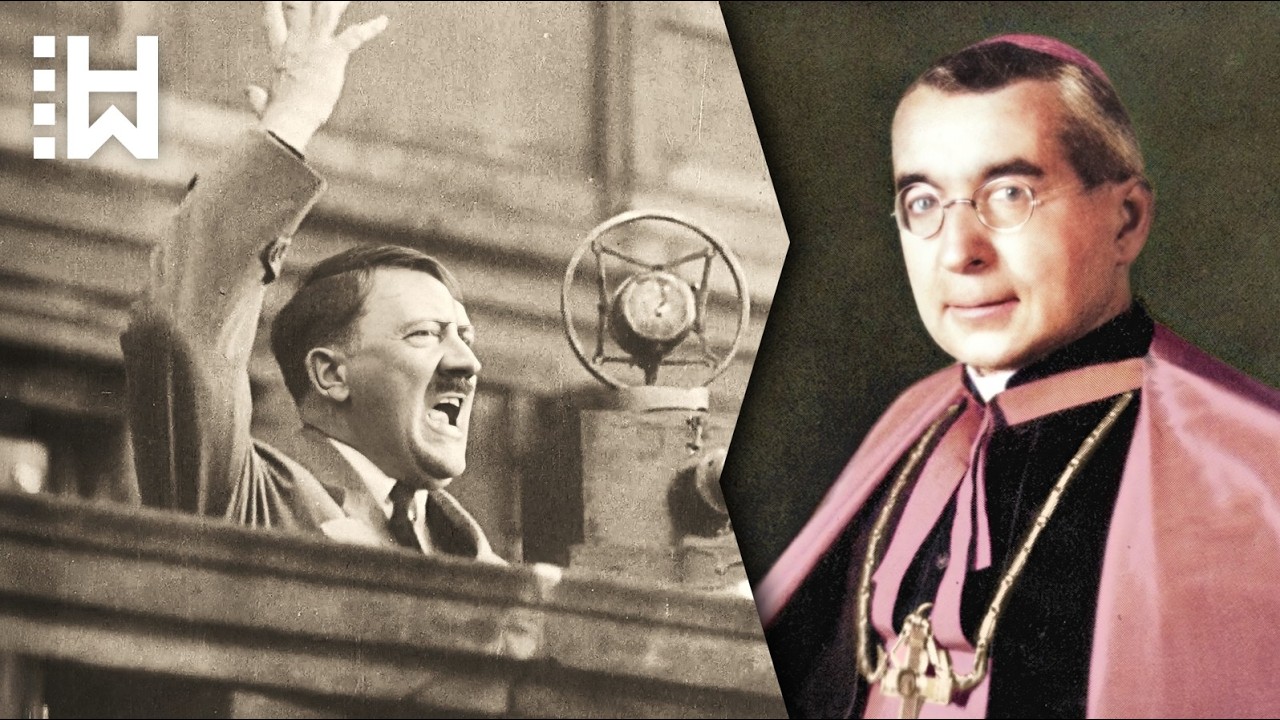
Some came openly. Others arrived in secret, told only by word of mouth that a churchman was willing to help them escape. The men who found their way to him included some of the most wanted war criminals in Europe. The bishop’s name was Alois Hudal.
Born on the 31st of May, 1885, in Graz, then part of the Austro-Hungarian Empire, Hudal grew up in a family with little money; his father was a shoemaker. He showed academic ability from an early age, and in 1904 he enrolled to study theology at the University of Graz. Ordained to the priesthood in July 1908, he first served as a parish chaplain in Kindberg, a small town in Styria in today’s Austria. During his years of study he developed an unusual specialization for a Catholic priest from the German-speaking world: he became a notable scholar of the Eastern Orthodox churches, studying their liturgy and spirituality, and harbored long-term ambitions for reconciliation between Rome and the Orthodox world.
In 1911 Hudal earned his doctorate in theology from the University of Graz, then moved to Rome, where he entered the Teutonic College of Santa Maria dell’Anima, a seminary for German-speaking priests, serving as chaplain there from 1911 to 1913. During the First World War he served as a military chaplain, and in 1917 he published a collection of his wartime sermons, declaring that loyalty to the flag was loyalty to God, while also warning against what he called national chauvinism. In 1923, Hudal was appointed rector of the Teutonic College of Santa Maria dell’Anima in Rome, known simply as Anima, a position he would hold for nearly thirty years. The appointment came partly through Austrian diplomatic maneuvering.
Ludwig von Pastor, the Austrian historian and diplomat, had recommended Hudal to Pope Pius XI, specifically to ensure that an Austrian, rather than a German, Dutch, or Belgian candidate, would lead the college. Austria’s post-war influence in the Vatican was under pressure after the collapse of the empire, and Hudal became the public face of Austrian prestige in Rome. For more than a decade he was an influential and respected figure in the Catholic world. In June 1933, Cardinal Eugenio Pacelli, the future Pope Pius XII, then cardinal protector of the German national church in Rome, consecrated Hudal titular bishop of Ayala.
The ceremony placed Hudal at the center of Catholic-German relations at a moment of extraordinary danger, only months after Adolf Hitler had come to power in Germany in January 1933. From the early 1930s onward, Hudal’s political views shifted visibly and decisively. He was a committed anti-communist, and fear of Bolshevism shaped his entire political outlook. He had concluded that only a strong, unified German-Austrian military force could halt the advance of Soviet power in Central Europe and protect Rome from what he saw as the existential threat of godless communism and liberalism.
Within that framework, the rise of Adolf Hitler appeared to him not as a catastrophe but as a potential instrument for Christian civilization. From 1933, Hudal began publicly embracing pan-Germanic nationalism, the belief that all German-speaking peoples should be united into a single state, declaring that he wished to serve as a herald of the German cause. His invective against Jews intensified during these years, as he linked what he called the Semitic race with democracy, internationalism, and financial conspiracy. In 1937, Hudal published a book in Vienna entitled *The Foundations of National Socialism*.
In it he enthusiastically praised Hitler and proposed a reconciliation between Nazism and Christianity, arguing that the two could coexist if the regime left education in the hands of the churches while the Nazis controlled politics. He sent Hitler a personal copy with a handwritten dedication praising him as the new Siegfried of Germany’s greatness. The book also attacked the policies of the Vatican, arguing that Rome had been insufficiently supportive of the German cause against communism. The reaction from both sides was damaging.
The Nazi regime did not ban the book outright, but prevented its circulation in Germany, restricting it to two thousand copies. The Vatican was furious at the implicit criticism of its diplomacy and the explicit endorsement of a regime it was already engaged in an uncomfortable and contested relationship with. Hudal had managed to offend his superiors while simultaneously failing to impress those whose cause he championed. The publication effectively ended Hudal’s influence within the Vatican.
He was kept at arm’s length from positions of real responsibility and never given the authority he believed his rank and connections deserved. A few years earlier, when he had appealed to Pope Pius XI with his theory that the conservative wing of the Nazi party, headed in his interpretation by Hitler himself, could be Christianized and directed against communism, the response had been skeptical. After 1937, that skepticism hardened into something close to exclusion. The ambitious bishop who had once delivered speeches of honor in the presence of the Pope and multiple cardinals found himself increasingly marginalized in the institution he had spent his entire life serving.
In April 1938, Hudal helped organize a vote of German and Austrian clerics from the German College of Anima on the question of the Anschluss, the German annexation of Austria that had taken place in March of that year. The vote was held on the German heavy cruiser *Admiral Scheer*, anchored in the Italian harbor of Gaeta. Despite Hudal’s views, more than ninety percent voted against the Anschluss. The Second World War began on the 1st of September 1939, when Nazi Germany attacked Poland.
In the years that followed, Hudal’s position in Rome remained uncomfortable, though he retained his title and his rectorship at the Anima. His record during the war itself was more complicated than the simple picture of a Nazi collaborator would suggest. In October 1943, when the German occupation authorities in Rome began the deportation of the city’s Jewish community, Hudal wrote directly to Generalmajor Rainer Stahel, the German military commander of Rome, urging him to halt the operation. He warned that the deportations would damage relations between the church and the German Reich and provide propaganda material to Germany’s enemies.
According to several sources, Hudal may also have acted as a Vatican-based informer for Nazi Germany, reporting either to the Abwehr, the German military intelligence service, or to the Reich Security Main Office, the SS security and intelligence authority. After the German surrender in May 1945, Hudal began the work for which history would remember him. He used his position and his connections to help former Nazis obtain false identity documents and travel papers. The mechanism was straightforward in outline.
Hudal would vouch for a man to the Vatican’s Refugee Relief Organization, the Pontificia Commissione di Assistenza. The commission’s papers were not passports, but they were enough to approach the International Committee of the Red Cross, whose representatives in Rome would issue a displaced person’s travel document on the word of the bishop. That document, in turn, could be used to apply for a visa to Argentina, Brazil, Arab countries, or another destination willing to receive German-speaking immigrants. In practice, the Red Cross performed minimal checks, and the word of the bishop was accepted without question.
The men Hudal helped included some of the most significant perpetrators of the Holocaust. Franz Stangl, the commanding officer of the Sobibor and Treblinka extermination camps, came to Hudal after learning from other fugitives that the bishop was helping all Germans who needed assistance. Stangl later told the journalist Gitta Sereny that Hudal had arranged accommodation for him in Rome, provided money, and obtained documents enabling his travel to Syria. Hudal even arranged employment for Stangl in a textile factory there.
Gustav Wagner, deputy commander of the Sobibor extermination camp, was similarly helped. Alois Brunner, who had organized the deportation of Jews from France and Slovakia to the German extermination camps, also escaped through Hudal’s network. Adolf Eichmann, the man placed in charge of implementing the murder of European Jewry, obtained his false identity as Ricardo Clement with assistance from a Franciscan friar connected to Hudal. Hauptsturmführer Erich Priebke, an SS officer responsible for the Ardeatine massacre near Rome, in which 335 civilians were killed, confirmed directly to the Italian newspaper *La Repubblica* in 1994 that Bishop Hudal had helped him reach Buenos Aires.
Through these escape routes, later known as rat lines, other fugitives also fled Europe, including Josef Mengele, who carried out selections and experiments on prisoners at Auschwitz-Birkenau in German-occupied Poland. On the 31st of August, 1948, Hudal wrote to Argentine President Juan Perón requesting five thousand visas, three thousand for Germans and two thousand for Austrians. He described them not as Nazi refugees and criminals, but as anti-communist fighters whose wartime sacrifice had saved Europe from Soviet domination. In Hudal’s worldview, the men he was protecting were not perpetrators of mass murder but soldiers in a sacred war against godless Bolshevism, and the Allied prosecutions at Nuremberg and elsewhere were show trials orchestrated by the enemies of Christian civilization.
Hudal’s activities caused a press scandal in 1947, after the *Passauer Neue Presse*, a German Catholic newspaper, accused him of leading a Nazi smuggling ring. In January 1952, the Bishop of Salzburg in Austria informed Hudal that the Holy See wished him to step down from his position at the Anima. Hudal announced his resignation in June 1952, doing so with bitterness, insisting that his removal reflected the Vatican’s capitulation to Allied pressure rather than any genuine moral failing on his part. He withdrew to a residence at Grottaferrata, a small town near Rome, where he spent the final years of his life.
In 1962, the last year of his life, Hudal wrote his memoirs, published posthumously in 1976. They were not a confession in any conventional sense, but an extended complaint against the Vatican officials who had failed to support him, a bitter account of perceived injustices accumulated over decades, and an unapologetic defense of his role in helping Nazi criminals escape post-war justice. Writing with full knowledge of what the Holocaust had been, Hudal described his actions in these terms: “I thank God that he opened my eyes and allowed me to visit and comfort many victims in their prisons and concentration camps, and help them to escape with false identity papers. ” The victims, in Hudal’s view, were SS officers and camp commandants; the prisons, Allied internment camps.
The bishop who helped murderers escape justice died in Grottaferrata on the 13th of May, 1963, never having faced legal proceedings for his role in the infamous rat line. He was seventy-seven years old.