Late autumn in Minsk, 1943. A young woman walked out of a mansion that had just been turned into a graveyard, passing guards who did not so much as glance at her. She carried nothing in her hands. She had left something behind instead, something tucked beneath a mattress in the bedroom of one of the most feared men in occupied Belarus.
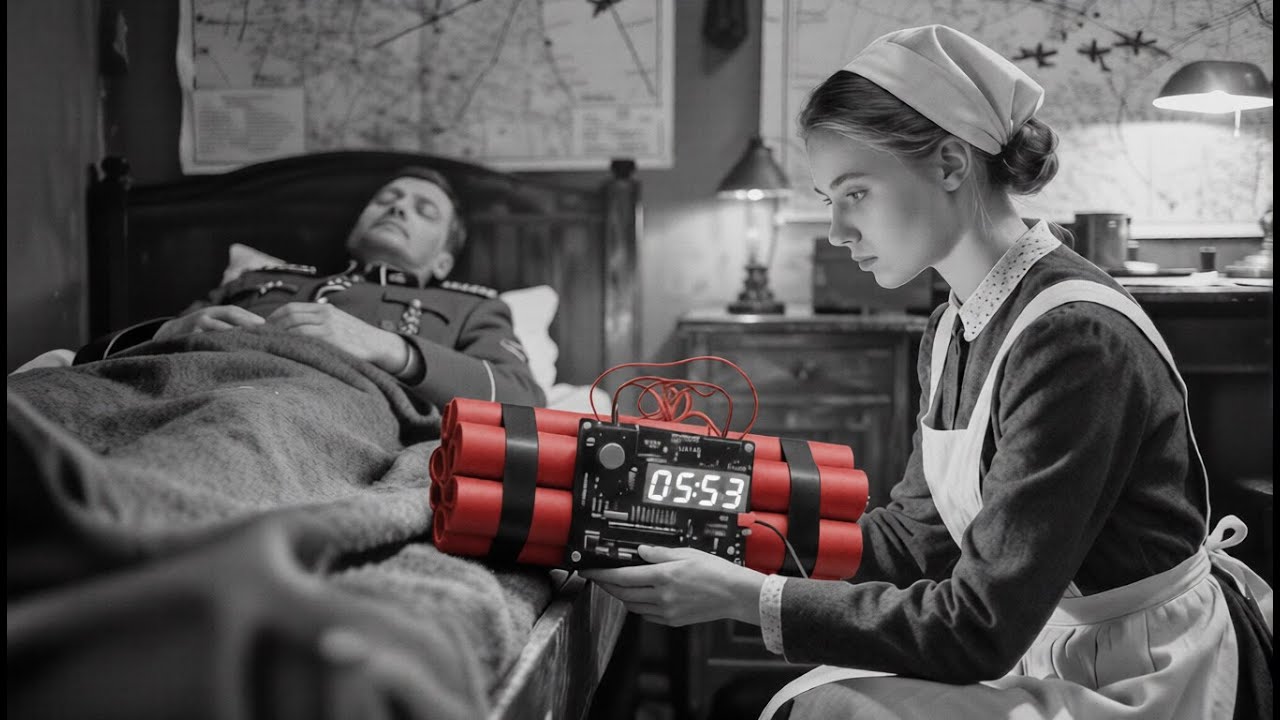
Behind her, in the room she had cleaned and tidied and memorized for months, a timed explosive waited. Yelena Mazanik did not run. She did not hurry. She walked as a maid walks, unhurried, unnoticed, part of the furniture of the house.
The SS guards patrolling the corridors saw only another servant going about her duties. They had seen her a hundred times. They would not see her again. She had just killed Wilhelm Kube.
The Eastern Front in 1943 was a landscape of terror. Nazi officers ruled towns like kings, their every order sealing the fate of civilians and soldiers alike. Among them stood Wilhelm Kube, one of the highest-ranking Nazi officials in occupied Belarus. Feared.
Ruthless. Seemingly untouchable. No soldier could walk into his mansion. No sniper could reach him from a distance.
The Gestapo guarded every hallway, every staircase, every window. Kube was the architect of terror in the region, responsible for mass executions, deportations, and the annihilation of entire villages. As long as he lived, thousands more would die. The Soviet partisans were desperate.
They needed someone inside. Someone so ordinary that the Nazis would never see her coming. Yelena Mazanik was born in Belarus in 1924. She grew up amid the hardships of Soviet life, unremarkable at first glance, but with a sharp mind, quick reflexes, and courage beyond her years.
When the Nazi invasion reached Belarus, she watched neighbors disappear, families slaughtered, towns burned. The brutality of occupation transformed ordinary citizens into soldiers of a hidden war, and Yelena’s path was set. She would join the Soviet underground, fighting with stealth and cunning rather than guns and artillery. Her skill would not be measured in numbers of kills, but in the precision of a single impossible strike.
By 1942, partisan networks in Belarus were desperately seeking inside operatives. The plan to assassinate Kube required someone who could gain direct access to his mansion, avoid suspicion from guards and Gestapo, and deliver a fatal device without being detected. Yelena’s attributes made her the perfect candidate. Young and unassuming, able to blend into civilian work.
Intelligent, observant, fearless. Her recruitment was not a volunteer opportunity. It was a death sentence if she failed. Yet she accepted immediately.
The odds were slim, but the impact of success could save thousands of lives under Nazi terror. Before entering the mansion, Yelena underwent clandestine training with Soviet partisan operatives. She learned to handle explosives in secret. She studied Nazi patrol patterns and guard routines, learning timing, precision, and patience, because even a fraction of a second’s mistake would be fatal.
She practiced concealment, disguise, and subtle sabotage. This was not combat training with rifles and grenades thrown across a battlefield. It was infiltration training. The art of being invisible while carrying death in your hands.
Every lesson reinforced one immutable truth: she could die at any moment, and no one would come to save her. Before the Kube operation, Yelena conducted small-scale assignments to prove her capabilities. She delivered messages under enemy scrutiny. She smuggled intelligence from Nazi offices to partisan command.
She observed and reported troop movements without leaving a trace. She sabotaged supply depots in stealth operations. Each successful mission increased her confidence and earned the trust of partisan leaders. Each success proved that a civilian could operate in the heart of the enemy’s stronghold.
The Nazis saw her as just another maid. She was anything but ordinary. In the mansion, Yelena entered a world of constant danger. Every corridor held the potential for discovery.
Every glance from a Nazi officer could reveal her secret. Every routine task, sweeping, cleaning, arranging linens, carried the weight of espionage. She was not just a maid. She was a living instrument of resistance, invisible to the enemy, yet fully aware of the deadly stakes.
The mansion was a fortress disguised as a home. Guards patrolled hallways. Officers demanded absolute obedience. The Gestapo monitored all movement.
The smallest mistake could trigger immediate execution. And yet, she adapted seamlessly. Her days followed a carefully orchestrated rhythm. While polishing furniture or preparing meals, she memorized layouts, guard rotations, and escape routes.
She recorded the comings and goings of Nazi officers, noting troop movements, communication lines, and security weaknesses. She smiled, obeyed orders, and performed her duties without raising suspicion, hiding her lethal purpose behind a veil of civility. Each evening she reviewed her observations, calculated risks, and visualized the assassination plan in meticulous detail. The mansion became a chessboard, and Yelena Mazanik was always three moves ahead.
She witnessed casual cruelty toward locals by officers and guards. She overheard brutal conversations about executions and reprisals. Any hint of rebellion among servants was punished swiftly. Yet Yelena remained calm, converting fear into determination.
Each day of service built the mental fortitude she needed for the most audacious partisan operation of the war. Her survival depended on invisibility, her success on patience, her courage on relentless focus. She carried out smaller sabotages. She misplaced documents, shuffled important papers, subtly delayed Nazi orders.
She concealed messages and smuggled intelligence to partisan contacts hidden in everyday household items. She compiled observation reports detailing officer schedules and guard shifts with meticulous accuracy. Each successful act reinforced the partisans’ trust in her and gave her confidence in her own abilities. The mansion was not only physical danger.
It was a battlefield of psychological tension. Officers and guards were unpredictable. Small mistakes could result in interrogation, imprisonment, or death. Yelena had to maintain a balance between visible obedience and covert resistance.
The Nazis assumed her compliance meant loyalty. The partisans knew her apparent submission hid a mind calculating every move, every risk, every moment to strike. She memorized Kube’s daily routines. Which room he slept in.
The timing of his guard rotations. The placement of his personal belongings. She identified weaknesses in mansion security that no one else noticed. She coordinated with partisans outside the city to ensure the timing of the assassination would be perfect.
Every detail mattered. A single misstep would not only mean her death, but could jeopardize the entire partisan network in the region. By September 1943, the plan had reached its final stage. This was not just an assassination.
It was a strategic strike designed to fracture Nazi command in Belarus and ignite hope among the resistance. Unlike battlefield bombs or artillery shells, the weapon entrusted to Yelena was compact, precise, and devastating. A timed explosive device engineered by Soviet partisans to fit inside everyday household items, evade detection, and deliver fatal force without requiring her to remain nearby. It was small enough to be concealed beneath clothing or hidden inside cleaning supplies, yet powerful enough to collapse a room.
Carrying it inside the mansion was nearly suicidal. Any unexpected inspection, any sudden order from an officer, any random search could expose her instantly. And exposure meant not just death, but torture, reprisals, and the destruction of the entire partisan network. The morning of the operation dawned like any other.
Sunlight filtered through the windows of the mansion. Guards rotated shifts. Servants prepared meals. Officers passed through hallways, absorbed in their routines.
But for Yelena Mazanik, this was the last normal morning of her life. She had already accepted the truth. There was no guarantee she would survive the day. Yet she showed no outward sign of fear.
She cleaned. She served. She obeyed. All while carrying death in silence.
Every step toward Kube’s quarters was a calculated risk. She passed armed SS guards who barely acknowledged her. Officers discussed executions over breakfast. Hallways echoed with boots and commands.
Each movement required perfect composure. Her heart pounded, but her face remained calm. Her mind raced, but her hands remained steady. The art of survival inside the enemy stronghold lay not in speed but in normalcy.
She had become so convincing as a servant that the very people she intended to destroy saw her as insignificant. That illusion would become their undoing. Kube’s bedroom was heavily guarded, yet domestic staff were allowed entry for cleaning and maintenance. Yelena timed her entry perfectly, when guards were rotating, when officers were distracted, when surveillance was minimal.
The room itself reflected the arrogance of power. Fine furniture. Luxurious fabrics. Personal items of a man who believed himself untouchable.
And beneath that luxury, Yelena would place his death. She moved to Kube’s bed. Every second felt like an eternity. She reached beneath the mattress and carefully positioned the explosive device exactly as trained.
No hesitation. No shaking. No second thought. Once placed, there was no turning back.
If discovered now, she would die within minutes. If not discovered, the device would detonate when Kube returned that night. A maid had just rewritten the fate of Nazi Belarus. Leaving the room was as dangerous as entering it.
She retraced her steps calmly, resisting every instinct to rush. Every movement had to appear routine. Every glance had to be neutral. She passed guards.
She passed officers. She passed servants unaware that death now waited behind them. And she walked out alive, undetected. Late that night, Wilhelm Kube returned to his quarters.
Confident. Unaware. Secure in the belief that his position and power made him invincible. When he lay down in his bed, he sealed his fate.
The explosion tore through the room, killing him instantly. One of the highest-ranking Nazi officials in occupied Soviet territory was dead. Killed not by soldiers, not by artillery, but by a woman disguised as a servant. The assassination sent shockwaves through Nazi command.
Gestapo units sealed the city. Mass interrogations began. Servants were arrested, tortured, executed. Security protocols collapsed under fear.
The Nazis could not comprehend how their fortress had been breached so completely. The truth was unbearable. They had been defeated by invisibility, by patience, by a woman they had refused to see. More devastating than Kube’s death was what it represented.
The occupiers were no longer safe. Even their most protected leaders were vulnerable. The resistance could strike anywhere. The morning after the explosion, Minsk awoke under siege.
Nazi banners still hung from buildings, but their authority had been wounded. The Gestapo moved swiftly and brutally. Streets were sealed. Entire neighborhoods locked down.
Homes searched without warning. Civilians dragged into interrogations. The Nazis could not accept that a maid had destroyed one of their own. To them, such a blow demanded punishment on a massive scale.
In the days that followed, the occupiers unleashed terror. Servants from Kube’s mansion were arrested en masse. Suspected partisans were executed publicly. Informants were coerced through torture.
Entire families disappeared overnight. The Nazi logic was simple. If fear could not prevent the assassination, it would punish it so savagely that no one would ever dare repeat it. But this brutality only hardened resistance.
For every execution, new recruits joined the underground. For every burned village, the resolve of the people intensified. Kube’s death had ignited something the Nazis could not extinguish. While Nazi fury raged through Minsk, Yelena Mazanik had already vanished.
Her escape was not dramatic or cinematic. It was quiet, calculated, and brilliant. She moved through partisan-controlled routes, changed identity, avoided major transport routes, and disappeared into the countryside where Soviet networks operated. Unlike many operatives captured in the immediate chaos after missions, Yelena’s ability to remain unseen once again saved her life.
Her invisibility, the very trait that allowed her to assassinate Kube, allowed her to survive afterward. The Gestapo interrogated dozens. They tortured servants. They executed suspects.
But they never found her. Because she left no trace, had no known associations, maintained perfect discipline before and after the mission, and had been protected by a tightly organized partisan structure. As Soviet forces advanced and liberated Minsk in 1944, the truth of Kube’s assassination emerged fully. Yelena Mazanik was revealed not just as an operative, but as one of the most successful female assassins of the war.
The Soviet Union honored her with Hero of the Soviet Union, the highest military distinction, the Order of Lenin, and national recognition for her contribution to the liberation effort. Her story was no longer secret. It became legend. Kube’s assassination disrupted Nazi administrative control in Belarus, weakened the SS command structure, forced the redeployment of security resources, and allowed partisan operations to expand dramatically.
More importantly, it proved that no Nazi leader was untouchable, even inside their most guarded spaces. This psychological blow echoed far beyond Minsk. Across occupied Europe, resistance movements saw that a civilian could kill a general, that a woman could dismantle Nazi authority, that terror could be turned back against its creators. But Yelena carried the weight of what followed.
Innocents suffered in Nazi reprisals. Servants were executed. Entire families paid the price. She never denied the pain that followed her mission, but she never doubted its necessity.
In war, even perfect victories come stained with tragedy, and she understood that better than most. When the war ended, Yelena Mazanik did not return to applause-filled halls or victory parades. She returned to silence. Unlike soldiers whose heroism was visible on battlefields, her war had been fought in corridors, bedrooms, kitchens, and shadows.
For years after the war, she lived quietly in the Soviet Union, far removed from the public image of war heroes that dominated newspapers and monuments. She had not worn a uniform. She had not commanded troops. She had not stood atop tanks or marched through capitals.
Yet her impact rivaled that of entire battalions. And still she chose anonymity. For decades, her story remained incomplete in public history, not because it lacked importance, but because it challenged traditional ideas of warfare and gender roles in conflict. A maid killing a general did not fit the narrative of armored divisions and battlefield heroics.
So her story was often reduced, simplified, or ignored. Yelena Mazanik’s legacy is not defined by number of kills, length of service, or military rank. She removed a pillar of Nazi occupation from inside the structure itself. She did not attack from the outside.
She destroyed it from within. Very few individuals changed the strategic course of a region through a single act. She did. Her courage did not roar through machine guns or explode through artillery barrages.
It existed in remaining calm under surveillance, smiling while carrying a bomb, walking through corridors knowing discovery meant torture. That kind of courage is rare, and far more terrifying to tyrants than armies. She showed that women could infiltrate where men could not, strike where armies could not, and shape wars without commanding soldiers. She was not a victim.
She was a weapon.






