The photograph has a way of stopping you cold. A man sitting on a bare steel beam eight hundred feet above the streets of New York, eating his lunch. No rope, no harness, no net. His boots hang out over open air, and behind him the whole city falls away into haze.
He is not doing anything heroic. He is resting. For him, that was a Tuesday. The towers those men built are still standing over Manhattan, and almost nobody who walks past them knows how they actually went up.
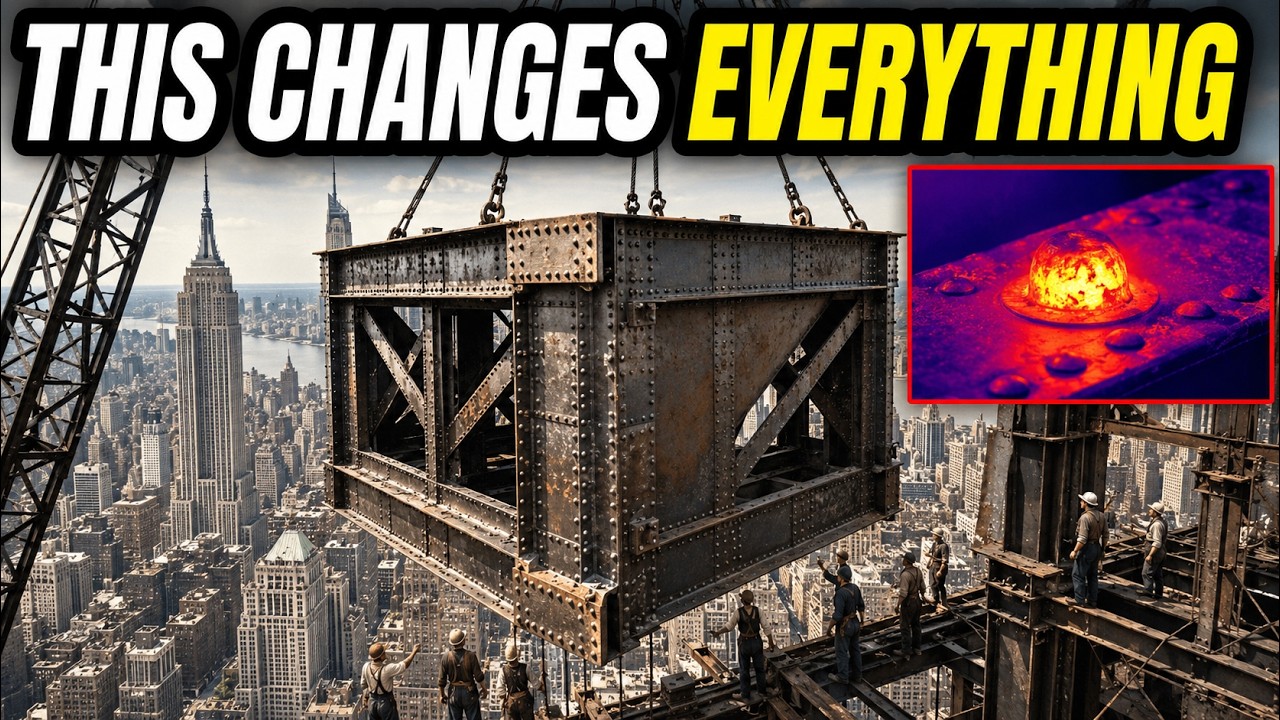
They were not welded. In 1913, nobody knew how to weld a building frame together, and the technique would not be worked out for another twenty years. They were not bolted either, not the way steel is bolted today. They were held together by rivets, millions of them—little iron pins heated in a coal fire until they glowed, thrown through the air one at a time, and hammered flat by hand, by men standing on a plank of wood with nothing underneath them but the drop.
The old construction photographs Lewis Hine took, the payroll records, a coroner’s report on a bridge that fell—they all point to the same truth. The skyline of the richest city on Earth was assembled by hand, one hot rivet at a time. And the men who were best at it, the ones who walked the naked steel like it was a sidewalk, came from one small community outside Montreal that paid for that skyline with its own dead. To understand any of it, you have to start with the wall.
For almost all of human history, there was a hard ceiling on how tall you could build, and the ceiling was the wall itself. Build with brick or stone, and the wall has to hold up everything above it. Every floor you add presses down on the walls below, so the higher you go, the thicker the bottom has to be. And thick walls eat the building alive from the inside.
You can see exactly where that ceiling was, because it is still standing in Chicago. The Monadnock Building, finished in 1891, is the tallest brick building anyone ever raised on load-bearing walls: sixteen floors of rentable space, two hundred and fifteen feet. To hold up those sixteen floors, the brick walls at street level had to be six feet thick. Six feet.
You could lie down inside the wall. At the top they taper to about eighteen inches, but down at the bottom, a wall thick enough to be a small room runs all the way around the building doing nothing at all except holding weight. The engineers who built the Monadnock ran the numbers and decided that was the practical limit. Go any higher with brick, and the walls at the bottom would swallow so much of the ground floor that there would be almost nothing left to rent.
You would be paying for a mountain of masonry to hold up a handful of offices. The wall had beaten the building. In a city like New York or Chicago in the 1880s, where land near the center cost more than almost anywhere on Earth, that ceiling was a genuine crisis. Everyone wanted to be downtown.
The land was finite, and the only direction left was up. With brick, up was the one thing they could not have. The answer, when it came, was so simple it sounds obvious now, and it was not obvious at all. The answer was to stop asking the wall to hold the building up.
Give the building a skeleton instead. The first man to really do it was William Le Baron Jenney, in Chicago in 1885, in a building called the Home Insurance Building. It was ten stories, later twelve, and by the standards of what came after it was not even tall—about a hundred and thirty-eight feet. But Jenney did something inside it that had never been done in a tall building before.
Instead of thick masonry carrying the load, he built a rigid cage of iron and steel columns and beams, and he let that metal frame carry the entire weight of the structure. The floors rested on the frame. The roof rested on the frame. And the walls—the brick and stone you actually see from the street—did not hold anything up anymore.
They just hung on the outside of the skeleton like a curtain, keeping the weather out. Think about how strange that idea was at the time. A wall that holds nothing. A building that would stand up perfectly well with no outer wall at all, just the steel bones standing there in the open air.
People did not trust it at first. There is a story, impossible to fully prove, that a city inspector climbed the Home Insurance frame, convinced it was about to fall over, and could not find a single thing wrong with it. What Jenney had proven was that the height limit was gone. If the frame carried the weight, then the only questions left were how strong you could make the frame, and how high you were willing to send men to build it.
Within a few years, Chicago had five steel skeleton buildings. Then New York understood what it meant, and the race for the sky was on. But the frame alone was not enough. Two other things had to arrive at almost the same moment, or the skyscraper would have stayed an idea on paper.
The first was the steel itself. For most of the 1800s, steel was expensive, made in small batches, too dear to build with in bulk. Then, from the 1850s onward, the Bessemer process and the mills that followed it turned steel into something you could pour out by the ton and buy cheap. By the 1880s, a builder could order thousands of tons of identical rolled beams and columns from a mill and have them shipped into the middle of a city.
Without cheap, abundant, reliable steel, Jenney’s skeleton was just a clever sketch. The mills made it real. The second thing was the elevator, and specifically the part of the elevator nobody thinks about: the brake. You could build a tower thirty stories high, but if the only way to the top was the stairs, nobody would rent the top.
The top would be the cheap floors. What changed that was a man named Elisha Otis. Elevators already existed hauling freight, but everyone knew the rope could snap and drop the whole thing. In 1854, at the Crystal Palace in New York, Otis stood on a raised platform in front of a crowd and had the rope cut on purpose.
The platform dropped a couple of inches and stopped, held by a safety brake he had invented. “All safe, gentlemen,” he told them. “All safe. ”
Three years later, the first passenger elevator with that brake went into a store in New York.
That is the moment the top of a building became worth more than the bottom, because now you could get people up there safely and quickly. The frame let you build that high. The elevator made the top floors worth paying for. Now you have your steel skeleton, your safe elevator, and your cheap steel from the mills.
Somewhere in Pennsylvania, men have rolled the columns and the beams and the girders. A train has hauled them into the city, and a derrick has hoisted a beam up to where it needs to go, and two men have muscled it into position and dropped a couple of temporary bolts through the holes to hold it there for now. Then those holes have to be closed for good, permanently, so the joint will never move again. Today, you would weld it or run in a high-strength bolt and torque it down.
Back then, you had neither. What you had was the rivet, and the four men who lived and died by it. A rivet is just a short iron pin with a rounded head on one end and a plain stub on the other. Cold, it does nothing.
The whole trick is heat. The way you turned a bucket of cold iron pins into the thing holding a skyscraper together was a four-man crew called a riveting gang, and every one of the four had a job, and every job was insane in its own particular way. The first man was the heater. He worked a small coal forge, and here is the first detail that tells you what kind of work this was: the forge was often nothing but a little furnace set on a wooden plank laid across two beams out on the open steel, hundreds of feet up.
The heater fed rivets into the coals and worked the fire until they glowed cherry red, somewhere around eighteen hundred degrees, soft enough to hammer. And when a rivet was ready, he did not carry it anywhere. He picked it up with a pair of tongs, and he threw it. He threw a glowing hot iron pin, sometimes fifty or sixty feet, sometimes up to the next floor, through the open air of a construction site to the second man, the catcher.
And the catcher caught it. In the early days, he caught it in an old paint can. Later, somebody built a proper catching cone, but the idea never changed. A man stood on a beam with a metal can and caught a piece of iron coming at him at close to eighteen hundred degrees out of the air, without falling off the building, and he did it hundreds of times a day.
If he missed, that rivet was now a burning projectile falling into the city street below, so he learned not to miss. When he had it in the can, he plucked it out with his own tongs and jammed it, still glowing, into the empty hole in the steel where the joint had to close. Now the third man, the bucker up, pressed a heavy iron bar against the rounded head of the rivet from one side and leaned his whole body into holding it dead still. And the fourth man, the gunman, put a pneumatic hammer against the soft stub sticking out the other side and pulled the trigger.
The hammer beat the stub flat, mushrooming it out into a second head. Now the rivet had a head on both ends and could never pull back through the hole. And here is the physics that makes it work. The rivet went in hot, so as it cooled over the next few minutes it shrank.
And shrinking, it pulled the two pieces of steel together with tons of force and locked them. The building tightened itself as it cooled. Every joint in the whole tower is a small piece of iron that came across the gap on fire and then squeezed the structure together by getting cold. There was one more problem the frame had to solve: the wind.
A tall steel skeleton left to itself will sway and rack in a strong wind like a bookshelf with no back on it. So the engineers ran diagonal braces and stiff riveted corners into the frame—knee braces and portal bracing tying the columns and beams into rigid boxes that could take the push of a gale and barely move. Each of those braces was another set of joints, and every joint meant more rivets hammered by hand. The stillness you feel standing in an old skyscraper on a windy day was paid for one rivet at a time by a man on a plank.
Four men, then: a forge on a board, a paint can, an iron bar, a hammer. And they did that, joint after joint, all day, moving out along the beams as the frame climbed, working on planks a foot wide with the wind pulling at them and the street a quarter of a mile straight down. There was no harness. There was no net for most of this era, and for most of these men no hard hat either, just a cloth cap.
If you froze up, you were sent down and not asked back, because a man who froze on the steel got other men killed. A single skyscraper needed hundreds of thousands of rivets. Every ton of steel in it was pinned in place by hand, one glowing rivet caught in a can at a time. There was no other way to do it.
That is not a figure of speech. There was literally no other way to hold a tall steel building together back then. The entire skyline you picture when you think of old New York was built by four-man gangs playing catch with fire on the edge of nothing. Which brings us to the men themselves, and to the one community that became the most famous high steel workers in the world and paid the highest price for it.
Up the Saint Lawrence River from Montreal, there is a Mohawk community called Kahnawake. In the 1880s, a railroad bridge was going up across the river right at the edge of their land, and the bridge company hired local Mohawk men as day laborers, expecting them to haul materials down on the ground. But the men kept climbing. The crews noticed that these particular workers walked out onto the narrow steel over the open river with no apparent fear at all, moving along a girder a few inches wide the way you or I walk down a hallway.
The company started training them as riveters, and a reputation was born that would follow the Mohawk of Kahnawake for the next hundred years: high steel. They became the men you sent up when the job was highest and the fall was longest. There is a myth attached to this that the men themselves have spent generations correcting. The story people like to tell was that Mohawk ironworkers simply felt no fear of heights, as if it were something in the blood.
The men who did the work have said plainly that this is not true. They were afraid, the same as anyone standing on a beam a thousand feet up ought to be. What they had was training and nerve and a refusal to let the fear move their feet, and a community where the older ironworkers taught the younger ones exactly how to walk the steel and exactly what would kill you. It was a skill handed down father to son, and they were better at it than almost anyone alive.
And being the best at the most dangerous job in the country meant that when something went wrong, it went wrong for them worst of all. On the evening of August 29th, 1907, the men of Kahnawake were working on the Quebec Bridge, a few miles upriver from Quebec City. It was going to be the longest cantilever bridge in the world, with more than eighteen hundred feet of span reaching out over the water. And that number, eighteen hundred feet, is where the disaster begins.
The original design had called for a shorter span. Somebody had lengthened it to save money on the stonework of the piers, and in doing so had made the bridge heavier than the steel underneath it was ever calculated to hold. In the days before the collapse, workers had seen the warning signs with their own eyes. Rivets popping.
Steel bending that should have been straight. Joints that no longer lined up. The order to stop work was finally given, but it reached the site too late. At about twenty-five minutes to six, with the men getting ready to come down for the day, the whole south arm of the bridge—thousands of tons of steel—folded and dropped into the Saint Lawrence in about fifteen seconds.
Seventy-five men died that evening. Thirty-three of them were Mohawk from Kahnawake. One small community, thirty-three men gone in a quarter of a minute. The youngest was eighteen years old.
The oldest was forty-four. More than two-thirds of them were married, and they left behind twenty-four widows and dozens of children. In a community that size, on that one day, four family names that had run for generations simply ended. There was no one left to carry them forward.
The women of Kahnawake made a decision after that. They decided the men would never again all work the same bridge or the same tower at the same time. The work was not going to stop, because the work was how the community fed itself. But they would spread the men out across different jobs and different cities, so that a single collapse could never again take the whole next generation in one afternoon.
And the men kept going. They rode the trains down to New York and they built the city. When you look at the great towers of Manhattan, a great many of the rivets in them were caught and driven by Mohawk hands, by the sons and grandsons of the men who fell from the Quebec Bridge in 1907. The tower that crowned the whole first era went up in New York between 1910 and 1913, and it was paid for by a man who sold nickels and dimes.
Frank Woolworth had made an enormous fortune out of five-and-ten-cent stores, and he wanted a headquarters that would announce it to the world. He hired the architect Cass Gilbert, and together they built the Woolworth Building. When it opened in 1913, it was the tallest building on the planet: seven hundred and ninety-two feet, sixty stories. It held that title for seventeen years.
The numbers behind it are the numbers of the whole system made concrete. Twenty-four thousand tons of steel in the skeleton. Seventeen million bricks in the walls that hung off that skeleton holding nothing up. Seven thousand five hundred tons of terracotta molded into Gothic details so fine that people started calling the building the Cathedral of Commerce.
And all of that steel was riveted together by hand, by four-man gangs working hundreds of feet up. Woolworth paid for the entire thing in cash. The final cost came to around thirteen and a half million dollars, and he wrote a check for it, because a mortgage would have suggested he needed one. Then, at the very end of the 1920s, the race went vertical in a way the world had never seen.
Two towers climbing at the same time in Manhattan, each trying to be the tallest thing ever built by human hands. One was the Chrysler Building. Its architect, William Van Alen, was in a bitter contest with the men building 40 Wall Street downtown, and 40 Wall Street looked like it was going to win by a few feet. So Van Alen did something that people still smile about.
He had a hundred-and-twenty-five-foot steel spire built in secret, in pieces, hidden inside the top of the Chrysler Building where no rival could see it. Then, one day in the autumn of 1929, in a little over ninety minutes, his crews raised that spire up through the crown of the building and riveted it into place, and the Chrysler Building suddenly stood over a thousand feet tall, taller than anything else on Earth. Its rival had been beaten by a spike of steel that nobody knew existed until it was already in the sky. Even that trick, the last flourish in the race to the top, was finished the same way everything else was.
It was riveted. The Chrysler Building held the title for eleven months. A few blocks away, the tower that ends this story was already going up, and it went up faster than anyone had ever built anything like it: the Empire State Building. They built it in the depths of the Great Depression, with men lined up desperate for any work at all.
The steel frame climbed at a pace of more than four floors a week. From the start of the structural steel to the finished building was about one year. Roughly thirty-four hundred workers were on it, earning around fifteen dollars a day—which in 1930, with the country falling apart, was a wage men would risk almost anything for. And risk it they did, because the frame that reached twelve hundred and fifty feet into the sky over Manhattan was riveted together the exact same way the Woolworth had been, and the Chrysler spire had been, and the Quebec Bridge had been: by men out on the open steel with a forge and a can and a hammer.
This is when Lewis Hine took the photographs mentioned at the start. The building’s owners hired him to document the construction, and instead of shooting from a safe distance, he went up with the men. He climbed out onto the beams. He hung off derrick cables to get the angle.
He photographed a man riding the hook of a crane a thousand feet up, and men eating lunch on a girder with the whole city spread out beneath their boots, and a riveter leaning back into nothing to reach a joint. He called the men “the sky boys,” and he called the collection *Men at Work*. Those photographs are the reason we can still see this labor at all, because most of it left no other record. The men in them are mostly not named.
Hine noted a few. There is a plaque in the building’s lobby that honors the craftsmen, but for most of the sky boys, we have the image and nothing else. A face, a beam, the drop, and no name. The official count says five men died building the Empire State Building.
Some of the newspapers of the day claimed far more, and the true number has been argued over ever since. But even five men falling from a building that went up in a single year tells you what this work was. That building, finished in 1931, is very close to the last great tower of its kind. At almost exactly the moment the Empire State was topping out, the thing that would end the whole four-man-gang era was already arriving on other job sites: welding.
Through the 1930s, engineers finally worked out how to weld steel building frames together reliably—joint fused to joint with an electric arc instead of pinned with a hot rivet. Welding was lighter, quieter, needed fewer men, and did not require anyone to throw fire across open air. Over the next twenty years, welding and high-strength bolts took over completely. By the end of the 1950s, the riveting gang—the heater, the catcher, the bucker up, the gunman—was simply gone.
An entire trade, the trade that built the American skyline, disappeared inside a single generation. But the rivets are still there. Every one of those old towers—the Woolworth, the Chrysler, the Empire State, and hundreds of others across New York and Chicago—is still standing on hundreds of thousands of rivets that were heated in a coal fire, thrown through the air, caught in a can, and hammered flat by a man on a plank a hundred years ago. Every joint in those buildings is a small permanent record of four men doing something almost unbelievable over and over until the tower was finished.
The steel pulled itself tight as it cooled, and it has been holding tight ever since, long after every man who set it is gone. The story was pieced together out of photographs, payroll books, and a coroner’s report on a bridge in Canada. What stands out is how little of it got written down at the time. We remember the architects.
We remember Cass Gilbert, and we remember Frank Woolworth who wrote the check, and we remember Van Alen and his secret spire. We do not, mostly, remember the heater on the plank, or the Mohawk catcher plucking fire out of a paint can six hundred feet up, or the eighteen-year-old from Kahnawake who went into the Saint Lawrence in 1907 before he ever got the chance to build a tower. Their work is the most visible thing in the biggest cities in the country. Their names are almost entirely gone.
Standing at the bottom of one of those old towers looking straight up the way tourists do, what you are actually looking at is not just steel and stone. It is a hundred thousand small decisions made by men with no rope, catching fire in the air, so that the building could climb one more floor. That was how America built its way into the sky before the machines that made it safe ever existed. By hand.
One hot rivet at a time.






