The pain began as a buzzing in his ear, a strange and unwelcome hum that had never troubled him before. King Francis II of France had barely returned from a hunting trip in Orléans in mid-November of 1560 when the dizziness set in, a familiar companion to a young man who had known sickness all his life. His family saw nothing unusual. They were accustomed to his bouts of ill health, and they likely expected this one to pass like all the others.
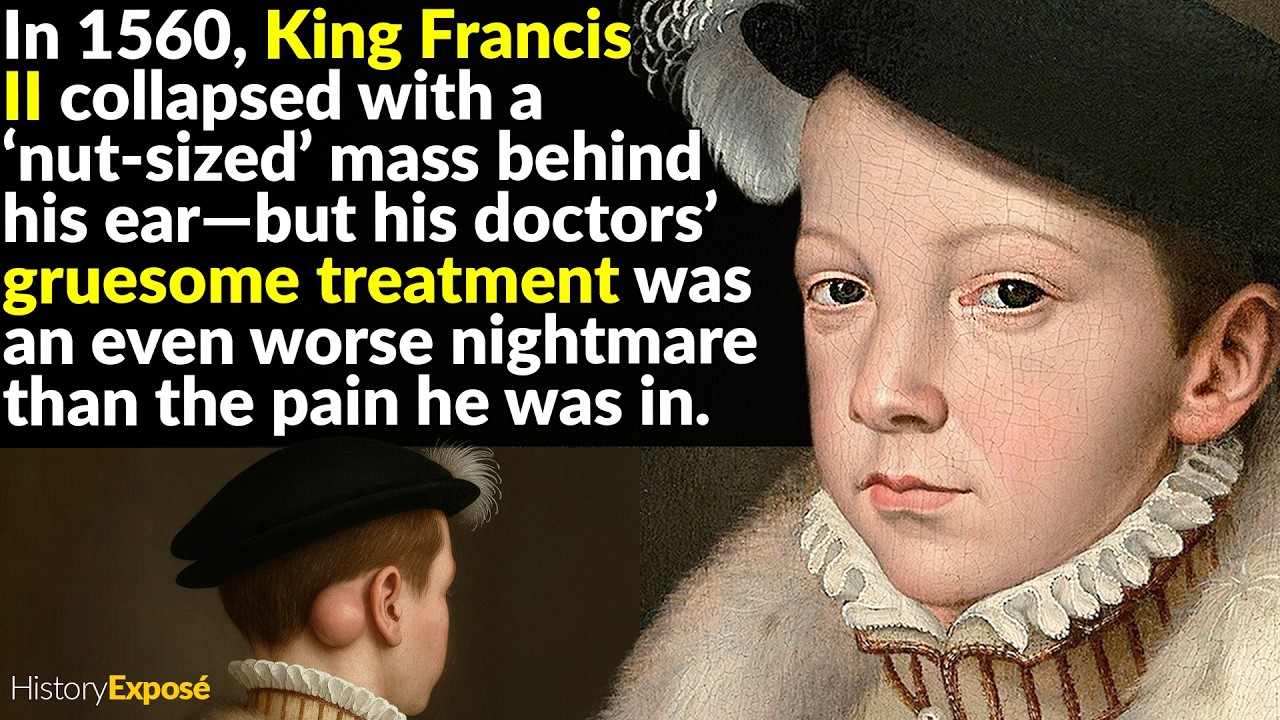
They could not have been more wrong. The following Sunday, as Francis attended church, he collapsed in the middle of the service. When his attendants rushed to him, they discovered a swollen spot the size of a large nut behind his ear. It was an abscess, and it was now sending brutal, stabbing pains through his head.
The doctors lanced it immediately, forcing pus to flood Francis’s mouth and nostrils. The pressure eased, and for a moment, the young king found relief. But no one should have held their breath. Francis had been marked by tragedy from the very beginning.
His father, King Henry II of France, had been married to Catherine de’ Medici for over a decade before she finally conceived, and the delay was hardly a secret. Henry spent most of his time with his mistress, Diane de Poitiers, while Catherine endured the immense pressure placed upon a queen who had yet to produce an heir. When she finally became pregnant, the hopes of an entire dynasty rested on the child. Francis was born in 1544, a boy who arrived carrying enormous expectations, ones his father would only ratchet up further.
Just after his fourth birthday, Francis was thrust into a violent and dangerous game of politics. His father, determined to shore up Catholic power in France against the burgeoning Protestant factions, allied himself with the Catholic kingdom of Scotland. As part of this arrangement, Francis was betrothed to the five-year-old Mary, Queen of Scots. It was a brash piece of politicking, and it stirred enemies that Francis would keep for life.
England was none too happy about Scotland gaining an advantage through an alliance with France. England’s own boy king, Edward VI, had only recently taken the throne, and his father Henry VIII had originally intended for Edward to win Mary’s powerful hand in marriage. England became even less pleased when France ratified the marriage agreement. The Scottish sent their little queen to grow up in the French court, not only so she might adapt to French ways but also to make the deal harder to break.
When Mary arrived, she brought a surprise with her. She was older than Francis and already tall for her age, and she would eventually grow to about five feet eleven inches, an extraordinary height for a woman of that era. She was strikingly beautiful. Francis offered a much different picture.
As the two children grew up in each other’s company, one thing became unmistakable: physically, they could not have been more different. Mary was tall, elegant, and articulate, while people described Francis as short, fragile, and prone to a stutter. Yet somehow, their relationship flourished. Neither of them had asked for this betrothal, but according to Francis’s family, they got along splendidly.
Even so, it was a marriage of unequals, and this quickly became apparent. Frequently ill and far less worldly than his betrothed, Francis came across as more of a younger brother to Mary than a romantic interest. People commented on the little attentions Francis paid her, but Mary took the lead, coaxing him out of his shell by urging him to hunt and to try other outdoor activities. They would need that strong alliance to survive what lay ahead.
In April of 1558, when Francis was fourteen and Mary fifteen, the pair entered into a formal betrothal as a prelude to their swiftly approaching wedding. The ceremony, sometimes called Mary’s handfasting, took place at the Louvre and included formal dancing, along with Mary signing a contract declaring her wish to marry. But the happy day was marred by dark events. After the festivities ended and the various ambassadors began to head home, horrific tidings reached Francis and his family.
No fewer than four of the men who had attended the handfasting perished before ever returning to Scotland. It did not take long for people to believe the worst. It was possible the diplomats were victims of the plague, but Scottish opponents of the union believed something far darker. Some said the men had been poisoned during the betrothal negotiations as part of a plot.
It was not an auspicious beginning to Francis and Mary’s union, though their wedding did compensate for some of the whispers. The French royal family pulled out all the stops for the wedding on April 24, 1558. Mary wore a crown with the massive egg of Naples ruby at its center, and Henry II and Catherine de’ Medici gifted their new daughter-in-law with a ruby-and-diamond pendant that was later called the Great H of Scotland. Francis received something from the marriage too: after the wedding, he was officially the king consort of Scotland.
But he hardly acted like it. Unlike his bride, Francis was not a sight to behold on his wedding day. He reportedly limped from one ailment or another, appeared puffy-faced and sallow, and his ill health had taught him to hate public events, especially one where all attention was on him. Yet in the midst of all the wedding drama, Francis and Mary were holding on to a deep secret.
On April 10, just before the betrothal formalities, Mary had discreetly signed an agreement stating that if she died without issue, Scotland would fall under French rule. It was a clause that would enrage Scotland if it ever came to light, but it never happened, because fate was far crueler to Francis. As part of their honeymoon period, everyone expected Mary and Francis to produce a new generation of French-Scottish royalty. By the next summer, rumors even circulated that Francis had gotten Mary pregnant.
By the time people realized these rumors were false, catastrophe had already blown through. In June of 1559, Francis’s father, Henry II, was unwinding from all his son’s wedding stress by participating in a jousting tournament. The tournament was supposed to celebrate the peace France had just brokered with the Hapsburgs of Austria, but it ended in ghastly bloodshed. While the king was jousting with one of his guardsmen, the man’s lance broke and splintered directly into Henry II’s face.
It was a brutal moment that would change Francis’s young life forever. The doctors did not know it at the time, but one of the splinters had pierced the king’s eye, causing brain damage. On July 10, Henry perished in agonizing fashion from sepsis that crept into his brain. It was an utterly horrific way for Francis to become king of France.
Nothing about the days that followed was easy. Near the moment of his father’s passing, all of Francis’s family secrets began coming out of the closet. After years of playing second fiddle to Henry’s mistress Diane de Poitiers, Catherine de’ Medici enacted the ultimate power play. She banned Diane from Henry’s deathbed and then exiled her entirely.
After years of taking a back seat, Catherine was positioning herself as an influence at court right on the eve of her son becoming king. But it became very messy. Francis was only fifteen years old when he became king, and Mary was just sixteen. Incredibly, French law declared that fifteen was old enough to be considered an adult, and there was no necessity for Francis to have a regent to help him rule.
Luckily, Francis was wise enough to know he needed one anyway. Unluckily, he may have made the wrong choice. Francis chose his wife Mary’s uncles from the House of Guise: Francis, Duke of Guise, and Charles, Cardinal of Lorraine, as his advisers. They were capable candidates and already wielded immense influence in the French court.
But in choosing his wife’s side of the family, Francis had ignored one vital member: his own mother. More often than not, when a king died unexpectedly and his heir took over, the heir’s mother acted as regent. Francis had apparently skipped right over Catherine de’ Medici. The story was more complicated than that, however.
According to one report, the teenage Francis had gone directly to his mother after becoming king and told his ministers to ask Catherine for orders on that very first day. But too deep in mourning for her late husband to take on the responsibility, Catherine pointed the ministers in the direction of Mary’s uncles. If this was true, Catherine quickly and viciously changed her mind. Up until this point, Mary had been well-liked by practically everyone in the French court.
But after Catherine was shunted away from power and Mary replaced her as queen of France, the Medici matriarch turned into quite the mean girl. Suddenly jealous of Mary, she gave her daughter-in-law the cold shoulder, possibly to compensate for her lack of power in Francis’s court. Francis did what he could to intervene. In a seeming bid to placate his mother, he granted Catherine de’ Medici the most opulent settlement ever made to a queen dowager.
To seal the deal, he also began every royal letter with the phrase, “This being the good pleasure of the queen, my lady mother. ” Evidently, Mary, Queen of Scots, was no rival to Catherine de’ Medici when it came to Francis’s heart. Not that Francis could put up much of a fight for his wife. He had always been a fragile youth, and the pressures of the crown only intensified his frailty.
He frequently suffered from eczema, dizzy spells, and a runny nose. Many believed that one of the reasons he was so keen to have a regent, despite being of age, was because he understood he did not have the physical fortitude to run the country alone. At his coronation, this became all too clear. Francis was officially crowned king of France on September 21, 1559, with Mary’s uncle Charles heading up the ceremony.
But the rite contained an embarrassing detail: the crown was far too heavy for the sickly king, and multiple nobles had to hold it on his head throughout the ceremony. It would become a metaphor for the rest of his short, bitter reign. In truth, King Francis II had inherited a kingdom as sick as himself. In 1559, France was on the edge of bankruptcy, and lenders, almost entirely out of hope of getting their money back, were unlikely to provide Francis any future funding.
If that were all, maybe the young king could have navigated it. Instead, far greater problems loomed. France’s Protestant versus Catholic battle was heating up, turning vicious and bloody. Two months after Francis’s coronation, in response to the trial of the Protestant martyr Anne du Bourg, latent unrest erupted into violence across Paris.
It rapidly spiraled out of control. With a chronically sick teenager on the throne and two Catholic nobles potentially loyal to the Scottish crown acting in his stead, many in France were not just unhappy with their royal family. They understood just how vulnerable they were. In no time at all, a faction of Protestants, helped by malcontent military men, began plotting a conspiracy to unseat the Catholic uncles from the House of Guise and exert control over Francis themselves.
It backfired, but it backfired on almost everyone. The rebel faction took Louis de Bourbon, the first prince of Condé, as their leader and began gathering strength. Francis’s regents reacted with terrifying speed. After learning about the conspiracy in advance, the brothers of Guise quickly crushed the rebellion and maintained their grip on Francis’s ear and throne, even as Bourbon escaped.
But this had a disastrous ripple effect. Although the central conspiracy failed to unseat Francis’s Catholic advisers, it spurred a state of unrest throughout the provinces. Soon, all over the kingdom, guerrilla armies and Protestant citizens invaded churches and took them for their own. It was at this point that Francis finally showed his mettle.
He was sickly, but he was apparently no fool, and it did not take a genius to see that his kingdom was falling into shambles. Infuriated by the rebellions, the teenage king showed a dark side. He unleashed a torrent of troops across the country, quelling rebellion wherever there was even a whisper of it. Then he got his personal revenge.
After months of trying to catch him, Francis and his allies finally nabbed the Prince of Condé, overwhelming him with men and detaining him. Although the noble rebel continually filibustered the proceedings, Francis and the Guise brothers were at last able to sentence him to imprisonment. Francis had finally found a taste for blood, but also a taste for controversy. Just after Francis’s wedding, England’s Catholic Queen Mary I had died, and her Protestant sister Elizabeth took the throne.
This was an opening for Francis and his wife. Like many other places in Europe, some in England wanted another Catholic queen and looked to Mary, Queen of Scots, since she had a claim to the English throne through her grandmother, Margaret Tudor. Instead of backing away from this drama, Francis and Mary jumped right in. After their marriage, they naturally took new heraldry to honor their union, and in so doing, they made a bold choice.
They decided to nestle the English coat of arms inside their heraldry, calling out Mary’s claim, and thus Francis’s claim, to the English throne. When English diplomats at the French court noticed the bravado, they turned around and reported the new heraldry to Queen Elizabeth. Irritated at the young upstarts and their apparent threat, Elizabeth had the English College of Arms officially declare the heraldry invalid. Still, this was not enough for her.
Elizabeth forgot very little, and years later, she decided to show Francis and his wife her real might. In January 1560, Elizabeth sent a fleet to Edinburgh’s port of Leith, where French troops, still friendly with Scotland, had set up a military base. She had her ships blockade the port, then brought in thousands more men to besiege the city. For Francis, the timing could not have been worse.
France gave Francis enough of a headache, but Scotland was its own kettle of fish even without Queen Elizabeth. In 1559, many Scots decided they had had quite enough of the French in their land and forced them out of Edinburgh. Fearing for her own safety, Francis’s mother-in-law, Marie of Guise, fled for the Scottish countryside and begged France for help. Francis and Mary sent troops across and eventually reinstated their grip on Scotland, but they had little time to bask in the victory.
The hunting trip to Orléans in November of 1560 was meant to be a respite. Instead, it began the final, horrifying chapter of Francis’s life. After the collapse in church and the lancing of the abscess, relief proved temporary. Later in the month, it became clear that Francis was nowhere near out of the woods.
He began suffering from seizures and could no longer speak or move. His wife and mother alternated nursing and praying for him while the doctors busied themselves with desperate attempts at a cure, including rhubarb enemas and even discussing trepanning, that is, drilling a hole in his head. But it was all too late. After a brief period where they thought the king was turning a corner, the abscess erupted once more, and Francis became utterly delirious before turning completely inert.
On December 5, 1560, after weeks of agony that mirrored his father’s own end, Francis perished just a handful of weeks shy of his seventeenth birthday. But his tragic legacy was not over yet. Even as he lay dying, his own mother was angling for his power. Fed up with taking a backseat to the throne behind the Guise brothers, Catherine de’ Medici orchestrated an agreement with the court that guaranteed she would become regent when Francis’s younger brother, the future Charles IX, took the throne.
In the midst of Francis’s final ragged breaths, his mother was thinking of herself. It was not the only heartbreak in the years that followed. The religious turmoil between Catholics and Protestants that ignited during Francis’s reign grew into a raging fire after his demise. In 1572, with his brother Charles IX still serving as king and Catherine still at the helm, the St.
Bartholomew’s Day Massacre saw the deaths of thousands, perhaps tens of thousands, of Protestants, all under the direction of the French royal family. Another issue concerned the lack of an heir. Although they had been young, people at the time questioned why Francis and Mary had not produced a single sign that they had consummated their union in the year and a half they were married. Historians still wonder if the pair ever slept together, even as Mary wrote to her mother after the wedding night, “All I can tell you is that I account myself one of the happiest women in the world.
” The answer to that question might have been ruinous for Francis. There is evidence that his own family thought he was impotent, a view supported by some historians. We will never know for sure what Francis might have become if he had survived his poor constitution, but the reign of King Francis II of France was all too brief and all too brutal. Despite marrying one of the most powerful queens in Europe, he witnessed the gruesome demise of his father, navigated vicious religious turmoil, and ultimately succumbed to a monstrous ailment.
A boy king he might have been, but his life was far from innocent.






