Ilsa Koch heard the cell door close behind her on the morning of September 1st, 1967, and made her decision. She was sixty years old, imprisoned in the women’s correctional facility at Aichach in Bavaria, and had spent the better part of two decades inside walls that had become the entire horizon of her existence. By the time the guards found her, she was dead. She had hanged herself in her cell.
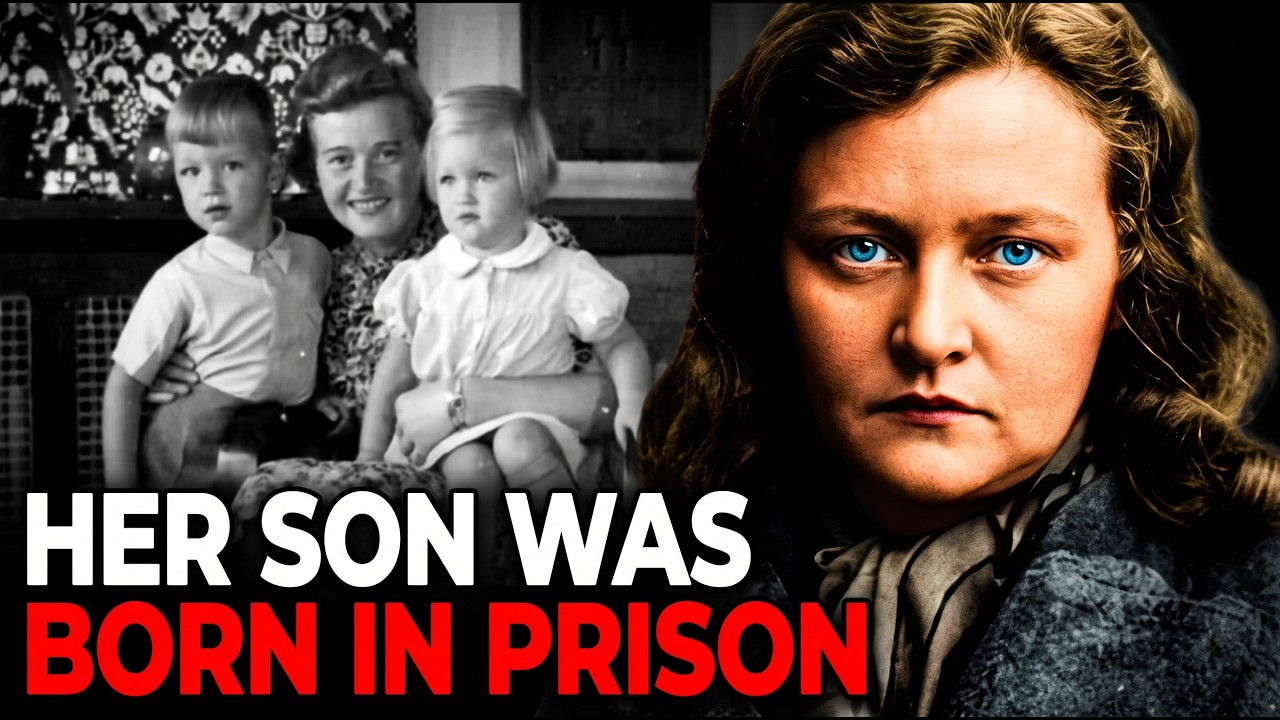
The date carried a dark irony that would not go unremarked: it was the twenty-eighth anniversary of Germany’s invasion of Poland, the act that had begun the war in which her crimes were committed. The woman the world knew as the Witch of Buchenwald had not died as a soldier or a general or a formal member of the Nazi military hierarchy. She had been a wife, the wife of Carl Otto Koch, commandant of the Buchenwald concentration camp. But by the time the war ended, her name had become synonymous with a particular kind of cruelty: allegations of lampshades made from human skin, shrunken heads kept as trophies, whippings administered with casual contempt, prisoners murdered for entertainment.
Whether every rumor was verified or not, she had become one of the most despised women in the history of the Third Reich. Now she was gone, and the questions that outlived her were not about her own guilt, which had long since been settled in courts on both sides of the Atlantic, but about the people she had left behind. What had become of her children, who bore her blood and her name into a post-war world that wanted nothing to do with either? What had happened to the family of the Witch of Buchenwald?
To understand that story, it is necessary first to understand who Ilse Koch was and how she came to occupy her terrifying position. She was born Margarete Ilse Köhler on September 22nd, 1906, in Dresden, the daughter of a factory foreman. She grew up in a working-class family and showed no particular signs in her youth of what she would become. She worked for a time as a bookkeeper and a librarian, professions that conjure images of quiet domesticity rather than brutality.
But the Germany of the late 1920s and early 1930s was convulsing with economic misery, political radicalism, and the rising thunder of National Socialism. Ilse was drawn into the orbit of the Nazi Party, joining the NSDAP in 1932, the year before Hitler took power. It was through the party that she met the man who would define the rest of her life: Carl Otto Koch, a career SS man, ambitious and brutal in equal measure. He had already served at Sachsenhausen and Columbia House before being appointed commandant of the newly established Buchenwald camp.
By the time Ilse and Carl married in 1936, he was a rising figure within the SS concentration camp system. Their marriage was, by all accounts, a meeting of shared ideology. Ilse was not a passive wife dragged along by an overbearing husband; she was an enthusiastic participant in the world the SS had built. In 1937, Carl Koch was transferred to Buchenwald, situated on the Ettersberg hill near Weimar in what had once been the heartland of German classical culture.
Under his command, and with Ilse living on the camp grounds in a villa not far from the prisoner barracks, Buchenwald became a place of systematic terror, forced labor, starvation, and murder. Ilse Koch took to camp life with an enthusiasm that horrified even some of her contemporaries. She rode horses through the camp grounds, reportedly whipping prisoners who did not move out of her way quickly enough. She was said to point out prisoners with interesting tattoos who would subsequently be killed and their skin preserved.
She strutted through the camp in tight riding clothes, fully aware of the effect her presence had on starving, terrorized men who were forbidden to look at her under pain of severe punishment. Survivors would later testify to her cruelty in vivid and horrifying detail. Prisoners knew her as die Kommandeuse, the female commandant, a title that carried a very specific kind of dread. The marriage produced three children.
Their first child, a son named Artwin, was born in 1936, the same year as their marriage. A second child, a daughter named Gisela, followed in 1937. A third child, another son, arrived in 1943. These three children grew up in the shadow of Buchenwald, in the villa their parents occupied while thousands of human beings suffered and died beyond the fence line.
What they understood about where they lived, what they heard and saw, are questions historians and psychologists have grappled with for decades, and there are no comfortable answers. Carl Koch’s fate came before the war ended, and it represents one of the more darkly ironic chapters in the entire story. Despite commanding a camp where tens of thousands of people would die, he was not brought down by his victims or by Allied forces. He was investigated and eventually tried by the SS itself.
The charges were not murder, not cruelty to prisoners, not systematic terror. The SS did not care about any of that. The charges were corruption and embezzlement. It emerged that Koch had been systematically stealing from the camp, from the property of murdered prisoners, from the SS treasury.
He had also been involved in the murder of prisoners who might have been able to testify against him regarding these financial crimes. The investigation was led by SS Judge Georg Konrad Morgen, a figure who would later claim at Nuremberg that he had been trying to bring the camp system to account, though historians remain divided on how much genuine moral courage was involved in his work versus institutional self-interest. The investigation found sufficient evidence to charge Carl Koch with murder and corruption. He was tried before an SS and police court, found guilty, and on April 5th, 1945, just days before American forces arrived to liberate Buchenwald, he was executed by the SS itself.
He was shot on the grounds of the very camp he had commanded. His wife was already under arrest by that point, having been detained by the Germans themselves in 1944 on similar charges. When American soldiers rolled into Buchenwald on April 11th, 1945, they found a camp whose commandant was already dead, whose commandant’s wife was already in custody, and whose horrors nonetheless stunned even men who had been told to prepare themselves for the worst. The evidence American forces found there, the shrunken heads, the tattooed human skin specimens preserved in jars in the pathology department, the testimonies of survivors who poured out their experiences with desperate urgency to any Allied soldier who would listen, transformed Ilse Koch from a regional SS figure into an international symbol of Nazi evil.
She was formally arrested by American forces and held for trial. The first major proceeding against her came in 1947, when she was tried before an American military tribunal at Dachau as part of the Buchenwald trial. The trial covered a wide range of defendants connected to the camp, including guards, doctors, and administrative personnel. Ilse faced charges that included participation in a criminal organization and assault.
The specific charges around the human skin allegations were more difficult to prosecute under the evidentiary standards the tribunal applied. Nonetheless, survivor after survivor testified to her cruelty, her contempt, her enthusiastic participation in the degradation and murder of prisoners. The tribunal found her guilty and sentenced her to life imprisonment. For a brief, astonishing moment, that sentence was commuted.
In 1948, General Lucius Clay, the American military governor of Germany, reviewed the convictions from the Dachau trials and reduced a number of sentences. In Ilse Koch’s case, he reduced her life sentence to four years, citing what he described as insufficient evidence to prove that she had personally ordered killings. The outcry was immediate and enormous. American newspapers ran headlines describing the reduction as an outrage.
Senators and congressmen demanded explanations. General Clay maintained his position, arguing that the legal standard had to be applied consistently regardless of public sentiment. The controversy reached the United States Senate, where Joseph McCarthy, then at the beginning of his political career and not yet associated with the anti-communist crusade that would later define his legacy, was among those who made speeches in 1948 attacking the sentence reduction as a miscarriage of justice. A Senate investigation subcommittee was convened to examine the Dachau trials.
Its findings, published in 1949, were critical of certain aspects of the American military tribunal process, but did not result in the restoration of Ilse Koch’s life sentence, as the West German government was already moving toward its own prosecution. Ilse was released in 1949, having served approximately three years. The release did not mean freedom in any real sense, and it certainly did not mean the end of her legal troubles. In West Germany, there was immediate and sustained pressure to try her again under German law.
In 1950, West German authorities arrested her again. The new trial, conducted before a West German court in Augsburg, would be far more exhaustive than the American military proceeding. It lasted until 1951 and heard testimony from dozens of survivors of Buchenwald. Witnesses described her conducting personal inspections that resulted in prisoners being murdered, described her ordering beatings, described the culture of sadistic pleasure she had cultivated in the camp.
The question of the human skin artifacts, which had dominated American coverage of Buchenwald, was addressed in careful and legally precise terms. The West German court’s findings were more nuanced than the sensational newspaper coverage had suggested. While the existence of such artifacts at the camp was confirmed, the direct personal connection between Ilse Koch and the selection of victims for this purpose was handled carefully under the strict evidentiary rules of a civilian criminal court. What was proven to the court’s satisfaction by an enormous weight of evidence was that Ilse Koch had been a direct and enthusiastic participant in the terrorization and murder of prisoners.
In 1951, the West German court sentenced her to life imprisonment. This time there would be no commutation. But before following Ilse into those proceedings, there is a question the history books often skip over. Where were her children during all of this?
When Ilse was arrested by American forces in 1945, her children were effectively orphaned. Their father had been executed by the SS. Their mother was in Allied custody. Three children, ranging from roughly two years to nine years old, were left without parents in the ruins of postwar Germany.
The youngest legitimate child, born in 1943, has a particularly complicated story. In some accounts, this child was born while Ilse was already under German SS investigation, and the paternity of this child has been disputed. Some historians and contemporary investigators believe the child was not Carl Koch’s, that Ilse had been involved with another man. What is known with confidence is that the children were placed into the care of the German welfare system, that they were separated from their mother for the years of her imprisonment and trials, and that they grew up bearing the most notorious surname in postwar Germany.
Artwin Koch, the eldest, faced the most direct and devastating consequences. Born in 1936, he was approximately nine years old when his father was executed and his mother arrested. He spent his formative years in the care of institutions and foster families. He grew up knowing exactly who his parents were.
How could he not? The name Koch in the context of Buchenwald had become globally synonymous with atrocity. Historical accounts of Artwin’s later life are fragmentary, as he, like so many children of perpetrators, worked hard to disappear from public record. What is known suggests that he changed his name at some point in his adult life, a common step taken by many children of notorious Nazis who needed to build lives in postwar German society.
For Artwin, the situation was perhaps even more acute than for many others, because his mother, unlike most Nazi leaders’ wives, had been tried and convicted personally. She was not simply the wife of a criminal. She was a convicted criminal herself. The stigma was doubled, layered, inescapable.
Gisela Koch, the daughter, born in 1937, faced the same fundamental challenge. She spent roughly the first eight years of her life in the world of the SS, in the world of the camp, in the villa at Buchenwald. She was old enough at liberation to have genuine memories of that world, memories she then had to carry through the rest of her life. What she saw or understood of the camp’s operations cannot be known.
What is certain is that she did not become a public figure, did not contribute publicly to the historical record about Buchenwald, and did not to any documented extent engage with the memorial and educational institutions that sprang up around her family’s history. She found whatever accommodation she could with the irreversible facts of her childhood. The youngest legitimate child, born in 1943, has the most obscured fate of all three. The circumstances of the birth, the disputed paternity, the extreme youth at the time of both parents’ legal catastrophes, and the evident effort to maintain anonymity all combined to make this the most difficult thread to follow.
And then there was a fourth child, the one most invisible in contemporary accounts, the one whose existence represents perhaps the most extreme version of the question of inherited identity and unearned guilt. It was during the period of her initial detention by American forces that Ilse Koch discovered she was pregnant. By late 1945, it became clear she was expecting. In September 1947, while in American detention awaiting the completion of her trial proceedings, she gave birth to a son.
The child was given his mother’s maiden name and became known as Uwe Köhler. He was born into a prison. He was taken from his mother and placed in German welfare care. He grew up not knowing who his mother was.
Uwe was raised in an orphanage and later by foster families in Bavaria. He did not know the name of his biological mother. He did not know the name of the camp. He did not know that his birth had occurred in a prison.
He built a life, becoming by several accounts a reasonably well-adjusted individual who worked in a skilled trade and maintained a quiet existence in a small Bavarian town. Then, at some point in his late teens or early twenties, he found out. The details of how he discovered his parentage vary across different sources, but the fact that he discovered it is not in dispute. At some point in the late 1960s, Uwe Köhler visited Ilse Koch in Aichach prison.
He met his biological mother. Accounts of this meeting and of the relationship that followed are sparse and sometimes contradictory. What is known is that Ilse Koch was apparently moved by the existence of this son she had effectively never known. What is certain is that the circumstances of their reunion took place against the backdrop of her deteriorating mental state.
By the late 1960s, she had been in prison for the better part of two decades. She was aging, isolated, and by multiple accounts had developed significant psychological problems. The knowledge that her children, all of them, had been taken from her and raised apart from her, combined with the relentless public hatred directed at her, had clearly taken a toll. On September 1st, 1967, Ilse Koch hanged herself in her cell at Aichach prison.
She was sixty years old. She had been sentenced to life, and she served it in a sense, though she ended it on her own terms. She had served nineteen years in West German imprisonment at the time of her death. She had not repented by any account.
She had not contributed to the historical record in any useful way. She had not provided testimony, had not written a memoir of historical value, had not named others who deserved investigation. Her children, as her legal heirs, were presumably notified. What that notification meant to each of them cannot be known.
There is no documented record of any public response from any of them. The silence was complete. The death of Ilse Koch did not end the story of her family. In many ways, it intensified certain aspects of it, because death removed the living focus of public hatred and replaced it with questions that were harder to answer.
What did her children owe the world? What did the world owe them? Were they victims of their parentage, or were they somehow tainted by it? Uwe Köhler, who had visited his mother before her death and who thus had some direct experience of what she was, was left to continue his quiet Bavarian life, bearing knowledge that most people around him presumably did not share.
In one extraordinary documented instance, a West German journalist tracked him down in the late 1960s or early 1970s and attempted to interview him about his mother. Uwe reportedly refused to speak publicly about her and expressed his wish to be left alone to live his life without reference to his origins. Artwin Koch navigated his life with what appears to have been a consistent strategy of withdrawal from public attention. He changed his name, moved to a part of Germany where he was not known, built a career.
He may have married and had children of his own, children who would be the grandchildren of Ilse and Carl Koch, children who may or may not have been told anything about their grandparents’ history. What can be said is that Artwin did not, unlike some children of perpetrators, become a public figure or advocate in any capacity related to his family’s history. He did not follow the path taken by Niklas Frank, the son of Hans Frank, the Nazi governor general of Poland, who spent his adult life publicly condemning his father and engaging with Holocaust memorial and education work. He did not follow the path of Martin Bormann Jr.
, the son of Hitler’s powerful secretary, who became a Catholic priest and spent his life attempting to atone for his father’s crimes through religious service and public engagement. Artwin Koch’s path was the path of silence and disappearance. The broader question of what happened to Ilse Koch’s extended family leads into equally murky territory. She had siblings, a brother and a sister, both of whom survived the war and both of whom apparently worked hard to distance themselves from their notorious relative.
The Koch surname, which Carl had brought to the family, was the poisoned brand, not the Köhler name of Ilse’s birth. And yet even Köhler, after Uwe was given it as his surname, carried associations that were not entirely neutral. The idea that a relative of Ilse Koch could simply blend into ordinary German life without their connection being discovered or whispered about requires a degree of optimism about human nature that the postwar German experience does not entirely support. Communities talked, people remembered.
The German welfare system of the postwar years was not equipped in any psychological or institutional sense to deal with the very specific and extraordinary needs of children of convicted war criminals. There were no support groups, no therapeutic framework, no public figures modeling how to carry this kind of identity, no books written for such children about how to understand what their parents had done. They were simply placed in the system and expected to manage. That most of them apparently did manage, that they built functional lives and did not themselves become criminals or public menaces, is remarkable when you consider what they were carrying.
The liberation of Buchenwald on April 11th, 1945, was itself a historically significant moment, and not only because of the horrors American forces found there. The camp had developed in its final years a remarkable prisoner resistance organization, largely dominated by communist political prisoners who had managed to acquire hidden weapons and who, in the days just before liberation, had effectively taken control of portions of the camp as SS guards fled. When soldiers of the Sixth Armored Division of Patton’s Third Army arrived, they found a camp that had partially liberated itself. Among the survivors was Elie Wiesel, then sixteen years old, who had arrived at Buchenwald after the death march from Auschwitz.
He would go on to write Night, one of the most important literary testimonies to the Holocaust ever produced, and would win the Nobel Peace Prize in 1986. His presence at Buchenwald and his survival represents one of the most profound counterpoints to the crimes of Ilse Koch. From the same grounds where she had stalked and tormented and allegedly selected victims, one of the great moral voices of the twentieth century had emerged. General Eisenhower himself visited the camp on April 12th, 1945, the day after liberation.
He brought senior commanders and insisted that German civilians from the nearby town of Weimar be brought to the camp to see what had been done in their vicinity, in some cases in their name. The photographs of German civilians being led through the camp, their faces registering shock, shame, denial, or carefully neutral blankness, have become iconic images of the postwar German confrontation with Nazi crimes. Eisenhower reportedly said that he wanted the evidence gathered so thoroughly that no one would ever be able to deny that these things had happened. Among those captured and brought to justice in connection with Buchenwald was Hermann Pister, who had replaced Carl Koch as commandant of the camp in 1942 after Koch’s removal and subsequent investigation by the SS.
Pister had served at Stutthof before coming to Buchenwald, and under his command the camp’s killing operations continued and in many respects intensified. He was tried at the Dachau Buchenwald trial in 1947, the same proceeding in which Ilse Koch received her initial life sentence. He was found guilty and sentenced to death. He died in September 1948 at Landsberg prison before the execution could be carried out.
Another significant figure who faced justice was Dr. Waldemar Hoven, the camp physician who had conducted or overseen medical experiments on prisoners and who had also been implicated in the murder of prisoners whose knowledge of corruption within the camp leadership threatened to expose the Koch financial crimes. Hoven was tried and convicted at the Doctors’ Trial at Nuremberg in 1947, one of the subsequent Nuremberg trials conducted by American military tribunals. He was sentenced to death and executed at Landsberg prison in June 1948.
From that trial emerged the Nuremberg Code, a set of ethical principles governing human experimentation that became foundational to the development of modern bioethics. It was a perverse irony that some of the most important advances in medical ethics in human history were forged directly from the testimony of those who had survived the most extreme violations of those very principles. The broader circle of people connected to the Koch story includes not just the guards and commandants and their families, but also the prisoner functionaries, the Kapos who were prisoners themselves but who held positions of authority over other prisoners. Their fate after the war was as varied as their roles during it.
Some were prosecuted by both Allied and German courts for their brutality toward fellow prisoners. The legal and moral question of what responsibility prisoner functionaries bore for their actions, given that they were themselves subject to lethal coercion, has never been fully resolved and remains one of the most painful and contested areas of Holocaust scholarship. The town of Weimar, situated just eight kilometers from the camp gates, knew that Buchenwald existed. The residents heard the trains arriving.
They smelled the smoke from the crematorium on certain days depending on the wind direction. They employed camp prisoners on various labor projects in the town itself. The forced proximity between the cultural capital of classical Germany, the city of Goethe and Schiller and Liszt, and one of the most murderous installations in the Nazi camp system was not accidental. It was a deliberate choice by Heinrich Himmler, who selected the site in part precisely because of its proximity to Weimar as a statement about the relationship between the old Germany and the new one that National Socialism was building.
The West German trial that convicted Ilse Koch did not close the book on questions of justice for the camp’s crimes. Throughout the 1950s and into the 1960s, West German prosecutors continued to investigate and in some cases prosecute individuals connected to Buchenwald and to the broader SS camp system. The establishment of the Central Office of the State Justice Administrations for the Investigation of National Socialist Crimes in Ludwigsburg in 1958 represented a more systematic attempt to pursue perpetrators who had evaded earlier proceedings. Its work led to a series of high-profile trials in the 1960s, including the Ulm Einsatzkommando trial of 1958 and the Frankfurt Auschwitz trials of 1963 to 1965, which profoundly shaped West German self-understanding.
The Frankfurt Auschwitz trials in particular, prosecuted by Attorney General Fritz Bauer, a Jewish survivor of Nazi persecution who had returned to Germany specifically to pursue this work, represented a generational watershed. Unlike the Nuremberg trials, which had been conducted by foreign powers and which many Germans could somewhat distance themselves from, the Frankfurt trials were conducted by Germans under German law with German defendants and German judges. They forced a confrontation with the past that the Allied-run proceedings had not fully achieved. The detailed and graphic testimony about the mechanics of the Auschwitz killing process, delivered in public for weeks, had an enormous impact.
For the Koch children sitting somewhere in West Germany, presumably watching or reading the coverage, the experience of seeing this public reckoning with the camp system that their own parents had been part of must have been intensely personal and deeply complicated. The documentary filmmaker Erwin Leiser, whose 1960 film Mein Kampf used archival footage to construct a devastating account of National Socialism, and Alain Resnais’s Night and Fog from 1956, which included footage from Buchenwald specifically, brought the visual reality of the camp system to general audiences in ways that pure legal proceedings could not. Whether the Koch children ever saw these films, and if so, what they experienced watching them, is a question without an answer. But the films existed.
The images existed. The world in which they were trying to build lives was a world that periodically confronted them with the photographic and documentary record of what their parents had done. The story of what happened to Ilse Koch’s family after World War II does not have a satisfying ending, because it is not that kind of story. There is no redemption arc, no documented acknowledgement, no public act of contrition or engagement that would allow the circle to be closed.
The story ends instead in the quiet obscurity that the Koch children sought and apparently achieved in lives lived out of the public eye, in a Germany that was itself slowly and imperfectly working through what it had done. It ends with Uwe somewhere in Bavaria carrying knowledge that most people around him probably did not share. It ends with Artwin Koch under whatever name he chose to live, building a life that required a constant negotiation with the past he carried. It ends with Gisela, the daughter who remembered the villa and the grounds and the first years of her life at Buchenwald, finding whatever accommodation she could with the irreversible facts of her childhood.
And it ends with the youngest child, whose very name and identity are the least documented of all, living whatever life they lived with whatever relationship to the family history they chose to maintain. These are human stories, and they deserve to be acknowledged as such. Not to excuse anything, not to diminish the suffering of the victims, not to suggest that the children of perpetrators are themselves victims in any way comparable to those who suffered and died at Buchenwald. The survivors and the murdered are in a category of moral priority that is not shared by the children of those who killed them.
But the humanity of the Koch children, their status as people who had done nothing wrong and who nonetheless carried an extraordinary burden, is also real and worth acknowledging. The central and irreducible fact is the suffering of the prisoners who were subjected to the system she participated in and contributed to. More than 56,000 people died at Buchenwald. They had names and faces and families and hopes and histories that the camp sought to erase.
The work of the Buchenwald memorial, the work of Holocaust scholarship, the work of survivor testimony projects is to restore some of those names and faces and histories, to insist on the individuality and humanity of each person who was murdered there. The story of Ilse Koch and her family is told in the service of that larger story, as an illustration of the human reality of how the crimes were committed and what consequences flowed from them. But it is always, in the final analysis, secondary to the story of the people who suffered and died at Buchenwald, whose memory deserves to be honored and whose humanity must never be forgotten.






