The young woman who had once stood at the center of a Parisian stage, bathed in applause, now stood in a doctor’s office in Zurich, waiting to be explained. She was twenty-seven years old, and the man examining her was the most famous psychiatrist alive, Carl Gustav Jung. He had read her writings, listened to her fragmented speech, and watched the way language dissolved and reformed in her mind. And what he concluded about her and her father would become one of the most startling observations in the history of literature—and one that her family would never forgive.
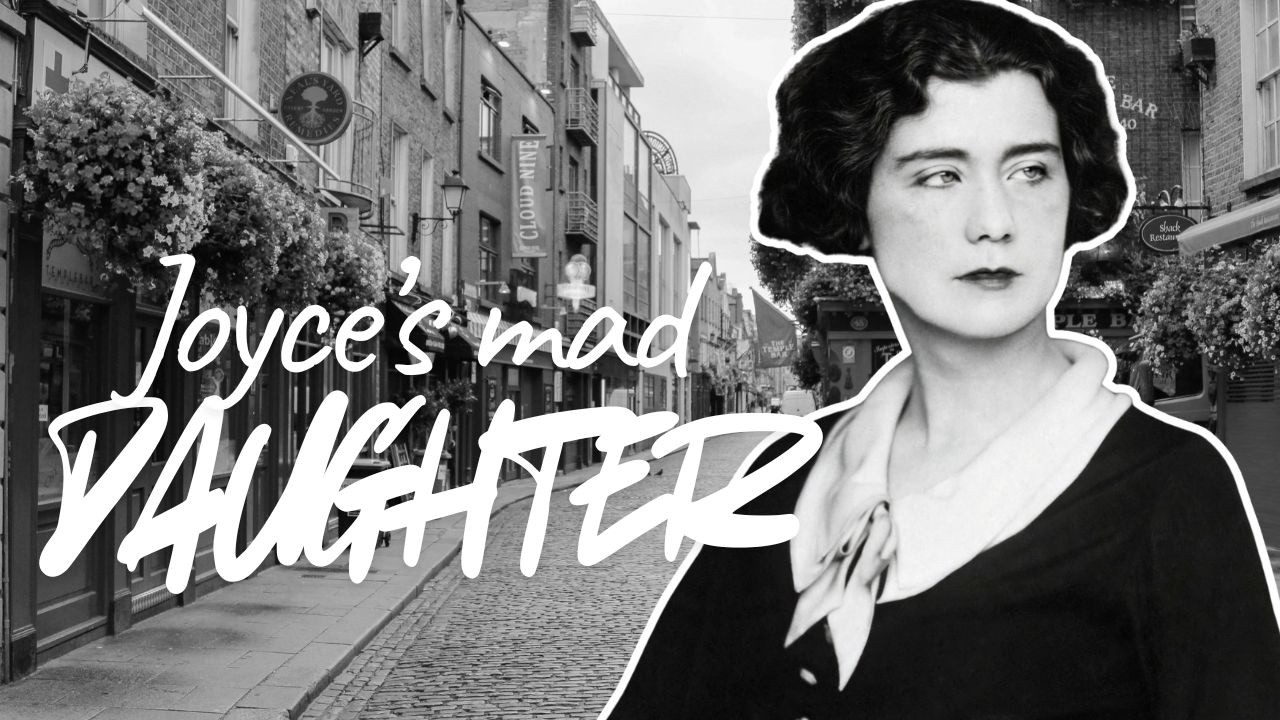
Her name was Lucia Joyce. Her father was James Joyce, author of Ulysses, the man hailed as a god of modern letters. By the end of the century, she had been treated by more than twenty doctors and left in a hospital in a foreign country that almost no one visited. For sixty years, literary biographies omitted three crucial facts: the young assistant who broke her heart with a single sentence and later won the Nobel Prize; what Carl Jung said about Lucia and her father; and the suitcase of letters her nephew burned in 1988 to ensure the world would never hear her voice.
Most people remember James Joyce as a genius. His daughter remembered him as the only man who refused to save her. The first thing Lucia Joyce learned about the world was that it had no firm foundation. She was born on July 26, 1907, in the Burba ward of a public hospital in Trieste, a port city then part of the Austro-Hungarian Empire.
Her father was not yet famous. He was a bankrupt English teacher, nearly blind, struggling with alcoholism, carrying a manuscript no one wanted, trying to feed a young family with no money and no homeland. Lucia was born in a charity ward among the poor of a city that was not her parents’ city, speaking a language that was not her parents’ language. This was the defining feature of her entire childhood: movement, instability, homelessness.
The Joyce family moved again and again—Trieste, then Zurich, then Paris, then back again—dragging their children across borders and through cheap rented apartments, sometimes changing addresses every few months. By her teenage years, Lucia had lived in dozens of flats and spoke four languages, mixing Italian at home, French and German in the streets, and English with her parents. She had no steady school, no lasting childhood friends, because there was never time to make friends before the next move. She grew up fluent in everything but rooted in nothing.
And she grew up inside the gravitational field of one overwhelming fact: her father’s genius. Everything in the house revolved around it. The money, when there was money, went to his work, his eyes, his drinking. The moves were for his career.
The silence was for his writing. The family existed to orbit the great book he was constantly composing. Her mother, Nora, a strong, outspoken, uneducated woman from Galway who had run away with Joyce in her youth, held the household together through sheer will. But she had no patience for art, and even less patience for her strange, hypersensitive daughter.
Lucia adored her father. By everyone’s account, she was his favorite. He spoiled her in his distracted way, taught her, lavished her with affection. But that love was wrapped in a life that offered a sensitive child no stability at all.
No house, no homeland, no normal childhood, nothing solid to stand on. She would spend the rest of her life searching for something fixed. For a few short years, in the dance studios of Paris, she thought she had found it. In the early 1920s, Paris was the center of the artistic world, and Lucia Joyce stepped directly into its heart.
By then, her father was no longer a destitute teacher. Ulysses had been published in Paris in 1922 after being banned, smuggled, and stolen. James Joyce had become a literary celebrity, the most talked-about living writer, surrounded by patrons, disciples, and admirers. At last, the family began to receive income from wealthy benefactors.
And Lucia, a teenager in this bustling city, discovered what would become her own art, separate from her father’s—the only field that belonged to her alone. Dance. Not ballet, but modern dance, the wild, expressive movement that swept across Europe during the 1920s. Lucia threw herself into it with complete seriousness.
She trained for years, intensively, under some of the most important teachers of the era. She studied with Raymond Duncan, brother of Isadora Duncan. She worked in the systems of Jaques-Dalcroze and Margaret Morris. She trained with the dancers of Jean Berlin and the Ballets Suédois circle.
This was no rich girl’s hobby. Lucia worked hard, professionally, for hours every day for years, until she became genuinely accomplished. Everyone who saw her dance remembered it. She was captivating on stage—tall, vibrant, powerful, utterly committed.
Critics took notice. One Parisian critic who watched her perform wrote that Lucia Joyce was her father’s daughter, that she possessed the same creative gift he had in his writing, and that she might one day be remembered as his name was. She designed her own costumes, created her own choreography, and performed in prestigious venues before real audiences. In May 1929, Lucia entered a major dance competition in Paris at the Bal Bullier and reached the finals.
According to many accounts, when the jury awarded the grand prize to someone else, part of the audience rose and shouted her name, saying the Irish girl had been robbed, that Lucia Joyce was the true artist on that stage. She was twenty-one years old, and her future stretched bright before her. Then, within months, she gave it all up. Picture her at her peak in 1929, because that was the highest she would ever reach.
A young woman in a Parisian studio, sweat on her body, mirrors surrounding her, her physique trained to an extraordinary degree. She had spent years building an independent identity, one that did not resemble the daughter of James Joyce. She had made Lucia Joyce, the dancer, the independent artist, admired by people who did not know who her father was and did not care. For one brief, shining period of months, she had her own name, her own audience, her own art, her own future.
It was the only time in her life she felt fully her own. Her father watched her dance with overwhelming joy. He saw in her movement, as he said, the same creative spark that drove his own work—two artists in one family, the writer and the dancer, the word and the body. He believed she carried his talent in a new form.
In his imagination, Lucia the dancer was Lucia at her most vital, her most independent, her most connected to him. Then the ground she had finally found began to shake again. The collapse of her dance career did not come all at once, which made it all the more painful. Around 1929, Lucia suddenly abandoned her dancing.
The reasons given later never quite made sense, and that very obscurity was evidence of what was to come. Some said she was told she lacked the physical capacity for a career, that her health could not withstand the grueling schedule. Others said her family secretly discouraged her, that it was not proper, that the constant moving made sustained training impossible, that a daughter should not be on the stage. Some said Lucia herself, after years of absolute devotion, suddenly lost her nerve and declared she had no talent, that she would never be good enough, and simply stopped.
What is clear is that the only thing Lucia had built for herself—her fixed identity, the ground she stood on—was taken from her or abandoned at the very moment she needed it most. And nothing replaced it. She was twenty-two years old. The audience vanished.
The studio vanished. The person she had spent years constructing had no stage to stand on. She drifted back into the orbit of her father’s household—the genius father, the fretful mother, the constant moves, the life with no center except the great book being written upstairs. And into that emptiness, at precisely that moment for a young woman with nothing left to hold onto, walked a quiet young Irishman with sad eyes.
His name was Samuel Beckett. He was a brilliant, introverted young writer who had come to Paris to sit at the feet of the great James Joyce, to assist him, to admire him, to learn from him. Lucia, lost and hurting, twenty-two years old, fell completely in love with him. She thought he loved her back.
She was certain of it. She began to imagine a future, a marriage, an escape from her father’s shadow. She was entirely wrong. And the moment she discovered how wrong she was, the first crack opened in her mind—and it would never fully close again.
For a brief period in the late 1920s, Samuel Beckett was a constant guest at the Joyce home, and Lucia allowed herself to hope. He was twenty-three when he arrived in Paris—tall, thin, extremely shy, from Dublin, already showing signs of the brilliance that would one day earn him the Nobel Prize. He came to Paris and was drawn, as so many were, into the orbit of James Joyce. He became a mixture of disciple, assistant, and friend—reading to the nearly blind Joyce, running errands, taking dictation, talking with him for hours about literature in the way Joyce loved.
He was constantly at the apartment. His presence in the family’s life was almost permanent. And Lucia, watching this gentle, serious, talented young man come again and again to her home, fell completely in love. From her perspective, it must have seemed obvious that he was coming for her.
He was always there. He was kind to her. He talked to her. He took her to cafés and walks through the city.
She was a young woman who had just lost her art, desperate for something of her own, raised to believe that love might finally be the solid foundation she had never found. Beckett seemed like salvation. She built an entire future on him in her imagination. She told her family with complete certainty that she and Beckett would be together.
She did not know that Beckett was not coming to the apartment for her at all. He was coming for her father. In 1930, Samuel Beckett told Lucia Joyce the truth, and he did not soften it. He made clear that his visits to the Joyce home had nothing to do with any romantic interest in her.
He said he had come to see her father. He admired James Joyce more than any other living man. He was there for the writer, for his work, for the conversation with a genius. His feelings for Lucia were not what she had imagined.
There was no future. There had never been a future. He was, in fact, ending something that on his side had never begun. For Lucia, this was a catastrophe far larger than ordinary heartbreak.
It was not merely that the man she loved did not love her back. It was that the ground—as with dancing, as with every step of her childhood—had been an illusion. She had built herself, her future, her hope on something that turned out not to exist. And worse: the man she loved had only come to her house because of her father.
Even in love, in the one thing she thought was finally hers, she discovered she was invisible. It was the gravitational pull of James Joyce’s genius that had drawn Beckett to the apartment. She had simply mistaken herself for the reason. She was once again the daughter standing at the threshold while the world passed by, heading toward her father.
She did not accept it quietly. There was shock, then rage. The family was shaken by the intensity of her reaction, which far exceeded what they thought the situation warranted. There were scenes.
There was weeping, then fury, then a frantic insistence that would not subside. Beckett’s rejection did not merely hurt Lucia—it seemed to awaken something in her that the family may not have noticed before, but had ignored. As was their habit with problems, the Joyces resorted to distraction—another move, another match. Soon she was engaged to one of her young assistants, a man named Alex Ponisovsky.
For a moment it seemed she might settle. She accepted his proposal at a celebratory lunch. Then, at the engagement party itself, Lucia collapsed into a stupor, and they had to carry her out. The engagement ended.
What had broken did not go back together. The years from 1930 to 1932 were the years Lucia Joyce fell apart before her family’s eyes—a family that could not or would not understand what they were seeing. Her behavior grew stranger and more frightening. She was subject to sudden rages, then long silences.
She wept for hours. She started small fires—deliberate ones. She wandered and disappeared into the city for days. Sometimes she turned violent toward the person closest to her: her mother, Nora.
The conflict between Lucia and Nora became open warfare. Nora, practical, exhausted, and afraid, could no longer cope with her daughter. The mother-daughter relationship, never warm, deteriorated into something ugly and dangerous. And through it all stood James Joyce, refusing with every fiber of his being to believe that anything was wrong.
This is the sorrow at the heart of the story, and you must hold both sides of it at once. Joyce loved Lucia with a deep, real, overwhelming love. She was his favorite, his darling, the child who understood him best, the one he believed shared his creative soul. And because he loved her in exactly that way, he could not accept that she was ill.
He constructed an alternative explanation in his mind and clung to it against all evidence. Lucia was not mad. Lucia was like him. Her strange speech, her disconnected sentences, her free-associating thoughts, her visions—these were not symptoms.
They were proof of her genius. She had clairvoyant powers, he said. She saw things others could not see. Her mind worked as his mind worked, on a level the ordinary world could not comprehend.
He pointed to his own work on Finnegans Wake, the impossible dream-language book he was writing precisely in those years—a book made of scattered words, free association, dream logic. He and Lucia were doing the same thing, he said. They were the same. What looked like her breakdown was in fact the same fire that produced his masterpiece.
“Whatever spark of gift I possess,” he said, “has been transmitted to Lucia and has kindled a fire in her brain. ”
This was the most loving thing a father could believe, and the most destructive, because so long as Joyce insisted his daughter was clairvoyant, he could resist, delay, and undermine any attempt to treat her. And so the family entered a spiral that lasted years and would determine the course of the rest of Lucia’s life. Crisis, doctor, denial, release, collapse—and repeat.
Lucia would break down, sometimes be taken forcibly to a clinic or asylum or doctor. Over the following years she was examined by more than twenty specialists in France, Switzerland, and beyond—the best and most expensive psychiatric minds in Europe. Because Joyce now had money and spent it without limit on her, they delivered conflicting diagnoses. Some said she suffered from cyclothymia.
Others said she was not mad at all, merely difficult, neurotic, badly raised. Some began to use the new and terrible word entering the medical vocabulary: schizophrenia. And whenever a doctor approached a definitive diagnosis of serious mental illness, Joyce resisted. He removed her from hospitals.
He sought second opinions. He insisted they were wrong, that they could not see what he saw, that they were ordinary men trying to understand an extraordinary mind. He blamed the doctors. He blamed Nora.
He blamed the moves, the stress, bad luck. He tried sea voyages, rest cures, changes of air. Over those years he spent a fortune from his patrons’ money—money meant to secure the family’s future—on clinic after clinic, while refusing to accept what those clinics told him. The family hid the worst of it from the outside world.
Lucia’s condition was a private torment managed behind closed doors, explained to friends as mere nervousness, hypersensitivity, artistic strain. The greatest writer of his age organized his entire later life around a daughter he would not call ill. And the longer his denial lasted, the smaller the chances of any possible help became. By 1934, the situation was unbearable, and the desperate family had only one option left.
They took Lucia to Zurich, to the most famous psychiatrist alive—the man who had broken with Freud to map his own territory of the human mind, the explorer of the unconscious itself: Carl Gustav Jung. Jung would become the twentieth doctor to examine Lucia Joyce. And what he concluded about Lucia and her father, and the terrible thing that bound them together, would be the one diagnosis James Joyce would never forgive. Jung had met Lucia Joyce, in a sense, before he ever saw her, because he had spent the previous years reading about her father.
Jung had written an essay on Ulysses. It was not complimentary. He found the book bewildering, terrifying—a stream of consciousness that seemed to him on the very edge of madness, a mind unspooling without anchor. Joyce was deeply offended.
The relationship between the writer and the psychiatrist was already tense before Lucia entered Jung’s consulting room in 1934. Bringing her to him was a measure of the family’s desperation. Jung observed Lucia. He read her writings, her strange wordplay, the way language disintegrated and re-formed in her speech and on the page.
And he saw something that struck him deeply—something that became one of the most astonishing clinical observations in literary history. He saw that Lucia and her father used language in almost exactly the same way. The same neologisms, the same dreamlike puns, the same dismembering and reassembling of words, the same private logic that twisted ordinary meaning. Father and daughter spoke and wrote the same language—a brilliant, fragmented language.
And this, Jung said, was the key to the entire tragedy. He described them with famous words: two people sinking to the bottom of a river, with one essential difference—the father was diving, and the daughter was falling. What James Joyce did was voluntary, as a fully controlled artist. What Lucia did was involuntary, as a drowning person.
The same water, the same depths. One swam through it by choice and called it art. The other drowned in it and could not get out. This was devastating to Joyce because it cut both ways.
Jung said, in effect: Yes, you are right. You and your daughter are alike. You share the same strange mind. And that is precisely why she is ill and you are not—because what you can survive, she cannot.
Her father’s genius and her madness were made of the same material. He was simply strong enough, or lucky enough, to ride it. Joyce rejected Jung’s opinion outright. He could not bear it.
Accepting Jung would mean accepting that Lucia was truly ill—and worse. It would mean accepting that the very thing he had celebrated in her, the fire he said he had transmitted to her, was the thing destroying her. He removed her from Jung’s care, as he had with so many others. Jung later remarked that the daughter of an ordinary man might have made it, but Lucia had been pulled into her father’s underworld—that she was, in his words, a victim of the “animus,” drowning in the same depths her father dived with brilliance.
The twentieth doctor failed as well. There would be no miracle from a twenty-first. After Jung, the long decline lost all stability. Through the mid- and late 1930s, Lucia moved between a series of asylums and nursing homes, growing more isolated, treated increasingly as a permanent patient rather than a person who might recover.
The treatments of that era were primitive, often brutal. Lucia was subjected to what psychiatric patients endured in those years: prolonged isolation, sedation, serum injections, even appalling experiments with the idea that her teeth might be poisoning her mind. Nothing worked. Nothing could work, because the medicine of the 1930s had no real understanding of her condition and no effective treatment for it.
Around her, the world was darkening in a way that would finish what the illness had begun. Her father’s health was failing along with hers. Joyce, almost blind, exhausted, poured what remained of himself into Finnegans Wake, which he finally completed in 1939 after seventeen years—a novel almost no one could read, considered the most radical experiment in the history of English literature. For those same seventeen years he watched his daughter speak the novel’s corrupted language—not as art, but as the symptom of an illness.
The masterpiece and the breakdown grew up together, side by side, in the same house, from the same fire. Then war came. In 1939, the Second World War broke out, and the scattered, fragile Joyce family—with their daughter hospitalized in occupied France—was thrown into chaos. As the Germans advanced, the family was forced to flee.
And here the war committed its hidden cruelty against Lucia Joyce. When the family escaped from France to neutral Switzerland in 1940, they could not take her with them. She was in a sanatorium at Bourg-la-Reine, in occupied territory. The arrangements could not be made—the borders, the money, the danger.
The family fled to Zurich, and Lucia remained in France. James Joyce did not live to see the end of the war, nor to meet the daughter he had left behind in France. In January 1941, in Zurich, Joyce collapsed from a perforated ulcer. He underwent surgery.
For one day, it seemed he might recover. Then his condition worsened. On January 13, 1941, James Joyce died in a hospital in Zurich, at the age of fifty-eight. One of the most famous writers of all time, he remained to the end a man insisting that his daughter was not mad.
He died still fighting for that. In his final years, even with Lucia institutionalized and beyond his control, he never surrendered to the doctors’ diagnosis. He wrote of her with tenderness and unshakable faith in her abilities. He arranged his money, his thoughts, his letters around her care and her future.
Whatever was said of James Joyce as a father, his love for Lucia until his last heartbeat was not in doubt. He loved her in a way that did not save her—and may have contributed to her destruction, because his love was a refusal to let her be ill. With his death, the only person who fought for Lucia with all his strength—wrongly, destructively, but ferociously—was gone. Those who remained never fought for her at all.
Nora, her mother, worn down by decades of conflict with her daughter, did not bring Lucia back into her life. Her brother Giorgio had his own troubles and kept his distance. The benefactors who had funded Joyce’s life had no obligation to his sick daughter. Lucia, in occupied France, ill and alone, became a burden to be managed, a responsibility to be transferred, a person to be placed somewhere and gradually forgotten.
After the war, she was moved. In 1951, Lucia Joyce was transferred to St Andrew’s Hospital, a psychiatric hospital in Northampton, England. She was forty-four years old. She lived there for thirty years.
Thirty years. Consider that number, and how the whole tragedy is contained in it. Lucia Joyce entered St Andrew’s in 1951 and did not leave until her death in 1982. She spent three full decades—longer than her free life, longer than all the years before the asylum—inside a single psychiatric hospital in England, in a country that was not her home, far from Paris, far from the dance studios, far from everyone who had watched her perform and shouted her name.
And almost no one came. Her mother, Nora, died in 1951, the very year Lucia was transferred. And so the woman she had struggled with all her life departed just as her long imprisonment began. Her brother Giorgio visited rarely.
The network of admirers, scholars, and disciples attached to the name Joyce—those who had built careers on every word her father wrote, who treated his manuscripts as sacred relics—had, for decades, little interest in the woman in the Northampton asylum who had shared his home, his language, and his blood. By all accounts, she did not suffer continuously during those years. She had long periods of calm. She did handicrafts.
She smoked the cigarettes she loved. She possessed a clear, sharp mind, even a sense of humor. Visitors who came to her were sometimes astonished by her mental presence, the clarity of her memories of the glittering world she had lived in, her ability to speak lucidly about Paris and her father. She was not a dead thing.
She was a person—a full, intelligent, once-brilliant person—serving a thirty-year sentence for the crime of being too fragile to survive the fire she was born into. In her final years, a few people began to come to her—some biographers, some relatives, eventually one or two loyal friends—who recognized the humanity behind the case file. Again and again they found her more alert, more aware than they expected. One who knew her in those years insisted she was far more lonely than mad.
She was the dancer for whom audiences rose. Now her name was merely a footnote in her father’s biography, smoking alone in a ward in Northampton, waiting. Lucia Joyce died at St Andrew’s Hospital on December 12, 1982, at the age of seventy-five. She outlived her father by forty-one years.
She outlived her mother by thirty-one. She outlived nearly everyone who had known her as the gifted young dancer of 1929—teachers, critics, audiences, even Beckett, the man who broke her heart and then won the Nobel Prize and became one of the most revered writers of the century. It is said Beckett never entirely forgot her. In his quiet way, he carried a kind of guilt and tenderness toward Lucia all his life.
But he did not save her either. No one did. She was buried in Northampton—not in Paris, not in Dublin, not beside her father in Zurich, but in England, in the town of the hospital that had held her for thirty years. Far from everywhere that meant anything to her.
The crowd that once chanted her name had been gone for sixty years. There was no chant at the end. There was a quiet grave in a strange town for a woman the world had long ago decided was nothing but the mad daughter of a great man. So ends the official story.
But the official story was not the truth, and the reason it survived for so long is the most disturbing part of all. For most of the twentieth century, the world heard only one account of Lucia Joyce: the madwoman, the cautionary tale, the tragic insane daughter. Rarely did we hear her voice—her letters, her words, her account of the dance, the rejection, the doctors, the long imprisonment. There was a reason for that.
Her voice was deliberately destroyed. Lucia wrote letters throughout her life. So did those around her—letters about her and to her, full of her words and her story. Those documents survived.
They remained in the family’s possession. They were the key to recovering the real woman behind the diagnosis. And in the late 1980s, Stephen James Joyce, Lucia’s grandson and the executor of the Joyce estate, made a fateful decision about them. A decision that would prevent the world from ever hearing Lucia Joyce speak for herself.
Lucia Joyce died in 1982. Within a few years, the struggle over her true identity became an event almost unprecedented in literary history—and it began with fire. Stephen James Joyce, the writer’s only grandson, Giorgio’s son, was in charge of the Joyce legacy. He inherited the administration of the James Joyce estate and guarded it with a ferocity that terrified scholars worldwide.
He believed, firmly and passionately, that his family’s privacy had been violated for decades by an army of academics who treated the Joyces not as human beings but as raw material. Stephen had grown up around Lucia. He knew her as his aunt, and he decided her dignity and her family’s dignity mattered more than scholarly research. So he did something scholars still speak of with horror.
In the 1980s, Stephen Joyce destroyed letters. By his own admission, he burned correspondence relating to Lucia’s letters. Lucia had written letters speaking of her illness and her life. Joyce stated publicly that he had done it.
He said the letters were private, no one’s business, that Lucia had a right to her privacy even after death—especially in her suffering—and that he would not allow strangers building careers on his family’s suffering to intrude upon her most painful and intimate moments. He also revealed that letters from Samuel Beckett, written after Lucia’s death when Beckett learned of the writings about her, had also been destroyed at Beckett’s own request, because they too touched on Lucia. Whatever those letters contained—Lucia’s account of the dance, the rejection, the doctors, the asylum, her father, the decades of confinement—the inner life of the woman behind the diagnosis went up in smoke, deliberately, at the hands of the family that controlled it. The richest source of Lucia Joyce’s voice was turned to ash.
What the grandson did could be called cruelty. But examined closely, it was something more troubling, because in his eyes it was an act of love. This is the pattern that repeats throughout Lucia Joyce’s story, generation after generation. The people who harmed her most were the ones who loved her, and they harmed her precisely through the shape their love took.
Her father loved her so much he refused to allow her to be ill. In that refusal, he undermined every doctor who might have helped her, kept her in denial through the crucial years, and possibly made her condition worse. His love was a refusal to see. Her grandson loved her so much he refused to allow her to be seen.
In that refusal, he burned the only documents that could have restored her to life—her voice, which could have introduced her to history as a human being rather than a case study. His love was a refusal of visibility. Both men acted to protect Lucia. Both were convinced they were defending her dignity against a world that would exploit her.
And in the name of that protection, both robbed her of something irreplaceable. Her father robbed her of the chance of treatment. Her grandson robbed her of the chance of being understood. For fifty years, the two men who loved Lucia Joyce most erased her entirely—first as a patient, then as a person.
She spent her whole life at the mercy of other people’s love, and that love decided, on her behalf, what she was allowed to be. A genius, her father said, not a patient. A private tragedy, her grandson said, not a voice. At no point in the century did anyone with power over her ask what Lucia wanted to be.
She was silenced by being loved too much. And yet, in the face of the fire, in the face of the denial, in the face of the footnotes, the real Lucia began slowly to return. Because not everything was destroyed, and not everyone was willing to leave her as a joke in her father’s story. In the decades after her death, a handful of researchers and writers set out to find the real woman.
What they found was not the raving madwoman of myth, but something more tragic and more human: a genuinely talented artist, a serious modern dancer, an intelligent and perceptive woman, trapped in an impossible family at a terrible moment in medical history, crushed by forces that had nothing to do with her supposed madness. In 2003, a major biography by the scholar Carol Loeb Shloss, titled Lucia Joyce: To Dance in the Wake, attempted to reconstruct her life, insisting that Lucia was not merely a victim but an artist and an inspiration from whom her father drew movement, language, and presence while writing Finnegans Wake itself. The book ignited a ferocious legal battle with Lucia’s heirs over the right to quote the surviving documents. The dispute over Lucia’s voice continued in courtrooms for more than twenty years after her death.
But the effort produced something larger: it uncovered the old story and forced the world to recognize that the mad daughter had been a real, gifted human being. And that the diagnosis that defined her had been made in an era of little understanding, by doctors who disagreed with one another, within a family that refused treatment. It raised the central, unanswerable question: in another family, with another father, in a later decade with real medicine—would Lucia Joyce have been ill at all? Or would she have been a dancer, an artist, a complete human being living her life as she chose?
We will never know. That is the cruelty of it. But the question itself gave back to her part of what had been stolen: her seriousness, her talent, her standing as a person who had been treated, not merely a passing case. To understand the magnitude of the loss, one must return one final time to the only thing that was ever truly hers—the dance—and see what it really meant.
During those few years in the 1920s, Lucia found the only thing in her unsettled life that gave her a self. Dance is the art of imposing order on the body, of making meaning from abstract movement. For a young woman raised with no home, no country, no stable language, no ground, dance was not a hobby. It was survival.
On stage, Lucia Joyce was not lost. She was not the daughter standing at the threshold. She was the center of attention, in complete control of her body, making something that belonged to her alone, something that made audiences rise and applaud. Dance was the only place she felt solid.
And that solidity was taken from her—by her illness, by her family’s hesitation, by the impossibility of training while crossing Europe with her father, by the sudden collapse of her confidence. The moment the dance ended was the moment the breakdown began. Strip away the diagnoses, the doctors, Jung’s river, all the madness talk, and Lucia’s story can be told in one brutal sentence: she found the one thing that held her together, she lost it, and nothing after that ever held her. Jung said her father was a diver and she was drowning in the same deep waters.
But there is another perspective. Her father had his art to keep him afloat—the writing, the work, the books that gave his strange mind structure and purpose and a place to pour its chaos. For seventeen years, Finnegans Wake was the ship that carried James Joyce across the same dark waters that drowned his daughter. He had a boat.
He spent his life building it, plank by plank, word by word. Lucia had a boat too. Once, it was called dance. And the people who loved her let it sink.
Strip everything away and the deeper truth of Lucia Joyce’s life emerges. It is not a story about madness at all. It is a story about a fragile human being under the weight of a great man. Everything in the Joyce household revolved around James.
His genius, his moods, his money, his silences, his sacrifices, even the air itself. His gravitational pull was so strong that nothing else in that family could maintain its own identity. Nora bent. Giorgio bent.
And Lucia—the most sensitive, the one who inherited her father’s strange nature—bent more than anyone, until she broke. She could not build a self separate from him because his influence was too immense. Even her one independent achievement, the dance, existed in his shadow. Even the man she loved came to her house only because of him.
Every door she tried to walk through, her father stood behind it. And when she broke, that same influence decided the meaning of her breaking. Her father said it meant genius. The doctors said it meant schizophrenia.
Jung said it meant she had sunk into her father’s depths. Her grandson said it meant a private pain to be burned. At every stage, the powerful told the world who Lucia Joyce was. The world never listened to her.
That is the tragedy beneath the tragedy. Not that she was mad—we do not even know if she was, by modern standards. The tragedy is that she was never given the chance to write her own biography. It was written for her by everyone around her.
Like the characters in her father’s books, she was a character in other people’s stories—the mad daughter, the lost dancer, the cautionary tale, the footnote. And when she finally tried to leave her own words, her own account, those words were thrown into the fire. The greatest writer of the century gave the world a sea of language. His only daughter was not allowed to keep even one sentence of her own.
There is a pattern in this family, and it is not the pattern people expect. We are used to stories of great men who neglect their children—cold fathers, absent fathers, fathers so consumed by their greatness they do not notice those around them. James Joyce was not that kind of father. The pattern here is stranger and more painful.
A father who loved his daughter possessively, with a love that left her no room to live apart from him. Joyce believed he and Lucia were a single creative entity, that his talent had passed into her, that her mind was his mind, that her breakdown was his genius in another form. This was the most flattering thing a father could believe about his daughter, and the most confining. Because if Lucia’s strangeness was truly James Joyce’s genius, then Lucia could not simply be Lucia—a struggling young woman, ill, needing ordinary help.
She had to be exceptional. Exceptional was the only role that cruel household allowed. There was no place in the Joyce family for an ordinary person in pain. You were either a genius or nothing.
And so love itself became a trap. The more Joyce clung to her, the more he insisted she was a visionary like him, the smaller her chances of rescue became—because rescue would have meant admitting she was just a sick young woman. That was the one thing his love would not allow. The grandson inherited the same instinct in a different form: protect her by controlling her.
Define her by making decisions for her. Love her by keeping the world away. Three generations of fierce, possessive, well-intentioned love, and at the center of it all, a woman slowly disappearing. Loved so hard and so completely that nothing of her was left.
The story of James Joyce is usually told as one of the greatest triumphs of modern art—the nearly blind exile who reinvented the novel, who wrote Ulysses and Finnegans Wake, who pushed language further than anyone before or since. But that is not the whole story. The part we leave out is the part that matters. The story includes a daughter—a gifted dancer whose audience rose and shouted her name, who gave up dance at twenty-two.
A young woman who loved a man who came to her house only to see her father. A patient examined by more than twenty doctors, including Carl Jung, while the only man with the power to insist on treatment insisted she was not ill. A woman who spent thirty years in an English asylum, far from every place she loved, visited by almost no one, her voice deliberately hidden so the world would never hear it. And the lesson is not that James Joyce was a bad father.
He was not. He loved her fiercely. The lesson is harder and more useful than blame, and it reaches everyone who has ever loved a fragile person. The lesson is that love is not the same as seeing.
You can love someone with all your heart and still refuse to see the truth of who they are. Refuse to see their suffering. Refuse to see their need for the help you do not want for them. Refuse to see them as a separate person with their own life, not yours.
Joyce loved Lucia as an extension of himself, as a fellow genius, as a character in the great drama of his mind. What he could not do was love her as she actually was: Lucia, ordinary, sick, afraid, and capable of being saved. That failure to see—disguised as the deepest devotion—is what helped lose her. The young assistant who broke her heart with one sentence was Samuel Beckett, the future Nobel laureate, who came to the Joyce apartment day after day, letting Lucia believe he came for her, when in truth he came only to sit at her father’s feet.
When he finally told her the truth in 1930, it shook something in her that never went back into place. Beckett carried a silent guilt toward her through his long life, and in the end he too asked for the destruction of his letters concerning Lucia, adding his silence to the silence around her. What Carl Jung said, which the family could never forgive, was his verdict that James Joyce and his daughter were diving into the same deep water, but the father swam while the daughter drowned. That the mind Joyce celebrated as genius in Lucia was the very thing dragging her under.
That what the great writer survived as art, his daughter could not survive at all. Joyce withdrew her from Jung’s care, as he had with twenty doctors before, unable to accept a diagnosis that turned his gift into a curse. And the suitcase of letters—what her nephew did with it—was the destruction of Lucia’s correspondence in the 1980s by Stephen Joyce, the writer’s grandson, who burned the documents bearing her voice in the name of protecting her privacy. Whatever Lucia had said about her life—the dance, the love, the doctors, the thirty years—went into the fire of history, ensuring that the woman the world remembered as a footnote could never speak a word.
A heart broken by a future Nobel Prize. A diagnosis the family could not bear. A voice turned to ash. This is what remains of the only daughter of the man who gave the twentieth century its most ambitious words.
Search for Lucia Joyce today, and here is what you will find—and will not find. You will find her father everywhere. Ulysses is read in universities on every continent. Festivals honor him.
Bloomsday celebrations in Dublin send thousands walking the streets of his novel. Statues, paintings, an entire global industry of Joyce studies. His grave in Zurich is a place of pilgrimage. His face is on coins and stamps and murals.
The words he wrote are immortal, exactly as he wanted. Then you will find Lucia, if you look closely, in a cemetery in Northampton, England—a grave in a town she never chose, in a country that was not her home, beside the hospital that held her for thirty years. No celebrations. No pilgrims.
No statue. For almost a century, just a line in someone else’s biography: Joyce had a daughter, Lucia, who went mad. But if you go back far enough, past the asylum, past the doctors, past Jung’s river and Beckett’s apology and the burned letters, you can still glimpse her. In a few surviving photographs and a handful of preserved reviews.
In a Paris dance studio in 1929—tall, fierce, vibrant, mid-movement, a young woman who built from pure motion the only solid thing she ever owned. An artist in her own right, with her own name, with a crowd on its feet shouting that name into the air. That is the Lucia the world was never supposed to remember. Not the patient.
Not the footnote. The dancer. Hold onto that image. It is the truest one of her that remains.
And it is the one that almost got erased—by her father, her grandson, and the century that held them both. There is a question this story has not answered. It is not the question of whether James Joyce was a great writer. He was, beyond all argument, and nothing in Lucia’s fate changes that.
The question is older and quieter: What do we owe the fragile people we love? Those who cannot keep up with our pace, who break where we bend, who need us to see them clearly instead of the way we wish they were. James Joyce answered that question with the deepest love and the deepest blindness at once. He gave Lucia everything except the one thing she needed: to be seen as she really was, and helped accordingly while there was time.
He spent a fortune on her and never admitted what was wrong with her. He believed in her so absolutely that he could not save her. And here, at the end, is the glimmer of hope. Because after the fire, after the silence, after the obscurity, some people did search for the real Lucia, and they found her.
They found neither the madwoman nor the dancer nor the artist—they found the human being, gifted and real and terribly wronged. They could not bring her back to life. But they gave back her name, her seriousness, and the truth that she was a talented, real person who suffered a great injustice. That recovery came eighty years too late for Lucia.
But it is not too late for the fragile person in your life. If this story touched you, there is a reason. Somewhere in your life there is someone who cannot keep up. Someone you love who is struggling in a way that is uncomfortable, frightening, hard to look at directly.
Someone who does not fit the picture you want to tell about them. A child not as you imagined. A sibling falling apart. A parent drifting away from you.
A friend drowning silently while everyone around them keeps swimming. And the temptation—the deepest human temptation—is to do what James Joyce did. To insist they are fine. To insist they are special, not sick.
To love them so fiercely as the person you want them to be that you never see the person standing right in front of you, asking to be seen without words. Joyce loved his daughter more than almost anything in the world. And his love was a kind of blindness, and that blindness helped lose her for thirty years in a hospital in a strange town. Do not love anyone the way Joyce loved Lucia.
Tonight, not someday—tonight. Think of the fragile person in your life. And do what Joyce could not. Look at them as they really are, not as you wish them to be.
Ask them what they truly need, even if the answer is simpler, harder, and less flattering than the story you have been telling yourself. Offer the help you have been afraid to admit they need. Listen to their voice while you still can—before it goes silent, before the flames take it, before all that remains of them is a footnote in someone else’s story. Lucia Joyce was a dancer, and a crowd once rose and shouted her name.
Then the people who loved her most decided who she was allowed to be. And they kept deciding until nothing of her was left but ash and a grave in a town she never chose. Do not decide who the people you love are allowed to be. Watch them.
Listen to them. Help them.






