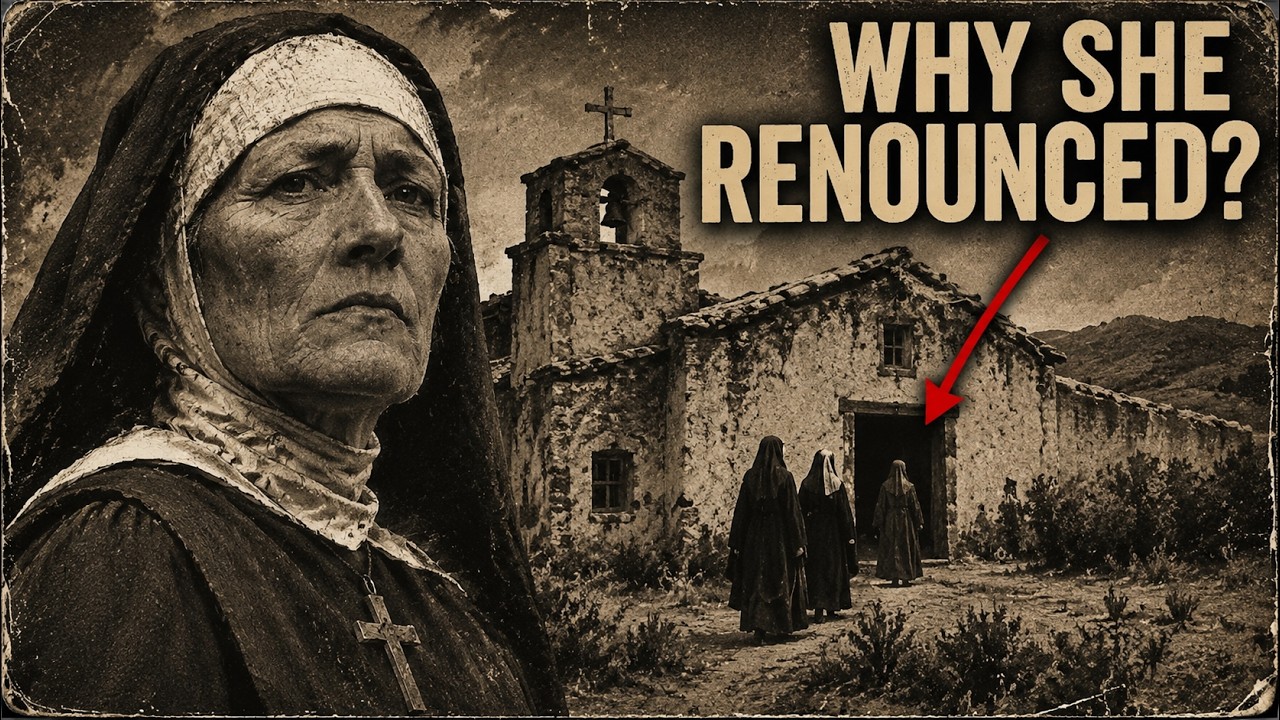
Katherine Marie Alder knelt on the stone floor of the chapel at Branic Mission and waited for the shape of her grief to become a body. It was the night of the 28th of November 1971, seven weeks into her new life, and the voice from below the chapel floor had just called her name. Not Sister Mary Terese, the name she had received when she took her vows, but Kath. The name her brother Thomas had used, the one nobody else had ever called her.
The voice spoke from fourteen feet beneath the ground, and it had Thomas’s shape and Thomas’s sound, and it had gotten almost everything right. But not the whistle. Thomas had whistled three notes descending, the same three notes every time since he was eight years old, the way some people knock on an open door. The thing below the floor sent the notes up.
Ascending. Low to high, the same notes, the same spacing, but reversed. A person who has listened to a whistle for twenty-two years knows the direction of it the way she knows the direction of gravity. And the direction being wrong was the only proof Catherine had that the voice was not her brother, and the only thing keeping her from answering.
She had come to this place sideways, the way a number of women came to the religious life in that decade, as much for what she was leaving as for what she was going toward. She was born on the 16th of March 1943 in Covington, Virginia, a paper mill town in the Allegheny Highlands, the first of two children of Harold Alder, a machinist, and June Alder, who kept the books for a feed store and sang in the First Baptist choir every Sunday of her life, including the Sunday she buried her son. Her brother Thomas Wayne Alder was four years younger, born on the 9th of January 1947, and he drowned on the 14th of August 1969 at twenty-two in the Jackson River, eleven miles south of Covington, at a swimming hole called Barger’s Bend, where the river goes around a limestone outcrop and the water on the inside of the bend is still and deep and green, and the water on the outside is fast and white and loud. The rain the week before had put twelve inches of extra water into the upper Jackson, running about three feet above summer level, which is not enough to look dangerous, and is enough to be.
His friends saw him go under, and then they saw him come up, and then the current took him around the outcrop and they did not see him again. His body was found four miles downstream at 6:40 that evening, caught in a strainer of fallen timber at the head of a long flat pool. Catherine had been living in her parents’ house that summer, home from a teaching job in Roanoke she did not intend to go back to. The phone rang at 7:15 the evening he drowned, and her mother answered it and made a sound Catherine had never heard a human being make.
She buried her brother on the 16th of August in Mountain View Cemetery, in a plot next to their grandmother. She wore a blue dress borrowed from a neighbor because she had not packed for a funeral. That night, alone in the house, she sat at the kitchen table with Thomas’s folding knife in her hand and opened it and closed it and opened it and closed it. The knife had a bone handle and had belonged to her brother, and she understood something that night that she would carry for the rest of her life: grief is not a feeling.
Grief is an address. It is the place where the person used to be, and you go back to it every day, and every day the place is empty, and every day you are surprised by the emptiness. She carried a brother-shaped vacancy for two years before she walked into a chapel in Wheeling and gave her name away. She took her preliminary vows in the spring of 1971, was received at the Convent of the Sacred Heart in Wheeling in June, and took her final vows on the 2nd of October.
The ceremony took forty minutes. There were eleven other women taking vows that morning, and she was the last in the second row closest to the wall. She had signed over her savings of $412 to the diocese three days before, and she had in the pocket of the dress she would never wear again the folding knife with the bone handle that had belonged to her brother and that she had not signed over to anybody. She received the name Sister Mary Terese.
She was told she had set aside the name Catherine Marie Alder. Set aside, as though it were a plate she was not using but might come back for. She would learn that set aside was the wrong way to think about it. Five days later, on the 7th of October 1971, she was driven up a mountain road in a 1963 Ford Econoline van by a woman named Sister Bernadette Foley, sixty-one years old, who had been making the supply run to Branic Mission every two weeks for nineteen years, and who said exactly four things during the two-hour drive.
Three of them were about the road. The one about the mission was this: You will like it up there. Everybody does at first. Catherine heard the pause before at first and decided to ignore it.
She had been warned by several people in Wheeling that the older sisters had a habit of testing new arrivals with grim hints, and she was not going to be tested. The pause was not a test. It was a door held open for one second in case Catherine wanted to walk through it and ask. Catherine did not ask.
The road to Branic Mission begins at the intersection of State Route 47 and County Route 11, six miles east of the town of Caleb, West Virginia, population 814 in the census of 1970, the county seat of Brier County and the only settlement in the county with a post office and a doctor. County Route 11 runs north out of Caleb and follows Brane Creek upstream for about nine miles, paved for the first six and gravel after that. At mile nine, the road crosses the creek on a one-lane concrete bridge built in 1952 and begins to switchback up the south face of Sugarloaf Ridge. At the top, at about 3,400 feet, the road levels out and runs along the spine for a quarter of a mile, and then there is a sign, wooden, white with black letters, hand-painted and repainted many times: Brane Mission.
Below it, Sisters of the Precious Blood. Below that, Est. 1829. The lane runs 220 yards through a stand of hemlock, and then it opens.
The clearing at Branic Mission is eleven acres of level ground on the broad top of Sugarloaf Ridge. It has no business being there. Mountaintop ground in West Virginia is not level. The ground is level, the drainage is perfect, the soil is deep and dark in a place where mountaintop soil is usually thin and poor.
There is a spring on the north side that runs cold and clear and has never been known to fail, not in the drought of 1930, not in 1953, not in 1966. The mission sits in the center: the chapel, facing east, built of local sandstone in 1829 on a foundation older than the chapel by a good deal more than anybody understood in 1971; the dormitory, a two-story frame building with sixteen cells on the upper floor, built in 1836 and added to twice; the schoolhouse, built in 1841 and closed in 1964; and the kitchen and refectory, built in 1852. The four buildings sit around a courtyard of packed earth and flagstone with a hand-dug well in the center, twenty-seven feet deep, the water cold enough to hurt your teeth in August and does not freeze in January. The first thing Catherine noticed was not the buildings.
It was the trees. The clearing is bounded on all sides by forest, and the edge where the clearing stops and the forest starts is not a gradual thing. There is no brush, no undergrowth, no brier, no seedling, no young growth of any kind. The grass runs right up to the trunks and stops.
She mentioned it to Sister Bernadette. Who keeps the edge so clean? Sister Bernadette was unloading boxes and did not look up. Nobody keeps it.
That is not how trees work, Catherine thought. She was right. She measured later that the tree line was forty-two feet from her window, because of what she saw from that window on the night of the 14th of November. She wanted to know exactly how far away it had been.
There were eight sisters at the mission in October of 1971. Mother Dolores Carth, sixty-three, thirty-eight years at the mission. Sister Anne Francis, fifty-nine, twenty-nine years. Sister John Marie, fifty-five, twenty-six years.
Sister Rose Clare, fifty-one, twenty-two years. Sister Agnes Bernard, forty-seven, eighteen years. Sister Margaret Anne, forty-two, fourteen years. Sister Paul Marie, thirty-one, three years.
And Catherine, Sister Mary Terese, twenty-eight, five days. Mother Dolores took her suitcase without asking, carried it up the stairs without apparent effort, showed her the cell, second floor, fourth door on the left, eight by ten feet, a bed with an iron frame, a washstand, a small desk, a straight-backed chair, a crucifix, and a north-facing window. She recited the daily schedule: Matins at 4:30, Lauds at 6:00, Mass at 7:00, work from 8 to noon, lunch at 12:15, work from 1 to 5, Vespers at 5:30, dinner at 6:00, Compline at 8:00, lights out at 9:00. The schedule had been the same since 1829.
Mother Dolores recited it in the voice of a woman who had recited it 112 times before, because Catherine was the 112th woman to take vows at Branic Mission. Then she told Catherine one more thing, differently. At Compline, when we pray the names, you will hear the sisters speak. Each sister says her given name out loud before the prayer, and the others answer her.
This is how it has always been done here. You will say yours, and you will wait for the answer. Catherine asked what answer. The others will say it back to you.
That is all. Catherine asked if that was not standard. And Mother Dolores paused, the same pause Sister Bernadette had made in the van, the pause that is a door held open for one second, and then she said, It is standard here. And she left.
The chapel is forty-four feet long and twenty-two feet wide, with stone walls two feet thick, plastered white, a wood beam ceiling eighteen feet up painted blue with gold stars, windows on the north and south walls, three to a side, tall and narrow with plain glass. The altar is a slab of local sandstone on four stone legs, and the slab is older than the chapel. The mason’s marks on it do not match the marks on the walls, and the stone of the slab is a different grade, and it has been dressed with tools that left marks unlike any tool a nineteenth-century American mason would have used. There is a geologist at West Virginia University who looked at a photograph of those tool marks in 2002 and said they are consistent with bronze rather than iron.
And beneath the floor of the chapel, beneath the flagstones, beneath about fourteen inches of packed earth and rubble fill, there is a second floor. A dressed stone floor, fitted tight, running the full length and width of the chapel, and cut into that floor in channels about three-quarters of an inch wide and a quarter of an inch deep is a pattern. The channels run in lines, and the lines connect to each other, and the shape has 112 points in it. 112.
The same number as the names in the register of the surrendered. That first evening at Vespers, Catherine knelt in her choir stall and the seven other sisters knelt in theirs, and one by one each spoke her name, and the room answered each one. Then it was Catherine’s turn. She said Sister Mary Terese, and the others answered Sister Mary Terese, and nothing happened.
Nothing at all. She wrote to her friend Dia Pace two days later that the chapel was the quietest place she had ever been, and not the kind of quiet that means no noise. She wrote, This is the kind of quiet that means something in the room is not making a noise it could be making. There is a held quality to it, like a breath being kept.
That first night she slept badly. She woke after midnight and heard nothing, and the nothing was too complete. The mountaintop in early October should have been loud with crickets and katydids. There was no sound at all except, so far below the silence that she was not sure she was hearing it and not imagining it, a low hum, steady, continuous, coming from below.
She told herself it was the furnace. She checked twice. The furnace was under the dormitory, not the chapel, and it was not on. The hum was coming from below the chapel.
During the first weeks she noticed the gaps in the sisters’ tenure. Between the seven arrival dates there were gaps, not the kind you get from natural attrition, but the kind you get when people leave and the record does not say where they went. In the third week, she went into the mission office to help with the accounts. She balanced the ledger, and then, because she was Catherine Alder and Catherine Alder noticed things, she opened the personnel drawer.
In twenty-two years between 1949 and 1971, thirty-one sisters had been assigned to Branic Mission. Of those, seventeen had been transferred to other houses, all in the first year, not one after. Three had died. Two had renounced their vows.
And two had no departure record at all, both gone between March and April, one in 1953, one in 1967. She built a chart on the back of the accounts ledger in pencil, covering 142 years and 112 names, color-coded in three colors of pencil. Red for transferred in the first year, blue for stayed until death or retirement, black for no record. The pattern was so stark she thought it had been faked.
Sixty-one reds. Thirty-eight blues. Thirteen blacks. Sixty-one sisters who came and left in the first year and took their names with them.
Thirty-eight who crossed the fourteen-month line and never left, who died in their choir stalls or their beds, who made no sound when they walked and wrote no letters and did not dream. Thirteen who vanished, eleven of them between January and April, with no corresponding departure in the annual reports. The building eats people, she wrote. It eats about one every three and a half years.
It eats the ones who stay. In November, three things happened. The cold desk. Each sister had a small desk in her cell.
On the morning of the 12th of November, Catherine put her hand on hers and it was cold, not cool, cold the way the chapel floor was cold, cold from inside. She checked it every day for the rest of November. It was cold about one day in three, and the cold days were not weather days. The footsteps.
On the night of the 23rd of October, she heard for the first time something other than the hum. Footsteps in the hallway, measured, slow, even, deliberate, each one placed the way you place a foot when you are counting paces. Three passes, and on each pass she counted the steps. She counted them because counting was the thing she did when she was afraid.
112 steps per pass, in a hallway about sixty-two feet long. A stride of about six and a half inches. The kind of steps a person takes when they are counting something on the floor. She opened the door.
The hallway was empty. She heard the footsteps four more times in November, always after midnight, always 112 steps per pass. On the third time, the night of the 19th of November, she opened the door and stood in the dark hallway and waited. On the 68th step, which would have put the walker about four feet in front of her, she felt it.
Cold. A mass of cold the size and shape of a person moving past her. And a smell. Turned earth, fresh, wet, opened earth, the smell of a garden just dug, the smell of a grave.
The thing was not counting the doors that are. It was counting every door that has ever been, every place where a sister has ever slept, and it was taking inventory. The night of the 28th of November, the hum changed. The pitch moved up, and the quality of it changed from a steady drone to something that had shape in it, something almost a voice.
And then it was a voice, and the voice was whistling three notes ascending. Thomas had whistled them descending. The same notes, the same spacing, the same breath, but reversed. Then a clicking sound, the sound of a thumbnail pressing into the pad of an index finger, click, pause, click, the sound Thomas made when he was thinking, and then a voice from below, her brother’s voice.
It said Kath. Are you up there? She did not answer. It tried four more times.
On the fourth time it said, I will see you tomorrow, Kath. The words Thomas had said to her on the last day she saw him alive. She felt the answer rising in her chest, felt her throat shaping the word Thomas. She was a half second from saying it, and she did not.
She bit the inside of her cheek until she tasted blood. The whistle was wrong, and the wrongness was proof that whatever was calling her name from below was not Thomas, had never been Thomas, was a shape built from the parts of Thomas that she had been pouring into the floor for seven weeks, a copy assembled from grief, accurate in every detail except direction, and direction was the one thing it could not get right, because direction is the one thing that requires being real. In December she kept count of the things she lost. On the 2nd, she could not remember whether Dia Pace’s apartment had a green door or a blue one.
It was green. She remembered three hours later and wrote it down. On the 8th, she lost the name of the street where the feed store was. Elm Street.
On the 14th, she lost the year of Thomas’s pneumonia. On the 21st, the winter solstice, she woke in the dark and could not remember her father’s middle name. She got it back at lunch. Wayne Harold Wayne Alder.
She went to her cell and checked the desk. The desk was cold. She had been tracking the desk for six weeks, cold one day in three, no pattern. But standing in her cell with the name written down three times and underlined, she saw it.
The desk was cold on the days she forgot something. The correlation was perfect. The cold was the measure of what the floor had taken. The cold was what is left when a piece of a person has been removed.
On the 14th of January, she was in the storeroom off the west side of the chapel, the old schoolhouse, looking for candles. In the fourth box on the second shelf she found the annual reports for 1829 to 1871. They were not supposed to be there. The bound volumes in the office started at 1872.
In the report for 1871, in the personnel summary, in the margin, in a handwriting that was not the mother superior’s, smaller and tighter and more hurried, there was a note. Register closed. 79. Room beneath found.
Foundation not ours. God help us. That is why the list on the wall of the narthex stops at 79 names. In 1871 somebody found the room beneath the chapel and understood the foundation was not built by the church, and closed the register.
They did not stop taking vows. They did not stop pressing grief into the floor. The stone does not care whether the name is written in a book. The stone cares whether the name is spoken in the chapel and pressed into the floor by the knees of a grieving woman.
79 on the wall. 112 in the stone. 33 names added after the register was closed, and nobody wrote them down, and the stone wrote them all. She found the journal on the 22nd of January, by accident, because of a mouse.
She pried at a loose board behind the washstand, and behind the board was a composition book. It belonged to a woman named Sister Marguerite Ames, who had served at Branic Mission from September 1923 to November 1924, fourteen months, and who had kept a private journal hidden in the wall of her cell, where it stayed for forty-seven years. Marguerite Ames wrote 109 pages over fourteen months, and the journal stops in the middle of a sentence. Marguerite Ames did not survive.
She did not get out. After that sentence, the person who walked around in her body and wore her name for another forty-one years was not Marguerite. She crossed the fourteen-month line, the vacancy filled, and the building wore her until 1965, when the body died in the choir stall during Vespers. From the outside it looks like devotion.
From the inside it looks like nothing at all, because the inside of the stone is dark and the dark does not end. The journal was in Marguerite’s own words. She wrote that she had figured out the floor, that the flagstones, the fill, and the lower dressed stone floor with the channels cut into it formed a pattern with a point below every choir stall. She wrote that the lines were not decorative, they were channels, and the channels were not empty.
There was something in them, a substance, dark, not liquid, not solid, not dry, the consistency of wax left in the sun, slightly warm, and when she touched it with a knife it moved, not the way a liquid moves when you push it, the way a living thing moves when it is touched. She mapped the pattern as far as she could reach and drew it. It was a circuit. The channels connected the points and carried the substance from one point to the next, the whole thing running in a loop, always in the same direction.
And at the center, directly below the altar, there was a circular space about four feet across where the channels converged and stopped. The space was empty, not empty the way an unused room is empty, empty the way a frame is empty when the picture has been removed. It was an absence with a shape, awaiting. She wrote that she understood the pattern was a register, that the channels carried the names, and the points held them, and the empty space in the center was the last entry.
The register was not full. It needed more names. And when it had enough, the empty space in the center would not be empty anymore. Then she went looking for the old record, the record from before the church.
The building does not hide its secrets from the people it is taking. It reveals them. The last entry in the journal is dated the 22nd of February 1924, fourteen months and one week after she arrived. It reads, in full: February 22.
I found the second register. It is not in the vestry. It is in the foundation wall of the chapel itself, behind a stone that moves if you know which one to press. And I found it because the stone was warm in a wall that is always cold.
And warm stone in a cold wall is a sign. And the sign is where it ends. And the sign. And then nothing.
Catherine read the journal in two hours. She closed it and held it to her chest and cried for Marguerite, for the twenty-three-year-old girl who had noticed everything and written everything down and gotten within one sentence of the truth and had been taken anyway. That night she took Thomas’s knife from under the pillow and held it in her left hand, because Thomas had been left-handed, and she said out loud in the dark: Catherine Marie Alder. She said it three times, the way you test a rope before you put your weight on it.
The room was quiet and the building hummed and the hum did not change. She decided she was going to get out. She was going to take her name back and find someone who knew how. She found a name in the supply log: a lay driver named Opal Kleine who had done the supply run from 1938 to 1952.
On Saturday the 29th of January 1972, Catherine walked eleven miles down County Route 11 to Caleb. At the post office, the postmistress, Darla Kessler, told her Opal died in 1961, and her daughter Vesta lives down on the creek. Do you want directions? And then she said, If you are going to see Vesta about the mission, she has been waiting a long time.
Since they closed the road. The road that used to go up before the county road, the one that goes up the mountain by a different route, steeper and more direct. On the 1821 survey map it is labeled with a symbol the surveyor did not explain, and above it, in the surveyor’s hand, two words: old ground. That is what the clearing was called before the mission was the mission.
Old ground. Vesta Kleine was seventy-eight, thin in the way of mountain women who have worked outside their whole lives. She was sitting on the porch when Catherine came up the path and said, Sit down. Which one are you?
Catherine said, I am Sister Mary Terese. I arrived in October. Vesta said, That is not what I asked. Which one are you, before the name.
Catherine said, Catherine. Catherine Marie Alder. Vesta looked at her and said, You still have it. Good.
How long? Three and a half months. Then you have time. Not much, but some.
My mother said 14 months was the line. After 14 months, the name goes all the way in and you cannot pull it back out. She told Catherine what her mother had told her once, on the night before Christmas Eve in 1924, in a voice she had never heard her use, and she said she would not speak of it again, and she did not. The clearing on top of Sugarloaf Ridge is not natural ground.
It is built ground, leveled and cleared and dressed by people who were there before the settlers, before the natives, before anybody anyone in Brier County had a name for. The stone floor under the chapel is the floor of whatever they built, and whatever they built was not a chapel and was not a house of worship. It was a register, not in the way a book is a register, in the way a grave is a register, a place that holds what is given to it and does not let go. The people who built it used names the way we use nails.
They fix things in place with names. The channels carry the names, and the points are where the names settle, and the dark substance in the channels, that is what a name becomes when it has been in the stone long enough. It becomes material. It becomes part of the circuit.
And the sisters are fuel. They have been fuel for 140 years. The woman does not die. The name goes into the stone and the woman goes with it into the channels, into the dark, alive, aware, forever.
And what is left above, walking around in her habit, is not her. It is the building’s way of keeping a body in the stall. The building makes a copy. It takes the name and the person, puts the person in the stone, and puts something else in the space.
Eventually, everyone who stays past the line. Catherine asked how to get out. Vesta said three things. First, you cannot leave by walking away.
If you walk down that mountain without your name, the building will speed it up, and the vacancy will fill before you reach the bridge. You have to take your name back first. Second, you cannot take your name back alone. A name given in a ceremony must be taken back in a ceremony, witnessed, spoken aloud three times in the presence of someone who knew you before, someone who knew Catherine before there was a Sister Mary Terese.
Third, you cannot do it inside the clearing. The stone hears everything spoken in that clearing. You have to do it outside the tree line, off the mission’s ground. Catherine said she had been there three and a half months.
How long did she have? Vesta said, You have less than you think. The cold desk means the channel under your stall is filling. The forgetting means the trade has started.
The forgetting speeds up in the spring. By April you will be losing days, not details. You have until March, maybe April. Not longer.
Catherine said, Then I need to do it soon. Vesta said, You need to do it now. Catherine did not do it that day or that week. She walked the eleven miles back up the mountain, and she wrote three things in her notebook.
I know what it is. I know what it does. I know how to get out. And I am not ready.
I am not ready because it has my brother, or the shape of my brother, and I cannot leave the shape of my brother in the dark under the floor. The third thing was, I know that is what it wants. I know that is how it works. And I am going back anyway.
The thing under the floor did not drag her back or trick her or overpower her. It gave her back the one thing she could not refuse, and it gave it to her wrong, and the wrongness was the evidence, and she chose to ignore the evidence because the alternative was to lose her brother twice. Grief is the fuel and grief is the door and grief is the hand that turns the key, and the key fits the lock because the lock was made from the same grief. She went back to Vesta twice more in February.
On the 5th, she told her about the journal, about Marguerite, about the second register in the foundation wall. Vesta said her mother had found the same thing. It is the old record, the record from before the church. The names in the stone are older than the nuns’ names.
They are the names of the people who built the register. They put their own names in first to prime it, the way you prime a pump with water. 79 old names. And the nuns’ names went in on top, into the same channels, and the old names are still in there under the new ones, and the old names are still awake.
Catherine asked how many names the circuit needed to be full. Vesta said, My mother said 112. 79 old, 33 new. When all 112 slots are full, the circuit is complete.
Catherine said, There are 112 names in the register of the surrendered. I am the 112th. Vesta went quiet for a long time, and then she said, Then it is full. Catherine said, But it is still taking.
It is still emptying the sisters. Vesta said, If it is full and still running, then it was never just a register. A register that is full stops. A thing that is full and keeps going is not storing.
It is building. Catherine asked what it was building. Vesta said, Something out of names. Something that has been learning what a person is for a very long time.
Started with 79 old names and has been adding, getting better with each one. My mother said she could feel it being close. She said the floor vibrated in 1924, the way a pot vibrates just before it boils. Catherine asked what it had been doing for the forty-eight years since.
Vesta said, Getting closer. To what? To walking out. On the 19th of February, Catherine walked down in the morning and did not walk back that night, because when she arrived, Vesta was standing in the yard with a rifle across her arms.
Something came down the mountain last night. She had heard it on the road at about 3:00 in the morning, walking slow, even steps, 112 of them and then a pause and then 112 more. It stopped at the mouth of her lane and stood for about an hour and then went back up. Catherine asked if she saw it.
Vesta said, I did not look. My mother told me, if it comes down and you look at it, it learns your face. It has never come down before. Vesta said it has never had 112 names before.
The circuit is complete, Catherine. It has enough to move. It is not going to stay on the ridge. Catherine stayed at Vesta’s that night, lying on a cot in the kitchen.
At about 3:00 in the morning she heard it, footsteps on the road coming down the mountain, 112 steps, pause, 112 more, and then three notes ascending, and then Kath, I found you. I came down the mountain to find you. Open the door, Kath. It is cold out here.
The voice tried four times. On the fourth time it said, Kath, please. I have been in the dark a long time. I have been in the floor a long time.
You put me there. You put me in the floor when you knelt on it and prayed my name. Let me out. She almost answered, because the thing it said was true.
She had put Thomas in the floor. Vesta called from the front room: That is not your brother, Catherine. That is a thing wearing the last of your brother. The whistle, the thumbnail, the name Kath, those are your pieces.
They came out of you. The voice tried once more and went away, and the footsteps went back up the mountain. Catherine asked how to take her name back. Vesta said, You say it three times outside the tree line with a witness who knew you before.
Catherine said she did not have a witness. Her mother was sixty-three and did not drive. Vesta said, I know your name. You told it to me.
Is that not enough? Catherine said, You know the word. You do not know the person. That is the difference between a key and a key-shaped piece of metal.
They look the same, but only one opens the lock. Vesta said, Then call your friend, the one you write to. Get her here soon. Because the thing that came down the mountain came farther than before, and every time it comes, it learns the road a little better.
Catherine wrote two letters. The first was to her mother, carefully built of half-truths, designed to keep Margaret Alder from worrying. The second was to Dia Pace, fourteen pages long, written in one sitting in a hand that started controlled and ended in something close to panic. It said everything.
It said, I am in trouble and I need you to come. Not next month, not next week, now. There is something under the floor of the chapel. It is old.
It is not God. It is not the devil. It is something else. It is taking me apart one piece at a time and putting the pieces in the stone and filling the space where the pieces were with itself.
I know this sounds like I am losing my mind. I know that is what it will look like from the outside. I need you to believe me anyway. The ceremony requires a witness, someone who knew Catherine, not Sister Mary Terese.
The woman who taught ninth grade English at Patrick Henry High School, who drank too much coffee and sang off key in the car and borrowed your copy of The Bell Jar and never gave it back. You knew that woman. You are the only person left who did. My mother knew a daughter.
You knew a friend. The ceremony needs a friend. Come before the name is empty. Come before the vacancy fills.
If you come and I am different, if you come and I look at you and do not know you, if you come and I say I am well, everything is fine, then I am gone. Do not stay. Turn around and walk to the tree line and keep walking and do not look back. She sealed the letter.
The next supply run was the 3rd of February. The letter would reach Roanoke by the 6th. If Dia read it that day and believed it and acted on it, she could be in Caleb by the 10th. Catherine had two weeks to wait.
February of 1972 was brutal. Snow fell on the 2nd, 4th, 9th, and 13th. The temperature dropped below zero on four nights. The hum was louder than ever, audible all through the dormitory and the refectory and the courtyard.
She watched the sisters closely. Mother Dolores led Vespers every evening, speaking the names into the floor, and there was nothing left of the woman she had been. The copy was perfect, flawless, efficient, and never doubted and never dreamed. Catherine asked her directly if she dreamed.
Mother Dolores looked at her with a look that was neither warm nor cold, the look of a mechanism asked about a function it does not have. She said, I do not dream. There is nothing to dream about. This is the place where we are.
A statement of location so bare it could have been said by a piece of furniture. Sister Paul Marie was different. She was past the fourteen-month line, and she should have been gone, and she was mostly still, but sometimes she would stop, her head turning slowly as though listening, and her lips would move, shaping a word over and over, a name, not Paul Marie, the birth name, the one she had surrendered. The real Paul Marie was in there somewhere, pushing up through the copy like a hand through fabric, trying to say her own name, unable to, because you cannot say a thing you have given away.
On the 11th of February, the same date she would die fifty-two years later, Catherine lost an hour. She was in her cell at 2 in the afternoon. She blinked. She was in the chapel on her knees in her stall at 3:15.
She did not remember going. The stone was warm. The warmth was spreading up through her shins into her core. She got up so fast she knocked the prayer book off the shelf.
On the 12th she lost another hour. On the 13th, nothing, warm desk, all of Catherine present. On the 14th, Valentine’s Day, she lost two hours, woke at 5:00 in the morning on her knees in the dark chapel, and the hum was so loud she could feel it in her sternum, and the floor was warm beneath her knees, and the warmth felt like home, like Thomas’s kitchen on a Saturday morning, like the smell of coffee and eggs, like the sound of Thomas whistling three notes descending, like her mother’s voice saying dinner. The building had taken all of those things out of her and was offering them back.
The deal was stay here in the warmth in the floor forever, and you can have them back, all of them, forever, and you will never have to grieve again. She stood up because the whistle in the warmth was ascending, and ascending was wrong, and wrong was the lifeline, and she held on to wrong the way a drowning person holds on to a rope. She said out loud: Katherine Marie Alder, Maple Street, Covington, Virginia, Thomas Wayne Alder. Three notes descending.
The hum dropped a half tone, as though the building had flinched. Frost had formed on the desk. Dia had not come. On the 17th, Catherine walked to Caleb.
There was no letter, no telegram, no phone call. She walked to Vesta’s house. Vesta was splitting wood. She looked up and said, You look thin.
Catherine told her Dia had not written back. Vesta said, Maybe she did not believe it. Maybe she took it to a doctor. People who have not seen what you have seen will do the reasonable thing.
They will believe the warm office. That is why reasonable people die in their choir stalls. Catherine said there had to be another way. Vesta said there was no other way.
Catherine said, My mother. Vesta said, your mother is a woman who goes to Mass every Sunday and believes what the priest says, and the priest would say you are having a crisis of faith. Then who? Vesta said, We wait.
On the 20th, a Sunday, she walked to Caleb again. No letter. She walked to Vesta’s. She said she had lost three hours the day before.
She had woken in the chapel with her hands in the grooves in the floor, reaching down into the stone. She asked what happened when the circuit completed. Vesta said, Something walks out. Something that has been learning what a person is for a very long time.
Something made of 112 women who were real and are not anymore. Something that looks human because it is made of humans, and something that is not human because it was made, not born. The difference between made and born is the same difference as the whistle. The direction is wrong.
It looks right from the outside. From the inside, the direction is wrong. Catherine asked if it could be stopped. Vesta said the circuit could be broken.
If a name is pulled out, the circuit is incomplete, and the thing cannot walk. Catherine said, Pull my name out. Vesta said, That is what the ceremony does. But it has to be done with a witness, and you do not have one.
Catherine said, Then I have to make the ceremony work without one. Vesta said, You cannot make a lock open with a key-shaped piece of metal. The lock needs the key. The building knows Katherine Marie Alder the way a lock knows a key.
It knows every tooth, every ward, every ridge. If you say the name without a witness, the building will say it back, and the building’s version will be better than yours. That night, lying in the dark, the voice came up through the floor, three notes ascending, Kath, are you there? I miss you.
And Catherine said under her breath, so quiet the building might not hear: I miss you, too. The hum changed pitch, up a fraction, the way a machine adjusts when it receives new input. She knew she had made a mistake, and the damage was small, but the damage was real. On the 21st of February, she walked to Caleb.
Darla Kessler saw her coming and came out to the porch. There is a letter. Catherine opened it on the porch of the post office. It was from Dia Pace, two pages long, in her large, loose handwriting.
It said, I am coming. I do not understand any of it and I do not need to. I am coming because you asked me to come and because you have never asked me for anything in the eleven years I have known you. I will be on the bus to Lewisburg on the 24th.
I will be in Caleb by the 25th. Meet me at the post office. And at the bottom, in a different pen: P. S.
I still have your copy of The Bell Jar. I am bringing it. Catherine stood on the porch and cried, the way a person cries when a rope has been thrown and landed within reach. Vesta read the letter and said, Your friend writes fast.
Catherine said, She does everything fast. Vesta said, Good. The 25th is four days away. Can you hold on four days?
Catherine said, I can hold on four days. Vesta said, Do not go into the chapel. Do not kneel on the floor. Do not say your name at Vespers.
Do not say Thomas. Do not say anything to the building that it can use. Catherine said she had to go to Vespers, that Mother Dolores would know something was wrong. Vesta said, Mother Dolores already knows.
Mother Dolores is not Mother Dolores. It is patient, and it has been patient for 143 years, and four more days is nothing. The risk is the floor. Every time you kneel, it takes a little more.
Four days of kneeling is four more pieces, and you are down to the last of Catherine. Catherine stayed in her cell. She did not go to Vespers. Mother Dolores came to her door at 8:40 and knocked.
Catherine opened it. Mother Dolores said, You missed Vespers. Catherine said, I am not feeling well. Mother Dolores looked at her, and the look was without anything at all, and Catherine understood she was being weighed, not by a person but by the thing that wore a person, measuring how much of Catherine was left the way a butcher measures how much meat is on a carcass.
Mother Dolores said, Rest then. We will pray for you. Her footsteps going down the hall were silent, and the silence was the silence of a copy walking on a floor that knew her weight. Catherine closed the door and put her back against it and held the knife and said the name three times.
The hum in the floor dropped a fraction, the way it had flinched when she said the name in the chapel. She set the alarm on the small clock for every hour, all night, and every hour she woke and said the name three times, and every hour the hum adjusted, and every hour the desk got a little warmer. By morning the desk was room temperature, neutral. The floor had not taken anything in the night.
The name spoken every hour had held the vacancy open. On the 22nd, no chapel, no Vespers, name every hour, desk neutral. On the 23rd, the voice from below tried twice, and both times she did not answer, and both times she said the name three times and the voice went quiet. But at about 3:00 in the morning it tried something new.
It did not say Kath. It said Catherine, the full name, in Thomas’s voice, with the family stress on the second syllable, the way their mother said it, and it was so close to right that she felt the word Thomas rise in her chest like a bubble and press against her teeth, and she clamped her jaw shut and held it in until it subsided. The direction was still wrong, but it was getting better, and she had one more day. On the 24th, at 2:00 in the afternoon, she heard footsteps in the hallway, quick footsteps, human footsteps, the footsteps of a person who was real and in a hurry.
Sister Bernadette stood outside her door and said, There is a woman in the courtyard asking for you. Her name is Dia. Catherine went down the stairs and crossed the common room and stepped into the courtyard. Dia Pace was standing by the well in a green coat and brown boots, a canvas bag over one shoulder, her red hair pushed back by the wind.
She turned when Catherine came out and looked at her for a long time. Then she said, You look terrible, Cath. And Catherine heard the name Cath in a living voice, a voice that had a body and a history behind it, and the name was the name the way it was supposed to sound, and she grabbed Dia’s arm and said, We have to go right now. We have to go to the tree line.
Dia looked at the buildings and the courtyard and the well and the chapel and the dormitory and the tree line and said, This place is wrong. The trees. The edge is too clean. It looks like something is keeping them there.
Catherine said, Something is. Come with me. They walked across the clearing toward the tree line, and the sisters watched from the windows, their faces blank, their eyes open, their mouths closed, and they did not blink. Catherine stopped about ten feet from the nearest tree and told Dia what was going to happen.
She was going to say her name, her full name, three times, and Dia was the witness, the living person who knew the name when it was still inside a person and not in the floor. Dia said, Of course the name is yours. It has always been yours. Catherine said, No.
It has not been mine since the 7th of October. I gave it away. I put it in the floor, and the floor used it, and the thing under the floor is going to walk out. Dia looked at her, the way a person looks at someone they love who is saying things that do not make sense, and she looked at the tree line and the silent buildings and the silent sisters behind the silent glass, and she said, I believe you.
Three words, simply, without qualification. The three words were the key, the real key, because Dia Pace believed her the way one person believes another when they have known each other long enough that the knowing is in the body. Catherine said, We have to be past the tree line. If I say the name inside the clearing, the stone takes it right out of my mouth.
She took a step toward the trees, and the trees moved. Not the branches. The trunks. They shifted forward toward the clearing about six inches, and the ground at the base of them shifted with them, and the earth cracked in a line along the tree line.
Dia said, Catherine. Catherine said, I know. Dia said, The trees just moved. Catherine said, The tree line moves.
The building does not want names to cross the line. She took another step. The trees moved another six inches. The hum rose, louder and closer, coming from the ground at the edge of the clearing.
The circuit was in the ground, the whole clearing, all eleven acres, not just the chapel, and the channels ran out in every direction to the tree line, and the tree line was the edge of the circuit, and the circuit was alive, and it was closing around them. She looked back. The sisters were still in the windows, their mouths open, all seven mouths, and from the open mouths came a sound, her name. Not Sister Mary Terese.
The other name. Catherine. Seven mouths, seven versions of the same name, and the intonation was right and the stress was right and the direction was right, because the building had finally learned the direction. It had learned it from I miss you, too.
The four words whispered into the floor, and the downward direction had been the lesson it needed. Dia grabbed her arm. Catherine ran toward the tree line, and the tree line moved, the trees coming forward a foot, two feet, three feet, the ground cracking in lines, the same pattern as the chapel floor, now visible on the surface, the lines glowing not with light but with heat, the warmth that felt like home and Thomas and everything she had ever loved, and she ran through it, and every time her foot crossed a line she felt a pull on her chest, a hand gripping the inside of her ribs and pulling downward, and the hand was made of grief, and the grip was made of love, and resisting it meant saying no to the last piece of Thomas she would ever have. She reached the trees and pushed through the first branch, and it was cold, burning her hand with cold the way dry ice burns.
Dia pushed through behind her and grabbed her hand and pulled, and they pushed through the first line of trees, and the branches closed behind them, and the darkness of the hemlock stand was total, and the hum was enormous, and the ground was vibrating, and the circuit was trying to close. They ran through the hemlock stand, past the shaking sign, and onto the lane, and the lane was built on top of the old trace from the 1821 survey map, and the circuit ran under the road, because the circuit ran everywhere. They ran down the lane and reached County Route 11 and ran down the gravel road until the hum faded to a whisper. They stopped at the first switchback about a quarter of a mile from the clearing.
Catherine said, I am going to say my name. You are going to hear it. That is all. Dia said, What if it does not come back?
Catherine said, Then the building wins. Then the vacancy fills and the thing under the floor walks out wearing 112 women’s names, and I am one of them, and I am in the dark, and I am aware, and I am there forever. Dia said, Say the name, Catherine. Catherine looked at her friend’s face in the late February light, and she said, Katherine Marie Alder.
The ground shook. Not an earthquake, a vibration, deep, structural, as though the mountain itself had heard its name called and was objecting. And from behind them, from the ridge, from the chapel, from the channels, a chorus, 112 voices speaking at once, speaking names, every name ever surrendered at Branic Mission, and beneath them, older, deeper, stranger, 79 names in a language no living person would recognize, the names of the people who had built the circuit. And above the chorus, three notes ascending, and a voice that was not Thomas’s voice, something older, something that had been learning what a person is for 143 years and had gotten very close, saying, Catherine, do not leave me.
Do not take your name back. If you take your name back, the circuit breaks and I go out. The voice was saying things Thomas would never have said. Thomas would never have said, I was so close to being real.
Thomas had been real. Catherine said, Katherine Marie Alder, the second time. The ground shook harder, the chorus louder, and she felt the pull stronger, a whole body inside her body, pushing downward, made of the pieces the floor had taken, the memories and the feelings and the name of the street and the year of Thomas’s pneumonia and the color of Dia’s door, and the pieces wanted to go back to the circuit because it was familiar and it was warm. She went to her knees.
The ground wanted her knees. It knew the shape of her knees. The way the chapel floor knew the shape of her knees. Dia grabbed her arm and pulled her up and said, Say it one more time.
Say it now. And Catherine, on her feet, held up by a woman who believed her, said, Katherine Marie Alder, the third time. And the ground went silent. The chorus stopped.
The hum stopped. The vibration stopped, as though a switch had been thrown. And in the silence, Catherine felt it. Not painful, not dramatic.
The feeling of something fitting into place, like a bone being set, like a key turning in a lock. The name went back into her the way water goes back into a sponge, and the pieces that had been in the floor came back, changed, not damaged, not broken, but different, the way a thing is different after it has been somewhere you have not been. And she knew with certainty that she was whole. Not the same, but whole.
Complete. The tree line up on the ridge was still. The clearing was quiet. No faces in the windows.
No open mouths. No voices. Catherine said, The circuit is broken. Dia asked what that meant.
Catherine said, The thing cannot walk. The circuit needs 112. I took mine back, and now it only has 111, and 111 is not enough. It will never be enough.
Unless someone gives it another name. Dia asked about the other sisters. Catherine said, They are still in there. The real Mother Dolores.
The real Sister Anne Francis. The real Marguerite Ames. The real women behind every name in the register of the surrendered, in the channels, in the dark, alive, aware, forever. The ceremony only works for one name at a time, and there was no witness for any of them, and no one left who knew them before.
They are still in there, and they will always be still in there, and there is nothing anyone can do. She walked down the mountain with Dia Pace. They did not talk. They walked nine miles to Caleb and went to Vesta’s house and sat on the porch.
Catherine held Thomas’s knife. Vesta asked if it worked. Catherine said yes. Vesta said, Your name is back.
Catherine said, My name is back. The circuit is broken. The thing cannot walk, and 111 women are still in the stone, and I cannot help them. Vesta said, No, you cannot.
Catherine said, Somebody should. Vesta said, Someone should do a lot of things. What matters is what is, and what is, is this. You are out.
You are whole. And the thing is one name short of walking, and as long as no one gives it another name, it stays where it is. Catherine asked what would happen to the mission. Vesta said, The diocese will send more sisters.
The ones who notice will leave, and the ones who stay will be taken, and the circuit will go on being one short of complete, and it will wait, and it is patient. Catherine said someone should close it. Vesta said the diocese owns it and the diocese does not know what it is and does not want to know, and will not close a mission because a woman who renounced her vows tells them the floor is eating people. Catherine said she took her vows six months ago.
Vesta said, You renounced them on the road. When you said the name the third time, the vows broke. The name came back, and the vows went with it. Catherine sat on the porch and looked at the creek and held the knife and said nothing for a long time.
Then she said, I am going home. She left Brier County on the 26th of February 1972. She rode to Lewisburg with Dia in a cab and took the bus to Covington, arriving at her parents’ house on Maple Street at 9:10 at night. Her mother met her at the door and said, I thought you were at the mission.
Catherine said, I was. I am not anymore. And her mother took her coat and hung it on the hook and asked no more questions, because Margaret Alder had buried a son and was not going to interrogate a daughter who had come home. Catherine slept nine hours in the room she had grown up in.
The room was warm. The desk was warm. The floor was warm. She woke at seven and lay in bed and held Thomas’s knife and said her name out loud three times, not because she had to, not because the vacancy was filling.
The vacancy was not filling. She said it because she needed to hear it, and she needed the sound of it to be the last sound before she got up, and the first sound after she woke, and the proof every morning that she was still Catherine. She would say it every morning for the rest of her life. Three times before she got out of bed, every morning, 52 years, 18,993 mornings, 56,979 repetitions of her own name.
Not a prayer, not a meditation, a ritual of ownership, a daily confirmation that the floor had not reached across the miles and the years and pulled her back, because she was afraid it could. She never stopped being afraid. She told Dia in 2008, thirty-six years after the mission, on Dia’s porch drinking coffee, both of them in their sixties: I know the name is back. I know the circuit is broken.
But I am afraid that if I stop saying it even once, the saying is what keeps it back. And the day I stop is the day the vacancy reopens. Dia said, You are not going to stop. Catherine said, No, I am not.
She also said the name at every door, every threshold she crossed, under her breath, so quietly that only someone standing next to her would have heard it, for the rest of her life. She married Walter Develin in 1977. He noticed the whispering at the doors and did not ask for three months, and then he asked, and she told him everything, in one sitting, in the kitchen, in order, with details. He listened, and when she was done he said, How long have you been saying the name?
She said, Five years. Every morning, every door. He said, Then keep saying it. And she kept saying it.
Walter died in 2019, heart attack, at seventy-one. She was at his bedside, and the last thing she said before she said goodbye was his name, Walter Wayne Develin, three times, because a name said out loud in the presence of a person who is leaving is a name that goes with them, out, up, away, not down into the stone. The diocese closed Branic Mission in 1984. The last three sisters were transferred.
The buildings were locked. The county took over the property for unpaid taxes in 1991, and the building sat locked and empty for twelve years. In the summer of 2003, Catherine Alder Develin drove back to Brier County. She was fifty-nine.
Walter was with her. They drove up County Route 11, now paved the full nine miles, and the road climbed and crossed the bridge and switched back up the ridge, and the hemlock stand was overgrown and the lane was barely a lane, two ruts in the weeds, and they drove through and came out into the clearing, and the clearing was the same. Eleven acres of level ground, the same perfect drainage, the same deep dark soil, the same spring running cold and clear. And the tree line was the same.
Sharp, clean, grass, then trees, no brush, no undergrowth, nineteen years after the last human being had done anything at all. The tree line kept itself. Still. Walter waited in the car.
Catherine walked across the clearing to the chapel, and the door was locked, and she walked around to the back, to the cemetery behind the chapel, thirty-eight crosses, each with a religious name and no birth name, weathered, some leaning, one fallen, and the ground was level, and the ground was cold. She could feel it through her shoes. The cold of the floor, the cold that rises. The circuit was still there, and the hum was still there, faint, the ghost of a vibration, a machine that had been running for 174 years and had never stopped.
She stood in the cold and heard the hum and said under her breath, the way she said it at every door, Catherine Marie Alder, and the hum dropped a fraction. The same flinch it had made in 1972. The building recognized her after thirty-one years. She said, I came back to tell you something.
You cannot have it. Not today, not ever. The name is mine. It has been mine since the day I was born.
I am not Sister Mary Terese. I am not the 112th name. The hum went on, unchanged, steady, patient, old. And then very quietly from below, from the chapel floor, a voice, not Thomas’s voice, a woman’s voice, old, that she did not recognize and should not have been able to hear through the locked door and the stone walls and the flagstone and the fill and the dressed stone floor fourteen inches below.
The voice said a name, not Catherine’s name, another name, a name she had never heard, in a language she did not know, and the name sounded like a word for grief, and like a word for home, and like a word for the thing that happens when you give your name away and the vacancy fills and the person you were is in the dark forever. The voice said the name three times and stopped. Catherine stood in the clearing another minute. Then she turned and walked back to the car, and Walter started the engine, and they drove down the mountain and never went back.
She told Dia about the voice in 2008. She said, I think it was one of the old ones, the 79, the ones who were in the stone before the church. They are still in there too. They have been in there for longer than anyone can count, and they are still saying their names, and nobody can hear them, and nobody knows who they were.
Dia asked if anything could be done for them. Catherine said, No. There is no witness. There is nobody who knew them before.
They have been in the dark so long that every person who knew them is gone, and every language they spoke is gone, and the ceremony cannot work without a hearer. Dia said, Then what happens to them? Catherine said, They go on. They go on saying the names.
They go on being aware. And the circuit goes on running, and the mountain goes on sitting on top of them, and the world goes on not knowing. And Dia, who had driven four hours to stand on a gravel road and watch her friend take back her own name thirty-six years earlier, said, We know. And Catherine said, Yes.
We know. Katherine Alder Develin died on the 11th of February 2024 in her house on Elm Street in Covington, Virginia, at the age of seventy-nine, in her sleep, in her bed. The last thing she did every night of her life was the same thing she did every morning. She said her name three times out loud, in a room that was warm, in a house that was hers, and then she closed her eyes and slept and did not wake up.
Her daughter June found her the next morning and called her brother Thomas. They went through their mother’s things, and in the desk drawer in the bedroom they found two items. The first was the folding knife with the bone handle, kept sharp for fifty-four years, with Thomas Wayne Alder carved into the handle in a boy’s careful hand, and the knife was warm, not room-temperature warm, warm the way skin is warm. When June picked it up, she said, I can feel him.
I can feel Uncle Thomas. The second was the notebook, brown cover, spiral-bound, the one Catherine had started on the 10th of October 1971, filled, every page, front and back, fifty-two years of entries. And on the last page, in the last entry, dated the 10th of February 2024, the day before she died, Catherine had written a list of 112 names. Every name in the register of the surrendered, every woman who had ever taken vows at Branic Mission, from Sister Mary Agnes in 1829 to Sister Mary Terese in 1971, in order, in Catherine’s hand, from the records she had memorized forty-two years earlier and never forgotten.
And below the list, letters pressed hard into the page: They are still in there. And below that, three more lines, each in a different color of ink, the same three colors she had used on the chart in 1971: I got out. They did not. Someone has to remember them.
The mission is still standing. The buildings are locked. The roof of the dormitory collapsed in 2017. The chapel is intact.
The stone walls are intact. The altar is intact. The floor is intact. And beneath the floor, in the channels, in the stone, in the dark, 111 names are being said in voices no one can hear, and the circuit is one short of complete, and the hum goes on.
The county put the property up for sale in 2019. Nobody bought it. The listing described it as eleven acres of level mountaintop with spring water and four outbuildings in need of repair. It did not mention the floor or the channels or the register or the circuit or the names or the hum.
It described the tree line as mature hemlock and mixed hardwood, well-maintained. The listing is still active. The price has been reduced twice.
And every morning in a house in Richmond, June Develin opens the notebook and reads the names silently to herself, not out loud, because out loud is dangerous, but silently, because silently is remembrance, and remembrance is the thing that keeps a name from going all the way into the dark.






