In December 1626, a few days after a difficult labor in a castle in Stockholm, a queen was reported to have said of her newborn daughter, “Take her from me. I will not have such a monster. ” The woman who recorded those words was the daughter herself, decades later in Rome, a long memory and a longer list of grievances behind her. The exact wording can be held loosely.
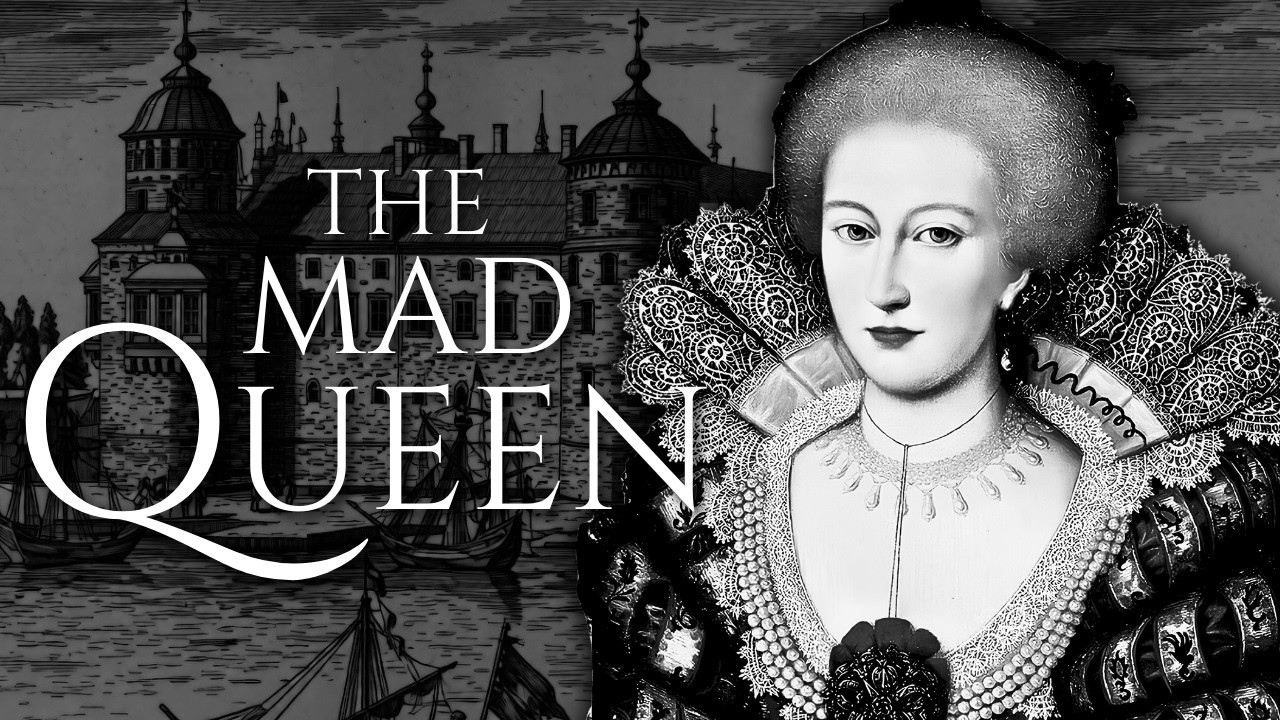
But the woman the words were pinned to spent the rest of her life being described in roughly that spirit by her daughter, by the council that ruled Sweden in her daughter’s name, and by three centuries of historians who mostly took the council’s word for it. Maria Eleonora of Brandenburg was born on the 11th of November 1599 in the Ducal Castle at Königsberg, now Kaliningrad, a city whose castle was later destroyed by Soviet demolition. Her father, John Sigismund, Elector of Brandenburg, was a large man given to drink and rage. Her mother, Anna of Prussia, was sharper, proud, and Lutheran to the bone, and their marriage was loud public arguments and flying crockery.
Her grandfather, Albert Frederick, Duke of Prussia, had been considered unwell in the mind since his early twenties, had twice tried to kill himself, and had lived for forty years under regents while his duchy was run for him. The family’s known quantity of madness would be pointed at later when her own daughter was told she had inherited instability from both sides. She was one of the most sought-after Protestant brides in Europe by 1620. The future Charles I of England was mentioned, along with a Polish crown prince and others.
But she had already made up her mind. She wanted the king of Sweden. Gustavus Adolphus had come to the throne in 1611 and by 1613 had fallen for a Swedish noblewoman, Ebba Brahe, whom his mother refused to let him marry. She was married off to one of his generals, and the king reportedly stayed in love with her for years.
When told to look abroad in 1616, he heard about the girl in Brandenburg, and something fixed on her. It became a matter of honor for him to have her hand and none other. Her brother, the new Elector, offered the younger sister instead. The king refused.
The princess, when consulted, made it clear she preferred the King of Sweden. Her mother, Anna, hated the match, fearing for her family’s position in Prussia under the Polish crown, which viewed the Swedish king as a usurper. She wrote to Sweden to stop the visit, even describing her ill husband as weak-willed. When he died in December 1619, the match seemed dead.
Then in the spring of 1620, Gustavus Adolphus arrived in Berlin under a false name, pretending to be a captain. Anna refused him a meeting, but the princess contrived to be in the same room, and everyone noticed her interest. The king left, making a show of touring other courts. Anna’s resistance collapsed, and she arranged the negotiations herself, moving her daughter beyond her son’s reach and helping herself to valuables from the treasury on the way out.
On the 7th of October 1620, Maria Eleonora left with her mother and sister, and a Swedish naval detachment carried them across the Baltic to Kalmar. The wedding was held in Stockholm on the 25th of November 1620, and three days later she was crowned queen. She was twenty-one years old, and she had gotten exactly what she wanted. Almost nothing else about her new country pleased her.
She never learned Swedish. She disliked the landscape. She was homesick. But she was in love with her husband, sentimentally devoted to him, and he was a king at war, almost never near her.
When he was away, she fell ill; when he came home, she recovered. The court noticed and made notes. The notes were not kind. A tradition grew that she was tempestuous, excessive, neurotic, and jealous, given to harsh language, even turning it on the king in front of strangers, complaining that his officers saw more of him than she did.
Her first pregnancy ended in July 1621 with a stillborn girl, and she fell severely ill, never seeming entirely to recover. A second daughter was born in October 1623 and lived eleven months, the heir to Sweden, before dying in September 1624. The third pregnancy ended in the spring of 1625 when she insisted on joining her husband on a yacht trip in calm water, a storm came up suddenly, the boat nearly capsized, and as she came ashore she cried out that she could not feel her child. She delivered a stillborn son.
In 1626 she was pregnant a fourth time, and everyone expected a boy. The child was born on the 8th of December in the old castle in Stockholm. It was a hard labor. The baby was born covered in hair, a dark downy fleece from head to knees, with a large nose and a loud, unmistakable voice.
The women looked and listened and told the king he had a son. The cannon began firing. Then someone looked more carefully. The baby was a girl.
His half-sister carried her to the king, and he said, “She’ll be clever. She has fooled us all. ” He ordered the birth announced with all the ceremony due to a male heir and named her Christina. Her mother was told several days later.
The recorded outburst was the line about the monster. In her agitated state she reportedly tried to injure the child. The daughter, grown up, believed it. Christina’s memoir lists accidents from her infancy laid at her mother’s door: a beam falling on her cradle, a drop down stairs, a fall onto a stone floor that damaged her shoulder and left her with one shoulder visibly higher than the other for life.
The king’s response was to arrange for the girl to be raised as much like a boy as possible, and in his will he gave his wife only a minor part in the upbringing, afraid that whatever was wrong with the mother might pass to the child. The wars with Poland and then Germany kept the king away. In August 1627, he was hit by a musket ball near the spine that could not be removed, the reason he later rode into battle without a breastplate. She had five years to wait for what that meant.
In 1630 he sailed for Germany. Before leaving, he told the council his wife was a miserable woman, and privately told the chancellor, Axel Oxenstierna, that his family would merit pity, the mother lacking in common sense, the daughter a minor. He did not leave his wife any written promises about her position after his death. She fell apart when he left, wrote that she wanted to die, and petitioned to join him.
He let her. She caught up with him in January 1632, and for most of that year she was with the army or near it. The winter of 1631 into 32 was as close as she ever got to the life she wanted, the Swedish court in effect at Mainz with the king at her side. They were seen together for the last time at Erfurt on the 28th of October 1632.
He left her there with a garrison and rode north to deal with Wallenstein. On the 3rd of November she wrote to Oxenstierna, “Without his royal majesty’s presence, I am worth nothing, not even my life. ” He died on the 6th, at the Battle of Lützen. The fog that morning was so thick the Swedes waited until nearly eleven before attacking.
The king rode at the front in a buff coat and no breastplate. In the early afternoon he took a regiment of cavalry too far forward and lost his escort. The first shot shattered his left arm. The second hit him in the back.
He fell over the horse’s neck, his foot caught in the stirrup, and the horse bolted, dragging him face down across the wet ground. The imperial horsemen found him alive, and the rest was done at close quarters. The apothecary counted nine wounds, most of them delivered after he was already on the ground. Then they stripped him down to his three linen shirts and left him.
The Swedes won the battle. They found him after the fighting was over, carried him to a village church, and the next day an apothecary embalmed him. The entrails went into a chest. The heart, noted as uncommonly large, was kept separately for the queen.
The coffin started north. She had said her life was worth nothing without him. Three days later he was dead. She did what she had said she would do.
The coffin reached Wolgast, the little port where she had first landed, and stopped for the whole winter. She had the lid taken off, and she visited the body regularly, daily, patting it and embracing it, choosing what he wore, weeping and moaning, paying no attention to the putrefaction. She also gave an order: she wanted the coffin big enough for two. She was not going to allow him to be buried without her, which meant in practice he was not going to be buried at all until she died.
The ship left Wolgast on the 16th of July 1633, the coffin and the queen aboard, and reached Nyköping on the Swedish coast. Waiting on the key was her daughter, six and a half years old, who had not seen her mother in two years. The girl later wrote that her mother drowned her with tears and practically smothered her in her arms. At Nyköping, Maria Eleonora made her position on burial official: it should not happen in her lifetime.
She added that she often thought of shortening it, a threat of suicide understood as one. She had her apartments hung with black cloth. The windows were covered so no daylight came in. Candles burned day and night.
Her daughter was moved in with her, slept in her bed, and over the bed hung a gold box containing the heart of Gustavus Adolphus. The child went to sleep every night beneath her father’s heart in a room with no windows, her mother weeping beside her, for the better part of a year. The child got sick badly enough that the ulcer on her chest gave her a high fever until it burst. She recovered and never forgot it.
She also hated her mother’s dwarfs and buffoons, who were in and out of the black rooms, and would associate them with her mother for the rest of her life. The council needed a state funeral, and they needed it without the queen dowager throwing herself into the grave. Some of the delay was not hers: the king had ordered a new burial chapel built, and it was not finished until the summer of 1634. On the 22nd of June 1634, nineteen months after Lützen, the coffin was brought to the Riddarholm Church and placed in the vault.
In the procession, behind the coffin, went the widow. After the burial, she tried to dig him up. Oxenstierna had to post guards at the tomb, soldiers in the church, to stop a queen from opening a vault. The last thing they made her give up was the heart.
After the interment, the sources say, she was compelled to place it in the coffin. The cloth she had wrapped it in survives in the Royal Armory in Stockholm. The gold box has vanished. The fight over the regency had started before the coffin reached Sweden.
In May 1633, the council set up a regency government for the six-year-old queen, five great officers of state with Oxenstierna at their head. The Queen Dowager was not among them, was not consulted, and was not even told until it was done. She was offended and pointed out, truthfully, that Swedish queens had served as regents before. The answer came from the chancellor’s brother: her information was highly exaggerated, and Sweden had no tradition of including Queen Dowagers in regencies for minors.
It was a lie, and he knew it. The truth was the sentence the king had said to his own brother before sailing: the mother lacking in common sense. They did not want to say it to her face, so they said there was no precedent instead. Then came the Form of Government of 1634, drafted by Oxenstierna, which put the regency on a permanent footing with no place for her anywhere.
Her exclusion was now law. She fought it in the only theater left to her, her daughter. If she could not govern Sweden, she could raise Sweden’s queen. The council wanted that least of all.
Her household was German, her language was foreign, and the council feared she was teaching the child to think ill of Sweden. In 1636 they took Christina away from her and gave her to the king’s half-sister Catherine, as the king had wanted. The will Maria Eleonora had resented in 1630 became the paper that took her child away in 1636. She was sent to Gripsholm Castle, forty miles from Stockholm.
Exiled is the word the sources use. Four years she was there. Her allowance was inadequate, she spent constantly, and the council threatened to put her income under compulsory administration. She wrote letters to her family and to Denmark.
In 1639, a letter to the Danish king was intercepted, and the council began to treat her as a risk. In July 1640, she ran. She announced a religious retreat into her private apartments, took one lady-in-waiting, dressed in ordinary clothes, and on the night of the 22nd of July let herself down from a window of Gripsholm Castle on a rope or a ladder. A boat was waiting, a carriage on the far shore, and the carriage took them south to Nyköping, where a Danish ship was waiting.
By the time anyone thought to disturb her retreat, she was at sea. She talked the captain into taking her to Denmark instead of Brandenburg, and presented herself to King Christian IV as a guest. He was not pleased. He had wanted to embarrass Sweden, not house its queen dowager.
Sweden’s reaction was fury. The council condemned her flight, struck her name from the church intercessions, withdrew her income, and took back her lands. Her own brother refused to have her. He died five months later, and her nephew Frederick William, the Great Elector, agreed to take her in on the condition Sweden paid for her.
She stayed in Denmark until 1643, when Sweden went to war with Denmark while she was still a guest of the Danish crown. She left that year for Brandenburg, and was put at Insterburg in East Prussia, a provincial castle far from anything she recognized as a court, on a Swedish pension that did not cover her expenses. She stayed there four years, writing letters about money and about her daughter. She had not seen Christina since the child was taken from her in 1636.
What changed was Christina. In 1644 she turned eighteen and took the government into her own hands. The regency was over. In 1648, with the Thirty Years’ War ending, Maria Eleonora wrote from Prussia and asked to come home.
Christina said yes. She arranged it, went down to the coast to meet the ship herself, and when the ship was held back by a storm, she slept out in the open two nights running on the ground in the Swedish autumn rather than go back to a bed, and caught a fever from it that put her in bed for days. She had been shut in a black room with a heart in a box for a year of her childhood and taken away from her mother by the state. She slept on the ground for two nights to be there when the ship came in.
The reunion was a good one. Christina gave her mother a generous allowance, installed her at Nyköping with a proper household, and bought her a palace in Stockholm, the grandest private house in the city, though she never actually paid for it. Maria Eleonora was nearly fifty. Visitors described her as amiable and majestic, still beautiful, well informed about art and architecture, interested in theater, backing musicians and painters.
She had her musicians and her dwarfs still, and for the first time since 1632, nobody was writing to a council about what it cost. In October 1650, Christina was finally crowned in the same church where her mother had been anointed thirty years less a month earlier. The mother sat in the congregation and watched a young woman with one shoulder higher than the other take the crown of Sweden, and the young woman was hers. Four years later, Christina abdicated.
Before she left, she and the incoming king traveled down to Nyköping to sit with the old queen dowager and promise her she would be provided for. They promised. On the 6th of June 1654, Christina abdicated, and within days she left Sweden dressed as a man, on her way eventually to Rome and the Catholic Church. It was described as one last devastating sorrow for the woman who had already lost everyone else.
Maria Eleonora died a few months later, in March 1655, at fifty-five. The sources that had been so detailed about her weeping in 1633 have very little to say about her dying. They buried her in the Riddarholm Church next to him, in the vault where she had once wanted a coffin big enough for two, where the heart she had been made to give up had been waiting for twenty-one years. She got, in the end, the thing she had asked for at Nyköping in the summer of 1633.
It just took the rest of her life. For three centuries, historians mostly took Christina’s word for it: a hysterical, extravagant foreigner, a domestic plague. Then, fairly recently, the tide turned. The main Swedish dictionary of women’s biography now opens its entry on her by calling her one of the most maligned queens in the historical record, arguing that the picture of the difficult wife and the mad widow was manufactured after the king’s death during the fight with the council by men who needed her to be unfit so they could keep her out.
A Swedish biography published in 2010 was titled, bluntly, The Queen who Said No. She said no to the regency arrangements, no to the burial, no to giving up the heart, no to giving up her daughter, no to Gripsholm, no to Sweden. A woman who kept saying no to the Council of the Realm in the 1630s was always going to be described by the council as a woman who could not be reasoned with. Every element of her mourning, taken on its own, had precedent among the crowned heads of Europe.
What has no precedent is all of it at once for nineteen months, with the coffin open and the child in the bed and the guards at the tomb. The woman who wrote to say she would be nothing without him three days before he died was telling the truth about herself in a way no council or biographer has quite managed to take at face value since. She said what she was, and then he died. Whether that is madness, or something given a gentler name now, or just what it looks like when a person who has lost four children and a husband stops pretending to be all right, can be left to the reader.
The heart was in the box. The child was under it. The guards were at the tomb. She has been in the vault beside him since the spring of 1655.
Nobody has to post a guard.






