The sheriff was a man who wrote everything down. That was the first thing anyone learned about Jonas Culver, and in the autumn of 1923 it was the thing that mattered most. For nineteen years he had kept a ledger on the corner of his desk in the courthouse at Merrill’s Field, Kentucky, and in it he recorded what people told him and what he saw with his own eyes. He did not record what he thought, as a rule.
He said his job was not to think but to record, and that the thinking would come from the records if they were kept faithfully. It is worth knowing this about him, because of what came later. Everything Jonas Culver wrote in his ledger was written carefully. What he wrote, he had seen or been told plainly.
He added no ornament. And the record he kept in the fall of 1923 was not ornamented. It was only what happened, and what was said, and, after a while, what he could no longer explain. On a Sunday in October of that year, two brothers named Rivers came out of the woods with a story that would keep the sheriff of Merrill’s Field awake for the rest of his life.
Their names were Ott and Milford Rivers. Ott was the elder by five years and the quieter of the two. Milford did enough talking for both of them, but by the time they reached the sheriff’s office, both were speaking low and neither wanted to sit down. They had been in the woods behind Cliffside Ridge, about a mile before Austin Hollow truly begins, working on a hunting stand.
They said the woods had felt strange that morning. Milford said the birds were suspiciously quiet for October. Ott said the light between the trees was the color of tea left standing too long. He was not a man given to poetry, and his brother looked at him strangely when he said it, but nobody in the sheriff’s office laughed.
They were both mountain men. They knew when to trust a feeling. What they had come to tell was this. There was a man standing in a clearing a quarter mile below the ridgetop, in a place they had not known to be a clearing.
He had not moved since they began watching him, which Milford estimated at over an hour. His head was not bowed. It was raised. He was staring at a tree—not at anything in the tree, but at the tree itself.
That tree, as Milford described it, was an ordinary tulip poplar of no particular age. They watched from the brush and thought about it for a while. Finally Ott came out of hiding. He said later that his feet did not want to go forward, and if not for his brother behind him, he would not have dared.
He approached quietly. He did not want to startle a man who might be armed with a rifle. But the man had no rifle. He had no weapon at all.
No hat, no coat, no pack. His boots were torn at the toes and the soles were worn as if he had walked an immense distance on them. And yet, Ott said, the strange thing was that the boots otherwise looked new. As if the miles had been put on them all at once.
Ott spoke to him. The man did not answer. Ott spoke again, closer now. The man did not turn his head.
Ott put his hand on the man’s shoulder, and only then did the man turn to look at him. Just a look, for one second only. Then his eyes went back to the tree. Milford caught up with them.
Together they walked the man out of that clearing. He walked. He did not resist. He did not lead them.
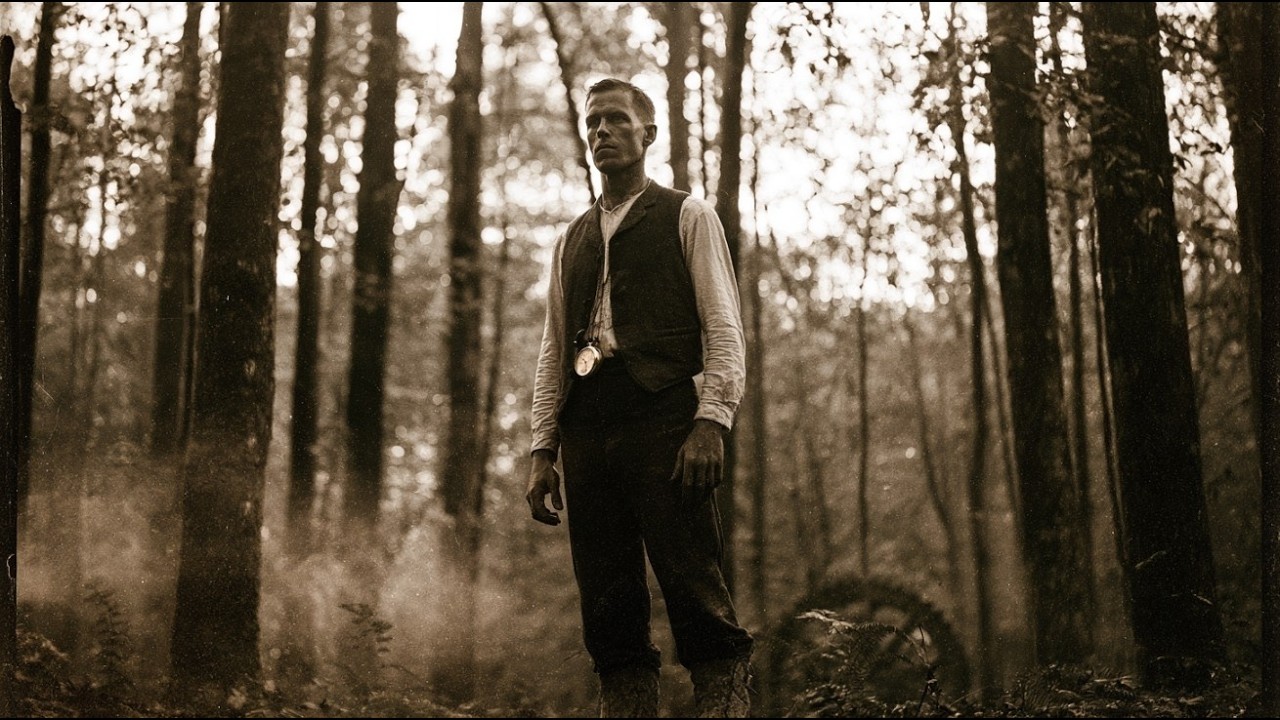
He went where they went, at the speed they walked, and he did not speak a single word the whole way down. It was past three in the afternoon when they reached the wagon road, and near dark when they brought the man into Merrill’s Field and up the courthouse steps, where Sheriff Jonas Culver had lit a stove and a lamp against the lateness of the hour. The man had nothing in his pockets but a dime. He carried a pocket watch on a cheap brass chain.
The watch had stopped at four minutes past three. Culver looked at the watch, set it on his desk, and did not wind it. In the inner pocket of his coat—though the coat itself was not with him—he had a small ledger bound in red leather. The ledger bore a name inside the front cover, in the man’s own hand: Ambrose Wetheral, Louisville, Kentucky, title examiner.
Authorized member of the National Association of Land Abstractors. There was a business address on Fourth Street and a home address on Chestnut. Inside the ledger were entries dating back to 1918, all concerning title work in seven counties across three states, mostly in eastern Kentucky and western Virginia. The last entry was dated September 21, 1923, about three weeks before the day Wetheral was found in the woods.
That entry was a single line. It read: “Summoned to Renshaw station for connection at Austin Hollow, Merrill’s Field County, at the request of Philom & Wychsel of Cincinnati. ”
Sheriff Culver put him in the small cell behind the courthouse, not because Wetheral was under arrest, but because it was the only room in Merrill’s Field with a bed and a lock, and because Culver did not know what else to do with him. He did not lock the door.
He kept it open with a chair and told the man to sit or lie down as he pleased. If he wanted water, there was a pitcher on the table. If he wanted anything else, he could ask. Wetheral asked for nothing.
He sat on the bed. He did not lie down. He stared at nothing. He did not eat.
He did not speak. That was the first evening. The second day passed the same way. Culver went in a few times to check on him.
He brought a plate of food and Wetheral did not touch it. He brought coffee and Wetheral did not touch it. Near noon, Culver sent a telegram to Louisville to verify the Chestnut Street address and to learn whether a Mrs. Wetheral existed there, or a partner, or anyone who could identify the man and say whether he was missing.
The reply came by wire near dark. Yes, a woman named Wetheral from Chestnut Street had reported her husband missing on the seventh of October. That was seven days before the Rivers brothers found him in the woods. The telegram added that Mrs.
Wetheral would come by train the earliest possible morning. Culver put the paper in his book and closed it. On the third day, Wetheral spoke. He asked for a lamp.
He said he wanted a small lamp, not the electric one. The courthouse at Merrill’s Field had been wired for electricity by then, and the cell had a bulb inside a wire cage overhead that gave off a blue cast Culver himself did not much like. Wetheral said, in a voice that had not been used for a while, that he wanted an oil lamp. He said he wanted to see the flame.
Culver went to the storeroom and found an old brass lamp that had been in the courthouse since before electricity, filled it, and brought it in. He set it on the small table beside the bed. He struck a match and lit the lamp. He turned off the electric bulb overhead.
He stayed in the room with Wetheral for a while. Wetheral watched the flame. After about ten minutes he began to tremble, but lightly, the way a man trembles when he has at last set down something he has been carrying for too long. He did not weep.
He did not speak yet. He watched the flame. After a time, Culver asked him quietly whether there was anything he could do for him. Wetheral did not raise his head.
He said, in a voice that came with the rhythm of a man far older than he was, that he was not yet sure he was still down below. He said he was not yet sure he was not still up there. Culver did not know how to take that. He told Wetheral he was in Merrill’s Field, Kentucky, in the county courthouse.
He gave the date. Wetheral nodded very slightly. He asked if that was the real date. Culver confirmed it.
Wetheral closed his eyes and did not open them for a long time. When he opened them, he said he was ready to tell what had happened. He said it might take a while. He said he was not entirely certain which parts of the story were true in the ordinary sense of the word and which were something else.
But he would tell it as he remembered it, in the order he remembered it. The sheriff could write it down, and afterwards the sheriff could do what he liked. The sheriff took out his ledger. He turned to a fresh page.
He wrote the date at the top. He wrote the name Ambrose Wetheral. He wrote the words: offered voluntarily, no attorney present, not sworn. He put down his pen.
He nodded. Wetheral began. He said he was forty years old, born in Bardstown to a family of merchants, and had entered the title business through a clerk’s job at a Louisville firm that later took him on. He had been a title examiner for sixteen years.
In the ordinary case, his work was a matter of paper. You read the deeds. You trace the chain of title back as far as it goes. You check the registry for liens.
You sometimes go out and walk the land when the deed is old or the survey is in dispute. You make sure the corners are where the paper says they are. He had walked land in every county between the Ohio River and Cumberland Gap and had never had any trouble. Nothing he could not resolve in an afternoon.
Nothing that made him think twice about a place. The letter arrived in the second week of September. It came to his office on Fourth Street. It was on proper letterhead.
The paper was heavy and cream-colored, printed at the top with an engraving of a lamb standing under a tree. At the bottom was printed: Philom & Wychsel, Timber and Real Estate. Cincinnati, Ohio. There was a street address.
He did not check it at the time. He had never worked with Philom & Wychsel, but there were dozens of firms he had never worked with, and the trade in the Ohio Valley was wide. The letter asked him to survey 640 acres at the head of Austin Hollow, Merrill’s Field County, Kentucky. The compensation offered was high—more than he would ordinarily get for work of that size—but not so high as to be suspicious.
It was signed by Mr. Reed Philom, the senior partner. It stated that the client was a private individual who wished to remain unnamed. It said the land had been a single holding since 1846 and needed a modern examination for a possible sale.
It said that if the terms were acceptable, he should reply by telegram, and the firm would send a train ticket and an advance. He sent the telegram. He received the ticket. He received the advance.
He was to be met at Renshaw station by a Mr. Grover Slate, who would drive him by wagon to the farthest point the road went, and from there he would continue on foot. He left Louisville on the fifteenth. He took the L&N south and east.
He changed trains at Corbin. He got off at Renshaw on the afternoon of the seventeenth, two days later. Grover Slate was there with the wagon. He was a man in his sixties, with a face seasoned by the seasons and a way of speaking that wasted no words.
He was polite. He tipped his hat. He asked if Wetheral was the man he was waiting for, and Wetheral said he was, and Slate took his bag and put it in the back. Then they set off.
They drove for more than three hours through country that widened and narrowed and widened again. The road was good for the first six miles and poor after that. There were three farms along the way, and Slate named the family at each as they passed. Wetheral no longer remembered the names now, except that one of them was something like Farlow.
The last farm was five miles from the start of the road, and after it the road was nothing but a logging trace. When the mill wheel came into view, Slate stopped the wagon and let his horse catch its breath. He sat for a moment before he spoke. He told Wetheral that the road ended here, in a manner of speaking.
There was a walkway behind the wheel that would take him the rest of the way. The wheel was old, and there had been a mill once, but no longer. He said he would wait, or return, on the agreed day. They had agreed on four days.
Slate said he would be there on the fourth day at noon at that spot. If Wetheral was not there, he would wait until dusk and no longer. Wetheral said that was reasonable. He got down from the wagon.
He took his bag. Slate did not move to help him. Slate said, “One more thing. ” And this was the thing Wetheral said he remembered precisely.
Slate said, “Don’t go past the mill wheel. ” Wetheral smiled, thinking it was a rural superstition, and said he had to. That was his job. Slate did not smile back.
Slate said again, “Don’t go past the mill wheel. And if you will, God keep you, don’t do it after dark. ” Then Slate turned the wagon and drove back the way they had come. Wetheral stood by the mill wheel with his bag in his hand and watched him go.
The wheel was moss-covered and larger than he had expected. It was set against the side of a small stream that must have run stronger in past seasons. The stream ran now, but low. The wheel did not turn.
The building the wheel had once served was gone. He could see the outline of its foundation in the grass from where he stood. That was all. There was no other trace of any mill.
He looked at the path going up. He looked at the ground. He waited a moment. He could not say exactly why he waited.
Grover Slate’s face had gone perfectly still when he said the last part about dark. Wetheral was not a man to ignore a warning given in earnest. But he was also, as he said, a professional. His work was walking land and reading deeds.
And the land and the deed were on the other side of the wheel. He took a step. Then another. He passed the wheel and the path took him upward.
The first thing that caught his attention past the wheel was the light. He was among beech and oak and poplar, in a forest he had walked a hundred times in his life, and the light falling through the canopy should have been green the way September light in a broadleaf wood is green. It was not. It was yellow.
Not the yellow of autumn leaves, for the leaves were still on the trees and mostly green. It was the yellow of old paper, the yellow of a book left under a window. He stopped and looked up, and the sky through the canopy was the same yellow, though he could see blue plainly beyond the ridge behind him. He told himself it was a trick of the eye, and he walked on.
The path rose. It turned left. He walked for half an hour, no more, before he came to a small clearing with a stone chimney in the middle of it. It stood twelve or fourteen feet high, built of river rock and mortar.
The mortar was old. The rock was mossed on the north side. He walked around it. There was no foundation for any house.
There was no burnt timber. There was no ash. The chimney stood alone in a clearing where no house had ever been built, or if a house had been built, it had vanished completely and left nothing behind but the chimney. He put his hand inside the firebox.
It was cold and dry and clean. He stepped back and looked at it for a while and could not think what to write in his book about it. He wrote, “Lone chimney. ” He wrote the location by his best estimate from the path.
He walked on. Less than twenty minutes later he came to the well. He nearly fell into it. The path led him around a mound of laurel, and there it was.
A hole in the ground about three feet across, ringed by a stone wall that rose about a foot above the level of the ground. There was no house near the well either. There was no yard. There was nothing.
Just the well and the path passing beside it. There was a rope tied to a hook set in the top stone. The rope ran down into the well, and he could not see the bottom. He reached out and took hold of the rope, meaning to pull up the bucket that must be on its end.
The rope crumbled at his touch. It came apart in his fingers like burnt paper. The rope had looked new. It was coiled on the top stone, and the coils looked greased.
But when he touched it, it turned to dust. He stepped back from the well quickly and did not look into it, because he was overcome by a feeling that he did not want to know what was at the bottom. He wrote in his notebook: “Well, dry rope, no bucket. Continued on.
”
The cabin appeared after about an hour. The path turned along the hillside and the woods opened, and there was a cabin in a clearing, and the cabin was occupied. He knew it at a glance. Smoke rose from the chimney.
A door stood slightly ajar. There were the usual signs of a house that someone lived in, or had been in recently. He stopped at the edge of the clearing. He called out.
No answer. He went forward. He called again. He reached the door.
He knocked. He waited. He pushed the door open. Inside was one room with a table, two chairs, and a bed against one wall.
There was a fire in the hearth, low but burning. He walked to the hearth. He looked at the fire. He stood there a long minute before he understood what he was looking at.
There was no wood in the fireplace. There was no wood laid on it. There was no ash on the hearth. There was a fire burning where there was nothing to burn.
The fire was warm. He brought his hand near it and felt the heat. The flames flickered the way flames flicker. And there was nothing beneath them to make them do it.
He backed out of the cabin. He did not close the door. He turned and stood on the threshold and looked at the clearing and the light. That yellow light he had noticed at the mill was stronger now.
It was the color of butter left out too long. The light had a weight to it. He wrote in his notebook: “Cabin occupied, no occupant. Fire without fuel.
” He turned back toward the path. His intention now was to leave. To end the job he could not, in his mind, complete. To go back to the mill and wait for Grover Slate, and let Philom & Wychsel send someone else if they wanted their delivery made.
That was his intention. He took out his watch to see how much daylight he had left. The watch had stopped. It had stopped at four minutes past three, which was about right by his guess at the sky.
He had wound it that morning in Renshaw. He had wound it fully. It was a good watch, an Elgin, given to him by his wife on their tenth anniversary. He had never known it to lose more than a minute in a week.
He shook it. He held it to his ear. There was no ticking. He set the crown and turned the stem.
The stem turned. But it did not catch. It turned freely the way a stem turns when the mainspring is broken. He put the watch back in his pocket.
He looked at the sun through the canopy. The sun did not move. He watched it for a minute to be sure. It did not move.
He looked at his shadow. His shadow did not move either. He put his hand on a tree and sat down on a root and tried to think. That was when he saw the woman.
She stood about eighty yards up the path in the yellow light, looking straight at him. She wore a plain gray dress of a cut he could not place. She wore no head covering. Her hair was pinned up.
Her hands were at her sides. She did not move. He stood slowly. He called out and asked if she needed help.
She did not answer. He took a step toward her. Then another. He kept his eyes on her.
And between the second step and the third, without seeing her move, she was no longer standing eighty yards up the path. She was forty yards to his left, off the path, among the trees. She was still looking at him. Her hands were still at her sides.
She was not moving at all. He stopped where he was and did not move again for a long time. She did not move either. He said, and these were his words as he told them, “She wasn’t doing anything to me, and I wouldn’t have known what was wrong if I lived forever.
But something was wrong in a way I couldn’t place and didn’t want to. ”
He backed up the path the way he had come. He did not turn his back to her. He backed away.
He kept his eyes on her. When he had backed about twenty yards, the woman was gone. He did not see her leave. She did not walk away.
She was there, and then she was not. When he could no longer see her, he turned and walked as fast as he could back the way he had come, toward the mill wheel. But the path did not take him to the mill wheel. He walked for nearly an hour at a pace that should have brought him back to the wheel three times over, but the path did not go downhill.
It ran along the hillside. It rose. It turned. The trees were the same ones he had passed on his way up.
He recognized them. There was a lightning-struck oak with a broken top that he had marked in his book on the way in. He passed it. He passed it again twenty minutes later.
He passed it a third time forty minutes after that. Each time he passed it, he found himself higher on the mountain than he had been before. He could tell by the tilt of the ground. He could tell by the way he was breathing, and by the fact that the path never went down.
At a time he could not determine, because his watch was still stopped and the sun was in the same place, he left the path. He could not bear it anymore. He struck his own way through the brush, downhill. He stumbled through mountain laurel and roots for what he guessed was an hour.
When he came back to a path, he did not know whether it was the same path or a new one. He was in a small yard. There was an outbuilding at the far end of the yard. It looked like a smokehouse.
It was made of dark, weathered wood, with a door secured by a latch and no windows. He walked toward it. He knew, he said, that he should not open it. He knew it the way one knows in a dream that one should not open a door, and yet one opens it.
He lifted the latch. He pushed the door. Inside, pocket watches hung from the beams above and sat on shelves along the walls. Dozens of them.
Some hung by their chains. Some were stacked in rows on the wood. Some were open, faces up. Some were closed.
They were of every kind and every age. There were watches he knew at a glance to be a hundred years old. There were watches he knew to be newer than his own. Every one of them was stopped, and no two of them, he said, had stopped at the same time.
He stood in that doorway and looked at them all. Then he looked at the shelf nearest the door, and he saw a watch he knew. It was an Elgin, hung on a cheap brass chain. It was open.
Its hands pointed to three and four minutes. When he took his own watch from his pocket to compare, he said his hands could barely hold it, because he already knew what he would see. He closed the door. He walked away.
He did not run. He was afraid that if he ran, something behind him might take it as an invitation to run too. He walked. He kept walking.
He left the yard by the other side. He did not look back toward the outbuilding. He never saw it again. The path ran along the edge of a rise for a time, and then it went down.
It went down. He could hardly believe it when he felt the ground falling away beneath his feet, and he did not trust it. He kept looking to see if it was a trick of the eye. It was not.
The path descended. It descended for what he judged to be nearly a mile. Then the path opened onto another yard. In this yard there was a small shelter made of split rails, roofed with bark.
Under the shelter, on a flat stone, lay a book. He did not want to look at the book. He knew, in the way one knows in dreams, what he would see. He walked to the shelter.
He picked up the book. It was a ledger bound in red leather, worn at the edges. It was exactly like the ledger in his inner pocket. He opened the front cover.
The name inside the cover was his own. His name, in his own hand. He knew his handwriting, and this was his handwriting. He turned the pages until he reached the last page with writing on it.
He read the date at the top of the entry. The date was August 9, 1926. The ledger in his pocket was current to September 21, 1923. He was reading, on a flat stone under a shelter, an entry dated three years in the future.
It was written in his hand. It described a tract of land in a place he had never heard of, for a client whose name he did not know. He closed the ledger and put it back on the stone. He turned around.
He walked back the way he had come. The path was still descending. He did not remember the rest of the descent. He remembered being in the woods.
He remembered the light changing from yellow to something like true evening light. He remembered a stretch when he was not sure whether he was walking or being carried. He remembered a stand of poplars. He remembered stopping in a clearing and looking at a tree because he could not find anything else to do.
Then he remembered a hand on his shoulder and a man’s voice saying something, and turning his head and seeing Ott Rivers’ face close to his own. And after that, the wagon road. And after that, the courthouse steps. That was Wetheral’s account.
Sheriff Culver recorded all of it, quietly, without interruption, as it came out over two long afternoons in the small cell behind the courthouse at Merrill’s Field. When Wetheral finished, Culver did not put the book away. He kept it out. He asked Wetheral a question.
He asked him what he thought had happened. Wetheral said he did not know. He said only what he had told the sheriff: that he was not sure any of it was real in the usual sense, but that it had happened, and that he had come out of it. He was not sure why.
Sheriff Culver had a case, then, and no place to put it. He was a precise man. He would not let a story like that go. He wrote to Cincinnati that same night.
He wrote to the postmaster there, and to the county recorder in Hamilton County, and to a friend of his in the sheriff’s office in Cincinnati, a man named Hoyt Aldridge who had once owed him a favor in a horse-stealing case that stretched across the river. He asked all three, in three separate letters, to look for a firm called Philom & Wychsel, Timber and Real Estate. He asked for a street address. He asked for a directory listing.
He asked Aldridge, in his letter, whether he could go to the address on the letterhead himself and see whether the firm existed. The replies came over the next two weeks. The postmaster wrote that no firm by that name existed in the records. The recorder wrote that no firm by that name was registered in Hamilton County or the state of Ohio.
Aldridge wrote a longer letter. He said he had gone to the address on the letterhead. The address existed. It was a building.
A five-story building on a good corner. The first floor was a hatter’s. The second was a dentist’s. The third was a lawyer’s.
The fourth was a print shop. The fifth was empty. There was no trace of Philom & Wychsel in the building. No one in the building had heard of them.
He had knocked on every door. He had asked. Nothing. Sheriff Culver put the three letters together in his file.
At the top of the file, in his small, precise hand, he wrote the words “Firm does not exist. ” He went the next morning to see Grover Slate. Slate lived in a small house half a mile from Renshaw. Culver knew him slightly.
Slate was polite. He invited the sheriff in. He offered him coffee. Culver accepted the coffee.
He told Slate why he had come. He asked Slate to tell him about the drive he had made to the head of the trail below Austin Hollow on the seventeenth of September, carrying a Mr. Ambrose Wetheral of Louisville. Slate looked at him for a while.
He said he had driven no one named Wetheral. He was sure of that. He did not know anyone named Wetheral. He had not been on the road to the head of Austin Hollow on the seventeenth of September.
He had not been up that road since August. He did not care for going up that road, and he did not go unless the pay was good, and he had not been paid for it in weeks. He was sorry, but the sheriff had been given wrong information. Culver watched him for a moment.
He said, plainly, that the man he was asking about had not misled him in this matter. The man had described Slate accurately: the wagon, the horse, the road, the three farms, and a name, Farlow. Slate was silent at that. He set his cup aside.
After a while he said there was a Farlow family on the road to the head of the trail, and he knew them slightly. He said his name and his trade were well enough known in this country. Anyone could have told the man that Grover Slate would drive a wagon up that road if the pay was right. He had not driven this man.
He said, looking at the sheriff steadily as he said it, that he had driven a man up that road in the middle of August, six weeks earlier. That man had also been going on business for a company the sheriff might not have heard of. Slate could not remember the name of the company. But he remembered the man’s name.
The man’s name was Enoch Kittelburn. Culver wrote down the name. He asked Slate to describe the man. Slate described a thin man, forty perhaps, dark-haired, with a good coat.
Slate said he never saw Kittelburn come back. Kittelburn had gone up the trail past the mill wheel, and Slate had waited at the wheel a day, and then a second day, and Kittelburn had not come. Slate had gone home. He had been paid in advance, so it did not trouble him in that regard.
He said, however, that he had thought about it since. He said, the way one speaks of a thing kept private for a long time, that he did not believe Enoch Kittelburn would ever come back. Culver wrote all of it down. He thanked Slate.
He drove back to Merrill’s Field. In his file, at the top of the second page, he wrote the words “Enoch Kittelburn, August, did not return. ” He sat and thought about it for a while. Then he went to the station stop at Renshaw and asked the stationmaster whether he remembered a man named Mr.
Ambrose Wetheral getting off a train on the seventeenth of September. The stationmaster looked in his records. He said no. No man by that name had come off a train in September.
In fact, his memory for faces was good, and he did not remember any stranger arriving on the seventeenth at all. Culver went back to his office. He sat with his files. He thought for a while.
Then he wrote to Louisville. He wrote to the Wetheral firm itself on Fourth Street. He asked whether they had heard of any title examiner or surveyor who had gone into Merrill’s Field County in the past few years and not come out. He asked whether they knew of any firm that had lost a man in Austin Hollow.
He asked, could they ask around. He signed the letter. He mailed it. The reply came from Louisville four days later.
A partner in the Wetheral firm wrote back. He knew of no man lost from his own firm, but he had asked around. There was a firm in Frankfort that had lost a surveyor named Fenwick Ballgraf in the fall of 1919. Ballgraf had gone up to do work in Merrill’s Field County.
He had been hired by a firm he had never worked with before, and he had gone. He had not returned. His firm had made inquiries. The firm that hired him was never found.
His body was never found. His widow was in Frankfort and would speak to the sheriff if the sheriff wished. Culver wrote to Ballgraf’s widow. He received a short, dignified letter.
She said her husband had walked the path past the mill wheel in Austin Hollow on the twenty-third of October 1919. She remembered that he had been hired by a firm called Philom-something. She was sure it began with Philom. She still kept the letter, and would send a copy if the sheriff wished.
Culver replied that he wished it. The copy arrived a week later. The letterhead was the same. The lamb under the tree.
Philom & Wychsel, Timber and Titles, Cincinnati, Ohio. The signature was the same. Reed Philom. Culver put the two letters side by side on his desk.
Wetheral’s letter and Ballgraf’s letter, and they were the same letter four years apart, from a firm that did not exist. Sheriff Culver did what any careful man in his place would have done. He went to the records. He was lucky in this.
Merrill’s Field County had kept its records since 1840. The books were in the basement of the courthouse. He knew where they were, and he knew how to read them. He spent most of a week down there with a lamp, going through the records.
He found what he had been looking for and what he had feared. Between 1840 and 1923, there were at least six documented cases in Merrill’s Field County of people who went up into Austin Hollow and did not come back. In each case, there was a record of some kind. Not always a search, but a record.
The oldest was from 1873. A man named Osric Pendelus built the mill at the base of Austin Hollow that summer. He had an assistant, a young man of twenty-two named Will Canon Yerby. They finished the mill by the end of August.
They ran it once to test the machinery. The wheel turned, the stone turned, and the mill ground a bushel of corn. On September 10, 1873, Pendelus’s wife came from Renshaw to see the mill, and found the wheel stopped, the door open, and no one inside. Pendelus and Yerby were never seen again.
The mill was never run again. The wife stayed in the country two more years, then moved to Louisville with her sister. The record was signed by the sheriff of that time with a single word: “Abandoned. ”
The next case was 1893.
A family called Culhane came from the south and took up a homestead in the upper reaches of Austin Hollow. The upper reaches of Austin Hollow were where Wetheral had walked, where the chimney had stood alone, where the well had been. The Culhanes were four adults: a married couple, Ansel and Verlyn Culhane, and Ansel’s brother and his brother’s wife. They took the land on a promise of timber.
They built a cabin. They were seen in Renshaw at the store two or three times a season. In the spring of 1897, when they had not come to town for several months, a neighbor from three miles away went up to see them. The cabin was standing.
The door was open. There was a fire in the hearth, low, but burning. There was nothing in the hearth to burn. The neighbor did not stay to search.
He came down and reported it, and a search was made. The four Culhanes were never found. The record was signed with the word “Gone. ” The neighbor’s name was Ott—the grandfather of the Rivers brothers who had found Wetheral.
His name was Vernon Rivers, and his description of the visit was in the file, in his own hand, and it matched Wetheral’s description of the fire. The third case was 1901. A vagrant, recorded as one Ren Cavalcade, of no fixed address, had passed through Renshaw looking for work. He said he had heard there was a mill up the hollow that might need a hand.
He was told there was no mill, and had not been one for thirty years. He went up anyway. A hunter saw him on the path past the mill wheel that evening. He was not seen again.
No search was made. He had no kin. The sheriff of that time had recorded the case as missing, never found. There were three other cases.
Culver, when he finished, did not write out the full tally in the account he gave later, but he had counted them. Eleven people, by his count, in fifty years, went up to the head of Austin Hollow, and not one of them came down. And in each of the three cases where a contract letter or a work order was found, the firm named did not exist and never had. In two of them, the letterhead was Philom & Wychsel of Cincinnati.
He closed the record books. He put out his lamp. He came up out of the basement. He sat at his desk for a long time.
He took two deputies with him. He took his first deputy, a man named Ellis Rumford, forty-one years old, who had been with him for twelve years and who could keep his calm in any circumstance. He took a younger man, Kade Hollinger, twenty-eight, new that year, but Culver had begun to trust him. They set out on a Monday in the first week of November.
They took two wagons and a spare horse. They took blankets and food and a lamp and a gun. They took a length of rope. They took a saw.
They did not tell Wetheral they were going. They took the road Slate had described. They passed the three farms. They reached the head of the trail below the mill wheel by late morning.
They left one man with the wagons, Hollinger. Culver and Rumford went up on foot with the lamp and the rope and the gun. They reached the mill wheel. They stopped and looked at it.
It was moss-covered. It did not turn. The stream beside it was thin. There was no house near it.
There was the trace of a foundation in the grass, as Wetheral had said. There was no other sign of any mill. They went past the wheel. The path took them upward.
The timber was hardwood. The canopy was high. The light coming through the leaves was green. It was ordinary November noon light, thin and clear, the color of a wood beginning to turn.
There was no trace of yellow in it. They walked for half an hour. They came to a clearing. There was no standing chimney in it.
There was no clearing at all in the place Wetheral had described. They walked another half hour. They came to a place where the path bent along a hillside. There was no well.
There was no cabin. There were no outbuildings. There was no laurel. There was no shed.
There were only trees and stones and the path, rising and running on. They walked for four hours. They saw no trace of anything Wetheral had described. They came down over a spur that Rumford knew, though not well.
They came out about a mile from the wheel and had to work their way back to it along the stream. They reached the wheel, and there Rumford stopped. Rumford had a good eye for trees. He was standing beside a beech at the edge of the path near the wheel, on the uphill side.
He was looking at the trunk. Culver came up. On the trunk of the beech, carved in neat letters in the bark, was the name Wetheral, and under it the year 1923. The letters were recent.
The bark had not begun to close over them. Rumford said the letters had been carved by a man who knew how to use a knife. Culver looked at them for a long time. He did not speak.
Then he told Rumford they were leaving. They collected Hollinger. They went to the wagons. They drove out the road they had come up.
They did not stop. Culver never went to Austin Hollow again in his life. Wetheral stayed in Merrill’s Field for six weeks. His wife came from Louisville the next day to take his statement.
She sat with him and wept a little and stayed at the inn across the square. Wetheral did not want to go home yet. He said he was not sure he was fit to go home yet. His wife did not press him.
She stayed with him. She read to him in the evenings. She wrote letters for him. He was sound in body and mind, as far as anyone knew.
He ate now, and slept a little. He spent most of his day sitting at the window of his room. He wrote in a small notebook he had bought at the store on the square. The sheriff saw the notebook a few times when he came to check on Wetheral.
He did not ask what was in it. Wetheral did not offer to show it. One Thursday in November, the sheriff came and Wetheral had left the notebook open on the table by the window. His wife was downstairs.
Wetheral was in the washroom. The sheriff, alone in the room for a moment, walked past the table. He did not sit down. He did not touch the notebook.
He looked at the open page. On the page was a list of names. Culver read it without meaning to. The first was Osric Pendelus.
The second was Will Canon Yerby. The third, fourth, fifth, and sixth were Ansel Culhane, Verlyn Culhane, and the two others whose names Culver had learned from the records. The seventh was Ren Cavalcade. There were three more names beneath that.
Then Fenwick Ballgraf. Then Enoch Kittelburn. Then Ambrose Wetheral. And after Ambrose Wetheral there was one additional name.
It was written in the same hand as the rest. In Wetheral’s hand. The name was Delwyn Corvitch. There was nothing after it.
The sheriff did not touch the notebook. He walked to the window. He looked out at the square. Wetheral came back into the room.
Wetheral looked at the sheriff. He looked at the notebook. He closed it. He said nothing about it.
The sheriff did not ask. Wetheral and his wife returned to Louisville on November 22. The sheriff shook his hand at the train station. He told him, “Take care.
” Wetheral thanked him. He said one more thing. He said, “If you hear a name in a certain way, Sheriff, you’ll know it when you hear it. Don’t.
” That was all. He got on the train. In the fall of 1925, a little over two years later, Sheriff Culver received a letter in the mail that made him sit down at his desk. The letter was from a firm in Louisville that had heard, through the Wetheral firm itself, that the sheriff of Merrill’s Field County should be notified of anything concerning a tract of land in Austin Hollow.
The letter stated, in polite official language, that a title examiner named Delwyn Corvitch had been employed by a firm called Philom & Wychsel, Timber and Titles, of Cincinnati, Ohio, to survey 640 acres at the head of Austin Hollow. Corvitch had left Louisville on the eighteenth of October. He had wired his wife from Renshaw on the nineteenth of that month. Nothing had been heard from him since.
His wife had made inquiries about the firm. Upon investigation, the firm did not exist. Sheriff Culver put the letter in the file. He wrote to Renshaw and asked at the station there.
The stationmaster remembered Corvitch. He remembered him getting off the train on the nineteenth of October. He remembered him heading for the road. He remembered a wagon meeting him.
He did not know whose wagon it was. It was not Grover Slate’s wagon. Slate had been in Louisville that week for his niece’s wedding. Culver checked.
Slate had indeed been in Louisville. The wagon that met Corvitch belonged to someone else, and no one could say who. Sheriff Culver did not go to Austin Hollow to search. He knew he would find nothing to find.
He wrote a letter to Wetheral in Louisville. He asked whether Wetheral would come. Wetheral replied politely that he would not. He said he had come once, and it had cost him more than he cared to say, and he did not think there was anything he could do that the sheriff was not already doing.
He asked the sheriff to forgive him. The sheriff did forgive him. He did not ask again. Culver remained sheriff until 1941, when he was seventy-five.
After that he lived quietly in his house on the west end of Merrill’s Field with his wife until his death in 1949. He was a close-mouthed man in his later years. He did not speak of the Ambrose Wetheral case with anyone. His two deputies who had gone up the mountain with him, Rumford and Hollinger, did not speak of it either.
Rumford died in 1938 of a heart attack. Hollinger left the county in 1929 and went west; word of him came during the war and after, and then stopped altogether. Wetheral lived out his life in Louisville. As far as anyone knew, he never returned to eastern Kentucky.
He died in 1946. His wife survived him by four years. There is a small file in the courthouse in Louisville concerning his estate, and in it is a note in his own hand, dated 1931, referring to the events of 1923 as “the only part of my life I was never able to explain. ” He had made his peace with it as much as one can, which is little.
When Sheriff Culver died, his son Ellery Culver came home from Cincinnati, where he was then practicing law, to settle the house. In his father’s desk, in a locked drawer, Ellery found a small ledger bound in red leather. It was worn at the edges. It was the twin to the ledger found in the pocket of Ambrose Wetheral’s coat in 1923, though Ellery did not know how Culver had come by it.
On the inside cover, in the sheriff’s small, neat hand, was the name Jonas Culver. Inside were the sheriff’s own notes on the case. They were the same notes that were told that night. There was, in addition, a note that Ellery had not expected to find.
It was on the last page. It was written in the sheriff’s hand. It said: “The mountain keeps what it wants. What it takes, it does not always give back as it was.
What it gives back, think twice before you believe it. ” Below that note, in different ink and in a hand that was not the sheriff’s, another name was written. The name was Ellery Culver. Ellery Culver was still alive when this story was gathered.
He was in Cincinnati, in his sixties, a partner in a firm that dealt in title registration. He had never, he said, entered Merrill’s Field County on any business. He had never walked in Austin Hollow. He had never been asked to.
But he was, even so, waiting for a letter. He said he had been waiting for one for about a year. He could not say exactly why. He said, and this was written down so it could be heard as he said it: “I have worked in this trade a long time, and I know what a real letter looks like, and I know my mother’s hand, and I know my father’s hand, and I know my own hand.
And I have had a feeling for a year that a letter will come to me from someone whose hand I know, and whose name will be on no firm. ” And when it comes, he said, he would open it, because one does not leave one’s mail unopened. But he had spent a year thinking about what he would do after that. He did not say what he had decided.
Perhaps he had not decided. Perhaps he was still deciding when the writer left him in his office in Cincinnati, and he shook hands at the door, and the writer went down the stairs to the street and the door closed behind him. There is no record, as far as is known, of any letter ever arriving for Ellery Culver from Philom & Wychsel of Cincinnati. There is no record of his going to Merrill’s Field County.
There is no record of his walking up into Austin Hollow. And there is no record, in any place searched, of the death of Ellery Culver. He does not appear in the census after 1950. He does not appear in the death records.
His firm’s records, when asked, showed him active until the winter of 1949, and then nothing. His secretary in his later years, when found in Newport in 1953, said her employer had gone out one Friday in December and had not returned the following Monday, and that his coat and hat were in the office, but the account book he kept on the corner of his desk was not. The mountain keeps what it wants. That is all there is.
A man came out of a hollow with no coat and no answers. A sheriff lived nineteen more years and never spoke the name of that mountain. And a son of that sheriff was still waiting for his letter when the story was gathered. The records end there.
The people do not.






