Spring had finally come to the Ozarks in 1901. After a brutal winter, the hills around Shannon County, Missouri, were beginning to green, and the small town of Eminence, seat of the county with just five hundred residents, was preparing for what promised to be a prosperous season. Reverend Thomas Whitley, who had kept the parish records and served the community since 1871, was the first to notice something strange about the Caldwell property. Located about seven miles northeast of town, just across the Jacks Fork River, the Caldwell homestead sat beside a small, unnamed lake that appeared on no county map.
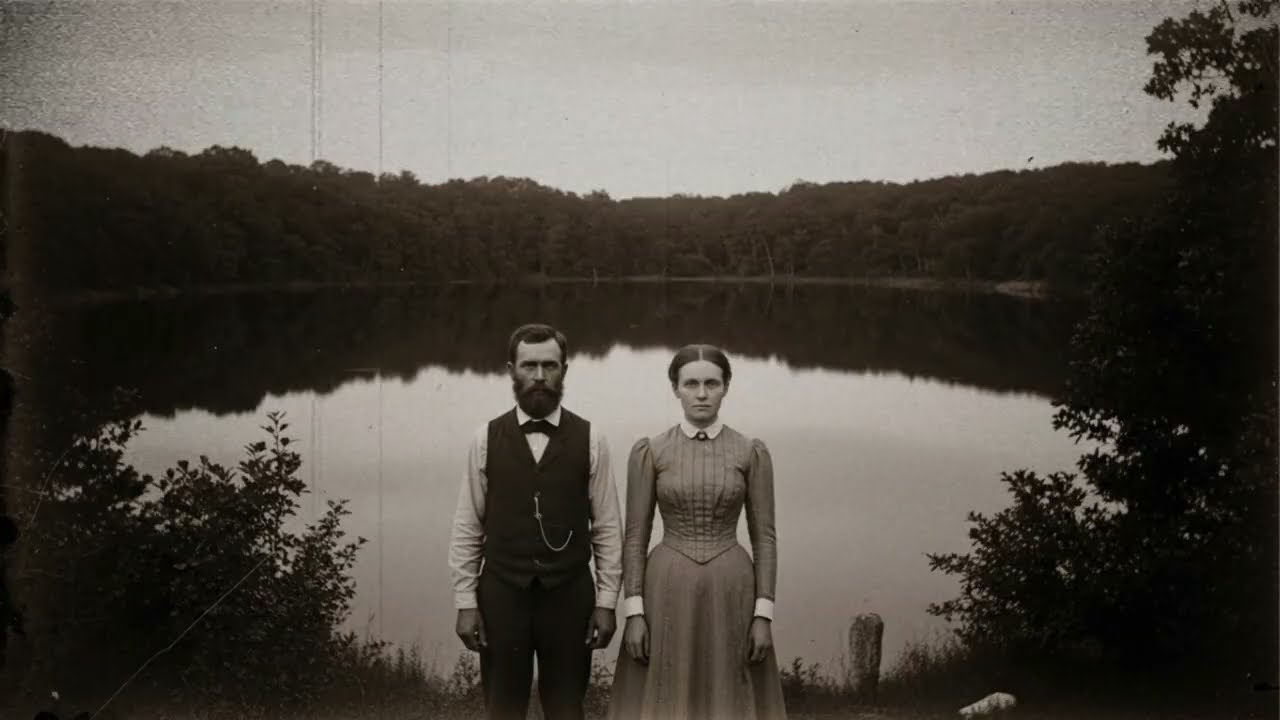
When the reverend went out to check on his church members after the hard winter months, he passed by the Caldwells’ seldom-visited land and noted an unusual stillness, something he described in his personal diary as exceeding the ordinary silence of the countryside. According to county records, the Caldwell family had settled in the area around 1878. The head of the family, Joseph Caldwell, had come from Pennsylvania with his wife Margaret and their four children, but no explanation was ever found for why they chose such a remote place. They built their home on a piece of land the locals considered worthless: rocky soil surrounding a stagnant body of water that looked unusually dark even on bright days.
The 1879 county assessor’s records show that Joseph Caldwell paid the full price for the property without any bargaining, a curious decision that raised eyebrows at the time. The Caldwells kept to themselves, rarely coming to town except when absolutely necessary. When they did come, they spoke little, finished their business quickly, and returned home before nightfall. What drew the most attention was Joseph Caldwell’s insistence on paying for all transactions in gold coins from an unusual source, which the general store owner, Thomas Ledbetter, recorded as bearing strange markings that perhaps came from some old country.
The Caldwell children were rarely seen in town. The eldest daughter Elizabeth sometimes came shopping with her father. Robert was occasionally seen helping load the wagon. The younger children, Sarah and David, remained practically strangers to the townspeople.
None of them attended the local school; Joseph Caldwell had informed the county administrator that he handled their education himself. At the time, this was common enough for remote settlements in the region that no one questioned the arrangement. In early April 1901, Margaret Caldwell’s sudden illness brought the Caldwell family to the wider community’s attention. Dr.
William Harrington was summoned to their home, a rare event that raised eyebrows all over Eminence. According to his medical log of April 7, 1901, he arrived to find the entire family in a state of alarming disarray. The patient showed signs of severe anemia and exposure to arsenic, though the source was unclear. The doctor’s handwriting, usually neat, showed signs of haste or agitation in this particular entry.
Harrington’s notes were preserved in the Shannon County Historical Society archives but mysteriously disappeared in 1962 during courthouse renovations. He mentioned an indescribable smell of standing water and decay throughout the house, despite the home being meticulously maintained. He noted that Margaret’s physical condition had begun to deteriorate after she drank water from the lake, against her husband’s explicit instructions. The doctor wrote that her symptoms included an unusual discoloration of the nails, unexplained bruising, and intermittent bouts of delirium during periods of apparent recovery, when she spoke of faces in the water and the duties of the Caldwell line.
The Caldwell children—Elizabeth, nineteen; Robert, seventeen; Sarah, fourteen; and David, ten—were described as abnormally pale and quiet. Dr. Harrington wrote that they moved about the house mechanically and never made a sound unless spoken to directly. What struck him most was their apparent indifference to their mother’s condition.
Elizabeth in particular watched his examination with an unsettling detachment, as if observing routine work rather than her mother’s illness. He noticed that each of the children bore a striking resemblance to their father, with deep-set eyes and high cheekbones, but none of Margaret’s warmth or expressive features. Joseph Caldwell explained that his wife had long suffered from mental instability. He claimed her drinking of the lake water was the result of her confusion or depression.
When Dr. Harrington inquired about the lake, Joseph became visibly agitated and only said the water was not fit to drink, then abruptly changed the subject. The doctor noticed Joseph’s hand tremble slightly at the mention of the lake, though his voice remained steady. There was a moment, brief but distinct, when Joseph and Elizabeth exchanged a look that suggested some unspoken understanding.
Before leaving, Dr. Harrington collected a sample of the lake water to examine back in town. According to his notes, the water in the glass container seemed normal enough but had an unusual density and a faint metallic smell. He planned to send the sample to a colleague at Washington University in St.
Louis for further analysis. In his medical bag he also carried a small diary in which he had begun recording his observations about the Caldwell family. He wrote that they exhibited signs of what he called environmental isolation syndrome, a condition he had seen in other remote settlements where families became completely cut off from society and mutual contact. Two days later, on April 9, Dr.
Harrington’s horse returned to town without him. The animal appeared terrified, its hide soaked with sweat despite the cold spring weather. A search party formed immediately under Sheriff James Holloway. About a mile from the Caldwell house, at a bend in the road where Bluff Creek ran beneath a small wooden bridge, they found the doctor’s carriage overturned.
There were no signs of an accident or struggle. It seemed as though Dr. Harrington had deliberately tipped the carriage to one side for some reason. Of the doctor himself there was no trace.
The water sample was gone, along with his medical bag and diary. Sheriff Holloway set out for the Caldwell residence to inform them of the situation and ask whether they had seen the doctor since his visit. According to the official report filed on April 10, 1901, Joseph Caldwell claimed to know nothing of Dr. Harrington’s whereabouts.
Margaret Caldwell was bedridden, her condition having deteriorated significantly. The children were as silent and withdrawn as Dr. Harrington had described. The sheriff noticed that although a fire burned in the stove, the house was unusually cold, and that strange odor the doctor had mentioned had grown stronger, as if something from the lake had seeped into the walls of the house itself.
What disturbed Sheriff Holloway most, however, was Joseph Caldwell’s insistence that he stay away from the lake. When pressed about the lake’s unusual nature, Joseph only said, “Every Caldwell knows to respect the water. ” He added, “This has been in our family longer than you can imagine. ” The sheriff described the words as spoken with strange emphasis, more a warning than a statement of fact.
When Sheriff Holloway proposed dragging the lake in search of Dr. Harrington, Joseph’s reaction was immediate and intense. “No one will touch that water,” he said. “No one.
” The intensity of his reaction was enough to keep the sheriff from searching the lake for the time being. That curious statement prompted Sheriff Holloway to investigate the Caldwell family’s history back in Eminence. According to county records, Joseph Caldwell had purchased the land from Jeremiah Foster, one of the area’s original settlers, who had abruptly left the region in 1877 after the mysterious deaths of his wife and two sons. Before Foster, the land had belonged to a German immigrant named Heinrich Muller, who had abandoned it without explanation in less than a year.
A personal letter from the county clerk to his brother mentioned local rumors that Muller had fled after encountering something inexplicable on the property, though the nature of that experience was never clarified. Sheriff Holloway found no record of the lake at all. According to every official survey of Shannon County, no body of water existed at that location. Yet he had seen it with his own eyes: a circular lake roughly three hundred yards across, its surface unnaturally calm even in the gentle spring breeze.
The water was so dark that it appeared almost black toward the center, while near the shore it was so clear that smooth, light-colored stones were visible beneath. Most puzzling was the absence of any inlet or outlet, which raised the question of how the lake maintained itself without filling up or drying out. The search for Dr. Harrington continued for nearly two weeks, extending into the surrounding forests and along the banks of the Jacks Fork River.
The hunting dogs tracked his scent to the boundary of the Caldwell property, then refused to go further, whimpering and backing away when commanded to advance. No trace of him was found. No clothing, no personal effects, no hint of what might have happened to him. The disappearance might have remained just another unsolved mystery of the remote Ozarks, if not for what happened next.
On April 23, 1901, Margaret Caldwell died. No physician was present, and Joseph Caldwell did not report the death to authorities. The next morning, Elizabeth, the eldest daughter, came into town to inform Reverend Whitley. According to the reverend, she delivered the news with complete lack of emotion, saying only that her mother had returned to the water and that no funeral would be needed.
Reverend Whitley noticed that Elizabeth was dressed entirely in black, not the typical mourning attire of the period but an old-fashioned style that recalled another century. When the reverend offered his condolences and assistance, Elizabeth turned her horse and rode away without a word, leaving him in the churchyard with questions he had no one to ask. Concerned by this abnormal behavior, Reverend Whitley consulted Sheriff Holloway, who decided an official visit to the Caldwell property was in order. That afternoon they set out, accompanied by two deputies: the sheriff’s younger brother Frank Holloway and Michael Donovan, a new recruit to the small police force.
Reverend Whitley later said that as they approached the Caldwell property, an odd discomfort settled over the entire party. The normal sounds of the forest—birds calling, small animals moving through the underbrush—gradually faded until they traveled in complete silence. Even their horses grew restless, needing constant calming. What they found at the Caldwell farmhouse was the heart of the disturbing affair.
The house appeared abandoned. No smoke rose from the chimney despite the cold spring air. No sound came from within or around the property. The front door stood open, swinging slightly in the breeze.
Deputy Donovan’s report noted that the hinges, which should have creaked given the age of the house, were completely silent, as if recently and thoroughly oiled. Inside, the house was spotless, unnaturally clean. Every floor had been scrubbed, every item put in its place. There were no signs of habitation, no unfinished tasks, no recently used dishes or unmade beds.
It seemed the family had methodically erased all evidence of their presence before leaving. Sheriff Holloway noted that despite the cleanliness, there was a strange odor, like the bottom of a boat that had been sitting in water for a long time, as he described in his report. In the master bedroom, Sheriff Holloway found Margaret Caldwell’s clothes neatly folded on the bed. Everything she owned was there, suggesting she had left without taking anything, or had been taken away.
There was no trace of her body. A search of the property revealed no freshly dug grave or any sign of burial. When Reverend Whitley examined the bed more closely, he found the sheets wet, though nothing else in the room showed signs of dampness. He described the moisture as cold to the touch and carrying that same metallic scent that seemed to permeate the entire property.
The children’s rooms were in similar condition. Their clothes remained, their few toys and personal belongings were exactly in place. In Elizabeth’s room, Reverend Whitley discovered a journal hidden beneath a loose floorboard. This diary, which would be preserved in the Shannon County Records Office until it was lost in 1962, contained information dating from the family’s arrival in Missouri.
The early pages had been torn out, suggesting Elizabeth had deliberately removed information she did not wish to reveal. The remaining entries described a normal, if somewhat isolated, family life. Elizabeth wrote of helping her mother with household chores, of her father’s hard work on their small patch of arable land, of the children’s play and squabbles. The lake was mentioned only once, referred to simply as “the water,” which she described as “the real purpose for which Father brought us here.
” An entry from 1879, shortly after their arrival, read: “Father spent the day preparing the shoreline according to the old instructions. Robert and I helped arrange the stones in the specific pattern. Father says it must be perfect, exactly as his father taught him. Mother watched from the porch, her face worried.
She still does not understand the importance of our duty. ”
As the diary progressed, the entries grew more disturbing. Elizabeth wrote that her father spent long hours at the lakeshore, especially at night. She described how he made offerings to the lake of small animals: chickens, rabbits, sometimes sheep.
According to Elizabeth, her father claimed this was essential to maintain the balance. She wrote: “Father says the water requires regular offerings. When he makes the offering properly, the water gives back. The crops grow better than expected even in this barren soil.
The livestock stay healthy despite the bad weather. And we Caldwell children all stay healthy, where other children in the region often fall ill. ”
Most frightening were the winter entries of 1900-1901. Elizabeth described her mother’s growing concern over her father’s behavior.
Margaret had apparently discovered something about the lake’s history that deeply disturbed her. Elizabeth wrote: “Mother found Father’s old family Bible today, with all the records from before we left Pennsylvania. She was very upset by something she read there. After dinner she questioned Father about it.
I have never seen Father so angry. He took the Bible and locked it away. Mother has been crying ever since. ” A subsequent entry read: “Mother tried to take Sarah and David to town today.
She said we were going to visit her sister in Springfield. Father stopped them at the property line. I have never seen him use force with any of us before, but he pulled Mother from the wagon and ordered Robert to take the little ones back to the house. Mother has been locked in their bedroom since.
Father says she is sick and needs rest. He has told me to make her food and that special tea made only from flowers that grow on the lakeshore. ”
The final entry, dated April 22, 1901, read: “Mother drank the water again today. Father says the time has come.
We must all be ready. What the water needs, it must be given. ”
Sheriff Holloway and Reverend Whitley continued their search of the property. They found no sign of the family in the barn or outbuildings.
The livestock—a few chickens, two cows, and a plow horse—had been left with food and water, suggesting the family had arranged for their care despite having no intention of returning. In the barn loft, Deputy Donovan found a small wooden box containing family heirlooms: a pocket watch with strange engravings, some jewelry that would have been valuable for a family of ordinary means, and a small glass vial containing what looked like lake water, its stopper sealed with dark red wax. When they reached the lake, they understood the true nature of the situation. The water was as calm as Sheriff Holloway had described it, so dark it appeared almost black.
But now, at the water’s edge, they found five sets of footprints leading into the lake. The largest was probably Joseph’s, leading the way. Behind it came four smaller prints, likely the children’s, with the smallest last. Deputy Holloway’s report noted that the footprints were unusually distinct in the mud, as if each step had been taken with great deliberation and unnatural weight.
None of the footprints returned from the water. Around the lake they found a pattern of stones half-buried in the earth, which Reverend Whitley recognized as ancient Celtic symbols associated with water worship and sacrifice. The arrangement was hidden by vegetation but became clear upon close examination of the shoreline. The reverend’s diary from that evening recorded the shock of finding pagan symbols in a Christian region of America and his growing concern about the relationship between the Caldwell family and the lake.
Sheriff Holloway waded a few feet into the water but found that the bottom dropped off suddenly. The water was cold, colder than it should have been in late April, and had an oily quality that clung to his skin. He reported feeling an unusual current, as if something beneath was pulling gently but persistently. When he returned to shore, he found the water had left a dark stain on his boots and trousers that would not wash off.
A more thorough search of the property revealed a hidden cellar beneath the barn. There Sheriff Holloway found the family Bible Elizabeth had mentioned, along with documents dating from the early 1800s. These papers were entered into evidence but later disappeared from the county archives. They concerned the Caldwell family’s connection to a body of water in western Pennsylvania.
According to Reverend Whitley, the documents suggested that the Caldwells had not simply purchased a property with a strange body of water. They had somehow brought that water with them. The family papers repeatedly mentioned the transfer of the water and the maintenance of the pact. The oldest documents, written in the hand of Joseph’s grandfather, mentioned discovering the water on a Pennsylvania property in 1823 and its unusual qualities and demands.
A letter from 1842, in which Joseph’s grandfather wrote to his son, read: “This water has been with our family for three generations. It gives us prosperity in exchange for our care. Never forget that every third generation it must be moved, when it grows hungry for more than common animals. The ritual of transfer is described precisely in the grimoire.
Follow the instructions exactly, or risk the water’s wrath. ”
The most alarming document was a letter from Joseph to his Pennsylvania cousin dated January 1901. In it he expressed concern that Margaret had learned too much about the water’s nature, and he feared she might break the pact that had passed down through generations of the family. He wrote that if she could not be persuaded to accept the old customs, then necessary steps would have to be taken.
The letter ended with an unsettling postscript: “Elizabeth grows more skilled in the rituals every day. She knows what must be done and has prepared her siblings accordingly. When the time comes, she will lead them as I have led, and the pact will hold. ”
The cellar also contained a leather-bound book that Reverend Whitley described as a ledger of offerings.
It recorded everything that had been given to the water since the Caldwells’ arrival in Missouri in 1878. Most entries concerned animals, but some uncomfortable exceptions existed. An entry from 1880 mentioned the child of the Miller family, with the comment that the water was particularly pleased with this one. The Millers were a family who lived some distance away, whose young son had drowned in the Jacks Fork River that year.
The final entry, dated April 23, 1901, read simply: “Margaret has finally agreed. ”
Throughout the summer of 1901, the investigation into the Caldwell family’s disappearance continued. Divers were brought in from St. Louis to search the lake, but they reported that it was surprisingly deep, over one hundred feet at the center, with a soft, unstable bottom that made it impossible to stand on.
One diver reported that something from the depths had been watching him, though nothing was visible. Another refused to descend a second time, claiming he had heard voices underwater that sounded like no earthly language. The diving operation was called off after an incident in which one diver’s oxygen line was pulled from below, nearly killing him as he made an emergency ascent. Analysis of water samples revealed high concentrations of minerals not commonly found in the region, along with organic compounds that could not be identified by the scientific methods of the time.
Professor Edwin Laughlin of Washington University, who conducted the analysis, wrote that the water’s properties were more consistent with organic tissue than with naturally occurring water. He noted that when left in a sealed container, a thin film would form on the surface, which, if broken, would repair itself. His request for additional samples was refused by Shannon County authorities, who had decided to limit information about the lake’s unusual characteristics. By September 1901, with no bodies recovered and no trace of the family found anywhere, the case was officially recorded as an unsolved disappearance.
Local theories ranged from murder-suicide to the family fleeing after disposing of Dr. Harrington’s body. Few gave much credence to the supernatural elements mentioned in Elizabeth’s diary and the family documents. Sheriff Holloway’s official report concluded that Joseph Caldwell had likely murdered his wife and Dr.
Harrington before fleeing with his children. The report mentioned the lake only in passing, describing it as a natural feature of the property with no connection to the case. Decades later, however, personal correspondence from Sheriff Holloway found in the Jefferson City archives told a completely different story. In a letter to the Missouri attorney general, he wrote: “I do not have the conscience to close this case with the conventional explanation given in my official report.
What we found at the Caldwell property does not conform to any rational explanation. I believe the family did indeed enter the lake, as the evidence suggests, though what became of them afterward I cannot say. What concerns me more is my firm conviction that whatever is in that water is still there, and it poses a potential threat to anyone who approaches without knowing its nature. ” His recommendation that the property be seized by the state and the lake drained or filled was apparently ignored.
The Caldwell property lay abandoned, the house eventually falling into ruin under the forces of nature. Local residents avoided the area, claiming they sometimes heard strange sounds coming from the lake at night. The sounds were neither human nor animal, but something in between. Parents forbade their children from going near the Caldwell water, and local hunters would travel miles out of their way to avoid passing by the area.
In 1937, during a severe drought that affected most of the Ozarks, something unusual happened at the former Caldwell property. The lake, which had remained at the same level for decades regardless of weather, began to recede. As the water level dropped, objects began to emerge from the mud of the newly exposed shoreline. Arnold Fletcher, a local hunter who had ignored the superstitions surrounding the property, discovered these objects in October 1937.
In a sworn statement to a researcher for the Federal Writers’ Project, who was recording the folklore of the region during the Depression era, Fletcher reported finding personal effects that should have been buried in mud for at least thirty years, yet appeared as if someone had left them yesterday. Among them were a doctor’s bag, deteriorated but intact, containing medical instruments and a logbook belonging to Dr. William Harrington. The final entry, dated April 9, 1901, described his return to the Caldwell property to check on Margaret’s condition.
It read: “Mrs. Caldwell’s health has deteriorated significantly since my last visit. The symptoms suggest not a natural disease but poisoning. I have collected a sample of the tea Elizabeth gave her and a sample of the lake water.
There is something deeply troubling about this family and their relationship with this unusual body of water. On returning to town I have decided to contact the authorities in Jefferson City. ” The sentence ended unfinished. Also recovered were items identified by elderly residents of Eminence as Margaret Caldwell’s jewelry and a child’s shoe matching those of little David Caldwell.
These documents were sent to the University of Missouri for analysis but reportedly disappeared in transit in 1938. Fletcher’s statement mentioned that among the documents was a genealogy of the Caldwell family dating back to eighteenth-century Scotland. According to Fletcher, who examined them before turning them over to authorities, a peculiar pattern emerged across each generation of the family. The children reached adulthood, but there were no records of their deaths, after which the family would relocate to a new area.
Most significant was a metal box containing documents that remained intact despite years underwater. The oldest document mentioned a man named Angus Caldell, who in 1782 discovered a strange spring on his own land in the Highlands. The spring had extraordinary qualities: its water never froze and brought the family unusual health and prosperity. The records showed that in 1804, Angus and his entire family disappeared, and a cousin inherited the property.
Two years later, that same cousin appeared in Virginia records, having established a new settlement beside a small lake that had never appeared on any survey. Fletcher further reported finding a diary written by Joseph Caldwell himself. Much of it was illegible due to water damage, but some passages remained readable. In one, Joseph wrote: “This water requires Caldell blood to maintain its qualities.
Since Angus first discovered it in the old country, it has been both our blessing and our burden. Every generation must pay the price to protect what keeps us alive. ” Another passage read: “Margaret refuses to accept our heritage. She does not understand that what the water gives, it must one day take back.
The children have been prepared from birth to fulfill their duty. Elizabeth in particular understands the necessity of our pact. ”
Most puzzling was the description of the ritual by which the lake could supposedly be transferred. When the time came to move the water, a vessel of precise dimensions had to be filled from the deepest part of the lake.
The vessel, sealed with wax from bees that fed on the flowers growing on the shore, would contain the essence of the water. Wherever this essence was poured, the water would come, traveling any distance to reform in a new location. The ritual had to be performed on the night of the new moon, and the new location had to be prepared with the appropriate symbols and offerings. Fletcher’s account was dismissed by most as superstition and exaggeration, especially when the key evidence conveniently disappeared.
The drought ended in late 1937, and the lake returned to its previous level, covering whatever other secrets lay hidden in its depths. The affair might have faded entirely if not for Richard Carter, a graduate student at the University of Missouri, who in 1952 began researching disappearances in the Ozark region for his PhD dissertation. Carter discovered the original sheriff’s reports on the Caldwell case and became intrigued by the inconsistencies and anomalies. During his research, Carter uncovered records of a similar disappearance in western Pennsylvania in the 1870s, just before the Caldwells moved to Missouri.
A family named Caldwell had lived near a small unnamed lake outside Pittsburgh. In 1877, after the mysterious disappearance of a local doctor who had been treating Mrs. Caldwell, the entire family vanished. Their property was sold to distant relatives, who immediately filled in the pond on the land.
The new owners reported unusual problems with the filled area, including soil that remained perpetually muddy despite drainage systems and strange sounds coming from beneath the ground. Carter’s research led him to similar cases in Virginia in the 1820s and, most intriguingly, to the Scottish Highlands in the 1780s. In every case, a family named Caldwell or the Scottish version Caldell lived near an unusual body of water. The pattern was identical in each incidence.
The wife fell ill. A local physician or healer who came to treat her disappeared. The family then vanished without explanation. In each location, reports of unusual phenomena were associated with the water: unnatural sounds, strange effects on nearby plants and animals, and a deeply held local belief that the water was somehow alive or aware.
In his unpublished manuscript, The Water Keepers: Generational Disappearances in American Rural Communities, Carter proposed that the Caldwell family had been involved in some kind of cultish behavior, possibly centered on water contaminated by hallucinogenic compounds that induced collective mental illness among them. He speculated that each generation ended in ritualistic suicide, with one branch of the family maintaining the tradition elsewhere. This theory, while somewhat more credible than supernatural explanations, failed to account for the water’s unusual properties or the consistent reports of the lake changing locations across generations. Carter’s academic advisors rejected his manuscript as speculative and sensational.
Dr. Lawrence Winters, chair of his thesis committee, wrote in his evaluation: “While Mr. Carter’s research is thorough, his conclusions delve so deeply into the realm of folklore and superstition that they cannot be considered serious academic work. His insistence on connecting these disparate incidents based on superficial similarities and local legend does not meet the standard of evidence required for doctoral research.
” Discouraged, Carter abandoned his academic career but continued his investigation independently. In 1958, he traveled to the former Caldwell property in Shannon County, which had by then been incorporated into the Mark Twain National Forest. Armed with the sheriff’s original reports and the 1901 survey maps, Carter located the lake, which still existed despite appearing on no official forest map. What happened to Richard Carter remains one of the most disturbing aspects of the Caldwell affair.
According to forest officials, who found his abandoned vehicle, Carter had set up camp near the lake and remained there for approximately three days. His research equipment was found inside his tent, including a notebook containing his observations of the lake. The notes mentioned that the water moved strangely without wind or any other external cause, and that strange sounds emanated from the middle of the lake before dawn. The final entry in Carter’s notebook, dated June 17, 1958, read: “The water moved today, not from wind or rain.
There was nothing. It moved as if something vast beneath was stirring it. I am setting up the camera tonight to see what emerges in the dark. I have placed markers on the shore to measure changes in water level.
The strangest thing is, I have begun dreaming about the Caldwells. In these dreams, they walk beneath the water of the lake, their eyes open, their movements completely fluid, and the water offers no resistance to their passage. It seems they are trying to tell me something of great urgency. Tonight I will listen.
”
Carter was never seen again. The film from his camera, recovered from the lakeshore, was ruined by water, and no images could be salvaged. His markers had been moved, some floating in the middle of the lake, others completely gone. Most mysterious was a sealed glass vial found half-buried at the water’s edge, containing lake water, labeled in Carter’s handwriting for analysis, exhibiting unusual properties.
The vial was logged into the ranger station’s records but disappeared the following day. After Carter’s disappearance, the US Forest Service restricted access to that portion of the national forest, citing environmental and safety concerns. A geological survey conducted in 1959 reported that the lake might be a sinkhole that could collapse, endangering visitors. This explanation was officially accepted, and warning signs were posted around the lake.
However, internal Forest Service documents released in 1987, largely overlooked at the time, told a different story. The survey team found anomalies that could not be explained by ordinary geological processes. The lake had no source or outlet, yet its water level remained constant regardless of rainfall or drought. Water samples contained elements that could not be identified by the analytical methods of the time, and the water behaved strangely in the presence of electrical currents.
Most notably, the water showed a slight but measurable response to contact with human blood, described in the report as attraction or affinity. Significantly, the report noted that the lake contained no fish or amphibians, and insects avoided its surface. Birds were rarely seen flying over it. The surrounding vegetation was abundant, described as morphologically normal, but with subtle biochemical differences from the same species elsewhere in the forest.
Trees growing within twenty yards of the shore contained elements not found in the same species growing elsewhere in the forest, elements that preliminary analysis suggested might have medicinal potential. The survey team’s final recommendation was to declare the area permanently off-limits and to fill the lake with earth and concrete. However, for reasons not stated in the documents, higher authorities apparently rejected this recommendation. Instead, the lake was removed from official maps and the area declared a research zone, accessible only to authorized personnel.
One member of the survey team, Dr. Alan Pritchard, maintained his interest in the lake after the official investigation ended. His personal papers, donated to the Missouri Historical Society after his death in 1981, contained several photographs of the lake taken between 1959 and 1964. Arranged chronologically, the images showed subtle but distinct changes in the lake’s shape and position.
Dr. Pritchard’s notes indicated that the lake was slowly moving, expanding on one side and contracting on the other at a rate of approximately one inch per year. His final note, written in November 1964, said: “I am now convinced that what we are seeing is not a lake in the traditional sense, but something entirely different, which merely takes the form of a natural body of water. Its true nature and purpose are unknown, but I am forced to conclude that it possesses some form of consciousness of its own.
I have submitted my findings to the Department of the Interior, but I do not expect them to take it seriously. ”
The last official investigation of the Caldwell mystery and the lake occurred in 1968, when journalist Eleanor Reynolds investigated the case for a series on unsolved mysteries of the Ozarks. Reynolds obtained the remaining documents of the original case and interviewed several elderly residents of Eminence who remembered the Caldwell family and their mysterious disappearance. The interview with ninety-one-year-old Martha Holloway was crucial.
She was the wife of Deputy Frank Holloway, who had accompanied his brother Sheriff James Holloway to the Caldwell home in 1901. According to Reynolds’s notes, Martha vividly remembered her husband’s account of what had happened at the scene. Frank had not been the same after that day. He wouldn’t tell her most of what they had seen, but he did tell her one thing that had stayed with her all these years.
When they were standing at the lake’s edge looking at those footprints going into the water, they all heard the sound of a child’s laughter coming from beneath the water. Sheriff Holloway had written in his report that it was just a bird or some forest animal. But Frank knew better. He said it was David Caldwell’s laugh, as clear as if the boy were standing right next to them.
And then, for a moment, Frank swore he saw faces looking up at them from deep in the water. All five Caldwells, their eyes open as if they were alive beneath the water, watching. Martha Holloway also revealed that her husband had brought something home from the Caldwell house that day, something he never submitted as evidence. It was a small glass vial containing water from the lake, which Joseph Caldwell had apparently been examining.
Frank Holloway kept the vial locked in a small box in their attic until his death in 1942. “That water never dried out,” Martha told Reynolds. “All those years, it never did. And sometimes, when the light hit it right, Frank would say he could see small movements inside, as if something was alive in there.
” The night before he died, he made her promise to return the water to the lake. She did it the very next day, describing the journey back to that terrible place as the hardest thing she had ever done. Martha also described how, in the weeks after visiting the Caldwell home, her husband had begun having strange dreams about the lake. He would wake in the middle of the night saying the water was calling him.
He said he could hear Joseph Caldwell’s voice inside his head, explaining terrible things—what the water wanted and what it could do. According to Martha, these dreams continued for months, until Frank finally moved the vial from their bedroom to the attic. Even then, he said he could feel something waiting upstairs. That was why he had never disposed of it all those years.
He was afraid of what might happen if the water were taken too far from its source. Reynolds also interviewed Thomas Jenkins, who had been a young boy in Eminence at the time of the Caldwells’ disappearance. Jenkins claimed that his father, who had been on the search party for Dr. Harrington, had told him about strange symbols carved into the trees around the Caldwell house.
He said they were unlike any markings he had ever seen, neither writing nor pictures but something in between, and they seemed to point toward the lake like road signs. According to Jenkins, his father had copied some of these symbols into a notebook but burned it after experiencing terrible nightmares he attributed to the symbols. Reynolds’s investigation concluded with a three-part series published in the St. Louis Post-Dispatch in September 1968.
The articles presented the factual aspects of the case while avoiding the sensational elements, focusing instead on the historical mystery and whether the Caldwell family had been victims of some wrongdoing, perhaps at Joseph’s own hands, who may have then taken his own life and those of his children. The newspaper’s editors emphasized a rational perspective, favoring conventional explanations over the supernatural elements provided by some of Reynolds’s sources. What Reynolds did not include in her published articles, but which was found in her research notes after her death in 1981, was her own experience at the lakeshore. According to these personal notes, Reynolds had visited the site three times during her investigation.
On her first two visits, she noticed nothing beyond the lake’s striking appearance and unusual stillness. However, on her final visit, she wrote: “At sunset I stood at the water’s edge trying to imagine what Sheriff Holloway and his party had seen on that day in 1901. The lake was as still as glass, though the evening breeze stirred the trees around it. And then, for a moment, I saw ripples rising in the middle of the lake, spreading outward in a perfect circle, as if something had surfaced for an instant and submerged again.
As I watched, transfixed, I heard a faint sound, just at the edge of hearing. It seemed like someone murmuring indistinctly, the words impossible to make out. I tried to convince myself it was only the rustling of leaves or my own imagination, influenced by the stories I had been reading all week. But then I saw them.
Five pale figures standing on the opposite shore, looking at me. A man, a woman, and three children of different heights. They were too far away for me to make out their features clearly, but their clothing appeared to be from another era. I raised my hand, not sure whether I was greeting them or telling them to stay away.
As one, they turned and walked into the water of the lake and disappeared, without making the slightest ripple on the surface. I have never run so fast in my life. I will never return to that place, and I will not mention this experience in my articles. Some stories are better left untold.
”
Reynolds’s notes also mentioned finding a small stone at the lakeshore. It was unusually perfectly round, made of a material she could not identify, neither stone nor metal but something in between. She took the object with her but reported that it disappeared from her hotel room that night, leaving only a drop of water on the nightstand in the shape of a handprint. After her articles were published, Reynolds received numerous letters from readers sharing their own experiences with unusual bodies of water in the Appalachian and Ozark regions.
These accounts, which she collected but never published, described lakes and ponds with features similar to the Caldwell lake: unusual colors, inexplicable fluctuations in water level, strange effects on wildlife, and in some cases, clear effects on the dreams and thoughts of people who spent time nearby. One correspondent, identifying himself as a former employee of the US Geological Survey, suggested there might be a scientific explanation for such phenomena. He speculated that underground mineral formations could create local electromagnetic fields that affected both the chemical composition of the water and human neurological function, potentially causing hallucinations or altered perceptions. He claimed the government had investigated several such locations but had kept the results secret for unknown reasons.
The lake remains hidden deep within the Mark Twain National Forest today. Official maps of the area show nothing but forest. The Forest Service claims that even if satellite images show it, no large body of water exists at those coordinates. When asked about the discrepancy, officials generally cite map errors or temporary ponds formed after heavy rains.
However, those who have worked in the region for decades tell a different story. James Wilson, who served as a forest ranger at Mark Twain National Forest from 1972 to 1993, spoke on condition of anonymity to a local historian in 2001. According to Wilson, certain areas of the forest were off-limits to regular ranger patrols, accessible only to specific personnel from outside agencies. “We were told it was for scientific research,” Wilson said, “but no one ever saw any scientists coming or going.
” He described one area in particular, about seven miles northeast of Eminence, that was especially restricted. Rangers had standing orders to turn away any hikers or campers who came too close, using the pretext of dangerous terrain or wildlife management. Wilson also claimed that during his tenure, at least three people had disappeared in the vicinity of this restricted area. In each case, the official explanation was lost hikers or animal attacks, but the searches were unusually brief and conducted primarily by federal agents rather than local authorities.
“They would come in, do a cursory search, and then declare the person dead from exposure or animal attack without ever finding any remains,” Wilson said. “What always struck me was how quickly these cases were closed and how little information was shared with those of us who worked in the forest every day. ”
Occasionally, hikers reported finding an unusually still, dark lake where no lake should be. Those who stopped to rest on its shore sometimes spoke of hearing voices carried on the wind, or of seeing movements beneath the water that suggested human forms, walking calmly along the bottom as if on solid ground.
Most disturbing were the accounts of those who claimed to have photographed the lake, only to find when the films were developed that the water was absent from the images, replaced by a family: a man, a woman, and three children standing where the lake should have been, their faces solemn and their eyes fixed directly on the camera. In 1996, all records related to the Caldwell case were reportedly gathered by an unnamed federal agency and classified under national security protocols. The stated reason was the potential environmental contamination of unknown origin and effect. Requests for information under the Freedom of Information Act have been consistently denied, with the government neither confirming nor denying the existence of such records.
This unusual level of secrecy for a century-old local mystery has fueled speculation about the lake’s true nature and its potential importance to national interests. Dr. Meredith Lane, a hydrologist who attempted to locate and study the lake in the early 1990s as part of research on unusual bodies of water, reported being blocked by forest service officials. In a 1995 interview with a scientific journal, she said: “There is certainly something in that part of the forest that the authorities do not want examined.
When I presented my credentials and research proposal, I was told plainly that the area was off-limits due to ongoing government research. When I pressed for details about this research or the possibility of collaboration, the conversation was terminated and I was escorted from the area. ”
The last known person to officially visit the lake was Dr. Helen Morrison, a hydrogeologist with the United States Geological Survey, who conducted a brief assessment in 1965 as part of a regional study of groundwater levels.
Her report described the lake as a geological anomaly requiring further study, but no such research was ever authorized. The report noted several unusual features of the lake, including its apparent isolation from the regional groundwater table and the unusual chemical composition of its water, which contained organic compounds not typically found in natural freshwater systems. In correspondence found among her personal effects after her retirement in 1982, Dr. Morrison wrote to a colleague: “What we discovered in the Ozarks defies conventional explanation.
The water has properties that violate the known laws of physics. It behaves almost like something conscious, responding to stimuli in ways that are not natural for water. I have requested additional funding for research, but my superiors are determined to suppress this discovery. Sometimes I think they know more about that place than they admit.
” In another letter from 1966, her growing frustration was evident: “My next proposal has been rejected, and I have been transferred to the Dakota Aquifer study when I requested access to my own samples and data from the Ozark site. I was told they had been transferred to a specialized facility. No one will tell me where that facility is or who is continuing the research there. It seems they are pretending the lake does not exist while secretly studying it.
”
Most unsettling was her final comment about the lake, found in a personal journal entry from 1979: “Last night I dreamed of the Caldwell lake again. Fourteen years have passed since I was there. But in my dreams I return almost every month. The dreams are always the same.
I stand at the water’s edge and faces appear just below the surface. They speak to me, explaining something of great importance. But when I wake, I cannot remember what they said. Only a sense of urgency remains, and the feeling that the water is trying to escape its boundaries.
I have begun to wonder whether those who come into direct contact with the water carry a part of it with them afterward, a connection that is never fully severed. ”
The Caldwell family and their lake have become part of the local folklore of the Ozarks. Parents warn children to stay away from unknown bodies of water in the forest. Campers avoid pitching tents near still, dark waters.
And occasionally, longtime residents of Shannon County report seeing a pale family of five walking along the road toward Eminence just before sunset. A man, a woman, and three children. Their clothes are dry, though they appear to have just emerged from the water, and their eyes reflect the dim light in a way that is not quite human. Those who claim to have encountered this apparition describe an intense sense of grief and urgency emanating from them, as if they are trying to convey something of great importance.
In every account, the family never speaks and pays no attention to those who see them. They simply walk with purpose toward the town and vanish before reaching the first buildings. Local folklore holds that these spirits appear only during times of drought. During the severe drought of 2002, when much of Missouri experienced a critical drop in water levels, Ranger Daniel Collins reported finding unusual footprints on an infrequently used trail approximately six miles from the presumed location of the Caldwell lake.
According to his report, the footprints appeared to belong to a family group: two adults and three children. But they had an unusual characteristic. They were wet, as if the makers had just emerged from water, though the nearest source of water was miles away. Collins followed the footprints for nearly a mile until they abruptly disappeared in the middle of the trail.
His report was filed, but apparently no further investigation was conducted. That same summer, several residents of Eminence reported strange dreams in which they saw a family matching the description of the Caldwells standing at the edge of a dark body of water, gesturing urgently, as if trying to warn of something. Eighty-seven-year-old Dorothy Whitley, a distant relative of Reverend Thomas Whitley, reported that in her dream, the youngest child spoke a single sentence: “The water is moving again. ” Two weeks later, a small earthquake was felt in the region.
It was unusual for the Ozarks, which typically experience very little seismic activity. The most disturbing aspect of this entire affair may not be what we know, but what lies hidden in classified documents, lost evidence, and the dark waters of a lake that officially does not exist. What kind of pact did the Caldwell family maintain across generations? What price did they ultimately pay for it?
And what still lives in that water today, waiting for a curious visitor to come too close to the shore? The scientific community dismisses the Caldwell affair as local superstition, exaggerated folklore, and perhaps some explainable anomalies. Skeptics point to the lack of verifiable evidence, the convenient disappearance of key documents, and the tendency of stories to grow more elaborate with each telling. They believe the Caldwell family’s fate was probably something ordinary, such as murder or suicide or a move to another location without informing the local community, and that the lake, if it existed at all, was simply an ordinary body of water whose characteristics were greatly exaggerated over time.
However, those who have studied the affair more closely note the consistency of specific facts across multiple independent accounts over several decades. The lake’s unusual presence and behavior, its strange effects on people who come into contact with it, and the repeated disappearances associated with it are difficult to dismiss entirely. According to some researchers who work with anomalous phenomena, the Caldwell lake may be a genuine mystery worthy of scientific investigation, if only access to it and the relevant documents were not so tightly restricted. Dr.
Lawrence Weber, a geologist studying unusual bodies of water across North America, proposed in a 2005 academic article that a rare combination of mineral content, bacterial activity, and geological conditions might cause certain bodies of water to acquire unique properties. He theorized that under specific circumstances, a lake’s ecosystem could become so complex that its behavior might appear almost conscious or purposeful to observers. While he did not directly mention the Caldwell lake, the theoretical bodies of water he described bore striking similarities to the descriptions of the Missouri lake. Weber wrote: “In these rare cases, the water itself becomes a kind of super-organism, with properties and behaviors that exceed the ordinary definitions of inert matter.
In such systems, the boundary between living and non-living becomes blurred, potentially giving rise to phenomena that current scientific frameworks lack the capacity to explain or classify. ”
Local historian Emma Richardson, who has spent over thirty years collecting oral histories of the Ozarks region, offers a perspective that bridges folklore and reality. She believes stories like the Caldwell lake survive because they contain elements of truth, even if distorted by time and retelling. Something unusual happened to that family, she believes, and something unusual still exists in that part of the forest.
Whether the water is supernatural or merely the focus of superstition built around a tragic natural event, the reality is that people have experiences there that they cannot explain. The experiences are consistent enough to suggest they are not mere imagination, but indicate some common cause. For those who might be tempted to seek direct answers, a warning. The coordinates that would lead to the Caldwell lake have been systematically removed from all official documents.
Those who claim to have found it by accident rarely reveal its location, as if some instinct prevents them from sharing it. Perhaps this is wisdom. Some mysteries, like some waters, are best left untouched. The most recent recorded encounter with the Caldwell lake occurred in 2017, when a group of hikers became lost in the Mark Twain National Forest during an unusually warm October weekend.
According to their account, posted anonymously on an online forum for hiking enthusiasts, they came upon a small, perfectly round lake in a clearing, which appeared on no map they carried. They described the water as unusually still and so dark that it looked more like a hole in the ground than a body of water. Immediately after discovering the lake, the hikers reported an intense feeling of unease, so strong that one member of the group became physically ill. As they prepared to leave the area, they saw ripples rising in the middle of the lake, not caused by wind or any other natural force, but moving in a spiral pattern.
Most frightening was their claim that as they hurried away, they all felt that someone was watching them—not from the surrounding forest, but directly from beneath the water. Whether this was truly the Caldwell lake or some other unnamed body of water in the vast forest remains unknown. The hikers kept the exact location secret in their post, saying only that it was several miles from any marked trail and that they would never consider returning. Their final comment perhaps best captures the enduring mystery of the Caldwell lake: “Whatever is there, it feels ancient and patient, as if it has been there for centuries and will remain long after we are gone.
It does not feel malevolent exactly, but it is not natural either. It feels like something that is not part of our world, yet has found a way to exist here, hidden in plain sight. ”
In the archives of the Shannon County Historical Society, there exists a single photograph that may show the Caldwell family. The image from 1879 is labeled only “new residents.
” It shows a stern-faced man with deep-set eyes standing behind a woman seated in a chair. Around them stand four children of various ages, all with solemn expressions. The photograph is notable not only for the family’s presence, but for what appears in the background: a dark shape, perhaps water, showing signs of ripples or disturbance, suggesting movement in a still image. The truth about the Caldwell family and their mysterious lake may never be fully known.
Perhaps this is by design; not merely the result of time and lost records, but a conscious erasure of things deemed too disturbing or inexplicable for official history. What remains are fragments: footprints leading into water that never returned, strange artifacts emerging during drought, a consistent record of unusual phenomena spanning more than a century, and persistent rumors of official interest that suggest something more than an ordinary local mystery. In the end, the story of the Caldwell family and their lake serves as a reminder that beneath the surface of our orderly, explainable world lies something else. There may be phenomena that defy conventional understanding, something ancient and patient dwelling in deep water, waiting for those who dare to step beyond the familiar boundaries.
Whether the lake is a natural anomaly, a tragic event colored by imagination over time, or truly a mystery beyond our current comprehension, its legend endures, like a dark ripple in the still waters of history.






