Absalom Vale stood at the table in the Louisville office, holding the folded paper his partner had just slid across the desk. Wettson explained the terms: double the usual surveying fee, expenses covered, and a bonus if the work was done before the first hard frost. The land was a purchase from expired military grants, several small valleys in the eastern part of the state that the company wanted mapped. Vale asked why the pay was doubled.
“There was some difficulty finding any local man to do it,” Wettson said. Vale asked why. Wettson smiled the way a man does when he tells you something he does not quite believe himself. “The mountain people down there have some strange ideas about land, that’s all.
”
The surveyor was thirty-eight that autumn, tall for the time, nearly six feet, thin as a man who spent his working days on foot in unforgiving country. His hands had been used for twenty years to hold a plumb line, steady a compass against a tree trunk, peel bark and mark timber. His right little finger was crooked from a bad fall in Bourbon County years before; he had never bothered to have it set. Eleven days later he rode a dun mare out of a place called Red Fern Crossing on a morning so cold his breath came out in silver ropes.
Red Fern Crossing was the last town on the map before the country broke into ridges. It was not much of a town even for that time and place: a store, a smithy, an inn with three rooms above a kitchen, a small framed church sharing its yard with the graveyard, and about fifty people, most of them related to each other two or three ways over. The inn was run by a widow named Rua Colby. She was near sixty, thin, silver hair pulled tight, eyes the pale gray of river ice.
She served him a plate of pork and cornbread and waited until he had eaten most of it before asking where he meant to go in the morning. When he told her, she said, “You’re a surveyor. ”
He said he was. “And nobody told you anything.
”
“Told me what? ”
She looked at him for a long, slow moment. “Sit here, Mr. Vale.
I’ll go get Barnabas. ”
Barnabas Coombs ran the general store across the way, a huge man in his mid-fifties with a long forked beard. He came in still wearing his apron, sat down across from Vale without a word, and waited until Rua closed the kitchen door and came back with coffee. “You’re going up into the hollow tomorrow,” Coombs said.
“That’s the plan. ”
“And Wettson didn’t tell you anything. ”
“He told me the mountain people there have some strange ideas about land. ”
Barnabas Coombs made a sound in the back of his throat that was not quite a laugh.
Then he said, “Listen, Mr. Vale. I’ll say this once. If you decide to go anyway, I won’t stand in the way of a grown man.
But I’ll say it. ”
The valley he was headed for was called, on the old maps, Hangman’s Hollow. There was a tree at the head of that valley, or there had been in his father’s time, a great burned-top black oak. That tree had hanged eleven men over two summers, in 1793 and 1794, when the law and outlaw killing ran together in this country.
Some of them deserved it. Some of them did not. And after the last one was cut down, the men who had done the hanging started dying in sorry ways. Not all at once.
Over the years, one by one, each of them in the woods, each of them alone. Then, at the turn of the century, a family had gone up into the hollow and taken the tree for themselves. Taken the name of the tree for themselves. They had been there ever since.
Three generations of them that Barnabas knew of. They answered to no authority, no court, and did not come down to the crossing. Vale asked their name. “Marrowbone,” Barnabas said, pronouncing it like a man saying a word he did not want lingering in his mouth.
Old Isham Marrowbone was the head of them now. His brother Vardaman lived with him, and a cousin named Thoro, and a woman named Merritt who had been married to a third brother before he was buried. Maybe a few others. Barnabas did not go up there and did not ask.
Vale asked if anyone had ever surveyed the place. A man from Frankfort had come in 1844 to try, Barnabas said. He never came out. His horse came out after twelve days, alone.
Nothing on the saddle but the bridle, strapped down tight as if you were leaving a horse for somebody. Rua Colby, standing by the stove, said quietly, “And there was one from Cincinnati in ’51. A timberman. ” Barnabas said the result was the same.
There had been others, not surveyors, just men who went up into that hollow for one reason or another and did not come back. No county sheriff had gone up there in his whole life. He rode right past the mouth of that trail and pretended he was going somewhere else. Vale thought about this for a while.
Then he said, “And no one has gone up there and come back. ”
Barnabas Coombs did something strange then. He looked at Rua Colby, and Rua Colby looked at Barnabas Coombs, and after a moment Barnabas said, “I know of one case in my whole life. A young preacher went up there in the summer of ’39.
He stayed in that hollow six days. On the seventh day he rode his little horse down off the mountain to Red Fern Crossing, past my store without stopping, and out the other end of town. He was never seen in this county again. ”
“Then he survived,” Vale said.
“He came out of the hollow. That’s what he did. Whether that counts as surviving, Mr. Vale, is a question I stopped answering when I was younger than you.
”
Then Barnabas Coombs gave him three things to remember. First: do not eat their salt. If they put salt on your plate, leave it. If they put salt in your coffee, leave the coffee.
Once you eat their salt, you are a guest, and their idea of guest was not his. Second: do not sleep with the door behind you, no matter which room they gave him, no matter which bed. Turn the bed if he had to. Sit up if he had to.
But do not put his sleep between himself and any door in that house. Third: if the sun went down while he was still walking, sit down. Do not keep walking. Vale said he would remember.
He rode out the next morning. He was not a superstitious man. He was educated for his time, and his time was the 1850s, when educated men in Kentucky were beginning to talk the language of science and geology and the logical order of things. He believed what Barnabas Coombs had told him the way one believes a story told soberly over coffee: partly, while the rest of him kept surveying.
The road narrowed to a track after two miles. The track narrowed to a footpath after five. The trees closed in and did not open again. He rode the mare where he could and led her where he could not.
By mid-afternoon of the second day he was inside the hollow itself. The descent was the first strange thing. Kentucky hills ran high and cold at the tops, warm and green in the bottoms. You went up out of one valley and down into another.
But Hangman’s Hollow was different. Over the last hill, the trail dropped down, down, down, farther than the hill behind him should have allowed. He kept looking back to check the height because it began to worry him arithmetically. By his estimate he was walking below the level of the creeks he had crossed that morning, and the creeks still ran somewhere above him, and yet no water came down here.
The light changed, too. It went from the normal yellow of a fall afternoon to something brown. Not exactly darker, older. The way light looks when it passes through several panes of window glass, or through the leaves of a season that is not the season you are standing in.
The third thing was the smell. He noticed it just before he heard the first voice. It was not unpleasant, which was what made it strange. Wood smoke and old apples and something else beneath, something like the inside of a cellar.
Familiar, almost. If asked to describe the smell of a well-run mountain kitchen at suppertime in October, one might approximate it. And yet he was still at least a mile from any dwelling. The voice came from somewhere to his right, among the trees.
A woman’s voice. “Sir, that mare of yours is about to throw a shoe on the near front. You’d best stop and see to her. ”
He stopped.
He looked. He saw no one. He looked at the mare. The near front shoe was loose.
Not thrown yet, but loose, and it would have been thrown within an hour if he had not fixed it. He set down his instruments. He tried to fix the shoe. It took him a quarter of an hour, kneeling among the leaves, sweating in the cold.
When he stood, the woman was standing on the path less than three yards from him, and he had not heard her come. She was in her mid-forties, he judged, not tall, broad-shouldered, in a plain gray dress and an iron-colored shawl. Her hair was yellow as old straw. Her face was not hard.
Her eyes were very pale, so pale in the brown light they seemed to have no color at all. “I’m Merritt Marrowbone,” she said. “You’re the Louisville man. ”
He said he was.
“My father-in-law sent me to fetch you. The way to the house is farther than you’ll want to walk in the dark, and dark comes early here. Come on, then. ”
She turned.
She walked. He followed. Walking behind her, he noticed that Merritt Marrowbone did not stir the leaves. His boots kicked them; hers did not.
He decided this was just a trick of the light. It was one of the small decisions Absalom Vale made in that first hour, decisions he would later revisit, sitting alone in a room in Louisville, turning them over and trying to understand them. The Marrowbone settlement sat at the far back of the hollow, in a small cleared yard, where three log dwellings faced inward around a fire pit. That was the fourth strange thing.
Mountain houses in that region always faced south or east to catch the morning light. The Marrowbone houses did not. They faced each other. Their doors opened onto the common yard.
Their few windows looked onto that same common yard. Not one window in any of those three buildings looked out at the forest. Old Isham Marrowbone stood at the door of the largest house, waiting. He was mid-sixties, short, spare, silver hair combed back off a broad forehead, clean-shaven, which was rare in that country in that year.
He wore a black coat over a white shirt buttoned to the throat, and had the courtesy of the old mountain gentry who had come from Virginia and the Carolinas before the turn of the century. He took off his hat as Vale dismounted, came forward, shook the surveyor’s hand, and said, “Welcome to our home, Mr. Vale. We’ve been expecting you.
”
“You were expecting me. ”
Old Isham smiled a small, neat, polite smile. “We don’t get much mail up here, sir. But news of the company’s survey has a way of spreading.
It wasn’t hard to know they’d send someone eventually. We’re glad it’s you. ”
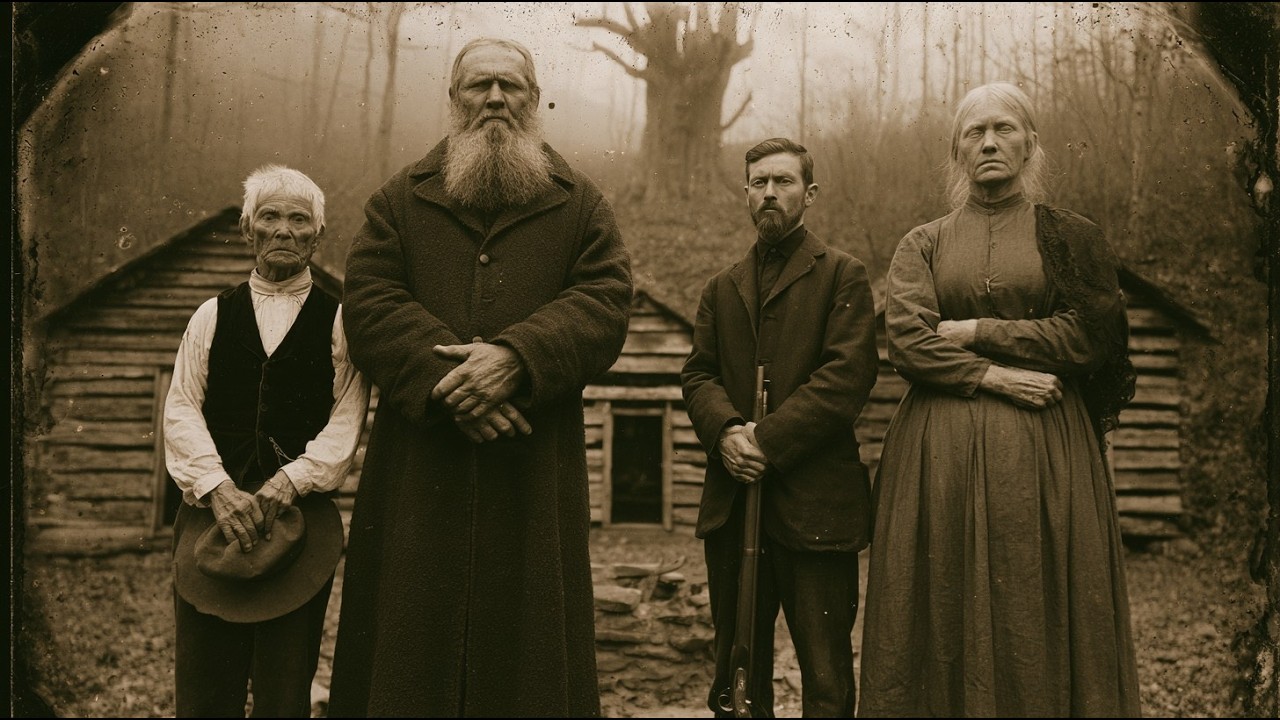
The other two came out of the smaller houses. Vardaman Marrowbone was a huge man, over six feet, broad-chested, with a thick gray beard down to the second button of his coat.
He did not speak then or later. He nodded once to Vale and stood by his brother. Thoro Marrowbone was in his early thirties, thin, tall, sharp-featured. He carried a rifle in the crook of his arm the way a man carries an old friend.
His eyes went to Vale’s gear before they went to his face, and Vale noticed, and would remember. The three of them and Merritt Marrowbone stood in the common yard, and old Isham said, “We’ve prepared a room for you in the west house. You’ll take supper with us tonight, and we’ll talk about the survey in the morning. The trail you came by will be dark within the hour.
You’ve had a long day, sir. ”
Vale thanked him. He tied the mare in a small lean-to at the edge of the clearing and walked toward the west house behind Merritt Marrowbone, past a fourth building he had not seen from the trail because it stood behind the largest of the three dwellings. It was smaller than the houses, more square, built of logs, but the joints were fitted so tight the seams were nearly invisible.
It had no windows at all, and its door was barred from the outside with an iron rod thick as a man’s wrist, set into two great staples driven deep into the wood. Vale asked, “Is that the grain store? ”
She did not turn to answer. She said, in a tone he could not read, “We call it the store.
”
She opened the door of the west house for him. “Supper’s in an hour,” she said. That ended the first day of Absalom Vale in Hangman’s Hollow. At the first supper, Merritt Marrowbone set a long wooden table in the largest of the three houses, old Isham’s.
Five places were laid: old Isham at the head, Vardaman at his right, Thoro at his left, Merritt at the foot, and Absalom Vale across from Isham on his left. The food was plain and good: pork, corn, squash, a pot of white beans, a plate of pickled beets, cornbread baked in a heavy iron skillet, and in the middle of the table, a small dish of white salt. Old Isham said grace. It was not the Presbyterian grace of Vale’s childhood.
It was longer than usual, and it named no God Vale knew. “We thank the earth under this house for what it gives, and the hollow that shelters us, and the tree at the head of the hollow that watches over us. Amen. ”
Vale said amen.
He noticed, as they began to eat, that no one at that table reached for the salt. He also noticed that Merritt Marrowbone was watching him, not staring, just watching. He remembered Barnabas Coombs. In the middle of the meal, old Isham himself picked up the small salt dish.
He turned it between his fingers, and said to Vale, “Sir, forgive me, but you haven’t seasoned your food. Merritt’s cooking is good enough, and I don’t blame her, but perhaps our salt doesn’t suit your taste. A poor host is one who doesn’t offer. ”
Vale looked at that small white dish.
He nearly reached for it. He had ridden all day. He had been received with courtesy. He was hungry.
He had been raised on politeness at strangers’ tables, and a simple refusal at a table like this was harder than a simple acceptance. But he thought of Barnabas’s plate, and heard in his head the big bearded man’s voice: Do not eat their salt. “Sir, I’m grateful to you,” Vale said, “but I have a condition of the blood that doesn’t allow me salt. My doctor in Louisville has forbidden it these three years.
Your table is good as it is. ”
Old Isham put the small dish back in its place. He looked at Vale for a long moment, then smiled the same small neat polite smile he had smiled at the door. “Well, we won’t trouble you, then.
Forgive me, sir. ”
Nothing changed at the table. The talk went on. Vardaman ate in silence.
Thoro asked polite questions about Louisville and the roads and the crops that year. Old Isham spoke of the hollow, the weather, and the tree at its head, which he called by name, the Tree, as if it were a person everyone knew. Merritt Marrowbone did not speak much, but once she smiled faintly. When Vale refused the salt, the smile left her face in a second.
He would later think she had smiled the way one smiles at a rabbit that understands the trap. He slept that first night in the west house. He did what Barnabas Coombs had told him. He moved the small rope bed so the door was at his right, not behind him.
He put his gear beside the door before he lay down. He kept his boots on. He kept his pistol, an old Colt, under the folded blanket he used as a pillow, out of habit more than expectation. He did not sleep well.
He slept the way one sleeps in a strange bed when the wind makes something in the yard you cannot identify. At some point he heard footsteps in the common yard. Not many. A few.
At another point he heard a low humming, not a tune, just a long note, almost inside the walls of the house rather than outside. But he heard nothing at his door, and by morning he was beginning to convince himself that Barnabas Coombs was an old man with old men’s fears, that Rua Colby was a widow with too much spare time, and that the Marrowbones, whatever they were, were only mountain people with mountain habits. That was the second day, and the survey began. Old Isham brought out a hand-drawn map of the hollow, drawn by his own father, he said, in the past century.
Vale laid it on the wooden table and studied it. It was a good map for something drawn by hand. The main features were correct. A small cross was marked at the tree at the head of the hollow.
The three houses and the fourth windowless building were drawn in. At points that seemed random to the surveyor, small circles were drawn in ink. He counted them. Seventeen.
Vale asked what the circles were. “They’re marks, Mr. Vale,” old Isham said. “My father put them down.
They have to do with the way of the hollow. They won’t affect your survey. You can pass right by them and never notice. ”
Vale set out that morning with Thoro Marrowbone as his guide, at old Isham’s suggestion.
Thoro carried the rifle; Vale carried the compass and the field notebook. The mare stayed in the lean-to. Thoro said the mare would hide in the deep parts of the hollow. He said this without looking at Vale.
They worked four hours in the northern part of the hollow. Vale took his bearings, marked witness trees, read his numbers. Thoro wrote them down for him in the field notebook at Vale’s request. His hand was surprisingly fine, like copperplate, the hand of a man who had learned to write at some point for someone who cared about the look of it.
Around midday they came to the first of the circle marks on old Isham’s map. It was a beech tree, and on the beech, at about the height of a man’s chest, a mark was cut. It was not a letter. It was not any shape Vale recognized.
Three lines meeting at a point, with a fourth line running across them. Old, deep, cut into the tree so long ago that the bark had grown thick and knotted around it. Whoever had made the mark, whoever he had been, must have turned to dirt a generation past. “This is one of the marks,” Vale said.
“Yes,” Thoro said. “And what does it mean? ”
“That’s a question you’d want to ask old Isham, sir. ”
“But you know.
”
Thoro looked at him then for the first time since they had left the clearing, and his eyes were pale and colorless as the Marrowbones’ eyes, which Vale had not noticed until that moment. Two Marrowbones with the same colorless eyes. In a family, that was not strange. He buried the thought.
Thoro said, “I know what my kin know, which is not the same as knowing what a thing means. Old Isham’s father put these marks in. His father’s father put the first one in the tree. We keep them.
”
“You keep them from what? ”
“From anything that might try to leave. ”
Thoro walked once around the tree slowly. He put his hand on the bark just below the mark, held it there a moment, then took it away.
“This is the oldest tree still standing. There was an older one further up the hill, but the bank that held it washed out in the winter I was born. My uncle went out to set a new mark, and came back the next morning having cut the new mark into his own arm because he couldn’t find the right tree in time. He carried it the rest of his life.
He said it was easier that way. ”
Vale looked at Thoro for a long moment. “And your uncle is buried. ”
“Those nine years… from what?
”
“The same thing we all bury, sir, in this hollow, when our time comes. ”
Thoro did not explain what it was. He kept walking. He said it as plainly as a working man says something about his work.
And Absalom Vale stood there in the brown light of Hangman’s Hollow, looking at a mark cut into a tree by a man dead fifty years, and knew for the first time, in some place in him older than his education and older than his profession, that Barnabas Coombs was not a foolish superstitious old man. He said nothing to Thoro. He wrote the location of the mark in his notebook. They kept walking.
That evening he noticed there were no birds in the hollow. No blue jays, no sparrows, no crows. He had been in the hollow a day and a half by then, and had not heard a single call. A hollow that still in a Kentucky autumn was not a natural hollow.
He noticed that the streambeds, though dry in the bottom of the hollow, were mossy and stained the way a streambed is when water has recently passed through it, and yet no water was passing through. And yet, when the wind blew in the right direction, he could hear a faint sound of running water somewhere, somewhere that, by the shape of the ground, could not be near. He noticed that Vardaman Marrowbone, the great silent brother, left the clearing every evening at dusk carrying an iron pail, and came back after full dark with the pail empty, and no one spoke of where he had gone. He noticed that the fourth building, which Merritt Marrowbone had called the store, was visited by old Isham himself once each morning at first light.
Old Isham went to it alone. He stood at the barred door for about a minute. He said something to it, too. The voice was too faint for Vale to catch, and then he walked away, and no one approached it for the rest of that day.
Vale noticed these things and wrote them in his field notebook, in the back, where survey notes were not kept. On the evening of the third day, sitting alone in the west house with the lamp low, he took out his field notebook and read what he had written, and realized he had begun, without deciding to, to keep a record of a different kind. That night he heard the voices. He was awake when he heard them.
He had trained himself since Barnabas Coombs to wake at every noise. They came at about what he judged to be midnight. They came from the forest. There was more than one voice.
He could not count them. Later, in Louisville, he would say they seemed to be more than five and fewer than twenty, and he could not narrow it further. They were speaking, or doing something like speaking. He could not make out any words.
The sound was low and rhythmic, and the rhythm was the rhythm of speech. But the words, if there were words, were not words in any language he had ever heard. Absalom Vale had heard the French of the river men, the German of the settlers north of the Ohio, the Cherokee of the old people down the hill. This was none of those.
It was no language at all. The voices came from the forest, and the Marrowbones in the two houses across the common yard did not move. Not one door opened. Not one lamp was added.
Not one voice rose inside those walls to ask what the sound was. Consider what it means that a family in a mountain house hears voices in the forest in the small hours and does not even get up to look. It means they have heard them before. It means they are accustomed to them.
It means the voices are expected in a way that is hard to describe. Vale lay on his bed and listened until the voices stopped, which was shortly before dawn. He did not sleep after that. He watched the light come.
When it was light enough to read, he took out the notebook and wrote in the back, in a hand steadier than he felt: “I do not believe I will be allowed to leave this hollow. ”
Later, in Louisville, he would take that page out of the notebook and keep it folded in his wallet for the rest of his life. On the fourth day he found the bones. He had gone out that morning without a guide.
He told old Isham at breakfast that he wanted to work the eastern slope that day, alone, because he would be climbing and did not want to slow his guide down. Old Isham considered this in his polite, ordered way, then said, “Certainly, Mr. Vale. Merritt will fix you a lunch.
”
Merritt Marrowbone had fixed him a lunch. He did not eat it. He walked past the eastern stretch and circled around it. Mid-morning he came to a small side hollow off the main one, not on old Isham’s map.
And in that hollow, in a shallow depression partly covered with leaves, he found a rib. A human rib. He knew what it was at once. He had surveyed enough ground to know the difference between a deer’s rib and a man’s, and this was a man’s rib, and it was not new.
The bone was clean and dry, the color of old ivory, weather-worn. He pushed the leaves aside. There was more than one rib. He found the remains of what he estimated, from the way they were arranged, to be seven men.
They had not been buried. They had been placed, each one, in the same arrangement, hands crossed, feet pointing toward the head of the hollow, toward the tree. The oldest were nearly bone. Moss had grown over their ribs and settled there.
Roots had grown through some of them, and the hollow, slowly, patiently, was beginning to take those bodies back. The newer ones had not yet been taken. Vale knelt in that small hollow for what he later estimated to be about an hour. He did not touch anything but the compass.
He counted the men. He wrote their arrangement in the back of his field notebook, in a shorthand he had never used before and would never use again. He tried once to say a Protestant prayer over them and found he could not speak. He tried once to close his eyes and found he could not do that either.
He noticed, at some point during that hour, that the ground under the men was warmer than the ground around them, that the leaves over them, where he had pushed them aside, were drier than the leaves on the ground beside them, and that a faint familiar smell rose from among them, like wood smoke and old apples and the inside of a sealed cellar. The same smell he had walked into when he entered the hollow. One of them was fresher than the others, and among that man’s ribs, Absalom Vale picked up a small brass compass. The maker’s mark on the back was still legible.
It read Cincinnati, Ohio. He put the compass in his coat pocket. He covered the bones again with the leaves he had moved. He came out of the draw.
He went back to the eastern slope and worked, or pretended to work, until mid-afternoon, then came back to the clearing at dusk with his notebook and his gear, took supper with the Marrowbones, and said nothing about what he had seen. He thought, he would later tell his partner Wettson, who told a man who wrote a private report for the company records, and from which the story first became known, that if any of the Marrowbones had known he had gone into that hollow, he would never have seen the morning. He was not quite right about that, but he was close. That night, sitting in the west house, he made his decision.
He would leave at first light. He would say he had received word. He would say the survey required his return to Louisville. He would ride out fast and not stop until he reached Red Fern Crossing.
And once he reached Red Fern Crossing, he would keep going, because Red Fern Crossing did not feel far enough from the Marrowbones for a man who had seen what he had seen. He did not sleep that night either. He waited for the first light, and when it came he rose, gathered his gear, opened the door of the west house very quietly, and stepped out into the common yard. Old Isham Marrowbone was sitting in a rocking chair on the porch of the largest house, watching the door of the west house.
His hat was on his knee, his hands folded over it. He had been waiting. “Good morning, Mr. Vale,” he said in his soft, courteous voice.
“You’re up very early. ”
“Good morning, old Isham. ”
“And you’re carrying your gear. ”
“I’ve had word I’m needed in Louisville.
I intend to set out this morning. ”
Old Isham considered this. “I saw no messenger,” he said. “He came late last night.
I didn’t want to disturb the household. I met him at the edge of the clearing. ”
Old Isham smiled his neat polite smile. “Mr.
Vale, please sit down. ”
Vale did not sit. “Please sit down, sir. We’d better talk.
”
He gestured to the second rocking chair on the porch of the largest house, and Vale sat because he did not know what else to do. “Mr. Vale,” old Isham said, “my family has kept this hollow for four generations. My great-grandfather set the first mark.
My grandfather set the Tree. My father set the marks you’ve been passing. I keep them now. There’s a duty in this hollow, sir, that goes back to 1794, and it is not lifted because a Louisville company decided to survey the land.
”
“Sir, my survey is separate from your family’s duty. ”
“No, sir. It is not. And I think you know that.
I think from the way you sat at my table last night, and the way you carry your gear this morning, that you’ve understood some of what you’ve walked into. ”
Vale did not answer. “My father used to say,” old Isham went on, “that the men who came up into this hollow to work its land did so from one of two impressions. Either they believed there was no hollow worth mentioning, and they came from ignorance, or they believed the hollow was a thing to be tamed, and they came from pride.
He said the ignorant ones were easier. He said the proud ones were harder to break. ”
He looked at Vale. “Which are you, Mr.
Vale? ”
“I am a surveyor. I came to work. ”
Old Isham nodded.
“Then I’ll tell you what I’ve told every surveyor, and every timberman, and every well-meaning preacher who has walked this trail in my lifetime. The hollow does not release what it has swallowed. That is the duty my family keeps. It was not a duty we chose.
It was laid on us in 1794, when the men of this county hanged eleven innocent people on the tree at the head of this hollow. And when what was in the ground beneath that tree acquired an appetite from that hanging, my family has fed that appetite, sir, for four generations. Not with our kin. That would violate the old understandings about what the hollow brings us.
And the hollow brings us those who come to it. It is very patient. It is very slow, but it brings them. ”
“And you feed it.
”
“We keep it. ”
“With the men in the hollow. ”
Old Isham was silent for a long moment. Then he said, “Ah.
” He said, “So you have been into that hollow. ”
He looked out at the common yard, at the sky beginning to turn pink over the trees. He said, “A pity, Mr. Vale.
A pity. Because if you had not gone into that hollow, I would have let you finish your survey and leave. I would have followed you to the mouth of the trail, and watched you go, and the hollow would have taken one of the next comers instead, and the balance would have held. But now.
It will not. The hollow has seen you see, and the hollow does not release what is seen. ”
“I will not stay here,” Vale said. “No, sir.
I don’t expect you to stay. That’s not how it works. The hollow doesn’t require you to remain here. All it requires is that you not leave with what you have seen.
”
He rose from the rocking chair, put on his hat, and said, “Vardaman will come in a moment. I ask you to go with him quietly. It will be easier for you. ”
And Absalom Vale, sitting on that porch in the dawn, understood in a moment of total clarity that the polite old man in front of him was not asking.
He ran. He did not stop to argue. He did not draw his pistol. He did not shout.
He rose from the rocking chair and ran off the porch, across the common yard, past the little lean-to where the mare was tied, and into the trees at the western edge of the clearing. He was not going for the mare. The mare was a trap. He had realized that sitting on the porch in a way he could not have put into words.
He ran for the trees. Behind him he heard old Isham Marrowbone say one word, clearly, in a voice not loud so much as carrying. He heard the word Vardaman. Then he heard, or felt, the heavy surge of movement.
Vardaman Marrowbone, the great silent man, moved through the woods of Hangman’s Hollow at a speed no man of that size should have possessed. Vale heard him coming from behind and did not turn, because turning cost three strides, and three strides were more than he could spare. He ran. The hollow rose in front of him.
The trail had descended into the hollow, down, down, farther than the land behind it should have allowed. Now it rose, rose steeper than it had descended. He ran, climbed, and the brown light of the hollow, for the first time in four days, began to thin ahead of him. He was climbing toward the ordinary yellow of an autumn morning.
He was climbing out, and behind him Vardaman Marrowbone was gaining, and around him, in the woods on both sides of the trail, he heard other footfalls. Twigs, he thought. Leaves. And once or twice he heard the faint humming he had heard the first night in the west house, which he had convinced himself was the wind, and he heard voices too, voices speaking no language he understood.
They were the voices from midnight, and this time they were not distant. They were in the trees on either side of him, pacing his strides. He ran. His lungs began to burn.
His crooked little finger throbbed in his right hand the way it did in cold weather. He ran, and somewhere during the climb he lost his hat. Somewhere higher, the toe of his boot tore on a root. Somewhere higher still, his notebook worked loose from the inside pocket of his coat and fell among the leaves.
He stopped to pick it up. He stopped because he realized, even with the pounding behind him and the voices on both sides, that the notebook was the only thing in the hollow that bore witness to everything he had seen. If he came out of the hollow without it, he came out empty-handed. He knelt among the leaves.
He put his hands into them. He found the notebook. He pushed it inside his shirt against his skin where it could not be lost. Then he rose.
And in the moment he rose, he heard Vardaman Marrowbone’s breath behind him, so close that Vale felt the warmth of it on the back of his neck. He did not look. He ran. He would say later, when he could speak of it at all, that at a certain point on the climb, a point he could not identify for you, the sound of Vardaman Marrowbone’s pursuit stopped.
Not slowed. Stopped entirely. And the sound of whatever paced him on both sides faded like a wind dropping, and he ran the last quarter mile up out of Hangman’s Hollow in total silence, so that the sound of his own feet on the trail seemed obscene to him. He reached the top of the last hill.
He fell to his knees among the fallen leaves. He looked down into the hollow. I will tell you what he wrote in the back of his field notebook about this, and I will stop there because I have nothing better than his own words. He wrote: “I looked down into the hollow and saw the four of them, old Isham and Vardaman and Thoro and Merritt, standing in the common yard in the middle of the clearing.
They were not looking at me. They were not looking at each other. They were standing in a small tight ring, faces turned inward, heads bowed. And in the middle of them, between them, the ground was moving.
Not the ground under them, the ground between them, as if something under the earth was rising toward the surface and being pressed back down. ”
He wrote: “I did not stay to watch any more of that. I got up and ran, and I do not remember the rest of that day. I do not think I want to remember it either.
”
He came back to Red Fern Crossing that evening at dusk, on foot, without gear, without the mare, without his hat, his boot torn at the toe. Barnabas Coombs was standing at the door of his store as if he had been waiting there. He said nothing to Vale. He came out into the road.
He took Vale by the elbow and walked him to Rua Colby’s house, and Rua Colby fed him a plate of something he did not remember afterward, and put him to bed in the smallest of the three rooms above the kitchen, and sat on a chair outside that room’s door all night. He left Red Fern Crossing the next morning on a borrowed horse and rode to Louisville without stopping more than the horse required. He walked into Wettson’s office after three days, put the field notebook on the desk, and said, “Sir, this hollow cannot be surveyed. Not by me, not by any man your company sends.
If you send another man up that trail, you will not see him again, and his blood will be on your hands, and on mine too for telling you this now, and you will remember that I told you. ”
“Sir, burn this notebook. ”
Wettson did not burn it. He kept it.
And so, decades later, a private account of that survey settled into a company record chest in Louisville, which is how the story finally came to me. Absalom Vale left the land company’s employ within the year. He went back to his people in a small town in the northern part of the state, took up a trade that did not require walking in forests, and lived quietly for the rest of his life. He never went east to Frankfort again.
He never spoke of Hangman’s Hollow. And on nights when the wind blew from the north and the leaves began to move in the yard, his housekeeper mentioned that Absalom Vale would get out of bed, go down to the sitting room, sit in a chair by the window, and watch the yard, and would not go back to bed until the wind died. She said he was not afraid. She said he was, she thought, listening.
She said that once, in the last year of his life, she went down to the sitting room at three in the morning and found him at the window, and asked him what he was listening to, and he answered without turning: “They are not close tonight, Mrs. Reed. Go back to bed. ”
She asked who they were.
He did not answer. She went back to bed. Absalom Vale died in the fall of 1889, peacefully, in his bed, of causes his doctor considered entirely ordinary. He was buried in the cemetery of the small town where he had settled, and his headstone is still there, bearing only his name and his age.
The Marrowbones remained in Hangman’s Hollow after his death. There is a record in the Louisville archives themselves of a second surveying attempt in 1867, after the war, by an Ohio man who did not know the local history. That man was never heard from again. Neither was any horse.
Old Isham Marrowbone died, or is said to have died, in 1879. Vardaman is said to have died the following winter. Merritt and Thoro kept the hollow between them for years after that. Whether it still exists in any form, I do not know, and I will not claim to know.
The county records for that part of the Cumberland range are, I say this with all the force I have, incomplete. There is one detail that stays with me, and I will leave it with you. On the last page of Absalom Vale’s field notebook, in the same steady hand he used for his survey notes, a single line is written. It is not dated.
There is no way to know when he wrote it. It may have been in the week he returned to Louisville. It may have been forty years later. The line says: “The hollow has not forgotten me either.
”






